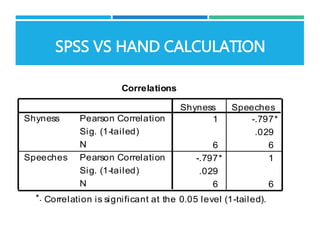
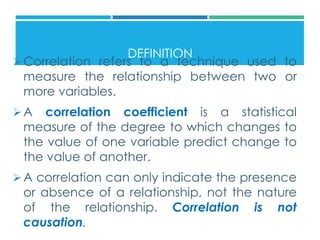
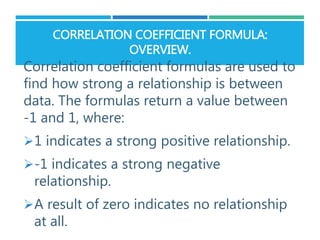
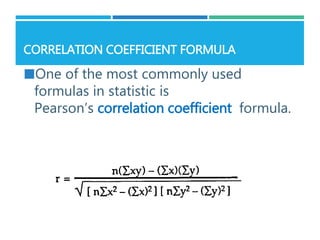
The document presents a presentation on coefficient correlation by Irshad Narejo. It defines correlation as a technique used to measure the relationship between two or more variables. A correlation coefficient measures the degree to which changes in one variable can predict changes in another, though correlation does not imply causation. Correlation coefficient formulas return a value between -1 and 1 to indicate the strength and direction of relationships between data. Positive correlation means high values in one variable are associated with high values in the other, while negative correlation means high values in one variable are associated with low values in the other. The document discusses Pearson's correlation coefficient formula and provides an example of calculating correlation by hand versus using SPSS.


![SPSS VS HAND CALCULATION
X Y XY X2 Y2
0 8 0 0 64
2 10 20 4 100
3 4 12 9 16
6 6 36 36 36
9 1 9 81 1
10 3 30 100 9
30 32 107 230 226
N ∑XY - ∑X ∑Y
r =
[ N ∑X2 – (∑X)2] [N ∑Y2 – (∑Y)2]
(6 X 10⁷) – 30 (32)
[6 (230) – 302] [6 (226) – 322 ]
r = -.797 (note cross
products term in the
numerator is negative)
and R-square = .635](https://image.slidesharecdn.com/presentationoncoefficientcorrelation-150407115117-conversion-gate01/85/coefficient-correlation-8-320.jpg)