PRESENTED BY: GARIMA SHARMA
M.Sc. Nursing 1st year
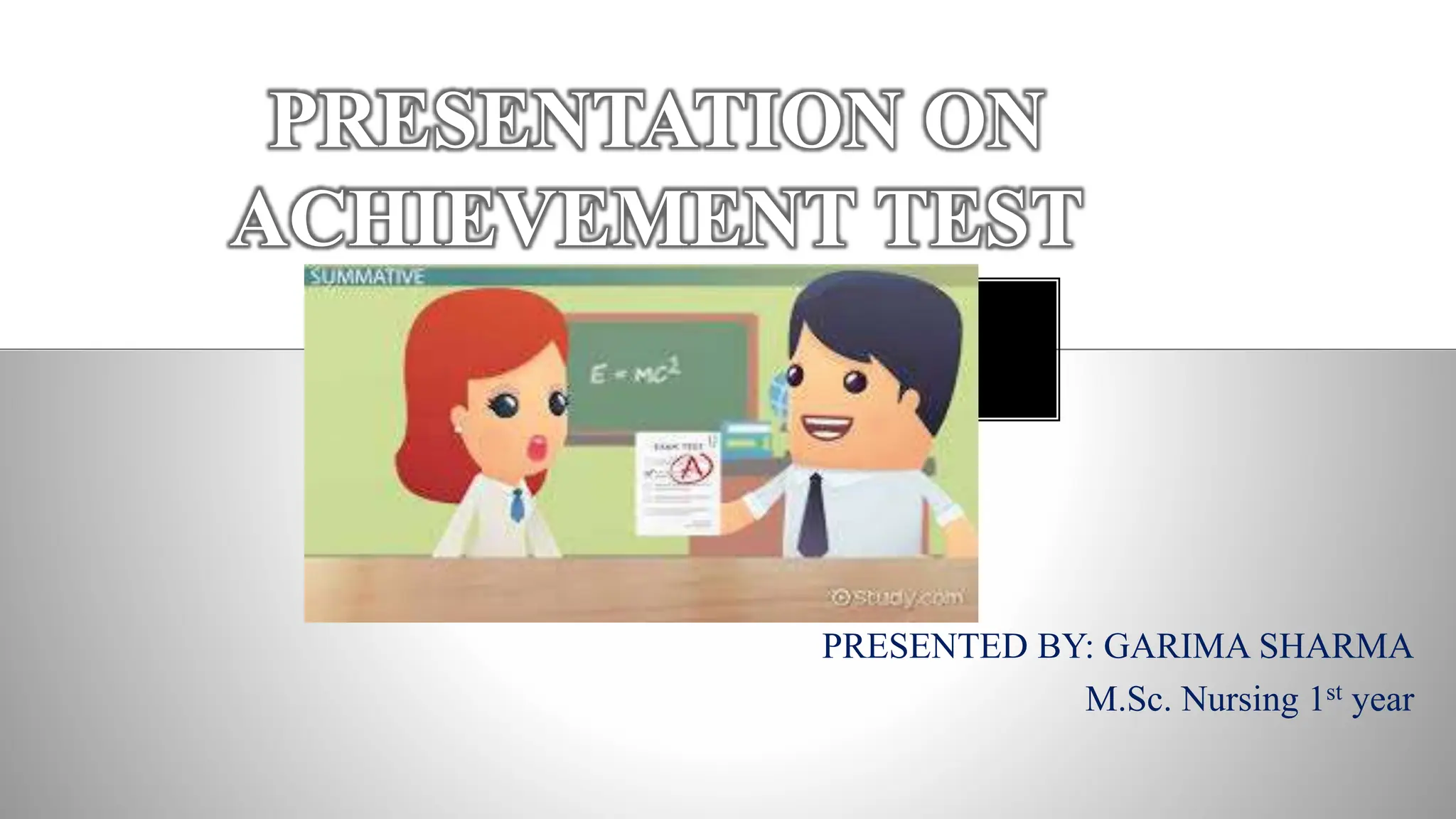
PRESENTATION ON
ACHIEVEMENT TEST
CONTENT OUTLINE
Introduction of achievement test
Definition of achievement test
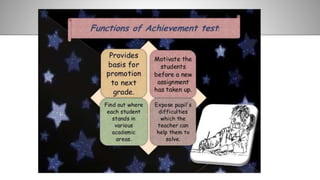
Functions of achievement test
Characteristics of achievement test
Classification of achievement test
Standardized test and teacher made tests
Steps in achievement test construction
Achievement test is an important tool in school evaluation and
has a great significance in measuring instructional progress of
the students in the subject area.
Achievement means one’s learning attainments,
accomplishments, proficiencies etc. It is directly related to
learner’s growth and development in educational situations
where learning and teaching are intended to and so on.
ACHIEVEMENT TEST
INTRODUCTION-
DEFINITION-
 “Any test that measure the attainment or accomplishment of an
individuals after a period of training or learning”
- NM Downie.
 “The type of ability test that describes what a person has learned to do”-
Throndike and Hagen.
 “A systematic procedure for determining the amount of students has
learned through instructions”
- Groulund.
Other functions of achievement test-
• It helps determination about the placement of the student in
a particular section.
• To know how effectively the student is performing in the
theory as.
CHARACTERISTICS OF ACHIEVEMENT TEST-
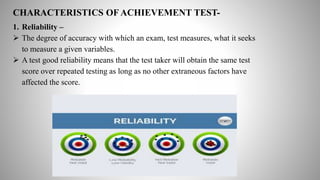
1. Reliability –
 The degree of accuracy with which an exam, test measures, what it seeks
to measure a given variables.
 A test good reliability means that the test taker will obtain the same test
score over repeated testing as long as no other extraneous factors have
affected the score.
2. VALIDITY-
 Validity is the quality of a test which measure what it is supposed to measure.
 It is a degree to which evidence, common sense, or theory supports any
interpretations or conclusions about a students based on his or her test
performance.
A test is valid when it-
 Measures what it intends to measure.
 Produces consistent scores over time.
 Can be objectively scored.
 Has representative norms.
3. Ease in administration-
A test is good only when the condition of answering are simple (
scientific and logical).Its instruction should be simple and clear.
4. Cost-
A good test should be inexpensive, not only from the view point of
money but also from the view point of time and efforts taken in the
construction of attest. Fortunately there is no direct relationship between
cost and quality.
5. Time-
Generally the time given to students is always in short supply however
the students too do not accept very long tests. Therefore a test should
neither be very long nor very short.
6. Acceptability-
A good test should be acceptable to student to whom its being given
without regard to any specific situation that is the question given in the
test should be neither very difficult nor very easy.
7. Objectivity-
A test objective when the scorer’s personal judgment does not affect
the scoring.
8. Specificity-
The items in a test should be specific to the objectives.
9. Precise and clear-
Items should be precise, clear so that the students can answer well
and score marks.
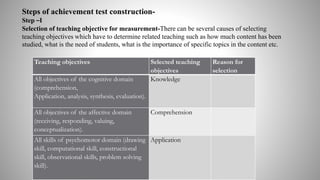
Teaching objectives Selected teaching
objectives
Reason for
selection
All objectives of the cognitive domain
(comprehension,
Application, analysis, synthesis, evaluation).
Knowledge
All objectives of the affective domain
(receiving, responding, valuing,
conceptualization).
Comprehension
All skills of psychomotor domain (drawing
skill, computational skill, constructional
skill, observational skills, problem solving
skill).
Application
Steps of achievement test construction-
Step –I
Selection of teaching objective for measurement-There can be several causes of selecting
teaching objectives which have to determine related teaching such as how much content has been
studied, what is the need of students, what is the importance of specific topics in the content etc.
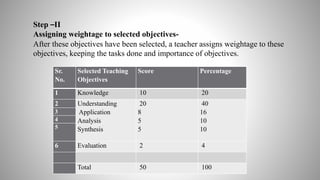
Sr.
No.
Selected Teaching
Objectives
Score Percentage
1 Knowledge 10 20
2 Understanding
Application
Analysis
Synthesis
20
8
5
5
40
16
10
10
3
4
5
6 Evaluation 2 4
Total 50 100
Step –II
Assigning weightage to selected objectives-
After these objectives have been selected, a teacher assigns weightage to these
objectives, keeping the tasks done and importance of objectives.
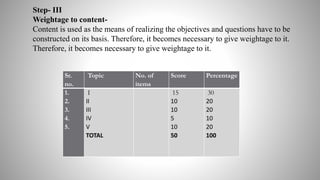
Sr.
no.
Topic No. of
items
Score Percentage
1.
2.
3.
4.
5.
I
II
III
IV
V
TOTAL
15
10
10
5
10
50
30
20
20
10
20
100
Step- III
Weightage to content-
Content is used as the means of realizing the objectives and questions have to be
constructed on its basis. Therefore, it becomes necessary to give weightage to it.
Therefore, it becomes necessary to give weightage to it.
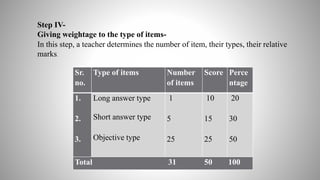
Sr.
no.
Type of items Number
of items
Score Perce
ntage
1.
2.
3.
Long answer type
Short answer type
Objective type
1
5
25
10
15
25
20
30
50
Total 31 50 100
Step IV-
Giving weightage to the type of items-
In this step, a teacher determines the number of item, their types, their relative
marks.
Step V-
Determining alternatives-
At this level, it is determined how alternatives may or options
should be given according to the type of questions. Giving
alternatives influences the reliability and validity of a test,
therefore it is suggested that alternatives should not be given in
the objective type test.
Sr.
no.
Section Type of items Score Percentage
1.
2.
3.
A
B
C
Objective type
Long answer type
Short answer type
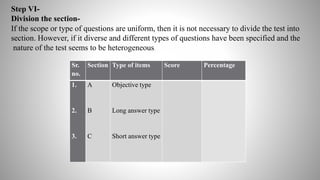
Step VI-
Division the section-
If the scope or type of questions are uniform, then it is not necessary to divide the test into
section. However, if it diverse and different types of questions have been specified and the
nature of the test seems to be heterogeneous.
S. no. Type of items Number of items Time
1.
2.
3.
Objective type
Long answer type
Short answer type
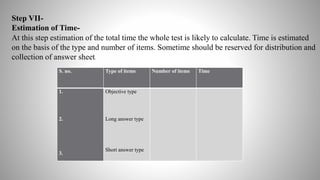
Step VII-
Estimation of Time-
At this step estimation of the total time the whole test is likely to calculate. Time is estimated
on the basis of the type and number of items. Sometime should be reserved for distribution and
collection of answer sheet.
S.n
o
Teaching
objectives
Knowledg
e
Comprehen
sion
Applicat
ion
Skills
Type of
question topics
(L) (S) (O) (L) (S) (O) (L) (S)
(O)
(L) (S)
(O)
(L)
(S)
(L) (S) (
O
)
1.
2.
3.
4.
5.
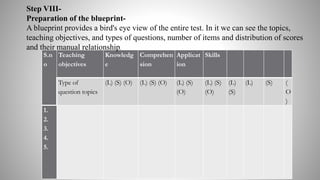
Step VIII-
Preparation of the blueprint-
A blueprint provides a bird's eye view of the entire test. In it we can see the topics,
teaching objectives, and types of questions, number of items and distribution of scores
and their manual relationship.
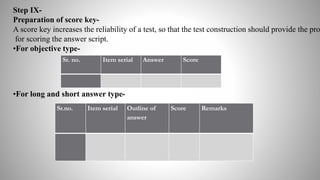
Sr. no. Item serial Answer Score
Step IX-
Preparation of score key-
A score key increases the reliability of a test, so that the test construction should provide the pro
for scoring the answer script.
•For objective type-
Sr.no. Item serial Outline of
answer
Score Remarks
•For long and short answer type-
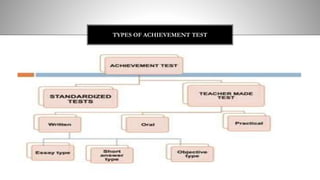
TYPES OF ACHIEVEMENT TEST
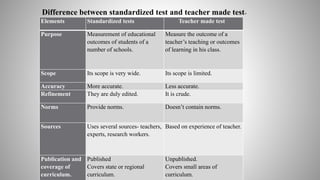
Elements Standardized tests Teacher made test
Purpose Measurement of educational
outcomes of students of a
number of schools.
Measure the outcome of a
teacher’s teaching or outcomes
of learning in his class.
Scope Its scope is very wide. Its scope is limited.
Accuracy More accurate. Less accurate.
Refinement They are duly edited. It is crude.
Norms Provide norms. Doesn’t contain norms.
Sources Uses several sources- teachers,
experts, research workers.
Based on experience of teacher.
Publication and
coverage of
curriculum.
Published
Covers state or regional
curriculum.
Unpublished.
Covers small areas of
curriculum.
Difference between standardized test and teacher made test-
I STANDARDIZED TESTS-
- Standardization means uniformity of procedures in scoring, administering
and interpreting the results.
- A standardized test is one in which the procedure, apparatus, and scoring
have been fixed so precisely that the same test can be given at different times
and places. (Lee J Cronbach)
- Standardized tool is one for which norms have been established.
- A standardized test is prepared after several trials of test to a large number of
students.
Characteristics of standardized tests-
1. Content is standardized- item- selection done by competent judges.
2. Administration is standardized- direction, time limits.
3. Scoring has been standardized- rules of rules, scoring key are
prepared.
4. Interpretation has been standardized- norms are provided..
5. Before finalization, test is tried out and administered on a number of
subjects for the expressed purpose of refining its items.
Importance of standardized tests-
 Give impartial information about an individuals.
 Provides information in much less time than provided by any other
devices.
 Tests measures those aspects of behaviors which otherwise could
not be obtained.
 In subjective observation we may overlook shy children but these
tests discover such cases also.
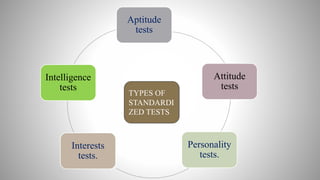
Aptitude
tests
Attitude
tests
Personality
tests.
Interests
tests.
Intelligence
tests
TYPES OF
STANDARDI
ZED TESTS
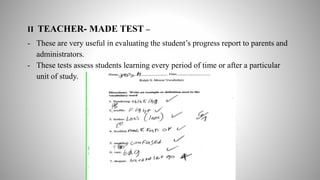
II TEACHER- MADE TEST –
- These are very useful in evaluating the student’s progress report to parents and
administrators.
- These tests assess students learning every period of time or after a particular
unit of study.
Uses of teacher made tests-
 To know the ability and achievements of students.
 Helps the teacher to assess the strengths and weaknesses of students.
 Motivates the students.
 Provides continuous evaluation and feedback to the teacher.
 Helps to achieve the particular objectives.
 Helps the teacher to adopt better instructional methods.
Limitations of teacher made tests-
 Tests are often ambiguous and unclear.
 They are either too short or too lengthy.
 Tests do not cover the entire content.
 Tests are usually hurriedly conducted.
 Supervision is not proper.
 Lot of scope for copying.
 Conducted as rituals only.
 Answer book not marked with care.
I Essay type-
“An essay test presents one or more questions or other tasks that requires
extended written responses from the person being tested”
- Robert LE and David AF.
“It is a test containing questions requiring the students to respond in writing.
It emphasize recall rather than recognition of the correct alternatives”
- Gilert Sax.
Features-
- No single answer can be considered throughout and correct.
- The examinee is permitted freedom of response.
- The answer vary in their degree of equality or corrections.
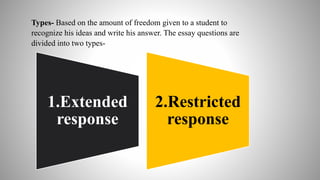
Types- Based on the amount of freedom given to a student to
recognize his ideas and write his answer. The essay questions are
divided into two types-
1.Extended
response
2.Restricted
response
1.EXTENDED RESPONSE-
 No restriction is placed on the students as to the points he/she
will discuss and the type of organization he/she will use.
 Most important, pertinent and relevant materials whatever he/she
wishes can be used. This type of questions permits a student to
demonstrate his ability to-Recall and evaluate factual knowledge.
 Organize his ideas in a logical, coherent fashion.
Q:You are caring for a child diagnosed recently with HIV who lives with
his parents and two teenage sisters.
Describe how to plan a care of child with HIV positive status .
Write an essay on care of child with HIV.
EXAMPLE
2. Restricted response-
 Students will have less scope, limited nature in the form because he/she is
told specifically the context in which his/her answer has to be made.
Principles for preparing restricted essay type test-
 Do not give too many lengthy questions.
 Avoid phrases, e.g. “discuss briefly”.
 Questions should be well- structured with specific purpose or topic at a
time.
 According to the level of students difficulty and complexity items has to be
selected.
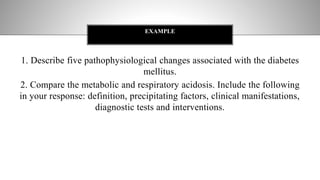
1. Describe five pathophysiological changes associated with the diabetes
mellitus.
2. Compare the metabolic and respiratory acidosis. Include the following
in your response: definition, precipitating factors, clinical manifestations,
diagnostic tests and interventions.
EXAMPLE
II SHORT OPEN ANSWER TYPE TESTS-
Short answer test items aim to test the knowledge by asking student to supply a
word, phrase or a number that answer a question of complete a sentence.
-R Ebel et al, 1986
Principles for preparing short type items-
 Use action oriented precise verbs.
 Question can be as long as possible, but answer should be short.
 Use precise, simple and accurate language in relation to the subject matter
areas.
 Provide the necessary space for answers below each question asked.
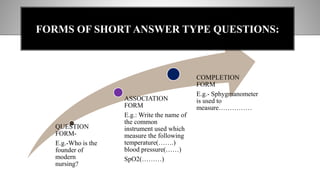
QUESTION
FORM-
E.g.-Who is the
founder of
modern
nursing?
ASSOCIATION
FORM
E.g.: Write the name of
the common
instrument used which
measure the following
temperature(…….)
blood pressure(……)
SpO2(………)
COMPLETION
FORM
E.g.- Sphygmanometer
is used to
measure……………
FORMS OF SHORT ANSWER TYPE QUESTIONS:
Advantages-
• Easy to construct and is useful to the lowest level of cognitive
taxonomy,i.e. knowledge of terminology, classification etc.
• Large sample of the content can be covered by including large number
of short questions.
• Marking is relatively objective as compared to the essay type questions
Disadvantages-not suitable for judging the power of analyzing an d
reasoning of students and for measuring complex learning outcomes.
III Objective type tests-
It refers to any written test that requires the examinee to select the correct answer
from among one or more of several alternatives or supply a word or two and that
demands on objectives judgment when it is scored.
Forms of objectives type tests-
a. Others- rearrangement, analogy, identification, and context – dependent type
(pictorial form, interpretative).
 Greater reliability and better content validity.
Merits-
 Easy for scoring.
 Objectivity in scoring.
 It will not vary from time to time or from examiner to examiner.
 More extensive and representative sampling can be obtained.
 It reduces role of luck or cramming of expected questions.
Disadvantages-
 Takes a lot of time and efforts in preparing the test.
 Provide little or no opportunity for measurement of student ability to recognize
and to express thoughts.
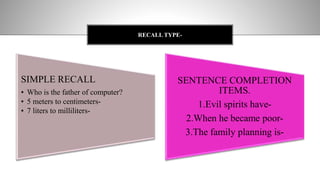
SIMPLE RECALL
• Who is the father of computer?
• 5 meters to centimeters-
• 7 liters to milliliters-
SENTENCE COMPLETION
ITEMS.
1.Evil spirits have-
2.When he became poor-
3.The family planning is-
RECALL TYPE-
Limitations-
 Ability to recognize matter, ability to provide matter logically
coherent fashion cannot be evaluated.
 Guessing is possible.
 The construction of items is difficult, requires special abilities and is
time consuming.
 Printing cost is high.
.
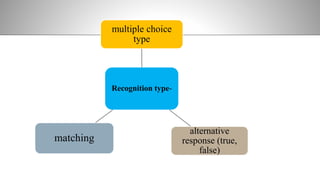
Recognition type-
multiple choice
type
alternative
response (true,
false)
matching
These are the most effective and flexible type of objective type test items and consist
of two parts
the stem- which presents the problem, presented in the form of an incomplete
statement or a question.
the option or responses- the list of possible/ correct answers/ possible distractors.
MULTIPLE CHOICE ITEMS.
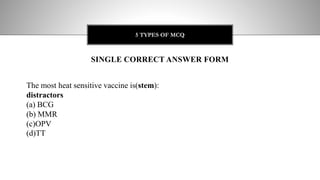
SINGLE CORRECT ANSWER FORM
5 TYPES OF MCQ
The most heat sensitive vaccine is(stem):
distractors
(a) BCG
(b) MMR
(c)OPV
(d)TT
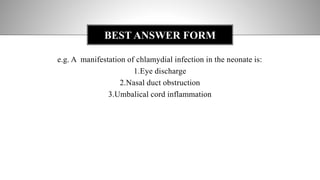
e.g. A manifestation of chlamydial infection in the neonate is:
1.Eye discharge
2.Nasal duct obstruction
3.Umbalical cord inflammation
BEST ANSWER FORM
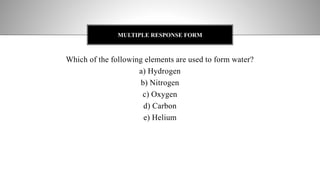
Which of the following elements are used to form water?
a) Hydrogen
b) Nitrogen
c) Oxygen
d) Carbon
e) Helium
MULTIPLE RESPONSE FORM
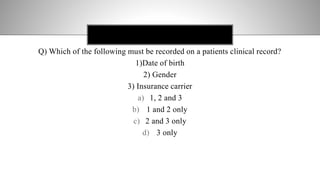
COMBINED RESPONSE FORM
Q) Which of the following must be recorded on a patients clinical record?
1)Date of birth
2) Gender
3) Insurance carrier
a) 1, 2 and 3
b) 1 and 2 only
c) 2 and 3 only
d) 3 only
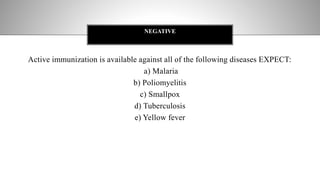
Active immunization is available against all of the following diseases EXPECT:
a) Malaria
b) Poliomyelitis
c) Smallpox
d) Tuberculosis
e) Yellow fever
NEGATIVE
Advantages-
 Ensure objectivity, reliability and validity.
 Provide constructive criticism.
 The range and variety of facts can be sampled in a given time.
 Provide precise and unambiguous measurement of the higher intellectual processes.
 Easy and rapid to score.
Disadvantages-
 Careful testing is required to avoid question testing only recall.
 Takes a long time to construct items in order to avoid arbitrary and ambiguous questions.
 Provide cues that do not exist in practice.
3. The alternate – response items.
It is essentially a two- response item in which only one of the answer is
presented and the student judges the truth or falsity of the statements.
E.g. True/false, yes/no, right/wrong,
Advantages-
 Good for young children with poor reading habits.
 Provide high reliability per unit of testing time.
 Can be scored quickly, reliably and objectively.
 Suitable to test beliefs, misconceptions, superstitions.
 Adaptable to most content area.
 Time saver.
 To distinguish facts from opinions.
Limitations-
 More susceptible to ambiguity, misinterpretations, therefore low reliability.
 Undue influence by good or poor understanding or luck in guessing.
 Lend them most easily to cheating.
 Tend to be less discriminating.
2. Matching type items.
These items form a special form, prepared in two columns. One set is
called ‘response column’ and the other is called ‘stimulus column’ the
items have to be Matched.
Advantages-
 It should be used only when the teacher is constructing multiple choice items
and discovers that there are several such items having the same alternatives.
 Used to determine whether a learner can discriminate among nouns, verbs,
adjectives, adverbs etc.
 Can be constructed easily and quickly.
 Space can be saved.
Limitations-
 If sufficient care is not taken in their preparation, they may encourage serial
memorization rather than association.
 It is sometime difficult to get cultures of questions that are sufficiently alike
so that a common set of responses can be used.
 Items are likely to include irrelevant clues to the correct answers.
1. Problem – situation test.
It describes the situations followed by possible solutions or conclusions and a
series of plausible reasons supporting these solutions are given. The problem is
so constructed, the solution and the supporting reasons can be indicated by the
student quickly and easily with minimum amounts of writing.
Advantages-
 Used to represent those patterns of behavior that constitute nursing competence.
 Specification of acceptable level of competence.
 Less time consuming for the students to answer.
 Useful to determine ability to apply principles to new or relate situations.
Disadvantages-
 Time consuming to prepare.
 Requires greater skills to prepare valid, reliable problem
situations.
 Require more space than other objective type.
Oral examination.
An examination consisting of a dialogue where the examinee asks
questions and the candidate will reply.
Advantages-
 Provides direct personal contact with the candidates.
 Provides opportunity to take mitigating circumstances into account.
 Provides flexibility in moving from the candidate’s strong point to weak point.
 The candidates has to formulate his own replies without cues.
Disadvantages-
 Lacks standardization, objectivity and reproducibility of results.
 Permits favoritism and possible abuse of the personal contacts.
 Suffer from undue influence of irrelevant factors.
 Shortage of trained examiners to administer the examination.
1. Practical examination.
To develop appropriate professional skills over a period of time with consistent
practice. Transportation facilities should be provided to take the students to the
place of examination.
Purposes- The practical examination should be conducted in actual fields, i.e.
hospital, clinics and health centers associated with parent school of nursing. To
assess-
 The ability of students to give care in a practical situations.
 The attitude of the students towards the clients.
 Expertise in practicing nursing techniques.
 Ability to give need based health education.
 Documentation skills
Advantages-
 Provides the opportunity to test all the senses in a realistic situation.
 Possibility of performance evaluation in clinical situation.
 Tests for investigate abilities, apply ready-made recopies.
 Rapport will be established.
 Provide opportunity to observe and test attitudes and responsiveness to a
complex situation.
Disadvantages-
 Lacks standardization conditions in bedside examinations/providing care/doing a
procedure with patient of varying degrees of cooperativeness.
 Lacks objectivity and suffers from irrelevant factors.
 Limited feasibility for large groups.
 Emergencies in a ward may act as hindrances.
 Takes longer time to complete the examination for the entire group.
 Unavailability of required cases with specific diagnosis.
 Noncooperation of community sometimes.
SO, ACHIVEMENT TEST IS A systematic procedure for
determining the amount of students has learned through
instructions”
CONCLUSION
SUMMARIZING-
Today we have discussed about
• Achievement test
• Its characteristics
• Importance
• Functions and steps in achievement test construction
• Classification of achievement test.
• Steps of achievement test construction
Achivement test Power point presentation

Achivement test Power point presentation

  • 1.
    PRESENTED BY: GARIMASHARMA M.Sc. Nursing 1st year PRESENTATION ON ACHIEVEMENT TEST
  • 2.
    CONTENT OUTLINE Introduction ofachievement test Definition of achievement test Functions of achievement test Characteristics of achievement test Classification of achievement test Standardized test and teacher made tests Steps in achievement test construction
  • 4.
    Achievement test isan important tool in school evaluation and has a great significance in measuring instructional progress of the students in the subject area. Achievement means one’s learning attainments, accomplishments, proficiencies etc. It is directly related to learner’s growth and development in educational situations where learning and teaching are intended to and so on. ACHIEVEMENT TEST INTRODUCTION-
  • 5.
    DEFINITION-  “Any testthat measure the attainment or accomplishment of an individuals after a period of training or learning” - NM Downie.  “The type of ability test that describes what a person has learned to do”- Throndike and Hagen.  “A systematic procedure for determining the amount of students has learned through instructions” - Groulund.
  • 7.
    Other functions ofachievement test- • It helps determination about the placement of the student in a particular section. • To know how effectively the student is performing in the theory as.
  • 8.
    CHARACTERISTICS OF ACHIEVEMENTTEST- 1. Reliability –  The degree of accuracy with which an exam, test measures, what it seeks to measure a given variables.  A test good reliability means that the test taker will obtain the same test score over repeated testing as long as no other extraneous factors have affected the score.
  • 9.
    2. VALIDITY-  Validityis the quality of a test which measure what it is supposed to measure.  It is a degree to which evidence, common sense, or theory supports any interpretations or conclusions about a students based on his or her test performance. A test is valid when it-  Measures what it intends to measure.  Produces consistent scores over time.  Can be objectively scored.  Has representative norms.
  • 10.
    3. Ease inadministration- A test is good only when the condition of answering are simple ( scientific and logical).Its instruction should be simple and clear. 4. Cost- A good test should be inexpensive, not only from the view point of money but also from the view point of time and efforts taken in the construction of attest. Fortunately there is no direct relationship between cost and quality.
  • 11.
    5. Time- Generally thetime given to students is always in short supply however the students too do not accept very long tests. Therefore a test should neither be very long nor very short. 6. Acceptability- A good test should be acceptable to student to whom its being given without regard to any specific situation that is the question given in the test should be neither very difficult nor very easy.
  • 12.
    7. Objectivity- A testobjective when the scorer’s personal judgment does not affect the scoring. 8. Specificity- The items in a test should be specific to the objectives. 9. Precise and clear- Items should be precise, clear so that the students can answer well and score marks.
  • 13.
    Teaching objectives Selectedteaching objectives Reason for selection All objectives of the cognitive domain (comprehension, Application, analysis, synthesis, evaluation). Knowledge All objectives of the affective domain (receiving, responding, valuing, conceptualization). Comprehension All skills of psychomotor domain (drawing skill, computational skill, constructional skill, observational skills, problem solving skill). Application Steps of achievement test construction- Step –I Selection of teaching objective for measurement-There can be several causes of selecting teaching objectives which have to determine related teaching such as how much content has been studied, what is the need of students, what is the importance of specific topics in the content etc.
  • 14.
    Sr. No. Selected Teaching Objectives Score Percentage 1Knowledge 10 20 2 Understanding Application Analysis Synthesis 20 8 5 5 40 16 10 10 3 4 5 6 Evaluation 2 4 Total 50 100 Step –II Assigning weightage to selected objectives- After these objectives have been selected, a teacher assigns weightage to these objectives, keeping the tasks done and importance of objectives.
  • 15.
    Sr. no. Topic No. of items ScorePercentage 1. 2. 3. 4. 5. I II III IV V TOTAL 15 10 10 5 10 50 30 20 20 10 20 100 Step- III Weightage to content- Content is used as the means of realizing the objectives and questions have to be constructed on its basis. Therefore, it becomes necessary to give weightage to it. Therefore, it becomes necessary to give weightage to it.
  • 16.
    Sr. no. Type of itemsNumber of items Score Perce ntage 1. 2. 3. Long answer type Short answer type Objective type 1 5 25 10 15 25 20 30 50 Total 31 50 100 Step IV- Giving weightage to the type of items- In this step, a teacher determines the number of item, their types, their relative marks.
  • 17.
    Step V- Determining alternatives- Atthis level, it is determined how alternatives may or options should be given according to the type of questions. Giving alternatives influences the reliability and validity of a test, therefore it is suggested that alternatives should not be given in the objective type test.
  • 18.
    Sr. no. Section Type ofitems Score Percentage 1. 2. 3. A B C Objective type Long answer type Short answer type Step VI- Division the section- If the scope or type of questions are uniform, then it is not necessary to divide the test into section. However, if it diverse and different types of questions have been specified and the nature of the test seems to be heterogeneous.
  • 19.
    S. no. Typeof items Number of items Time 1. 2. 3. Objective type Long answer type Short answer type Step VII- Estimation of Time- At this step estimation of the total time the whole test is likely to calculate. Time is estimated on the basis of the type and number of items. Sometime should be reserved for distribution and collection of answer sheet.
  • 20.
    S.n o Teaching objectives Knowledg e Comprehen sion Applicat ion Skills Type of question topics (L)(S) (O) (L) (S) (O) (L) (S) (O) (L) (S) (O) (L) (S) (L) (S) ( O ) 1. 2. 3. 4. 5. Step VIII- Preparation of the blueprint- A blueprint provides a bird's eye view of the entire test. In it we can see the topics, teaching objectives, and types of questions, number of items and distribution of scores and their manual relationship.
  • 21.
    Sr. no. Itemserial Answer Score Step IX- Preparation of score key- A score key increases the reliability of a test, so that the test construction should provide the pro for scoring the answer script. •For objective type- Sr.no. Item serial Outline of answer Score Remarks •For long and short answer type-
  • 23.
  • 24.
    Elements Standardized testsTeacher made test Purpose Measurement of educational outcomes of students of a number of schools. Measure the outcome of a teacher’s teaching or outcomes of learning in his class. Scope Its scope is very wide. Its scope is limited. Accuracy More accurate. Less accurate. Refinement They are duly edited. It is crude. Norms Provide norms. Doesn’t contain norms. Sources Uses several sources- teachers, experts, research workers. Based on experience of teacher. Publication and coverage of curriculum. Published Covers state or regional curriculum. Unpublished. Covers small areas of curriculum. Difference between standardized test and teacher made test-
  • 25.
    I STANDARDIZED TESTS- -Standardization means uniformity of procedures in scoring, administering and interpreting the results. - A standardized test is one in which the procedure, apparatus, and scoring have been fixed so precisely that the same test can be given at different times and places. (Lee J Cronbach) - Standardized tool is one for which norms have been established. - A standardized test is prepared after several trials of test to a large number of students.
  • 26.
    Characteristics of standardizedtests- 1. Content is standardized- item- selection done by competent judges. 2. Administration is standardized- direction, time limits. 3. Scoring has been standardized- rules of rules, scoring key are prepared. 4. Interpretation has been standardized- norms are provided.. 5. Before finalization, test is tried out and administered on a number of subjects for the expressed purpose of refining its items.
  • 27.
    Importance of standardizedtests-  Give impartial information about an individuals.  Provides information in much less time than provided by any other devices.  Tests measures those aspects of behaviors which otherwise could not be obtained.  In subjective observation we may overlook shy children but these tests discover such cases also.
  • 28.
  • 29.
    II TEACHER- MADETEST – - These are very useful in evaluating the student’s progress report to parents and administrators. - These tests assess students learning every period of time or after a particular unit of study.
  • 30.
    Uses of teachermade tests-  To know the ability and achievements of students.  Helps the teacher to assess the strengths and weaknesses of students.  Motivates the students.  Provides continuous evaluation and feedback to the teacher.  Helps to achieve the particular objectives.  Helps the teacher to adopt better instructional methods.
  • 31.
    Limitations of teachermade tests-  Tests are often ambiguous and unclear.  They are either too short or too lengthy.  Tests do not cover the entire content.  Tests are usually hurriedly conducted.  Supervision is not proper.  Lot of scope for copying.  Conducted as rituals only.  Answer book not marked with care.
  • 32.
    I Essay type- “Anessay test presents one or more questions or other tasks that requires extended written responses from the person being tested” - Robert LE and David AF. “It is a test containing questions requiring the students to respond in writing. It emphasize recall rather than recognition of the correct alternatives” - Gilert Sax. Features- - No single answer can be considered throughout and correct. - The examinee is permitted freedom of response. - The answer vary in their degree of equality or corrections.
  • 33.
    Types- Based onthe amount of freedom given to a student to recognize his ideas and write his answer. The essay questions are divided into two types- 1.Extended response 2.Restricted response
  • 34.
    1.EXTENDED RESPONSE-  Norestriction is placed on the students as to the points he/she will discuss and the type of organization he/she will use.  Most important, pertinent and relevant materials whatever he/she wishes can be used. This type of questions permits a student to demonstrate his ability to-Recall and evaluate factual knowledge.  Organize his ideas in a logical, coherent fashion.
  • 35.
    Q:You are caringfor a child diagnosed recently with HIV who lives with his parents and two teenage sisters. Describe how to plan a care of child with HIV positive status . Write an essay on care of child with HIV. EXAMPLE
  • 36.
    2. Restricted response- Students will have less scope, limited nature in the form because he/she is told specifically the context in which his/her answer has to be made. Principles for preparing restricted essay type test-  Do not give too many lengthy questions.  Avoid phrases, e.g. “discuss briefly”.  Questions should be well- structured with specific purpose or topic at a time.  According to the level of students difficulty and complexity items has to be selected.
  • 37.
    1. Describe fivepathophysiological changes associated with the diabetes mellitus. 2. Compare the metabolic and respiratory acidosis. Include the following in your response: definition, precipitating factors, clinical manifestations, diagnostic tests and interventions. EXAMPLE
  • 38.
    II SHORT OPENANSWER TYPE TESTS- Short answer test items aim to test the knowledge by asking student to supply a word, phrase or a number that answer a question of complete a sentence. -R Ebel et al, 1986 Principles for preparing short type items-  Use action oriented precise verbs.  Question can be as long as possible, but answer should be short.  Use precise, simple and accurate language in relation to the subject matter areas.  Provide the necessary space for answers below each question asked.
  • 39.
    QUESTION FORM- E.g.-Who is the founderof modern nursing? ASSOCIATION FORM E.g.: Write the name of the common instrument used which measure the following temperature(…….) blood pressure(……) SpO2(………) COMPLETION FORM E.g.- Sphygmanometer is used to measure…………… FORMS OF SHORT ANSWER TYPE QUESTIONS:
  • 40.
    Advantages- • Easy toconstruct and is useful to the lowest level of cognitive taxonomy,i.e. knowledge of terminology, classification etc. • Large sample of the content can be covered by including large number of short questions. • Marking is relatively objective as compared to the essay type questions Disadvantages-not suitable for judging the power of analyzing an d reasoning of students and for measuring complex learning outcomes.
  • 41.
    III Objective typetests- It refers to any written test that requires the examinee to select the correct answer from among one or more of several alternatives or supply a word or two and that demands on objectives judgment when it is scored. Forms of objectives type tests- a. Others- rearrangement, analogy, identification, and context – dependent type (pictorial form, interpretative).  Greater reliability and better content validity.
  • 42.
    Merits-  Easy forscoring.  Objectivity in scoring.  It will not vary from time to time or from examiner to examiner.  More extensive and representative sampling can be obtained.  It reduces role of luck or cramming of expected questions. Disadvantages-  Takes a lot of time and efforts in preparing the test.  Provide little or no opportunity for measurement of student ability to recognize and to express thoughts.
  • 43.
    SIMPLE RECALL • Whois the father of computer? • 5 meters to centimeters- • 7 liters to milliliters- SENTENCE COMPLETION ITEMS. 1.Evil spirits have- 2.When he became poor- 3.The family planning is- RECALL TYPE-
  • 44.
    Limitations-  Ability torecognize matter, ability to provide matter logically coherent fashion cannot be evaluated.  Guessing is possible.  The construction of items is difficult, requires special abilities and is time consuming.  Printing cost is high. .
  • 45.
  • 46.
    These are themost effective and flexible type of objective type test items and consist of two parts the stem- which presents the problem, presented in the form of an incomplete statement or a question. the option or responses- the list of possible/ correct answers/ possible distractors. MULTIPLE CHOICE ITEMS.
  • 47.
    SINGLE CORRECT ANSWERFORM 5 TYPES OF MCQ The most heat sensitive vaccine is(stem): distractors (a) BCG (b) MMR (c)OPV (d)TT
  • 48.
    e.g. A manifestationof chlamydial infection in the neonate is: 1.Eye discharge 2.Nasal duct obstruction 3.Umbalical cord inflammation BEST ANSWER FORM
  • 49.
    Which of thefollowing elements are used to form water? a) Hydrogen b) Nitrogen c) Oxygen d) Carbon e) Helium MULTIPLE RESPONSE FORM
  • 50.
    COMBINED RESPONSE FORM Q)Which of the following must be recorded on a patients clinical record? 1)Date of birth 2) Gender 3) Insurance carrier a) 1, 2 and 3 b) 1 and 2 only c) 2 and 3 only d) 3 only
  • 51.
    Active immunization isavailable against all of the following diseases EXPECT: a) Malaria b) Poliomyelitis c) Smallpox d) Tuberculosis e) Yellow fever NEGATIVE
  • 52.
    Advantages-  Ensure objectivity,reliability and validity.  Provide constructive criticism.  The range and variety of facts can be sampled in a given time.  Provide precise and unambiguous measurement of the higher intellectual processes.  Easy and rapid to score. Disadvantages-  Careful testing is required to avoid question testing only recall.  Takes a long time to construct items in order to avoid arbitrary and ambiguous questions.  Provide cues that do not exist in practice.
  • 53.
    3. The alternate– response items. It is essentially a two- response item in which only one of the answer is presented and the student judges the truth or falsity of the statements. E.g. True/false, yes/no, right/wrong, Advantages-  Good for young children with poor reading habits.  Provide high reliability per unit of testing time.  Can be scored quickly, reliably and objectively.  Suitable to test beliefs, misconceptions, superstitions.  Adaptable to most content area.  Time saver.  To distinguish facts from opinions.
  • 54.
    Limitations-  More susceptibleto ambiguity, misinterpretations, therefore low reliability.  Undue influence by good or poor understanding or luck in guessing.  Lend them most easily to cheating.  Tend to be less discriminating. 2. Matching type items. These items form a special form, prepared in two columns. One set is called ‘response column’ and the other is called ‘stimulus column’ the items have to be Matched.
  • 55.
    Advantages-  It shouldbe used only when the teacher is constructing multiple choice items and discovers that there are several such items having the same alternatives.  Used to determine whether a learner can discriminate among nouns, verbs, adjectives, adverbs etc.  Can be constructed easily and quickly.  Space can be saved. Limitations-  If sufficient care is not taken in their preparation, they may encourage serial memorization rather than association.  It is sometime difficult to get cultures of questions that are sufficiently alike so that a common set of responses can be used.  Items are likely to include irrelevant clues to the correct answers.
  • 56.
    1. Problem –situation test. It describes the situations followed by possible solutions or conclusions and a series of plausible reasons supporting these solutions are given. The problem is so constructed, the solution and the supporting reasons can be indicated by the student quickly and easily with minimum amounts of writing. Advantages-  Used to represent those patterns of behavior that constitute nursing competence.  Specification of acceptable level of competence.  Less time consuming for the students to answer.  Useful to determine ability to apply principles to new or relate situations.
  • 57.
    Disadvantages-  Time consumingto prepare.  Requires greater skills to prepare valid, reliable problem situations.  Require more space than other objective type. Oral examination. An examination consisting of a dialogue where the examinee asks questions and the candidate will reply.
  • 58.
    Advantages-  Provides directpersonal contact with the candidates.  Provides opportunity to take mitigating circumstances into account.  Provides flexibility in moving from the candidate’s strong point to weak point.  The candidates has to formulate his own replies without cues. Disadvantages-  Lacks standardization, objectivity and reproducibility of results.  Permits favoritism and possible abuse of the personal contacts.  Suffer from undue influence of irrelevant factors.  Shortage of trained examiners to administer the examination.
  • 59.
    1. Practical examination. Todevelop appropriate professional skills over a period of time with consistent practice. Transportation facilities should be provided to take the students to the place of examination. Purposes- The practical examination should be conducted in actual fields, i.e. hospital, clinics and health centers associated with parent school of nursing. To assess-  The ability of students to give care in a practical situations.  The attitude of the students towards the clients.
  • 60.
     Expertise inpracticing nursing techniques.  Ability to give need based health education.  Documentation skills Advantages-  Provides the opportunity to test all the senses in a realistic situation.  Possibility of performance evaluation in clinical situation.  Tests for investigate abilities, apply ready-made recopies.  Rapport will be established.  Provide opportunity to observe and test attitudes and responsiveness to a complex situation.
  • 61.
    Disadvantages-  Lacks standardizationconditions in bedside examinations/providing care/doing a procedure with patient of varying degrees of cooperativeness.  Lacks objectivity and suffers from irrelevant factors.  Limited feasibility for large groups.  Emergencies in a ward may act as hindrances.  Takes longer time to complete the examination for the entire group.  Unavailability of required cases with specific diagnosis.  Noncooperation of community sometimes.
  • 62.
    SO, ACHIVEMENT TESTIS A systematic procedure for determining the amount of students has learned through instructions” CONCLUSION
  • 63.
    SUMMARIZING- Today we havediscussed about • Achievement test • Its characteristics • Importance • Functions and steps in achievement test construction • Classification of achievement test. • Steps of achievement test construction