Criterion and Norm Referenced
Evaluation
Suresh Babu G
Assistant Professor
CTE CPAS Paippad, Kottayam
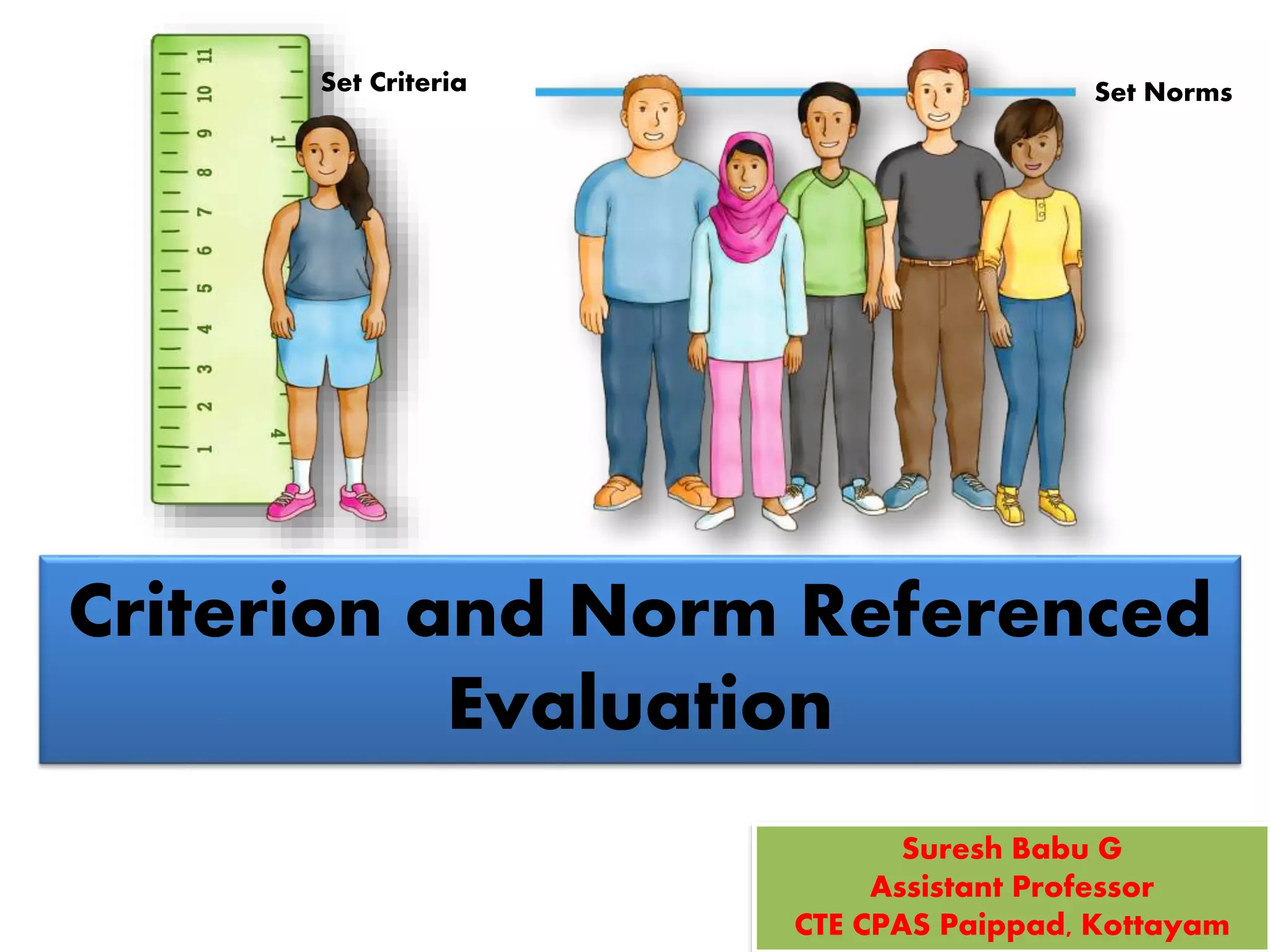
Set Criteria Set Norms
Criterion Referenced Evaluation
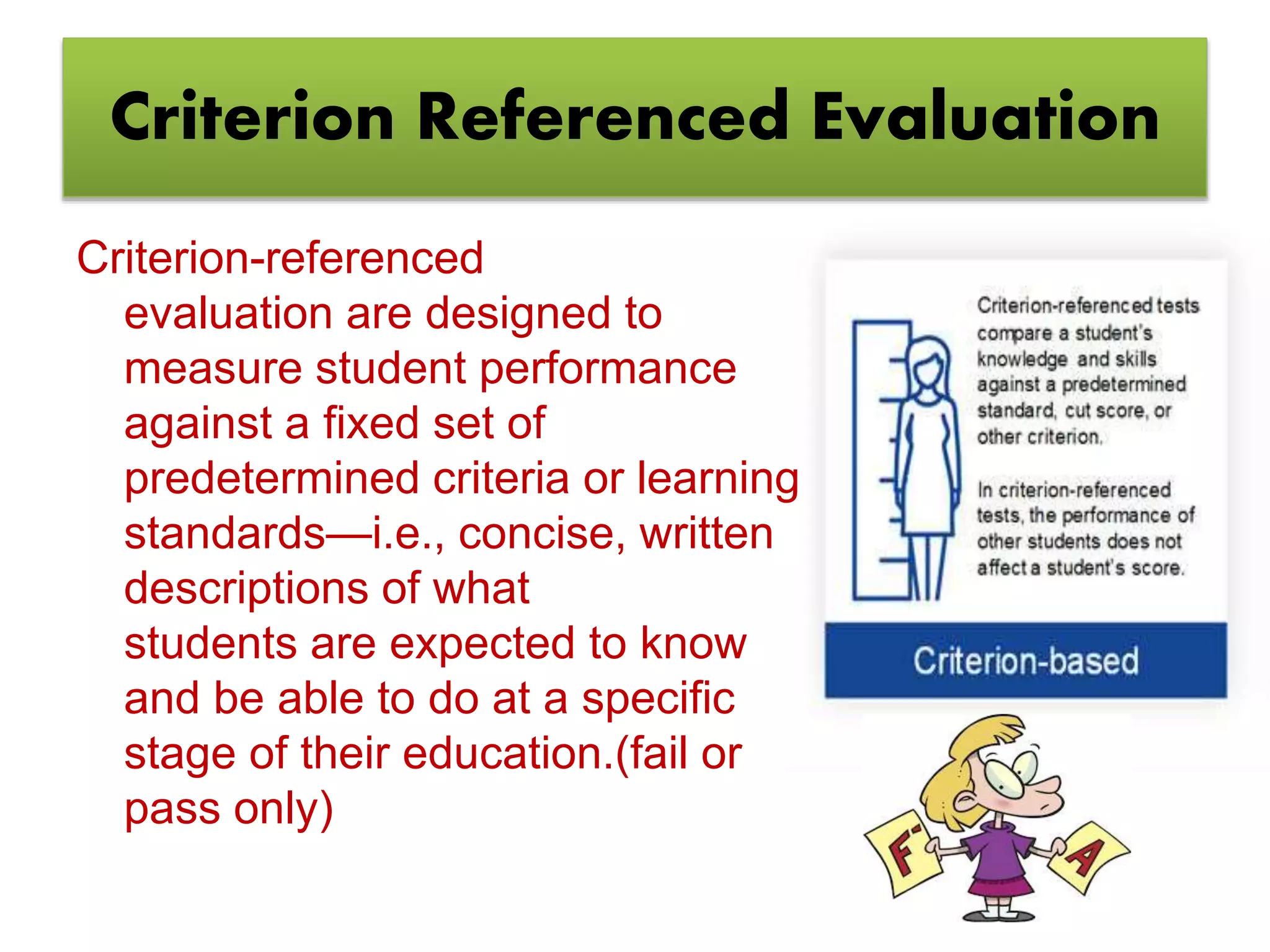
Criterion-referenced
evaluation are designed to
measure student performance
against a fixed set of
predetermined criteria or learning
standards—i.e., concise, written
descriptions of what
students are expected to know
and be able to do at a specific
stage of their education.(fail or
pass only)
Definition of Criterion Referenced
Test
Ivon (1970) defines a Criterion
Referenced test “One consisting of
items keyed to a set of behaviour
objectives”
Gronlund (1985), Criterion Referenced
test is “a test designed to provide a
measure of performance that is
interpretable in terms of a clearly
defined and delimited domain of
learning tasks”
Characteristics of Criterion
Referenced Test
 Its main objective is to measure
student’s achievement of curriculum
based skills.
 It is balanced representation of goals
and objectives.
 It is used to evaluate the curriculum
plan instruction progress and group
students interaction.
 It can be administrated before and after
instruction.
 It is generally reported in the form of
minimum scores, number of correct
items, percent of correct items and
derived score based on correct items
and other factors
Uses of Criterion Referenced Test
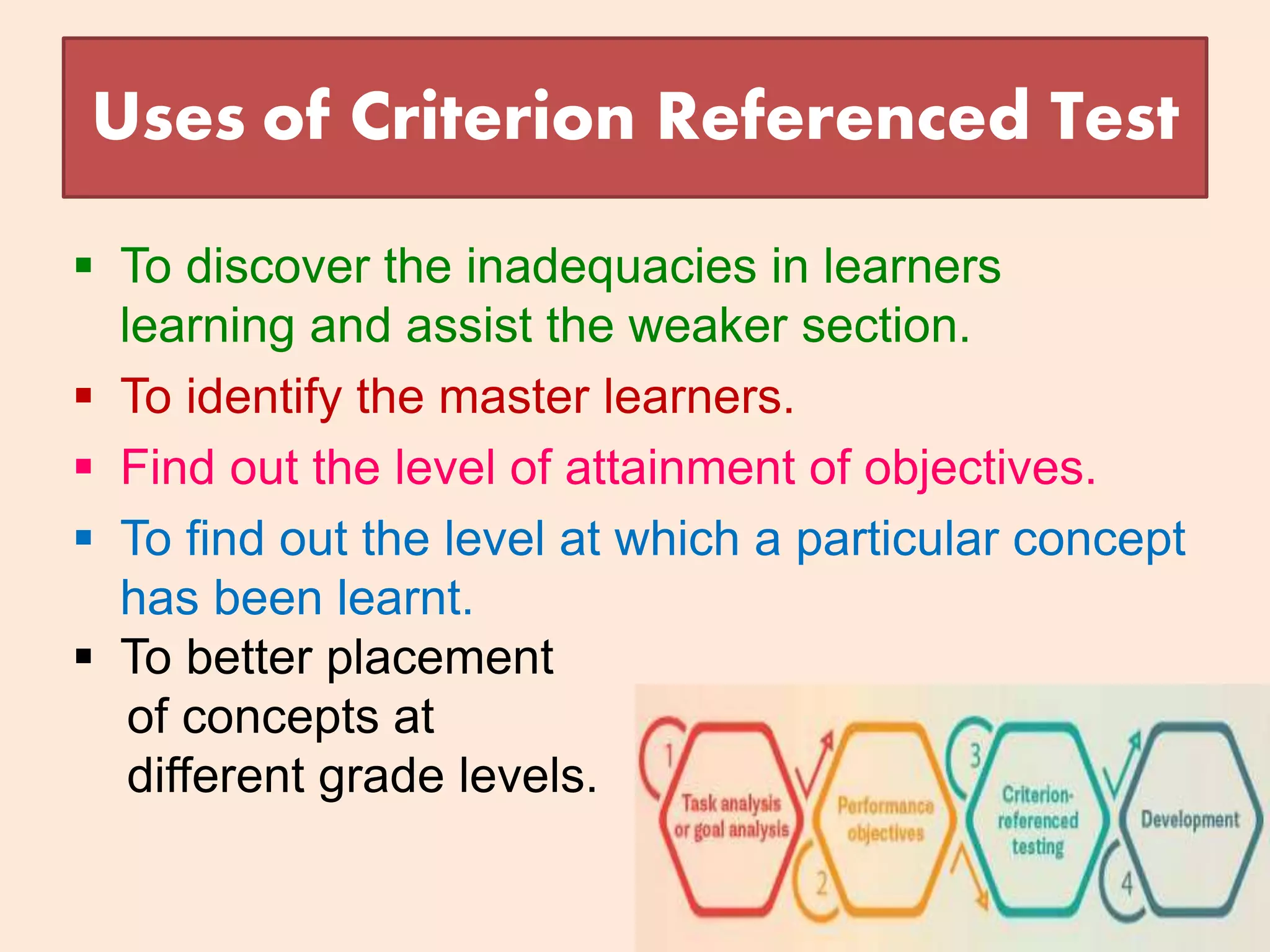
 To discover the inadequacies in learners
learning and assist the weaker section.
 To identify the master learners.
 Find out the level of attainment of objectives.
 To find out the level at which a particular concept
has been learnt.
 To better placement
of concepts at
different grade levels.
Limitations of Criterion
Referenced Test
Chase (1974) lists the following limitations
o Does not show how good or poor is the learners
level of ability.
o Influenced by a given teachers interest or
biases.
o Important for only a small fraction of important
educational achievement.
Norms Referenced Evaluation
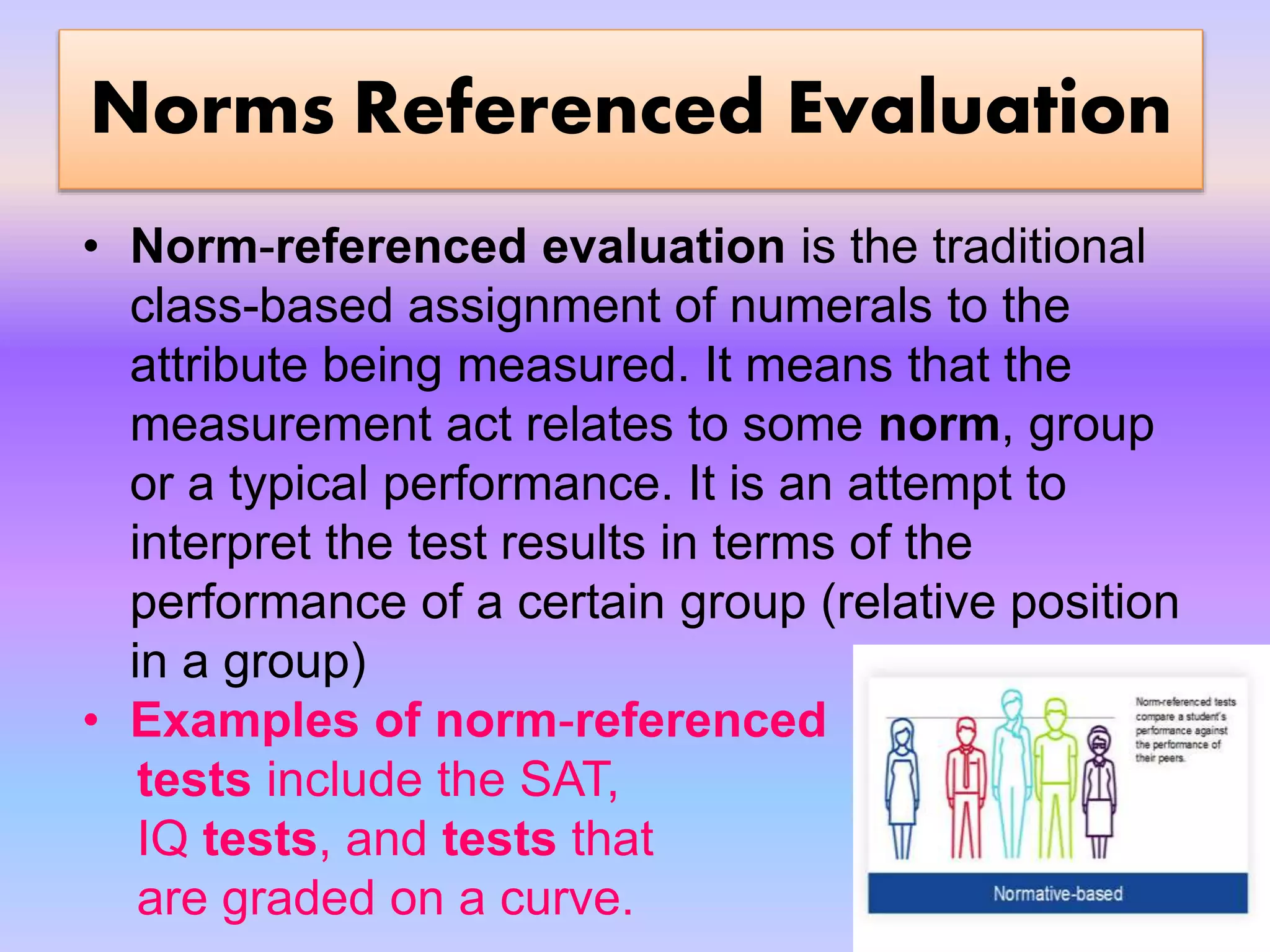
• Norm-referenced evaluation is the traditional
class-based assignment of numerals to the
attribute being measured. It means that the
measurement act relates to some norm, group
or a typical performance. It is an attempt to
interpret the test results in terms of the
performance of a certain group (relative position
in a group)
• Examples of norm-referenced
tests include the SAT,
IQ tests, and tests that
are graded on a curve.
Definition of Norms Referenced
Evaluation
• Gronlund (1976) stared that Norm-referenced
tests are “designed to rank students in order to
achievement, from high to low, so that decisions
based on relative achievements (eg, selection,
grouping, grading) can be made with greater
confidence”
• Bormuth it is designed “ to measure the growth in
a student’s attainment and to compare his level of
attainment with the levels reached by other
students and norm group”
Characteristics of Norms
Referenced Test
 Its basic purpose is to measure students
achievement in curriculum based skills.
 It is prepared for a particular grade level.
 It is administrated after instruction.
 It is used for forming homogeneous or
heterogeneous class groups.
 It classifies achievement as above average,
average or below average for a given grade.
 Reported in the form of
Percentile rank , linear
standard score.
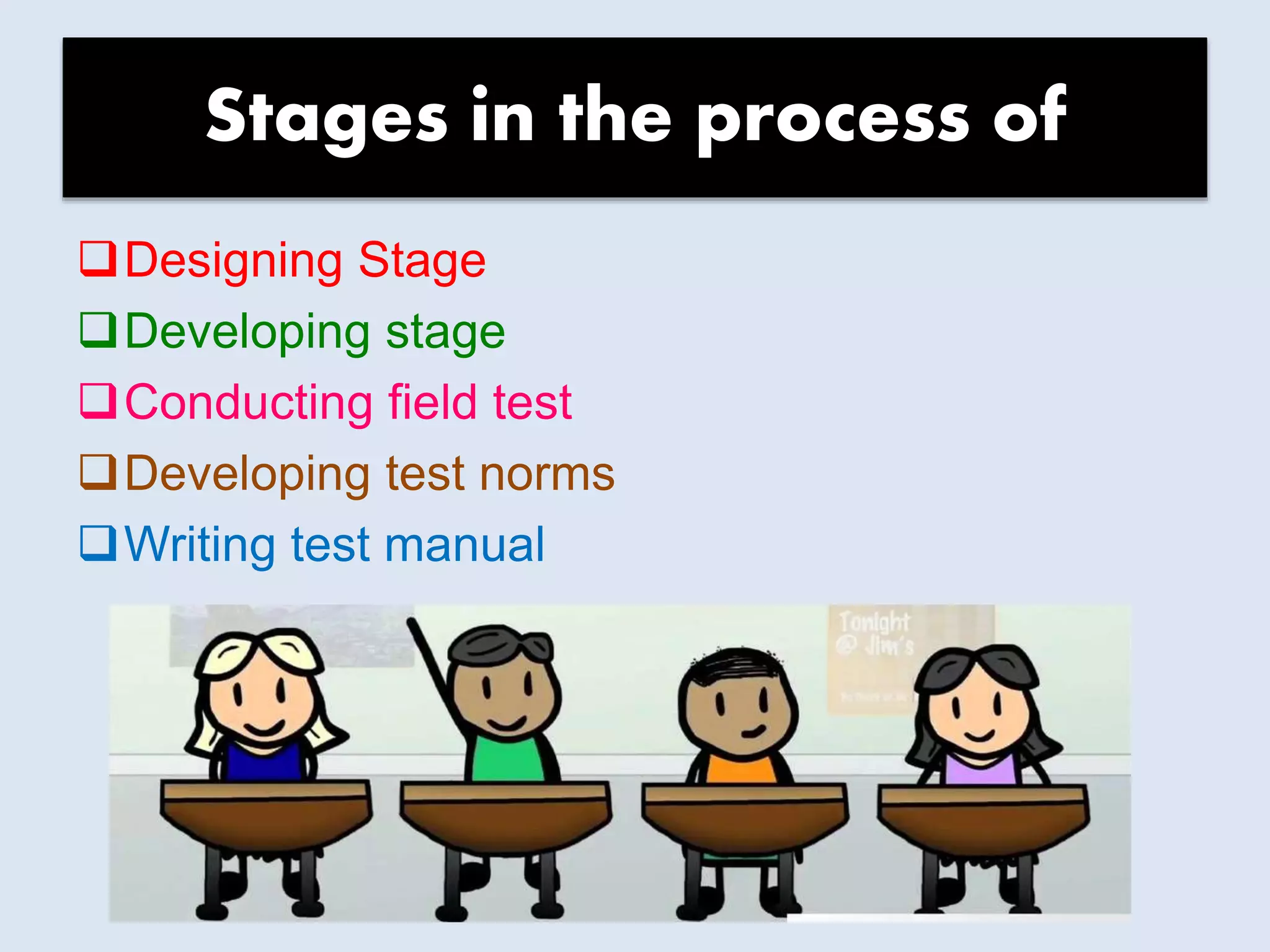
Stages in the process of
Designing Stage
Developing stage
Conducting field test
Developing test norms
Writing test manual
Uses of Norms Referenced
Evaluation
 It is useful in making aptitude testing
 To get reliable rank ordering of pupils.
 To identify the pupils who have mastered.
 Select best of the application for a particular
programme
 For effective comparison
of other possible
programme
Limitations of Norms Referenced
Evaluation
There is lack of congruence between what the
test measures.
Test items that are answered correctly by most
of the pupils are not included.
Promotes unhealthy competition.
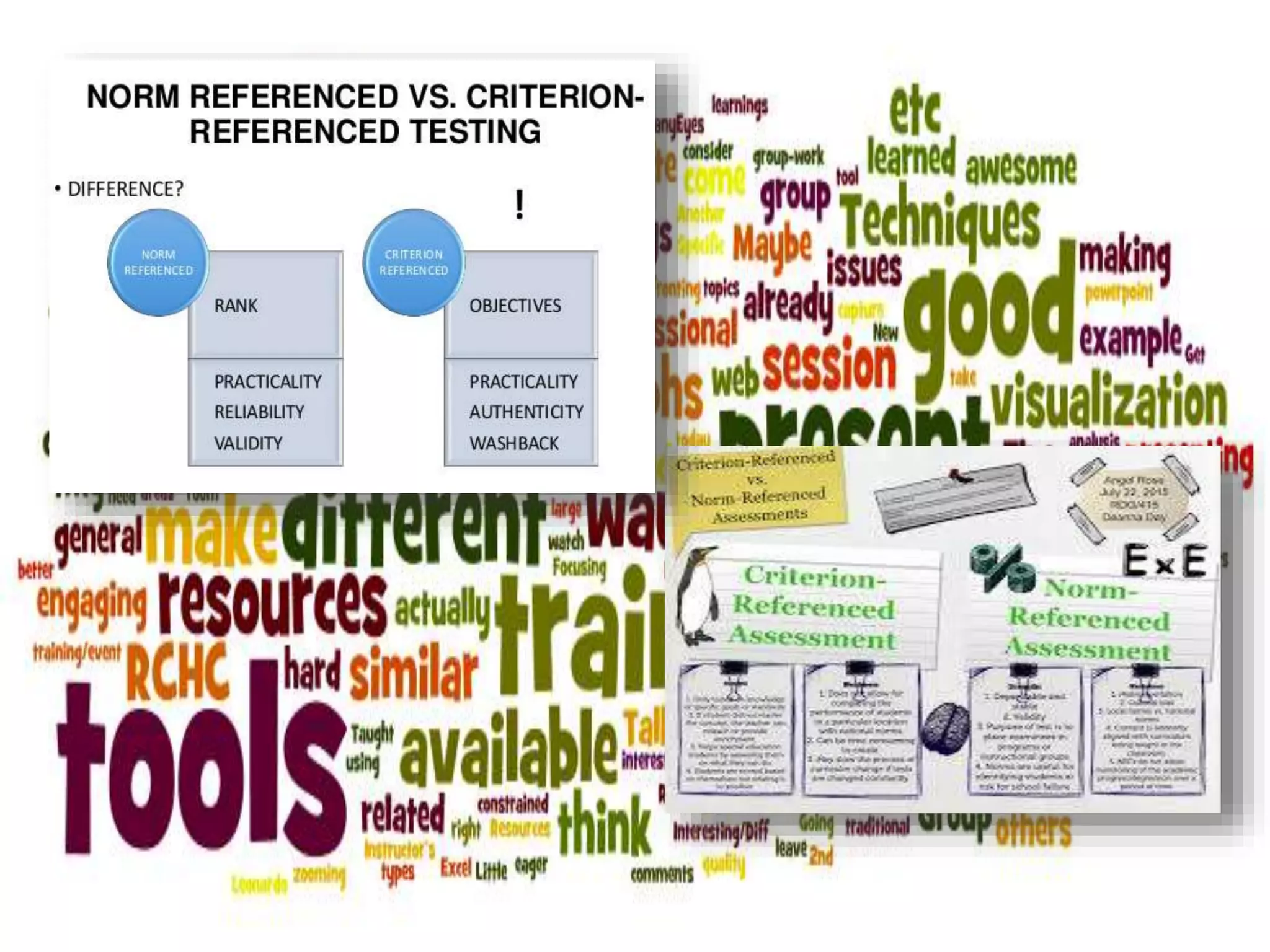
Difference between Criterion and Norm-Referenced Tests
Dimension Criterion-Referenced Tests Norm-Referenced Tests
Purpose To determine whether each student has
achieved specific skills or concepts.
To rank each student with respect to
the achievement of others in broad
areas of knowledge.
Type of
measurement
Measures specific skills Measures broad skill
Test Structure Each skill is tested by at least four items
in order to obtain an adequate sample
of student performance and to
minimize the effect of guessing.
Each skill is usually tested by less
than four items. Items vary in
difficulty. Items are selected that
discriminate between high and low
achievers.
Score
Interpretation
Each individual is compared with a
preset standard for acceptable
achievement.
Relative, Each individual is compared
with other examinees and assigned a
score
Distribution of
Scores
To measure specific objectives-based
language points
To measure general language
abilities or proficiencies
Knowledge of
Questions
Students know exactly what content to
expect in test items.
Students have little or idea of what
content to expect in test items.
Teachers “Teach to test”
Norms Referenced and Criteria Referenced Evaluation

Norms Referenced and Criteria Referenced Evaluation

  • 1.
    Criterion and NormReferenced Evaluation Suresh Babu G Assistant Professor CTE CPAS Paippad, Kottayam Set Criteria Set Norms
  • 2.
    Criterion Referenced Evaluation Criterion-referenced evaluationare designed to measure student performance against a fixed set of predetermined criteria or learning standards—i.e., concise, written descriptions of what students are expected to know and be able to do at a specific stage of their education.(fail or pass only)
  • 3.
    Definition of CriterionReferenced Test Ivon (1970) defines a Criterion Referenced test “One consisting of items keyed to a set of behaviour objectives” Gronlund (1985), Criterion Referenced test is “a test designed to provide a measure of performance that is interpretable in terms of a clearly defined and delimited domain of learning tasks”
  • 4.
    Characteristics of Criterion ReferencedTest  Its main objective is to measure student’s achievement of curriculum based skills.  It is balanced representation of goals and objectives.  It is used to evaluate the curriculum plan instruction progress and group students interaction.  It can be administrated before and after instruction.  It is generally reported in the form of minimum scores, number of correct items, percent of correct items and derived score based on correct items and other factors
  • 5.
    Uses of CriterionReferenced Test  To discover the inadequacies in learners learning and assist the weaker section.  To identify the master learners.  Find out the level of attainment of objectives.  To find out the level at which a particular concept has been learnt.  To better placement of concepts at different grade levels.
  • 6.
    Limitations of Criterion ReferencedTest Chase (1974) lists the following limitations o Does not show how good or poor is the learners level of ability. o Influenced by a given teachers interest or biases. o Important for only a small fraction of important educational achievement.
  • 7.
    Norms Referenced Evaluation •Norm-referenced evaluation is the traditional class-based assignment of numerals to the attribute being measured. It means that the measurement act relates to some norm, group or a typical performance. It is an attempt to interpret the test results in terms of the performance of a certain group (relative position in a group) • Examples of norm-referenced tests include the SAT, IQ tests, and tests that are graded on a curve.
  • 8.
    Definition of NormsReferenced Evaluation • Gronlund (1976) stared that Norm-referenced tests are “designed to rank students in order to achievement, from high to low, so that decisions based on relative achievements (eg, selection, grouping, grading) can be made with greater confidence” • Bormuth it is designed “ to measure the growth in a student’s attainment and to compare his level of attainment with the levels reached by other students and norm group”
  • 9.
    Characteristics of Norms ReferencedTest  Its basic purpose is to measure students achievement in curriculum based skills.  It is prepared for a particular grade level.  It is administrated after instruction.  It is used for forming homogeneous or heterogeneous class groups.  It classifies achievement as above average, average or below average for a given grade.  Reported in the form of Percentile rank , linear standard score.
  • 10.
    Stages in theprocess of Designing Stage Developing stage Conducting field test Developing test norms Writing test manual
  • 11.
    Uses of NormsReferenced Evaluation  It is useful in making aptitude testing  To get reliable rank ordering of pupils.  To identify the pupils who have mastered.  Select best of the application for a particular programme  For effective comparison of other possible programme
  • 12.
    Limitations of NormsReferenced Evaluation There is lack of congruence between what the test measures. Test items that are answered correctly by most of the pupils are not included. Promotes unhealthy competition.
  • 13.
    Difference between Criterionand Norm-Referenced Tests Dimension Criterion-Referenced Tests Norm-Referenced Tests Purpose To determine whether each student has achieved specific skills or concepts. To rank each student with respect to the achievement of others in broad areas of knowledge. Type of measurement Measures specific skills Measures broad skill Test Structure Each skill is tested by at least four items in order to obtain an adequate sample of student performance and to minimize the effect of guessing. Each skill is usually tested by less than four items. Items vary in difficulty. Items are selected that discriminate between high and low achievers. Score Interpretation Each individual is compared with a preset standard for acceptable achievement. Relative, Each individual is compared with other examinees and assigned a score Distribution of Scores To measure specific objectives-based language points To measure general language abilities or proficiencies Knowledge of Questions Students know exactly what content to expect in test items. Students have little or idea of what content to expect in test items. Teachers “Teach to test”