COLORIMETRY
And
SPECTROPHOTOMETRY
AmitKumarSingh
Asst.Professor(ClinicalBiochemistry)
USMAS,Rayat BahraUniversity,MohaliPunjab 23/05/2021
Introduction
โ€ข Photometry is the most common analytical
technique used in the biochemical laboratory.
It is designed to measure the intensity of a
beam of light.
โ€ข Photometric principles are applied to the
several kinds of analytical techniques:
(a) where absorbed or transmitted light is measured:
โ€ข Colorimetry
โ€ข Spectrophotometry
โ€ข Atomic absorption, and
โ€ข Turbidometry
(b)where emitted light is measured:
โ€ข Flame photometry
Introduction
โ€ข The components of most photoelectric
colorimeters are basically the same and the
basic method of operation is also similar for
all the instruments.
โ€ข In analytical chemistry, Colorimetry is a
technique โ€œused to determine the
concentration of colored compounds
(analytes) in sample solutionโ€ at visible
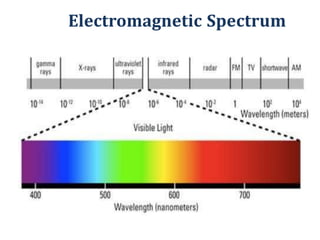
spectrum of light (400 โ€“ 700 nm).
Properties of Light
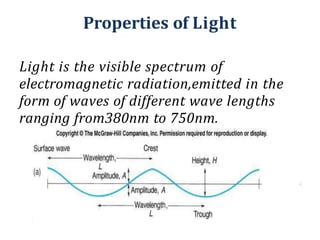
Light is the visible spectrum of
electromagnetic radiation,emitted in the
form of waves of different wave lengths
ranging from380nm to 750nm.
Electromagnetic Spectrum
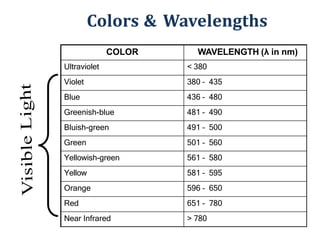
Colors & Wavelengths
COLOR WAVELENGTH (ฮป in nm)
Ultraviolet < 380
Violet 380 โ€“ 435
Blue 436 โ€“ 480
Greenish-blue 481 โ€“ 490
Bluish-green 491 โ€“ 500
Green 501 โ€“ 560
Yellowish-green 561 โ€“ 580
Yellow 581 โ€“ 595
Orange 596 โ€“ 650
Red 651 โ€“ 780
Near Infrared > 780
Principle of Photometry
๏ถSubstance to be measured by photometry must be
colored to begin with or can be made to produce
color derivatives by using certain reagents and
reactions.
๏ถIntensity of colour produced is propotional to the
concentration of the colour producing subs.present
in solution.
๏ถColored subs.absorbs light of a particular wave
length and the extent of light absorption depends on
the conc .of color producing subs.in solution.
๏ถAcharacteristic wavelength of absorption spectrum
is isolated from light passing it through filter
monochromator
๏ถSolution with colored subs. is kept in a cuvet&
allowed the subs. to absorb light.
๏ถDegree of light absorption by a solute of unknown
conc. Is propotional to degree of light absorption
by same solute in a solution of known conc.
๏ถSubs.of unknown conc. is measured by comparing
with same subs .in another solu. Of known conc.
Colorimetry
Principle
๏ถ.Colored solutions have the property of
absorbing certain wavelength of light
when a monochromatic light is passed
through them.
๏ถ.The amount of light absorbed or
transmitted by a colored solution is in
accordance with two laws:
๏ถBeerโ€™s law
๏ถLambertโ€™s law
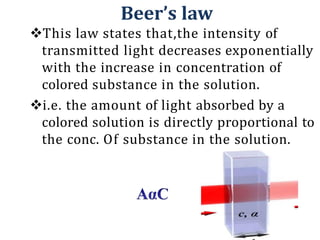
Beerโ€™s law
๏ถThis law states that,the intensity of
transmitted light decreases exponentially
with the increase in concentration of
colored substance in the solution.
๏ถi.e. the amount of light absorbed by a
colored solution is directly proportional to
the conc. Of substance in the solution.
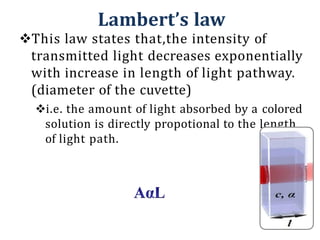
Lambertโ€™s law
๏ถThis law states that,the intensity of
transmitted light decreases exponentially
with increase in length of light pathway.
(diameter of the cuvette)
๏ถi.e. the amount of light absorbed by a colored
solution is directly propotional to the length
of light path.
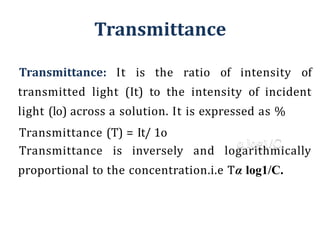
Transmittance
โšซTransmittance: It is the ratio of intensity of
transmitted light (It) to the intensity of incident
light (lo) across a solution. It is expressed as %
โšซTransmittance (T) = It/ 1o
โšซTransmittance is inversely and logarithmically
proportional to the concentration.i.e Tฮฑ log1/C.
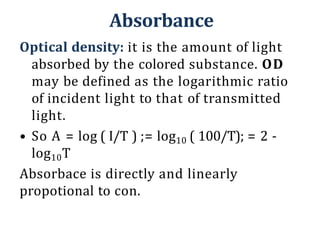
Absorbance
Optical density: it is the amount of light
absorbed by the colored substance. OD
may be defined as the logarithmic ratio
of incident light to that of transmitted
light.
โ€ข So A = log ( I/T ) ;= log10 ( 100/T); = 2 -
log10T
Absorbace is directly and linearly
propotional to con.
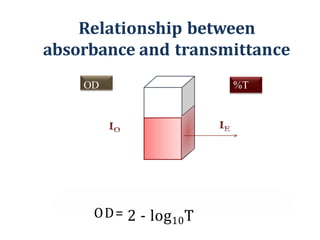
Relationship between
absorbance and transmittance
OD %T
OD= 2 - log10T
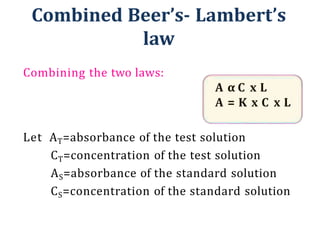
Combined Beerโ€™s- Lambertโ€™s
law
Combining the two laws:
A ฮฑ C x L
A = K x C x L
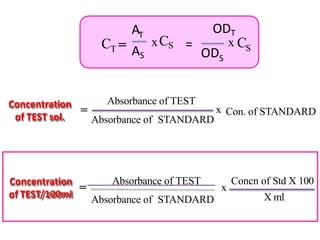
Let AT=absorbance of the test solution
CT=concentration of the test solution
AS=absorbance of the standard solution
CS=concentration of the standard solution
CT =
AT
AS
xCS
Concentration
of TEST sol.
Absorbance of TEST
Absorbance of STANDARD
x Con. of STANDARD
=
Concentration
of TEST/100ml
Absorbance of STANDARD
=
Absorbance of TEST
x
Concn of Std X 100
X ml
ODS
ODT
= x CS
Standard (calibration curve)
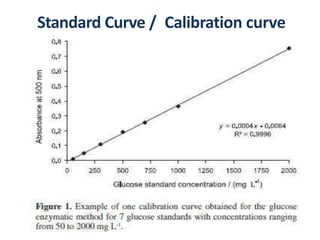
โ€ข The standard curve is prepared to check
whether the method of assaying a particular
substance follows Beerโ€™s Law, i.e. whether the
absorbance of the substance increases in a
linear way with its concentration.
โ€ข The standard curve is constructed by plotting a
vertical axis (y โ€“ axis, ordinate) for optical
densities (absorbance) and a horizontal axis (x
โ€“ axis, abscissa) the concentration of standard
solution.
โ€ข The concentration of the test/unknown can be
measured from the graph (standard curve).
Standard Curve / Calibration curve
Preparation of solution for
investigation
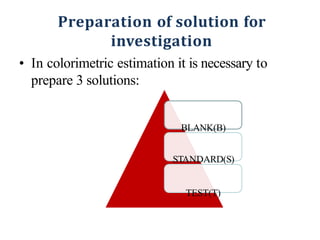
โ€ข In colorimetric estimation it is necessary to
prepare 3 solutions:
BLANK(B)
STANDARD(S)
TEST(T)
10/3/2016 4:36 PM
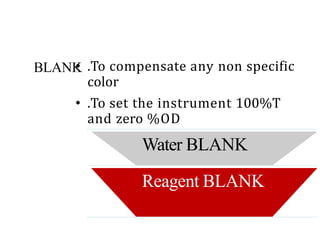
BLANK
โ€ข .To compensate any non specific
color
โ€ข .To set the instrument 100%T
and zero %OD
Water BLANK
Reagent BLANK
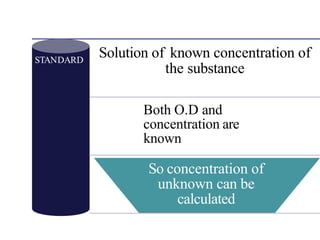
STANDARD
Solution of known concentration of
the substance
Both O.D and
concentration are
known
So concentration of
unknown can be
calculated
TEST
โ€ข Test solution is made by treating
a specific volume of the test
sample with reagents
As per procedure
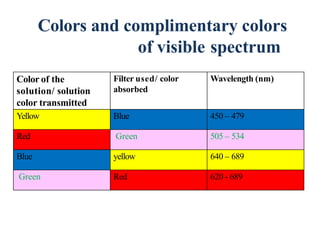
Complimentary color
๏‚ง Wavelengthbetween 400nm to 700 nm
form the visible spectrum oflight
๏‚ง Light passed through a solution which
selectivity absorbs radiation at fixed wave
lengths,then the color of the
transmitted light is complementary to that
of the absored light.
Colors and complimentary colors
of visible spectrum
Color of the
solution/ solution
color transmitted
Filter used/ color
absorbed
Wavelength (nm)
Yellow Blue 450 โ€“ 479
Red Green 505 โ€“ 534
Blue yellow 640 โ€“ 689
Green Red 620 - 689
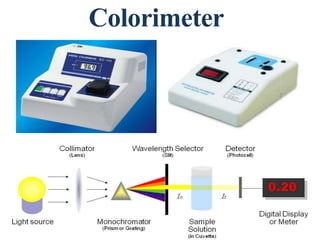
Colorimeter
Components of Colorimetry
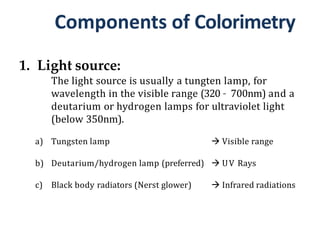
1. Light source:
The light source is usually a tungten lamp, for
wavelength in the visible range (320 โ€“ 700nm) and a
deutarium or hydrogen lamps for ultraviolet light
(below 350nm).
a) Tungsten lamp ๏ƒ  Visible range
b) Deutarium/hydrogen lamp (preferred) ๏ƒ  UV Rays
c) Black body radiators (Nerst glower) ๏ƒ  Infrared radiations
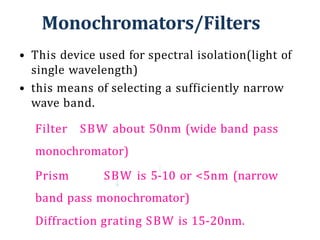
Monochromators/Filters
โ€ข This device used for spectral isolation(light of
single wavelength)
โ€ข this means of selecting a sufficiently narrow
wave band.
Filter SBW about 50nm (wide band pass
monochromator)
Prism SBW is 5-10 or <5nm (narrow
band pass monochromator)
Diffraction grating SBW is 15-20nm.
Monochromators
โ€ข Early colorimeters used Absorption filters (i.e. glass
filter, Gelatin filter) that transmitted a wide segment of
spectrum (50nm or more).
โ€ข Newer instrument use Interface filters that consist of
thin layer of magnesium fluoride crystals with a
semitransparent coating of silver on each side.
โ€ข Monochromator consists of:
โ€“ Entrance slit
โ€“ Absorption/ interface filter and
โ€“ Prisms or diffraction grating for wavelength selection
โ€“ Exit slit
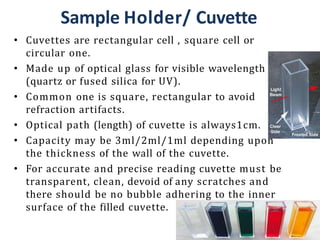
Sample Holder/ Cuvette
โ€ข Cuvettes are rectangular cell , square cell or
circular one.
โ€ข Made up of optical glass for visible wavelength
(quartz or fused silica for UV).
โ€ข Common one is square, rectangular to avoid
refraction artifacts.
โ€ข Optical path (length) of cuvette is always1cm.
โ€ข Capacity may be 3ml/2ml/1ml depending upon
the thickness of the wall of the cuvette.
โ€ข For accurate and precise reading cuvette must be
transparent, clean, devoid of any scratches and
there should be no bubble adhering to the inner
surface of the filled cuvette.
Photosensitive detectors
๏ถDetectors are the transducers, which convert
light energy to electrical enagery. A detector
should be possess follwing characteristics:
๏ถ Should be sensitive,stable
๏ถ Should have linear response,short response.
โ€ข Different detectors used are:
๏ถ Barrier layer cells (photocells)
โ€“ simpliest
๏ถ Photoconductive cells
(photodiodes) โ€“ newest
Read out devices
โ€ข The detector response can be measured by any
of the following devices:
a) Galvanometer
b) Ammeter
c) Recorder
d) Digital readout.
The signal may be transmitted to computer or print
out devices.
Criteria for satisfactory colorimetric
estimations
๏ถStability of color
๏ถIntensity of color The color of the solution
should be intense.
๏ถ Clarity of the solution Substance under
โ€ข investigation should be completely soluble.
๏ถ Specificity Color produced should be specific for
the desired constituent.
๏ถ Validity of Beerโ€™s law The intensity of color
โ€ข should be proportional to concentration.
Applications Of Colorimeter
โ€ข Estimation of biochemical compounds in blood,
plasma, serum, CSF, urine, etc.:
โ€“ Glucose
โ€“ Urea
โ€“ Creatinine
โ€“ UricAcid
โ€“ Bilirubin
โ€“ Lipids
โ€“ Total Proteins
โ€“ Enzymes [e.g.ALT, AST,ALP]
โ€“ Minerals [Calcium, Phosphorus etc.] etcโ€ฆ.
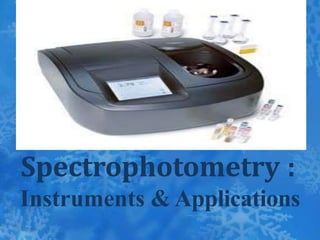
Spectrophotometry :
Instruments & Applications
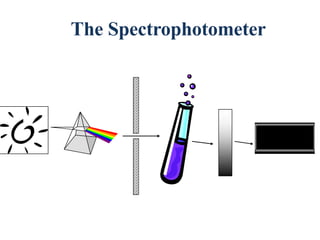
Principle of Spectrophotometer
โ€“ Solutes in a solution show characteristic absorption
spectrum in UV or visible or infrared region of
electromagnetic radiation.
โ€“ Characteristic
isolated by
absorption spectrum can be
passing the electromagnetic
radiation through a prism monochromator.
โ€“ Degree of absorption of electromagnetic
radiation depends on the condensation of solute
in solution.
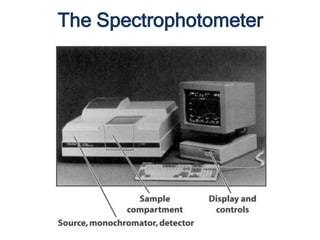
The Spectrophotometer
Introduction
โ€ข Spectrophotometer:
a) Single-beam
b) Double-beam
4
[41
]
Instruments
โ€ข Light source: provide a sufficient of light which is
suitable for marking a measurement.
โ€ข The light source typically yields a high output of
polychromatic light over a wide range of the
spectrum.[4]
42
Common monochromators:
โšซFilter
โšซPrism
โšซDiffraction grating
โšซInterference filter
โ€ข Monochromator : Accepts polychromatic input light from
a lamp and outputs monochromatic light.
โ€ข Monochromator consists of these parts:
I. Entrance slit
II.Collimating lens or mirror
III.Dispersion element
IV.Focusing lens or mirror
V.Exit slit [6]
43
Instruments
โ€ข Dispersion devices: Aspecial plate with hundreds
of parallel grooved lines.
โ€ข The grooved lines act to separate the white light into
the visible light spectrum.
44
The more lines
the smaller
the wavelength
resolution.[5]
Instruments
โ€ข Focusing devices: Combinations of lenses, slits,
and mirrors.
โ€ข relay and focus light through the instrument.[2]
45
Instruments
โ€ข Cuvettes: designed to hold samples for spectroscopic
experiments. made of Plastic, glass or optical grade
quartz
โ€ข should be as clear as possible, without impurities that
might affect a spectroscopic reading.[2]
46
Instruments
โ€ข Detectors: Convert radiant energy (photons) into an
electrical signal.
The photocell and phototube are the simplest
photodetectors, producing current proportional to the
intensity of the light striking Them .[1],[2]
47
Instruments
โ€ข Display devices: The data from a detector are
displayed by a readout device, such as an analog meter,
a light beam reflected on a scale, or a digital display , or
LCD .
โ€ข The output can also be transmitted to a computer or
printer. [3]
48
Applications
1. Concentration measurement
โ€“ Prepare samples
โ€“ Make series of standard solutions of known concentrations
[4]
49
Applications
โ€“ Set spectrophotometer to the ฮป of maximum light
absorption
โ€“ Measure the absorption of the unknown, and from the
standard plot, read the related concentration[4]
50
Applications
2. Detection of Impurities
โ€ข UV absorption spectroscopy is one of the
best methods for determination of impurities in organic
molecules. [7]
51
Additional peaks can be
observed due to impurities
in the sample and it can be
compared with that of
standard raw material.
Applications
3. Structure elucidation of organic compounds.
โ€ข From the location of peaks and combination of peaks
UV spectroscopy elucidate structure of organic
molecules:
o the presence or absence of unsaturation,
o the presence of hetero atoms.[7]
52
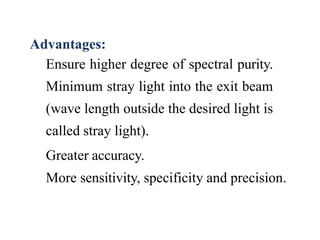
Advantages:
Ensure higher degree of spectral purity.
Minimum stray light into the exit beam
(wave length outside the desired light is
called stray light).
Greater accuracy.
More sensitivity, specificity and precision.
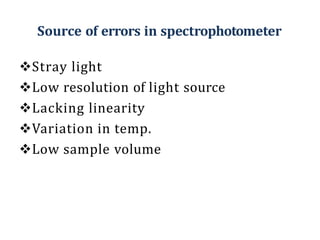
Source of errors in spectrophotometer
๏ถStray light
๏ถLow resolution of light source
๏ถLacking linearity
๏ถVariation in temp.
๏ถLow sample volume
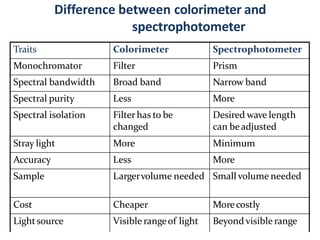
Difference between colorimeter and
spectrophotometer
Traits Colorimeter Spectrophotometer
Monochromator Filter Prism
Spectral bandwidth Broad band Narrow band
Spectral purity Less More
Spectral isolation Filterhas to be
changed
Desired wave length
can beadjusted
Stray light More Minimum
Accuracy Less More
Sample Largervolume needed Small volume needed
Cost Cheaper Morecostly
Lightsource Visible rangeof light Beyond visible range

Colorimetry & spectrophotometry

  • 1.
  • 2.
    Introduction โ€ข Photometry isthe most common analytical technique used in the biochemical laboratory. It is designed to measure the intensity of a beam of light. โ€ข Photometric principles are applied to the several kinds of analytical techniques: (a) where absorbed or transmitted light is measured: โ€ข Colorimetry โ€ข Spectrophotometry โ€ข Atomic absorption, and โ€ข Turbidometry (b)where emitted light is measured: โ€ข Flame photometry
  • 3.
    Introduction โ€ข The componentsof most photoelectric colorimeters are basically the same and the basic method of operation is also similar for all the instruments. โ€ข In analytical chemistry, Colorimetry is a technique โ€œused to determine the concentration of colored compounds (analytes) in sample solutionโ€ at visible spectrum of light (400 โ€“ 700 nm).
  • 4.
    Properties of Light Lightis the visible spectrum of electromagnetic radiation,emitted in the form of waves of different wave lengths ranging from380nm to 750nm.
  • 5.
  • 6.
    Colors & Wavelengths COLORWAVELENGTH (ฮป in nm) Ultraviolet < 380 Violet 380 โ€“ 435 Blue 436 โ€“ 480 Greenish-blue 481 โ€“ 490 Bluish-green 491 โ€“ 500 Green 501 โ€“ 560 Yellowish-green 561 โ€“ 580 Yellow 581 โ€“ 595 Orange 596 โ€“ 650 Red 651 โ€“ 780 Near Infrared > 780
  • 7.
    Principle of Photometry ๏ถSubstanceto be measured by photometry must be colored to begin with or can be made to produce color derivatives by using certain reagents and reactions. ๏ถIntensity of colour produced is propotional to the concentration of the colour producing subs.present in solution. ๏ถColored subs.absorbs light of a particular wave length and the extent of light absorption depends on the conc .of color producing subs.in solution.
  • 8.
    ๏ถAcharacteristic wavelength ofabsorption spectrum is isolated from light passing it through filter monochromator ๏ถSolution with colored subs. is kept in a cuvet& allowed the subs. to absorb light. ๏ถDegree of light absorption by a solute of unknown conc. Is propotional to degree of light absorption by same solute in a solution of known conc. ๏ถSubs.of unknown conc. is measured by comparing with same subs .in another solu. Of known conc.
  • 9.
    Colorimetry Principle ๏ถ.Colored solutions havethe property of absorbing certain wavelength of light when a monochromatic light is passed through them. ๏ถ.The amount of light absorbed or transmitted by a colored solution is in accordance with two laws: ๏ถBeerโ€™s law ๏ถLambertโ€™s law
  • 10.
    Beerโ€™s law ๏ถThis lawstates that,the intensity of transmitted light decreases exponentially with the increase in concentration of colored substance in the solution. ๏ถi.e. the amount of light absorbed by a colored solution is directly proportional to the conc. Of substance in the solution.
  • 11.
    Lambertโ€™s law ๏ถThis lawstates that,the intensity of transmitted light decreases exponentially with increase in length of light pathway. (diameter of the cuvette) ๏ถi.e. the amount of light absorbed by a colored solution is directly propotional to the length of light path.
  • 12.
    Transmittance โšซTransmittance: It isthe ratio of intensity of transmitted light (It) to the intensity of incident light (lo) across a solution. It is expressed as % โšซTransmittance (T) = It/ 1o โšซTransmittance is inversely and logarithmically proportional to the concentration.i.e Tฮฑ log1/C.
  • 13.
    Absorbance Optical density: itis the amount of light absorbed by the colored substance. OD may be defined as the logarithmic ratio of incident light to that of transmitted light. โ€ข So A = log ( I/T ) ;= log10 ( 100/T); = 2 - log10T Absorbace is directly and linearly propotional to con.
  • 14.
    Relationship between absorbance andtransmittance OD %T OD= 2 - log10T
  • 15.
    Combined Beerโ€™s- Lambertโ€™s law Combiningthe two laws: A ฮฑ C x L A = K x C x L Let AT=absorbance of the test solution CT=concentration of the test solution AS=absorbance of the standard solution CS=concentration of the standard solution
  • 16.
    CT = AT AS xCS Concentration of TESTsol. Absorbance of TEST Absorbance of STANDARD x Con. of STANDARD = Concentration of TEST/100ml Absorbance of STANDARD = Absorbance of TEST x Concn of Std X 100 X ml ODS ODT = x CS
  • 17.
    Standard (calibration curve) โ€ขThe standard curve is prepared to check whether the method of assaying a particular substance follows Beerโ€™s Law, i.e. whether the absorbance of the substance increases in a linear way with its concentration. โ€ข The standard curve is constructed by plotting a vertical axis (y โ€“ axis, ordinate) for optical densities (absorbance) and a horizontal axis (x โ€“ axis, abscissa) the concentration of standard solution. โ€ข The concentration of the test/unknown can be measured from the graph (standard curve).
  • 18.
    Standard Curve /Calibration curve
  • 19.
    Preparation of solutionfor investigation โ€ข In colorimetric estimation it is necessary to prepare 3 solutions: BLANK(B) STANDARD(S) TEST(T) 10/3/2016 4:36 PM
  • 20.
    BLANK โ€ข .To compensateany non specific color โ€ข .To set the instrument 100%T and zero %OD Water BLANK Reagent BLANK
  • 21.
    STANDARD Solution of knownconcentration of the substance Both O.D and concentration are known So concentration of unknown can be calculated
  • 22.
    TEST โ€ข Test solutionis made by treating a specific volume of the test sample with reagents As per procedure
  • 23.
    Complimentary color ๏‚ง Wavelengthbetween400nm to 700 nm form the visible spectrum oflight ๏‚ง Light passed through a solution which selectivity absorbs radiation at fixed wave lengths,then the color of the transmitted light is complementary to that of the absored light.
  • 24.
    Colors and complimentarycolors of visible spectrum Color of the solution/ solution color transmitted Filter used/ color absorbed Wavelength (nm) Yellow Blue 450 โ€“ 479 Red Green 505 โ€“ 534 Blue yellow 640 โ€“ 689 Green Red 620 - 689
  • 25.
  • 26.
    Components of Colorimetry 1.Light source: The light source is usually a tungten lamp, for wavelength in the visible range (320 โ€“ 700nm) and a deutarium or hydrogen lamps for ultraviolet light (below 350nm). a) Tungsten lamp ๏ƒ  Visible range b) Deutarium/hydrogen lamp (preferred) ๏ƒ  UV Rays c) Black body radiators (Nerst glower) ๏ƒ  Infrared radiations
  • 27.
    Monochromators/Filters โ€ข This deviceused for spectral isolation(light of single wavelength) โ€ข this means of selecting a sufficiently narrow wave band. Filter SBW about 50nm (wide band pass monochromator) Prism SBW is 5-10 or <5nm (narrow band pass monochromator) Diffraction grating SBW is 15-20nm.
  • 28.
    Monochromators โ€ข Early colorimetersused Absorption filters (i.e. glass filter, Gelatin filter) that transmitted a wide segment of spectrum (50nm or more). โ€ข Newer instrument use Interface filters that consist of thin layer of magnesium fluoride crystals with a semitransparent coating of silver on each side. โ€ข Monochromator consists of: โ€“ Entrance slit โ€“ Absorption/ interface filter and โ€“ Prisms or diffraction grating for wavelength selection โ€“ Exit slit
  • 29.
    Sample Holder/ Cuvette โ€ขCuvettes are rectangular cell , square cell or circular one. โ€ข Made up of optical glass for visible wavelength (quartz or fused silica for UV). โ€ข Common one is square, rectangular to avoid refraction artifacts. โ€ข Optical path (length) of cuvette is always1cm. โ€ข Capacity may be 3ml/2ml/1ml depending upon the thickness of the wall of the cuvette. โ€ข For accurate and precise reading cuvette must be transparent, clean, devoid of any scratches and there should be no bubble adhering to the inner surface of the filled cuvette.
  • 30.
    Photosensitive detectors ๏ถDetectors arethe transducers, which convert light energy to electrical enagery. A detector should be possess follwing characteristics: ๏ถ Should be sensitive,stable ๏ถ Should have linear response,short response. โ€ข Different detectors used are: ๏ถ Barrier layer cells (photocells) โ€“ simpliest ๏ถ Photoconductive cells (photodiodes) โ€“ newest
  • 31.
    Read out devices โ€ขThe detector response can be measured by any of the following devices: a) Galvanometer b) Ammeter c) Recorder d) Digital readout. The signal may be transmitted to computer or print out devices.
  • 32.
    Criteria for satisfactorycolorimetric estimations ๏ถStability of color ๏ถIntensity of color The color of the solution should be intense. ๏ถ Clarity of the solution Substance under โ€ข investigation should be completely soluble. ๏ถ Specificity Color produced should be specific for the desired constituent. ๏ถ Validity of Beerโ€™s law The intensity of color โ€ข should be proportional to concentration.
  • 33.
    Applications Of Colorimeter โ€ขEstimation of biochemical compounds in blood, plasma, serum, CSF, urine, etc.: โ€“ Glucose โ€“ Urea โ€“ Creatinine โ€“ UricAcid โ€“ Bilirubin โ€“ Lipids โ€“ Total Proteins โ€“ Enzymes [e.g.ALT, AST,ALP] โ€“ Minerals [Calcium, Phosphorus etc.] etcโ€ฆ.
  • 34.
  • 35.
    Principle of Spectrophotometer โ€“Solutes in a solution show characteristic absorption spectrum in UV or visible or infrared region of electromagnetic radiation. โ€“ Characteristic isolated by absorption spectrum can be passing the electromagnetic radiation through a prism monochromator. โ€“ Degree of absorption of electromagnetic radiation depends on the condensation of solute in solution.
  • 36.
  • 37.
  • 38.
  • 39.
    Instruments โ€ข Light source:provide a sufficient of light which is suitable for marking a measurement. โ€ข The light source typically yields a high output of polychromatic light over a wide range of the spectrum.[4] 42
  • 40.
    Common monochromators: โšซFilter โšซPrism โšซDiffraction grating โšซInterferencefilter โ€ข Monochromator : Accepts polychromatic input light from a lamp and outputs monochromatic light. โ€ข Monochromator consists of these parts: I. Entrance slit II.Collimating lens or mirror III.Dispersion element IV.Focusing lens or mirror V.Exit slit [6] 43
  • 41.
    Instruments โ€ข Dispersion devices:Aspecial plate with hundreds of parallel grooved lines. โ€ข The grooved lines act to separate the white light into the visible light spectrum. 44 The more lines the smaller the wavelength resolution.[5]
  • 42.
    Instruments โ€ข Focusing devices:Combinations of lenses, slits, and mirrors. โ€ข relay and focus light through the instrument.[2] 45
  • 43.
    Instruments โ€ข Cuvettes: designedto hold samples for spectroscopic experiments. made of Plastic, glass or optical grade quartz โ€ข should be as clear as possible, without impurities that might affect a spectroscopic reading.[2] 46
  • 44.
    Instruments โ€ข Detectors: Convertradiant energy (photons) into an electrical signal. The photocell and phototube are the simplest photodetectors, producing current proportional to the intensity of the light striking Them .[1],[2] 47
  • 45.
    Instruments โ€ข Display devices:The data from a detector are displayed by a readout device, such as an analog meter, a light beam reflected on a scale, or a digital display , or LCD . โ€ข The output can also be transmitted to a computer or printer. [3] 48
  • 46.
    Applications 1. Concentration measurement โ€“Prepare samples โ€“ Make series of standard solutions of known concentrations [4] 49
  • 47.
    Applications โ€“ Set spectrophotometerto the ฮป of maximum light absorption โ€“ Measure the absorption of the unknown, and from the standard plot, read the related concentration[4] 50
  • 48.
    Applications 2. Detection ofImpurities โ€ข UV absorption spectroscopy is one of the best methods for determination of impurities in organic molecules. [7] 51 Additional peaks can be observed due to impurities in the sample and it can be compared with that of standard raw material.
  • 49.
    Applications 3. Structure elucidationof organic compounds. โ€ข From the location of peaks and combination of peaks UV spectroscopy elucidate structure of organic molecules: o the presence or absence of unsaturation, o the presence of hetero atoms.[7] 52
  • 50.
    Advantages: Ensure higher degreeof spectral purity. Minimum stray light into the exit beam (wave length outside the desired light is called stray light). Greater accuracy. More sensitivity, specificity and precision.
  • 51.
    Source of errorsin spectrophotometer ๏ถStray light ๏ถLow resolution of light source ๏ถLacking linearity ๏ถVariation in temp. ๏ถLow sample volume
  • 52.
    Difference between colorimeterand spectrophotometer Traits Colorimeter Spectrophotometer Monochromator Filter Prism Spectral bandwidth Broad band Narrow band Spectral purity Less More Spectral isolation Filterhas to be changed Desired wave length can beadjusted Stray light More Minimum Accuracy Less More Sample Largervolume needed Small volume needed Cost Cheaper Morecostly Lightsource Visible rangeof light Beyond visible range