SPECTROPHOTOMETER
RASHMI H R
MEDICAL M.SC
DEPARTMENT OF PHARMACOLOGY
SLIDE INDEX
• Definition
• Introduction
• History
• Components of Spectrophotometer
• Dispersion devices
• Types of Spectrophotometer
• Uses of Spectrophotometer
• Applications
DEFINITION
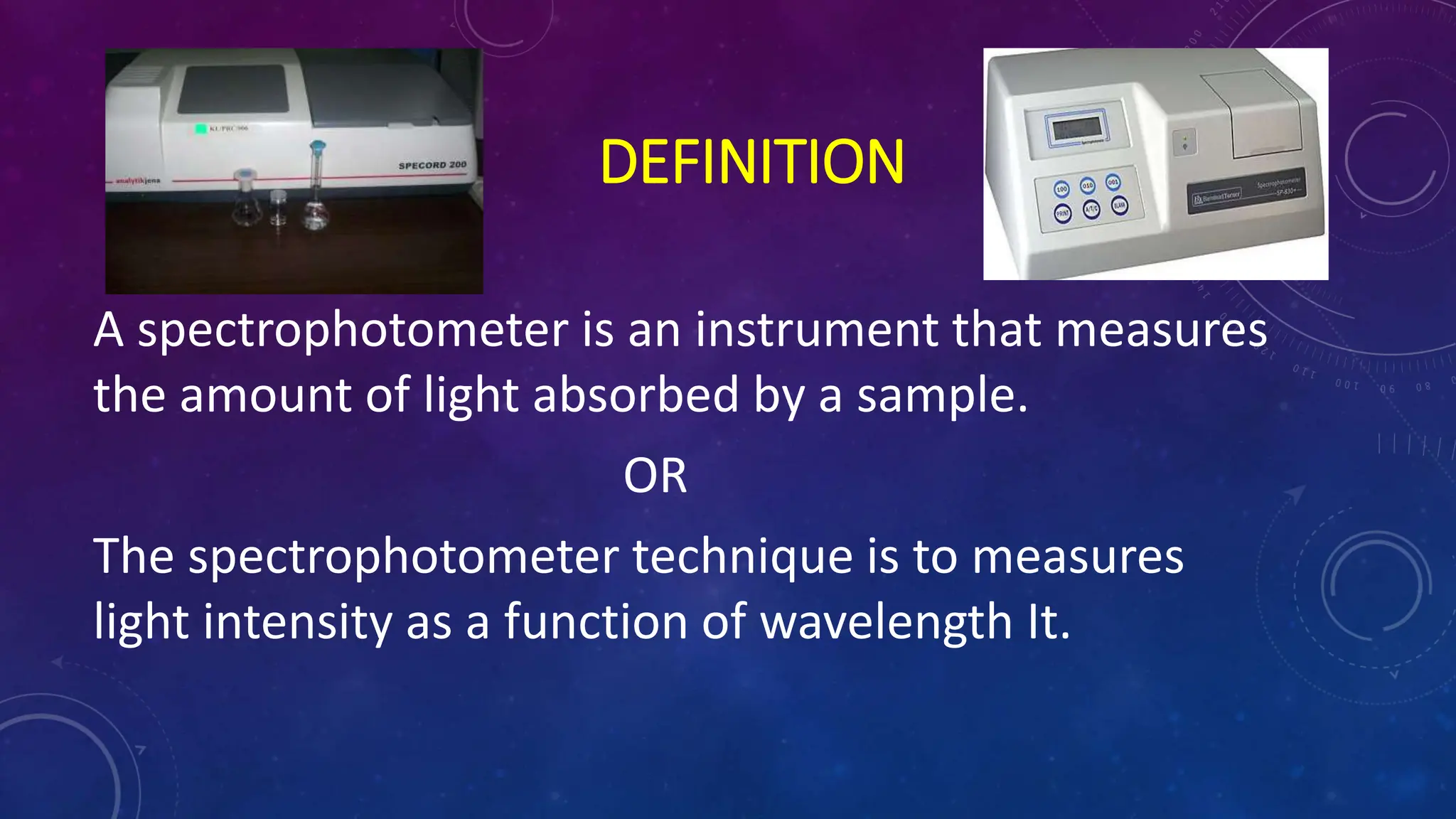
A spectrophotometer is an instrument that measures
the amount of light absorbed by a sample.
OR
The spectrophotometer technique is to measures
light intensity as a function of wavelength It.
INTRODUCTION
It does this by:
• 1. diffracting the light beam into a spectrum of wavelengths
• 2. direct it to an object
• 3. receiving the light reflected or returned from the object
• 4. detecting the intensities with a charge-coupled device
• 5. displaying the results as a graph on the detector and then
the display device.
HISTORY
• In Older times, it took weeks for the results to come out and, most of the
time, there was only 25 percent accuracy
• It was rather depressing for these scientists because quick results are very
important to them, and there wasn’t any good laboratory equipment at that
time to make the process faster.
• A scientist named Arnold J. Beckman and his colleagues at the National
Technologies Laboratory (NTL) invented the Beckman DU spectrophotometer
in 1940.
• Results come through simple process within few minutes.
• Results were 99.99 %accurate.
COMPONENTS OF SPECTROPHOTOMETER
DISPERSION DEVICES
• Dispersion devices causes a different wavelength of light to be
dispersion at different angles.
Types of Dispersion devices used are
• Prism
• Filters
Prism
Prism is used to isolate different wavelength
Prism may be made of glass or quartz.
Filters
Filters separate different parts of the electromagnetic spectrum by absorbing
or reflecting certain
wavelengths and transmitting other wavelengths.
 Absorption filters are glass substrates containing absorbing
species that absorb certain wavelength. A typical example is a cut on color
filter, which blocks short
wavelength light, and transmits
longer wavelength.
Absorption cells(Cuvettes)
A cuvette is a kind of cell (usually a small square tube) sealed at one end,
made of Plastic, glass or
optical grade quartz and designed to hold samples for spectroscopic
experiments.
Detectors
Any photosensitive device can be used as a detector
of radiant energy .The photocell and phototube are
the simplest photodetectors, producing current
proportional to the intensity of the light striking
them.
Display devices
The data from a detector are displayed by a readout
device, such as an analog meter, a light beam
reflected on a scale, or a digital display , Or liquid
crystal display(LCD) .The output can
also be transmitted to a computer.
TYPES OF SPECTROPHOTOMETER
• Single Beam
• Double Beam
• Split Beam
Single beam
The single beam spectrophotometer was the first
invented, and all the light passes through the
sample.
To measure the intensity of the incident light, the
sample must be removed so all the light can pass
through.
 cheaper because there are less parts and the
 system is less complicated.
 low cost
Double beam
 A double beam spectrophotometer compares the light intensity
between two light paths, one path containing a reference sample and
the other the test sample.
 Measurements from Double beam instruments are easier and more
stable.
Split Beam
 similar to the double beam spectrophotometer but it uses
a beam splitter instead of a chopper to send light along the
blank
 sample paths simultaneously to two separate but identical
detectors
Uses of Spectrophotometer
 To determines the absorbance or transmission of
characteristic wavelengths of radiant energy (light) by a
chemical species in solution.
 Identify organic compounds by determining the
absorption maximum.
 Used for color determination within the spectral
range
APPLICATIONS
1. Concentration measurement
• Prepare samples
• Make series of standard solutions of known concentrations
• [4]
• Set spectrophotometer to the λ of maximum light absorption
• Measure the absorption of the unknown, and from the standard plot, read the
related concentration[4]
2. Detection of Impurities
•UV absorption spectroscopy is one of thebest methods for
determination of impurities in organic molecules. [7]
Additional peaks can be observed due to impurities in the sample and it
can be compared with that of standard raw material
3. Structure elucidation of organic compounds.
•From the location of peaks and combination of
peaks UV spectroscopy elucidate structure of
organic molecules:
othe presence or absence of unsaturation,
othe presence of hetero atoms.[7
4. Chemical kinetics
•Kinetics of reaction can also be studied using UV spectroscopy.
The UV radiation is passed through the reaction cell and the
absorbance changes can be observed.[7]
5. Detection of Functional Groups
•Absence of a band at particular wavelength regarded as an
evidence for absence of particular
group [5]
6. Molecular weight determination
•Molecular weights of compounds can be
measured spectrophotometrically by preparing the
suitable derivatives of these compounds.
•For example, if we want to determine
the molecular weight of amine then it is converted
in to amine picrate. [7]

spectrophotometer-190604120316 (1).pdf......

  • 1.
    SPECTROPHOTOMETER RASHMI H R MEDICALM.SC DEPARTMENT OF PHARMACOLOGY
  • 2.
    SLIDE INDEX • Definition •Introduction • History • Components of Spectrophotometer • Dispersion devices • Types of Spectrophotometer • Uses of Spectrophotometer • Applications
  • 3.
    DEFINITION A spectrophotometer isan instrument that measures the amount of light absorbed by a sample. OR The spectrophotometer technique is to measures light intensity as a function of wavelength It.
  • 4.
    INTRODUCTION It does thisby: • 1. diffracting the light beam into a spectrum of wavelengths • 2. direct it to an object • 3. receiving the light reflected or returned from the object • 4. detecting the intensities with a charge-coupled device • 5. displaying the results as a graph on the detector and then the display device.
  • 5.
    HISTORY • In Oldertimes, it took weeks for the results to come out and, most of the time, there was only 25 percent accuracy • It was rather depressing for these scientists because quick results are very important to them, and there wasn’t any good laboratory equipment at that time to make the process faster. • A scientist named Arnold J. Beckman and his colleagues at the National Technologies Laboratory (NTL) invented the Beckman DU spectrophotometer in 1940. • Results come through simple process within few minutes. • Results were 99.99 %accurate.
  • 6.
  • 9.
    DISPERSION DEVICES • Dispersiondevices causes a different wavelength of light to be dispersion at different angles. Types of Dispersion devices used are • Prism • Filters
  • 10.
    Prism Prism is usedto isolate different wavelength Prism may be made of glass or quartz.
  • 11.
    Filters Filters separate differentparts of the electromagnetic spectrum by absorbing or reflecting certain wavelengths and transmitting other wavelengths.  Absorption filters are glass substrates containing absorbing species that absorb certain wavelength. A typical example is a cut on color filter, which blocks short wavelength light, and transmits longer wavelength.
  • 12.
    Absorption cells(Cuvettes) A cuvetteis a kind of cell (usually a small square tube) sealed at one end, made of Plastic, glass or optical grade quartz and designed to hold samples for spectroscopic experiments.
  • 13.
    Detectors Any photosensitive devicecan be used as a detector of radiant energy .The photocell and phototube are the simplest photodetectors, producing current proportional to the intensity of the light striking them.
  • 14.
    Display devices The datafrom a detector are displayed by a readout device, such as an analog meter, a light beam reflected on a scale, or a digital display , Or liquid crystal display(LCD) .The output can also be transmitted to a computer.
  • 15.
    TYPES OF SPECTROPHOTOMETER •Single Beam • Double Beam • Split Beam
  • 16.
    Single beam The singlebeam spectrophotometer was the first invented, and all the light passes through the sample. To measure the intensity of the incident light, the sample must be removed so all the light can pass through.  cheaper because there are less parts and the  system is less complicated.  low cost
  • 17.
    Double beam  Adouble beam spectrophotometer compares the light intensity between two light paths, one path containing a reference sample and the other the test sample.  Measurements from Double beam instruments are easier and more stable.
  • 18.
    Split Beam  similarto the double beam spectrophotometer but it uses a beam splitter instead of a chopper to send light along the blank  sample paths simultaneously to two separate but identical detectors
  • 19.
    Uses of Spectrophotometer To determines the absorbance or transmission of characteristic wavelengths of radiant energy (light) by a chemical species in solution.  Identify organic compounds by determining the absorption maximum.  Used for color determination within the spectral range
  • 20.
    APPLICATIONS 1. Concentration measurement •Prepare samples • Make series of standard solutions of known concentrations • [4] • Set spectrophotometer to the λ of maximum light absorption • Measure the absorption of the unknown, and from the standard plot, read the related concentration[4]
  • 21.
    2. Detection ofImpurities •UV absorption spectroscopy is one of thebest methods for determination of impurities in organic molecules. [7] Additional peaks can be observed due to impurities in the sample and it can be compared with that of standard raw material
  • 22.
    3. Structure elucidationof organic compounds. •From the location of peaks and combination of peaks UV spectroscopy elucidate structure of organic molecules: othe presence or absence of unsaturation, othe presence of hetero atoms.[7
  • 23.
    4. Chemical kinetics •Kineticsof reaction can also be studied using UV spectroscopy. The UV radiation is passed through the reaction cell and the absorbance changes can be observed.[7] 5. Detection of Functional Groups •Absence of a band at particular wavelength regarded as an evidence for absence of particular group [5]
  • 24.
    6. Molecular weightdetermination •Molecular weights of compounds can be measured spectrophotometrically by preparing the suitable derivatives of these compounds. •For example, if we want to determine the molecular weight of amine then it is converted in to amine picrate. [7]