TiO2 as Photocatalyst
What is photo catalyst?
 A catalyst changes the rate of chemical reactions, while it is not consumed by
the reaction itself.
 A photocatalyst is a substance that generates catalyst activity using energy
from light.
 The principle of photocatalytic reaction was to accelerate the nature’s
cleaning and purifying process using light as energy.
 The most commonly studied semiconductors include TiO2, ZnO, WO3,
Fe2O3, and ZnS for photo catalysis.
 Discovered in 1960’s, Dr. Fujishima of Japan found titanium metal, after
irradiated by light, could break water molecule into oxygen and hydrogen
gas. By restructuring titanium dioxide particles in Nano-scale, a number of
new physical and chemical properties were discovered.
 One of these newfound effects was photocatalytic oxidation which
accelerated the formation of hydroxyl radical, one of the strongest oxidizing
agents created by nature.
 Using energy found in the UV light, photocatalyst titanium dioxide could
breakdown numerous organic substances such as oil grime and
hydrocarbons from car exhaust and industrial smog, volatile organic
compounds found in various building materials and furniture, organic
growth such as fungus and mildew.
Why TiO2 is used as photocatalyst?
 good chemical stability
 absence of toxicity and relative low price
 It is also simple to modify the chemical and physical
characteristics of TiO2, including absorption range
and particle size.
 TiO2 is a good photocatalyst because the rate of
recombination of electrons, freed by photo
excitation, and positive holes is slow compared to
other photocatalytic materials
Mechanism of photocatalyst
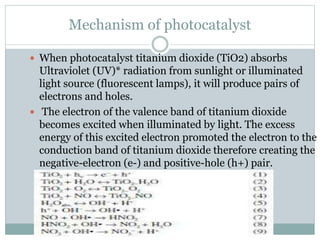
 When photocatalyst titanium dioxide (TiO2) absorbs
Ultraviolet (UV)* radiation from sunlight or illuminated
light source (fluorescent lamps), it will produce pairs of
electrons and holes.
 The electron of the valence band of titanium dioxide
becomes excited when illuminated by light. The excess
energy of this excited electron promoted the electron to the
conduction band of titanium dioxide therefore creating the
negative-electron (e-) and positive-hole (h+) pair.
Drawback of TiO2 as photocatalyst
 its large band-gap (Eg = 3.2 eV) that requires that
near-UV Light is used to photo activate. The UV light
only 5% of sunlight.
 Many techniques have been examined to extend the
spectral response of TiO2 into the visible region and
enhance its photocatalytic activity.
 improved TiO2 photocatalyst have been obtained by
doping with non-metal atoms such as carbon
nitrogen, sulphur or using cooped materials.

Ti o2 as photocatalyst

  • 1.
  • 2.
    What is photocatalyst?  A catalyst changes the rate of chemical reactions, while it is not consumed by the reaction itself.  A photocatalyst is a substance that generates catalyst activity using energy from light.  The principle of photocatalytic reaction was to accelerate the nature’s cleaning and purifying process using light as energy.  The most commonly studied semiconductors include TiO2, ZnO, WO3, Fe2O3, and ZnS for photo catalysis.  Discovered in 1960’s, Dr. Fujishima of Japan found titanium metal, after irradiated by light, could break water molecule into oxygen and hydrogen gas. By restructuring titanium dioxide particles in Nano-scale, a number of new physical and chemical properties were discovered.  One of these newfound effects was photocatalytic oxidation which accelerated the formation of hydroxyl radical, one of the strongest oxidizing agents created by nature.  Using energy found in the UV light, photocatalyst titanium dioxide could breakdown numerous organic substances such as oil grime and hydrocarbons from car exhaust and industrial smog, volatile organic compounds found in various building materials and furniture, organic growth such as fungus and mildew.
  • 3.
    Why TiO2 isused as photocatalyst?  good chemical stability  absence of toxicity and relative low price  It is also simple to modify the chemical and physical characteristics of TiO2, including absorption range and particle size.  TiO2 is a good photocatalyst because the rate of recombination of electrons, freed by photo excitation, and positive holes is slow compared to other photocatalytic materials
  • 4.
    Mechanism of photocatalyst When photocatalyst titanium dioxide (TiO2) absorbs Ultraviolet (UV)* radiation from sunlight or illuminated light source (fluorescent lamps), it will produce pairs of electrons and holes.  The electron of the valence band of titanium dioxide becomes excited when illuminated by light. The excess energy of this excited electron promoted the electron to the conduction band of titanium dioxide therefore creating the negative-electron (e-) and positive-hole (h+) pair.
  • 5.
    Drawback of TiO2as photocatalyst  its large band-gap (Eg = 3.2 eV) that requires that near-UV Light is used to photo activate. The UV light only 5% of sunlight.  Many techniques have been examined to extend the spectral response of TiO2 into the visible region and enhance its photocatalytic activity.  improved TiO2 photocatalyst have been obtained by doping with non-metal atoms such as carbon nitrogen, sulphur or using cooped materials.