Presented by:
Dr. Mohammed Al-olfe
‫الدولية‬ ‫االماراتية‬ ‫الجامعة‬
9/27/2021 1
 The spectrophotometer is used in the laboratory for determining
the presence or concentration of a substance in a solution, thus
allowing a qualitative or quantitative analysis of the sample.
 The word spectrophotometer is derived from the Latin word
spectrum, which means image, and the Greek word phos or
photos, which means light.
 The spectrophotometer is one of the main diagnostic and research
instruments developed.
 It uses the properties of light and its interaction with other
substances.
9/27/2021 2
 How it is work:
 Generally, light from a lamp with special characteristics is
guided through a device, which selects and separates a
determined wave length and makes it pass through a sample.
 The light intensity leaving the sample is captured and
compared with that which passed through the sample.
 Transmittance, which depends on factors such as the
substance concentration is calculated from this intensity ratio.
9/27/2021 3
Measurement Processes:
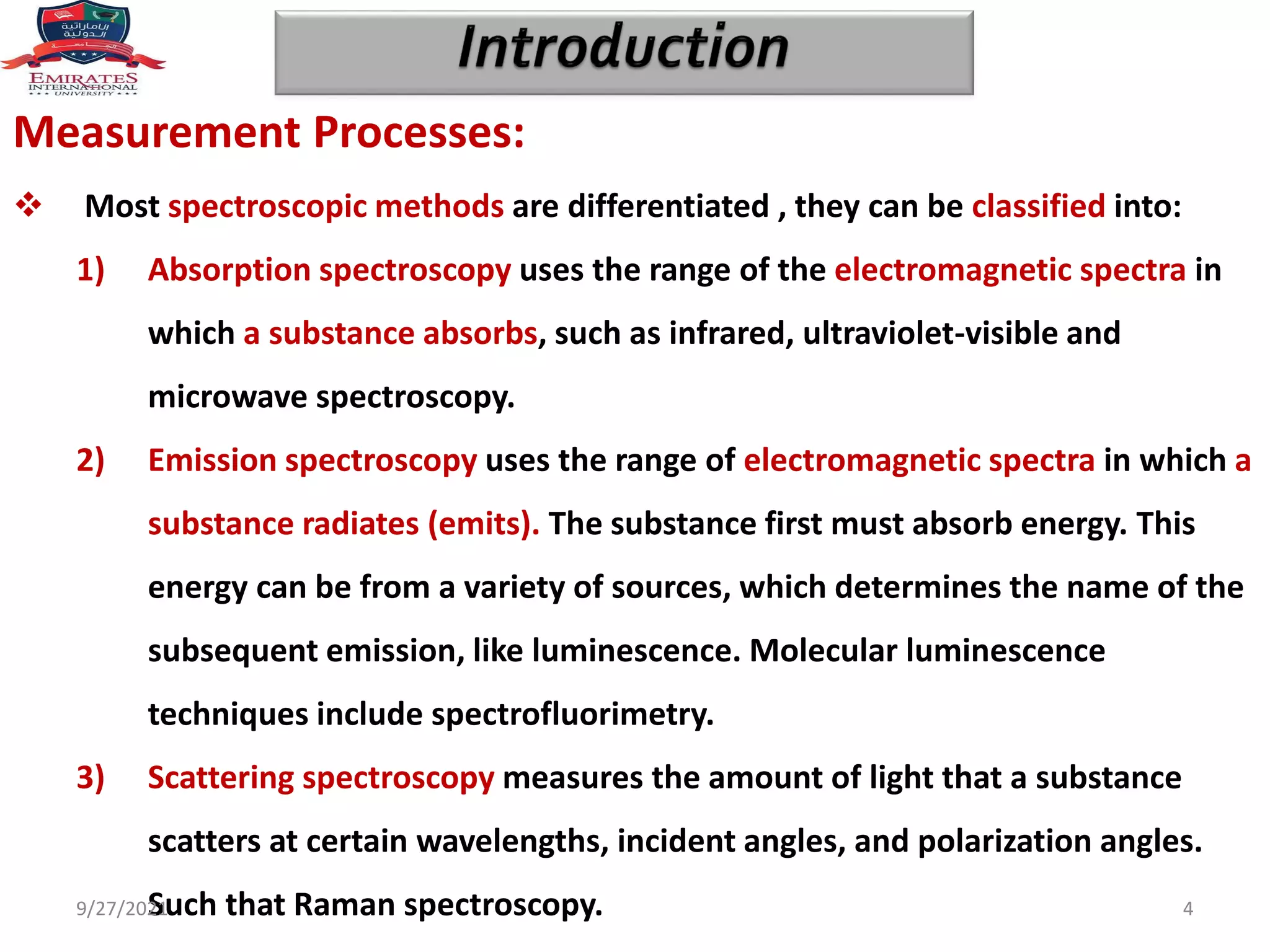
 Most spectroscopic methods are differentiated , they can be classified into:
1) Absorption spectroscopy uses the range of the electromagnetic spectra in
which a substance absorbs, such as infrared, ultraviolet-visible and
microwave spectroscopy.
2) Emission spectroscopy uses the range of electromagnetic spectra in which a
substance radiates (emits). The substance first must absorb energy. This
energy can be from a variety of sources, which determines the name of the
subsequent emission, like luminescence. Molecular luminescence
techniques include spectrofluorimetry.
3) Scattering spectroscopy measures the amount of light that a substance
scatters at certain wavelengths, incident angles, and polarization angles.
Such that Raman spectroscopy.
9/27/2021 4
 As a basic principle, light is considered to be a form of
electromagnetic energy. In space, it has a constant and universal
velocity [C] of approximately 3 x 10⁸ m/s.
 In any other medium (transparent) through which light passes, its
velocity will be slightly lower and can be calculated by the
following equation:
 Where:
 Vo = Velocity at which light passes through the medium
 n = Medium refraction index: whose value oscillates, in general, between 1.0
and 2.5.
9/27/2021 5
What is a wave?!
Harmonic
wave:
wavelength
frequency
or
wavelength
amplitude
velocity
frequency
wavelength
=
c
n
l
=
Frequency
(Hertz)
Velocity (300,000,000 meters/sec)
Wavelength (meters)
Propagation
 The electromagnetic energy has a very wide range of wavelengths.
Some examples are shown in the following table:
9/27/2021 7
 The electromagnetic energy has a very wide range of wavelengths.
9/27/2021 8
 The electromagnetic energy has a very wide range of wavelengths.
9/27/2021 9
X-Ray UV Visible IR Microwave
200nm 400nm 800nm
WAVELENGTH(nm)
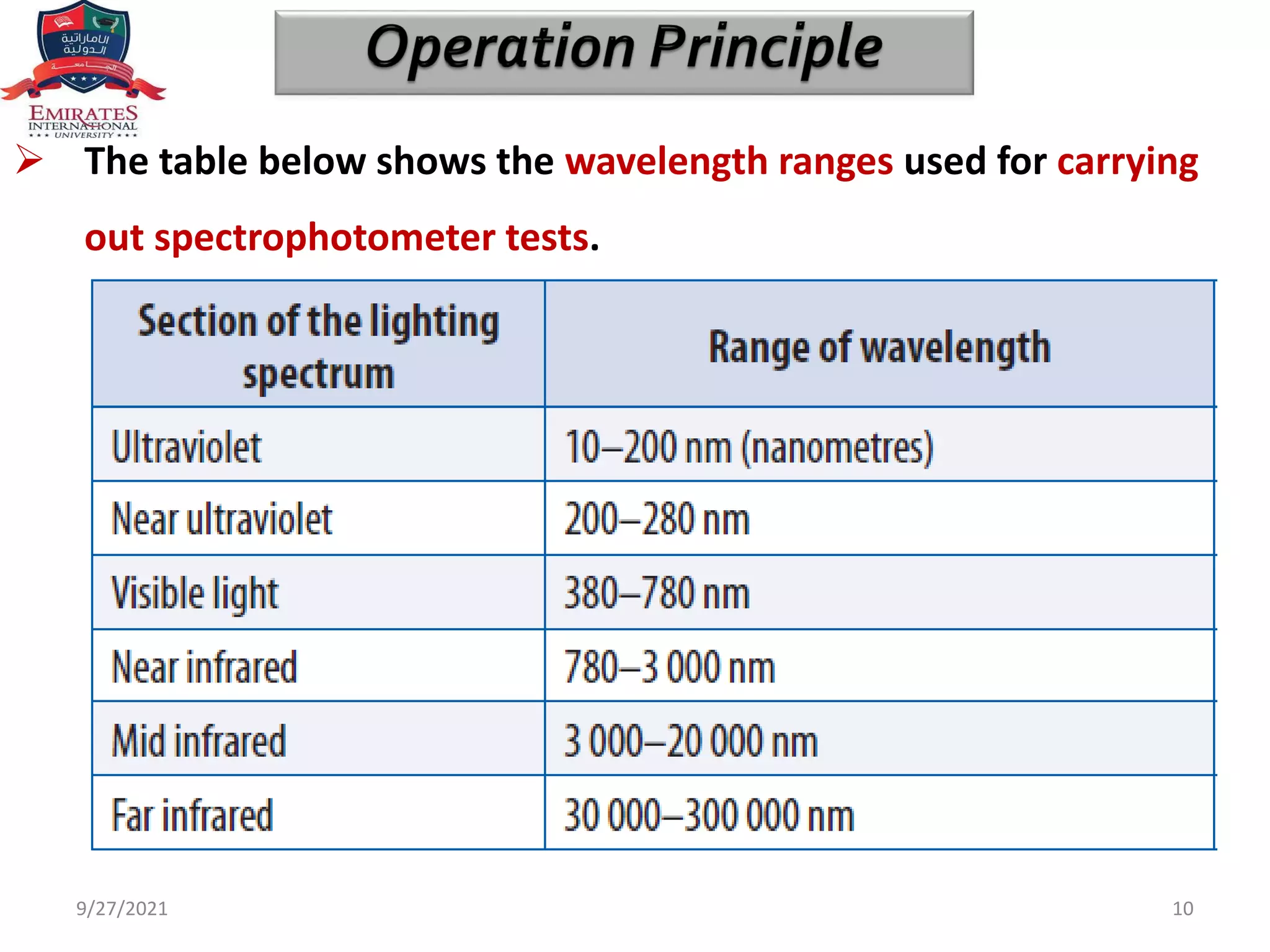
 The table below shows the wavelength ranges used for carrying
out spectrophotometer tests.
9/27/2021 10
 Upon passing or interacting the light with diverse mediums, light undergoes a
series of phenomena. Among these are featured reflection, refraction,
diffraction, absorption, diffusion, polarization and other phenomena measured
by various instruments and devices.
9/27/2021 11
 The phenomena on which spectrophotometry is based are mainly
absorption and transmission.
 In order to understand how, it is necessary to take Beer Lambert’s
law into account.
 Beer Lambert’s Law. Also known as Beer’s law or Beer Lambert
Bouguer’s law, it identifies the relationship between the
concentration of the sample and the intensity of light transmitted
through it.
 With regard to the law mentioned, there are two implicit
concepts: transmittance [T] and absorbance [A].
9/27/2021 12
 The transmittance [T] is the fraction of the incidental light of determined
wavelength passing through the sample.
 Where:
 It = intensity of the transmitted radiation
 Io = intensity of the incidental radiation
 The percentage of transmittance [%T] can be expressed by the following
equation:
 Absorbance [A] is related to transmittance [T] through the following equation:
9/27/2021 13
 The concentration of light absorbing molecules in a sample is proportional to the
absorbance [A] of that sample. It is expressed mathematically as:
 Where:
 A = Absorbance measured
 ε = Molécule absorbance coefficient [liters/moles/cm]
 l = Distance of the trajectory traversed (path length) by the light in the
sample
 c = Sample concentration [moles/liters]
9/27/2021 14
 The graphs demonstrated how absorbance [A] and transmittance [T] vary as a
function of the concentration [C] according to Beer Lambert’s law.
9/27/2021 15
Transmittance graph
Absorbance graph
Absorption Spectra:
Absorption
Spectra Plot of
Absorbance vs.
wavelength
called
absorption
spectrum.
Emission Spectra:
Emission
Spectra Plot of
emission
intensity vs.
wavelength
called
emission
spectrum.
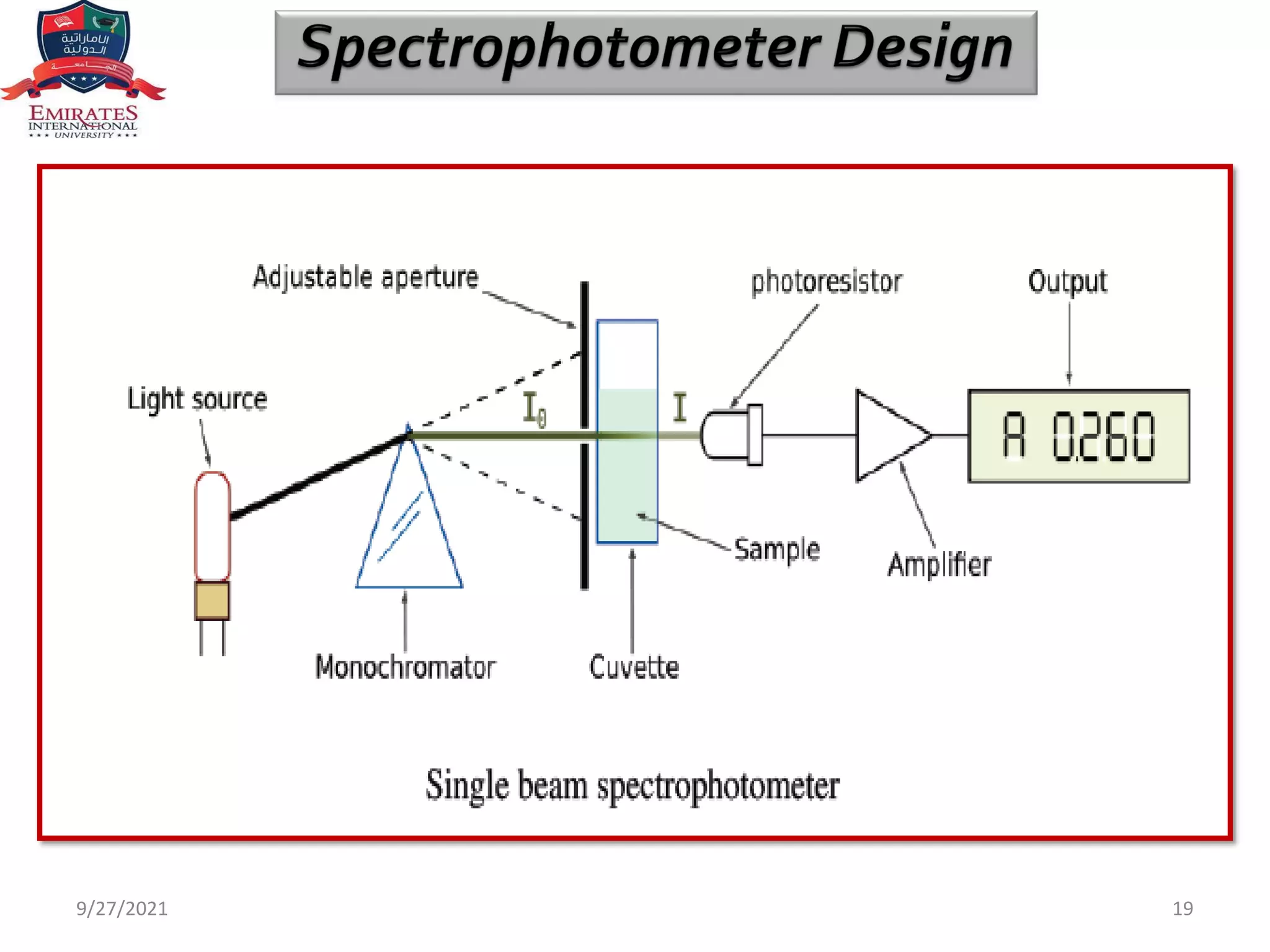
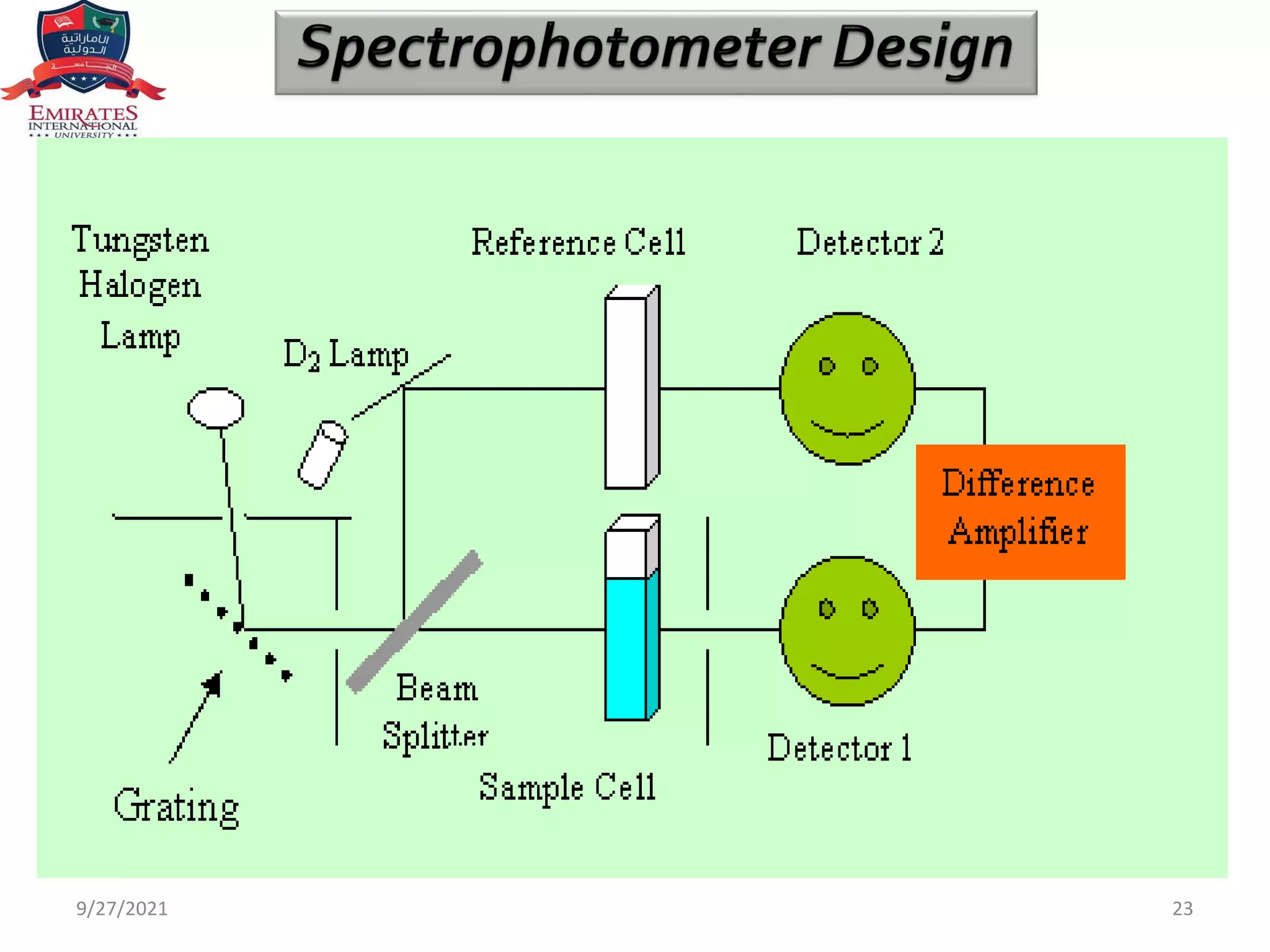
 There are two major classes of devices: single beam and double beam.
1) A double beam spectrophotometer compares the light intensity
between two light paths, one path containing a reference sample and
the other the test sample.
2) A single beam spectrophotometer measures the relative light intensity
of the beam before and after a test sample is inserted.
 Although comparison measurements from double beam instruments are easier
and more stable, single beam instruments can have a larger dynamic range and
are optically simpler and more compact.
 The most common spectrophotometers are used in the UV and visible regions
of the spectrum, and some of these instruments also operate into the near-
infrared region as well.
9/27/2021 18
9/27/2021 19
9/27/2021 20
9/27/2021 21
9/27/2021 22
9/27/2021 23
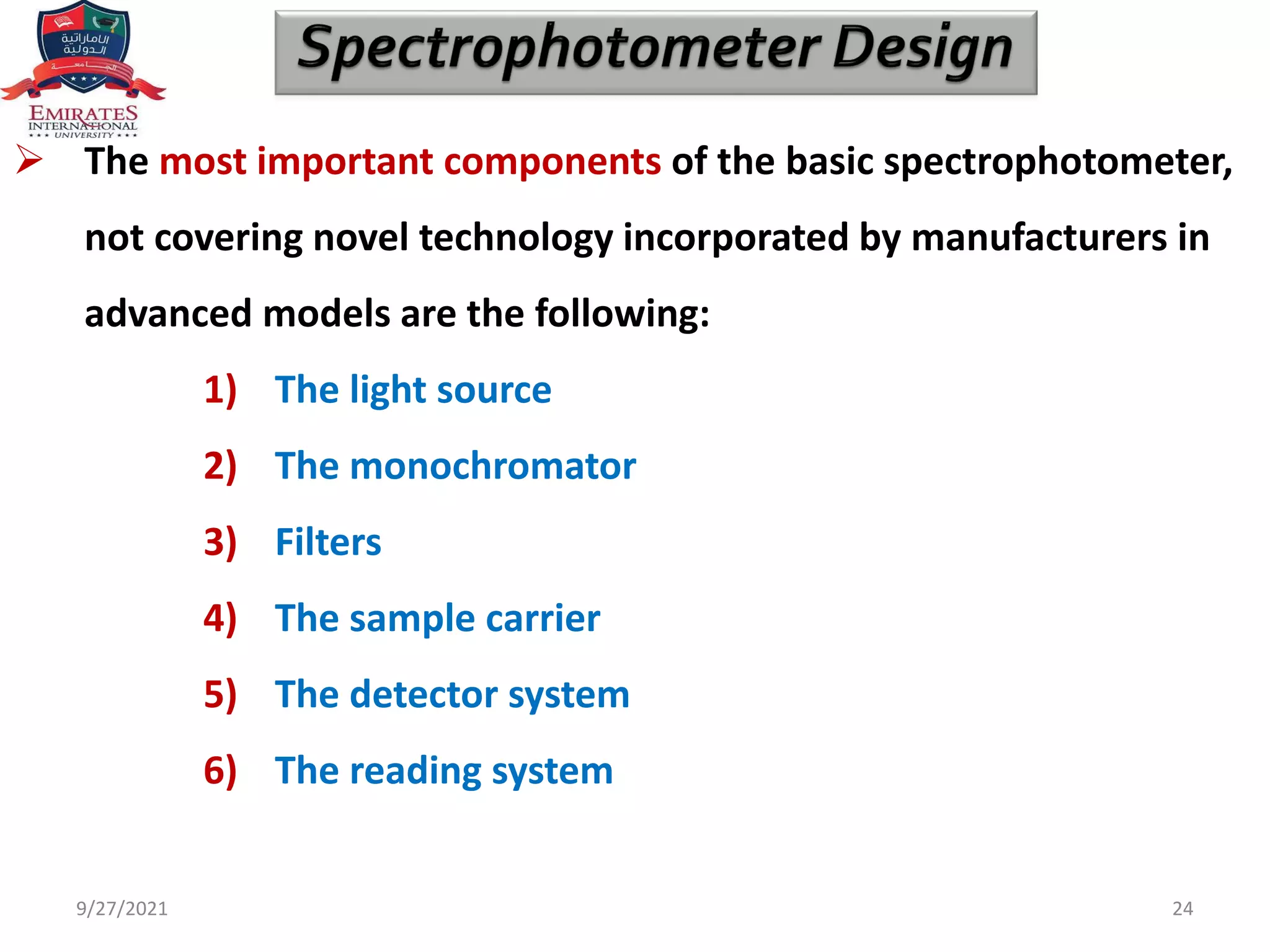
 The most important components of the basic spectrophotometer,
not covering novel technology incorporated by manufacturers in
advanced models are the following:
1) The light source
2) The monochromator
3) Filters
4) The sample carrier
5) The detector system
6) The reading system
9/27/2021 24
Light Source:
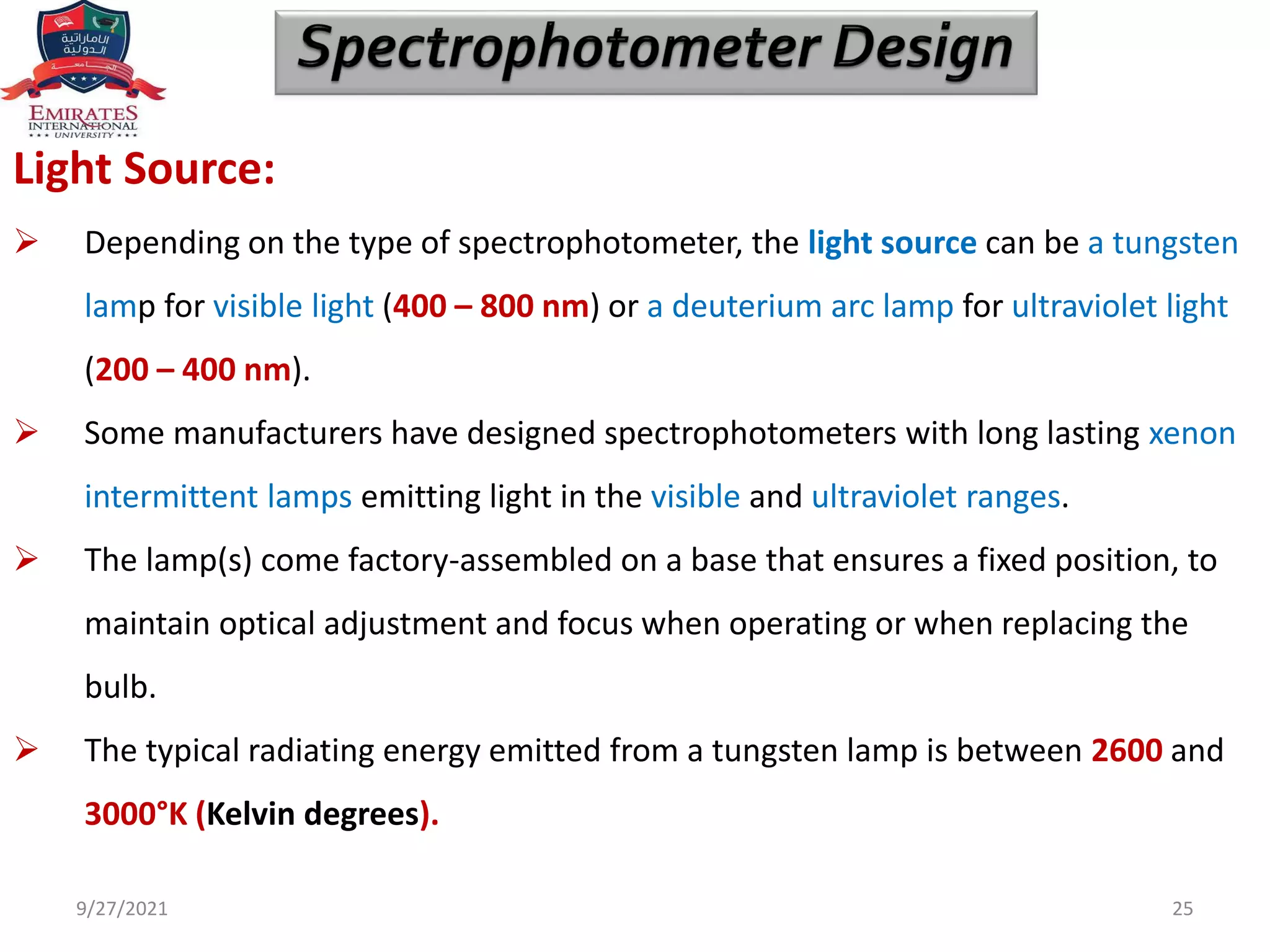
 Depending on the type of spectrophotometer, the light source can be a tungsten
lamp for visible light (400 – 800 nm) or a deuterium arc lamp for ultraviolet light
(200 – 400 nm).
 Some manufacturers have designed spectrophotometers with long lasting xenon
intermittent lamps emitting light in the visible and ultraviolet ranges.
 The lamp(s) come factory-assembled on a base that ensures a fixed position, to
maintain optical adjustment and focus when operating or when replacing the
bulb.
 The typical radiating energy emitted from a tungsten lamp is between 2600 and
3000°K (Kelvin degrees).
9/27/2021 25
Filter:
 Filters absorb light of different wavelengths, allowing only
light with a narrow range of wavelengths (bandwidth) to
bass through.
 Filters have a bandwidth of about 2 nm.
 Filters may be fixed or removable.
9/27/2021 26
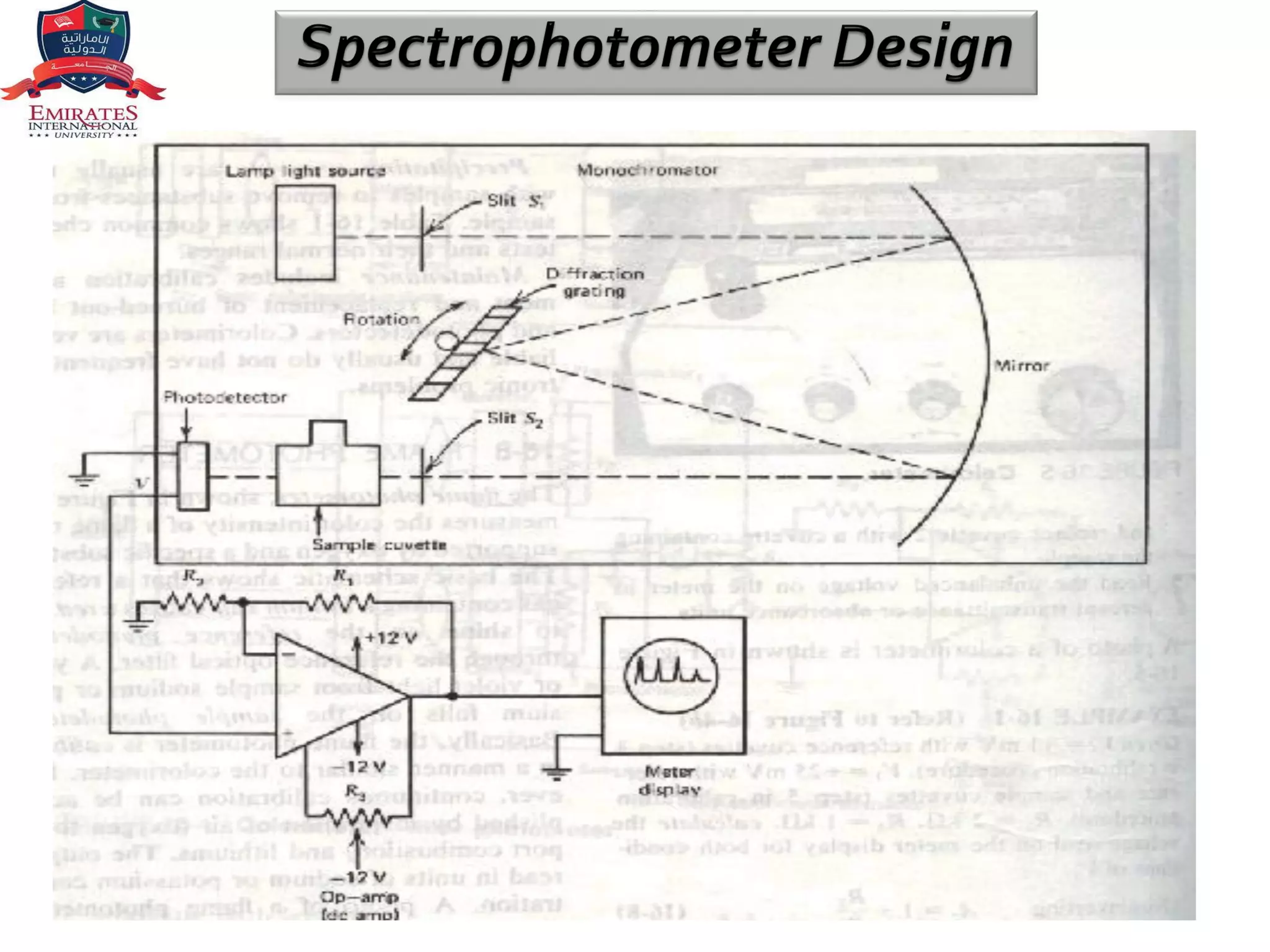
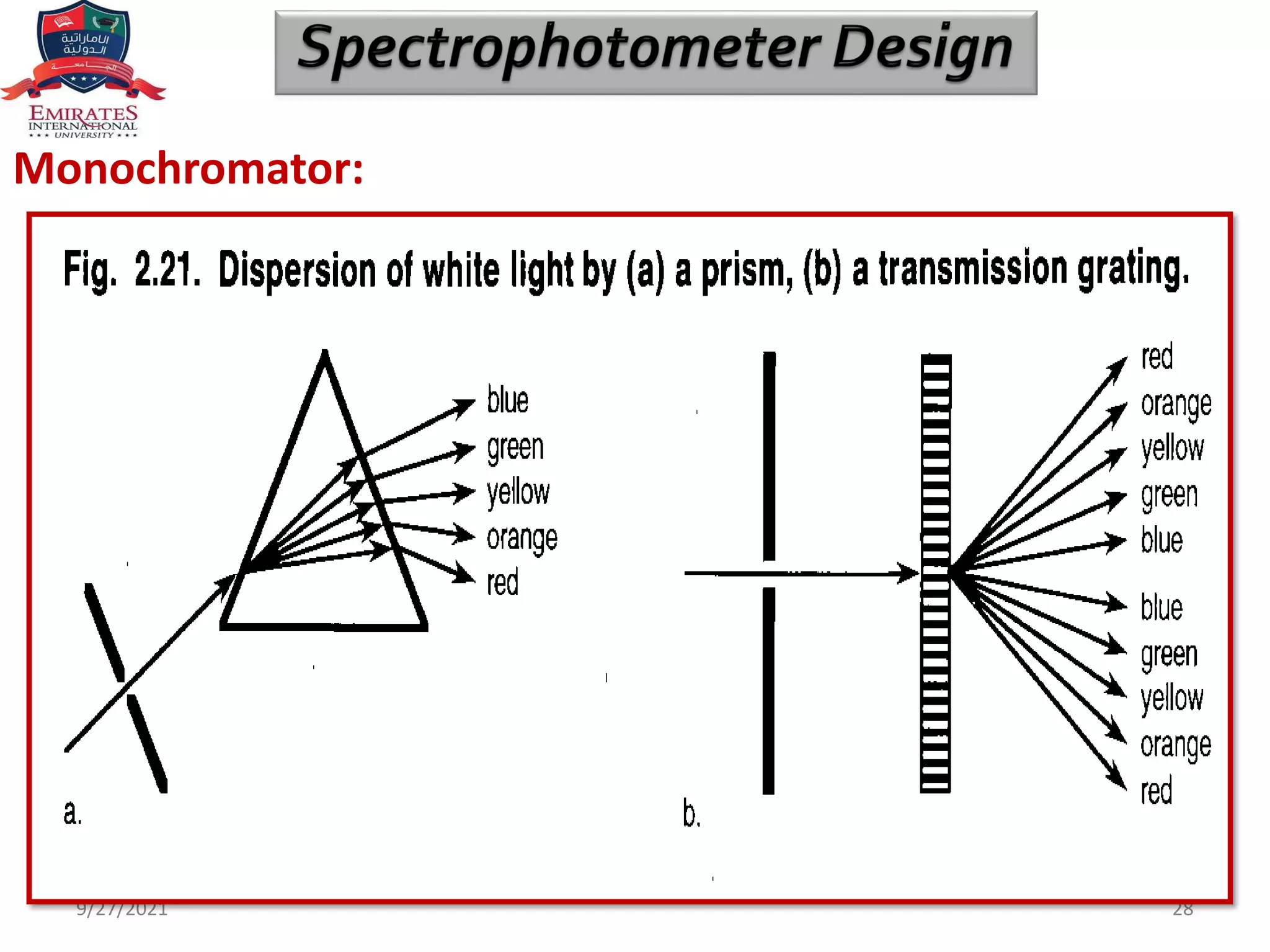
Monochromator:
 The monochomator is a set of elements used to disperse white light into waves
of different wavelengths, one of which is used in the sample reading.
 In general, it has an entry crevice or groove which limits the light radiation
produced by the source and confines it to a determined area;
 a set of mirrors for transmitting light through the optic system; an element for
separating the light radiation wavelengths (which may be a prism or a diffraction
(or transmission) grating); and an exit opening for selecting the wavelength
required to illuminate the sample.
 Diffraction gratings have the advantage of eliminating the non-linear dispersion
and being insensitive to changes in temperature.
9/27/2021 27
Monochromator:
9/27/2021 28
Simple holder:
 This device holds the sample(s) to be analyzed.
 There are various sample holder types to accommodate different
spectrophotometer models and sample volumes: these come as cuvettes,
microcells, microplates, test tubes and continuous flow cells, etc.
 In conventional spectrophotometers, the holder is a cell or cuvette of rectangular
shape.
 Cuvettes are made of glass to read in the range of 340 to 1000 nm and others of
silica to read in the visible range of 220 to 340 nm.
 There are also cuvettes and other sample holder types (e.g. microplates) in plastic
such as styrene or polystyrene which are disposable.
9/27/2021 29
Detector System:
 The detection system can be designed with photocells, phototubes, photodiodes
or photomultipliers.
 This depends on the ranges of wavelength, the sensitivity and the required speed
of response.
 The detection system receives light from the sample and converts it into an
electrical signal proportional to the energy received.
 This electrical signal can be processed and amplified to be interpreted by the
reading system.
9/27/2021 30
Detector System:
9/27/2021 31
Reading System:
 The signal which leaves the detector goes through various transformations. It is
amplified and transformed until its intensity becomes a proportional
transmittance/absorbance percentage.
 There are analogous reading systems (displaying results on a reading scale) or
digital ones (showing results on a screen).
 Analogous indicators traditionally bear the name meters. Their exactitude
depends among other factors, on the length and the number of divisions of the
scale (the more divisions, the more exact it is). Their main disadvantage is that
they can be incorrectly read, due to the operators’ fatigue or errors identifying
scales when there are several.
 Digital indicators usually show results on a screen as illuminated alpha numerals.
This makes reading errors less likely.
9/27/2021 32
Maintenance includes:
 Calibration adjustment and replacement of light source
bulbs and photo detectors.
 Mechanically rotating assembles (mirrors, diffraction
grating) will occasionally malfunction.
 The electronics is very reliable.
9/27/2021 33
9/27/2021 34
9/27/2021 35
9/27/2021 36
 Colorimeter or filter photometer is an optical electronic
device that measures the color concentration of a
substance in solution (following the reaction between the
original substance and a reagent).
 Optical color filters are used to select a narrow wavelength.
 The results are displayed in percent optical color
transmittance or absorption to indicate hemoglobin
concentration.
9/27/2021 37
9/27/2021 38
 Light passes through an optical color filter, is focused by
lenses on the reference and sample cuvettes and falls on
the reference and sample photodetectors.
 The difference in voltage between the two detectors is
increased by a dc amplifier and applied to a meter.
9/27/2021 39
 A calibration procedure is as follows:
1) Ground the amplifier input (V1) and adjust potentiometer (Ra)
for 0 volt
2) Remove the ground and place reference concentration in
cuvettes 1 an 2
3) Adjust potentiometer R1 for 0 V
4) Leave the reference concentration in cuvette 1 and replace
cuvette 2 with a cuvette containing the sample
5) Read the unbalanced voltage on the meter in percent
transmittance or absorbance units.
9/27/2021 40
9/27/2021 41
9/27/2021 42
 The flame photometer measures the color intensity of
flame that supported by oxygen and specific substance.
 The basic schematic shows that a reference gas containing
a lithium salt causes a red color to shine on the reference
photo detector through the reference optical filter.
 A yellow or violet light from sample sodium or potassium
falls on the sample photo detector.
9/27/2021 43
9/27/2021 44
9/27/2021 45
Calibration:
 Basically, the flame photometer is calibrated in
a manner similar to the colorimeter
 Continuous calibration can be accomplished by
inspiration of air and lithium.
 the output is read in units of sodium or
potassium concentration.
9/27/2021 46
Maintenance:
 Maintenance includes calibration, adjustment of
bulbs and photo detectors.
 Aspiration devices and flame chambers
occasionally require cleaning.
 Electronic failures are usually infrequent.
9/27/2021 47
9/27/2021 48

spectrophotometer 2.pdf

  • 1.
    Presented by: Dr. MohammedAl-olfe ‫الدولية‬ ‫االماراتية‬ ‫الجامعة‬ 9/27/2021 1
  • 2.
     The spectrophotometeris used in the laboratory for determining the presence or concentration of a substance in a solution, thus allowing a qualitative or quantitative analysis of the sample.  The word spectrophotometer is derived from the Latin word spectrum, which means image, and the Greek word phos or photos, which means light.  The spectrophotometer is one of the main diagnostic and research instruments developed.  It uses the properties of light and its interaction with other substances. 9/27/2021 2
  • 3.
     How itis work:  Generally, light from a lamp with special characteristics is guided through a device, which selects and separates a determined wave length and makes it pass through a sample.  The light intensity leaving the sample is captured and compared with that which passed through the sample.  Transmittance, which depends on factors such as the substance concentration is calculated from this intensity ratio. 9/27/2021 3
  • 4.
    Measurement Processes:  Mostspectroscopic methods are differentiated , they can be classified into: 1) Absorption spectroscopy uses the range of the electromagnetic spectra in which a substance absorbs, such as infrared, ultraviolet-visible and microwave spectroscopy. 2) Emission spectroscopy uses the range of electromagnetic spectra in which a substance radiates (emits). The substance first must absorb energy. This energy can be from a variety of sources, which determines the name of the subsequent emission, like luminescence. Molecular luminescence techniques include spectrofluorimetry. 3) Scattering spectroscopy measures the amount of light that a substance scatters at certain wavelengths, incident angles, and polarization angles. Such that Raman spectroscopy. 9/27/2021 4
  • 5.
     As abasic principle, light is considered to be a form of electromagnetic energy. In space, it has a constant and universal velocity [C] of approximately 3 x 10⁸ m/s.  In any other medium (transparent) through which light passes, its velocity will be slightly lower and can be calculated by the following equation:  Where:  Vo = Velocity at which light passes through the medium  n = Medium refraction index: whose value oscillates, in general, between 1.0 and 2.5. 9/27/2021 5
  • 6.
    What is awave?! Harmonic wave: wavelength frequency or wavelength amplitude velocity frequency wavelength = c n l = Frequency (Hertz) Velocity (300,000,000 meters/sec) Wavelength (meters) Propagation
  • 7.
     The electromagneticenergy has a very wide range of wavelengths. Some examples are shown in the following table: 9/27/2021 7
  • 8.
     The electromagneticenergy has a very wide range of wavelengths. 9/27/2021 8
  • 9.
     The electromagneticenergy has a very wide range of wavelengths. 9/27/2021 9 X-Ray UV Visible IR Microwave 200nm 400nm 800nm WAVELENGTH(nm)
  • 10.
     The tablebelow shows the wavelength ranges used for carrying out spectrophotometer tests. 9/27/2021 10
  • 11.
     Upon passingor interacting the light with diverse mediums, light undergoes a series of phenomena. Among these are featured reflection, refraction, diffraction, absorption, diffusion, polarization and other phenomena measured by various instruments and devices. 9/27/2021 11
  • 12.
     The phenomenaon which spectrophotometry is based are mainly absorption and transmission.  In order to understand how, it is necessary to take Beer Lambert’s law into account.  Beer Lambert’s Law. Also known as Beer’s law or Beer Lambert Bouguer’s law, it identifies the relationship between the concentration of the sample and the intensity of light transmitted through it.  With regard to the law mentioned, there are two implicit concepts: transmittance [T] and absorbance [A]. 9/27/2021 12
  • 13.
     The transmittance[T] is the fraction of the incidental light of determined wavelength passing through the sample.  Where:  It = intensity of the transmitted radiation  Io = intensity of the incidental radiation  The percentage of transmittance [%T] can be expressed by the following equation:  Absorbance [A] is related to transmittance [T] through the following equation: 9/27/2021 13
  • 14.
     The concentrationof light absorbing molecules in a sample is proportional to the absorbance [A] of that sample. It is expressed mathematically as:  Where:  A = Absorbance measured  ε = Molécule absorbance coefficient [liters/moles/cm]  l = Distance of the trajectory traversed (path length) by the light in the sample  c = Sample concentration [moles/liters] 9/27/2021 14
  • 15.
     The graphsdemonstrated how absorbance [A] and transmittance [T] vary as a function of the concentration [C] according to Beer Lambert’s law. 9/27/2021 15 Transmittance graph Absorbance graph
  • 16.
    Absorption Spectra: Absorption Spectra Plotof Absorbance vs. wavelength called absorption spectrum.
  • 17.
    Emission Spectra: Emission Spectra Plotof emission intensity vs. wavelength called emission spectrum.
  • 18.
     There aretwo major classes of devices: single beam and double beam. 1) A double beam spectrophotometer compares the light intensity between two light paths, one path containing a reference sample and the other the test sample. 2) A single beam spectrophotometer measures the relative light intensity of the beam before and after a test sample is inserted.  Although comparison measurements from double beam instruments are easier and more stable, single beam instruments can have a larger dynamic range and are optically simpler and more compact.  The most common spectrophotometers are used in the UV and visible regions of the spectrum, and some of these instruments also operate into the near- infrared region as well. 9/27/2021 18
  • 19.
  • 20.
  • 21.
  • 22.
  • 23.
  • 24.
     The mostimportant components of the basic spectrophotometer, not covering novel technology incorporated by manufacturers in advanced models are the following: 1) The light source 2) The monochromator 3) Filters 4) The sample carrier 5) The detector system 6) The reading system 9/27/2021 24
  • 25.
    Light Source:  Dependingon the type of spectrophotometer, the light source can be a tungsten lamp for visible light (400 – 800 nm) or a deuterium arc lamp for ultraviolet light (200 – 400 nm).  Some manufacturers have designed spectrophotometers with long lasting xenon intermittent lamps emitting light in the visible and ultraviolet ranges.  The lamp(s) come factory-assembled on a base that ensures a fixed position, to maintain optical adjustment and focus when operating or when replacing the bulb.  The typical radiating energy emitted from a tungsten lamp is between 2600 and 3000°K (Kelvin degrees). 9/27/2021 25
  • 26.
    Filter:  Filters absorblight of different wavelengths, allowing only light with a narrow range of wavelengths (bandwidth) to bass through.  Filters have a bandwidth of about 2 nm.  Filters may be fixed or removable. 9/27/2021 26
  • 27.
    Monochromator:  The monochomatoris a set of elements used to disperse white light into waves of different wavelengths, one of which is used in the sample reading.  In general, it has an entry crevice or groove which limits the light radiation produced by the source and confines it to a determined area;  a set of mirrors for transmitting light through the optic system; an element for separating the light radiation wavelengths (which may be a prism or a diffraction (or transmission) grating); and an exit opening for selecting the wavelength required to illuminate the sample.  Diffraction gratings have the advantage of eliminating the non-linear dispersion and being insensitive to changes in temperature. 9/27/2021 27
  • 28.
  • 29.
    Simple holder:  Thisdevice holds the sample(s) to be analyzed.  There are various sample holder types to accommodate different spectrophotometer models and sample volumes: these come as cuvettes, microcells, microplates, test tubes and continuous flow cells, etc.  In conventional spectrophotometers, the holder is a cell or cuvette of rectangular shape.  Cuvettes are made of glass to read in the range of 340 to 1000 nm and others of silica to read in the visible range of 220 to 340 nm.  There are also cuvettes and other sample holder types (e.g. microplates) in plastic such as styrene or polystyrene which are disposable. 9/27/2021 29
  • 30.
    Detector System:  Thedetection system can be designed with photocells, phototubes, photodiodes or photomultipliers.  This depends on the ranges of wavelength, the sensitivity and the required speed of response.  The detection system receives light from the sample and converts it into an electrical signal proportional to the energy received.  This electrical signal can be processed and amplified to be interpreted by the reading system. 9/27/2021 30
  • 31.
  • 32.
    Reading System:  Thesignal which leaves the detector goes through various transformations. It is amplified and transformed until its intensity becomes a proportional transmittance/absorbance percentage.  There are analogous reading systems (displaying results on a reading scale) or digital ones (showing results on a screen).  Analogous indicators traditionally bear the name meters. Their exactitude depends among other factors, on the length and the number of divisions of the scale (the more divisions, the more exact it is). Their main disadvantage is that they can be incorrectly read, due to the operators’ fatigue or errors identifying scales when there are several.  Digital indicators usually show results on a screen as illuminated alpha numerals. This makes reading errors less likely. 9/27/2021 32
  • 33.
    Maintenance includes:  Calibrationadjustment and replacement of light source bulbs and photo detectors.  Mechanically rotating assembles (mirrors, diffraction grating) will occasionally malfunction.  The electronics is very reliable. 9/27/2021 33
  • 34.
  • 35.
  • 36.
  • 37.
     Colorimeter orfilter photometer is an optical electronic device that measures the color concentration of a substance in solution (following the reaction between the original substance and a reagent).  Optical color filters are used to select a narrow wavelength.  The results are displayed in percent optical color transmittance or absorption to indicate hemoglobin concentration. 9/27/2021 37
  • 38.
  • 39.
     Light passesthrough an optical color filter, is focused by lenses on the reference and sample cuvettes and falls on the reference and sample photodetectors.  The difference in voltage between the two detectors is increased by a dc amplifier and applied to a meter. 9/27/2021 39
  • 40.
     A calibrationprocedure is as follows: 1) Ground the amplifier input (V1) and adjust potentiometer (Ra) for 0 volt 2) Remove the ground and place reference concentration in cuvettes 1 an 2 3) Adjust potentiometer R1 for 0 V 4) Leave the reference concentration in cuvette 1 and replace cuvette 2 with a cuvette containing the sample 5) Read the unbalanced voltage on the meter in percent transmittance or absorbance units. 9/27/2021 40
  • 41.
  • 42.
  • 43.
     The flamephotometer measures the color intensity of flame that supported by oxygen and specific substance.  The basic schematic shows that a reference gas containing a lithium salt causes a red color to shine on the reference photo detector through the reference optical filter.  A yellow or violet light from sample sodium or potassium falls on the sample photo detector. 9/27/2021 43
  • 44.
  • 45.
    9/27/2021 45 Calibration:  Basically,the flame photometer is calibrated in a manner similar to the colorimeter  Continuous calibration can be accomplished by inspiration of air and lithium.  the output is read in units of sodium or potassium concentration.
  • 46.
    9/27/2021 46 Maintenance:  Maintenanceincludes calibration, adjustment of bulbs and photo detectors.  Aspiration devices and flame chambers occasionally require cleaning.  Electronic failures are usually infrequent.
  • 47.
  • 48.