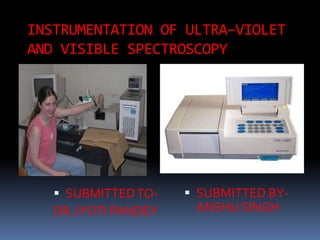
INSTRUMENTATION OF ULTRA–VIOLET
AND VISIBLE SPECTROSCOPY
 SUBMITTEDTO-
DR.JYOTI PANDEY
 SUBMITTED BY-
ANSHU SINGH
UV-VISIBLE SPECTROSCOPY
INTRODUCTION
UV- visible spectroscopy is known as electronic spectroscopy . In which the amount
of light absorbed at each wavelength of UV and visible regions of electromagnetic
spectrum is measured. This absorption of electromagnetic radiations by the
molecules leads to molecular excitation.
The regions of spectrum ultraviolet,4000-2000A; visible 8000-4000A.
INSTRUMENTATION
The main types of instruments in use for measuring the emission the emission or
absorption of radiant energy from substances are called by such as
spectrophotometers.
The various components of a UV-VIS spectrometers are follows.
Instruments for measuring the absorption of UV or visible radiation are
made up of the following components.
•Source of light
•Monochromators
•Sample cells
•Detector
•Recorder
Light source:
1 UV- Hydrogen discharge lamp
1 Consist of two electrode containing
hydrogen under low pressure.
2 Gives continuous spectrum in region 185-
350 nm.
2 Deuterium lamp:
1 -Consist of two electrode contain in
deuterium filled silica envelope
2 -Gives continuous spectrum in region
185-350 nm
3 - Radiation emitted is 3-5 times more
than the hydrogen discharge lamp
3 Xenon discharge lamp:
1 -Xenon stored under pressure in 10-30
atmosphere
2 - It possesses two tungsten electrode separated
by 8 cm
3 -Intensity of UV radiation more than hydrogen
lamp.
4 Mercury arc:
1 - Mercury vapour filled under the pressure
2 -Spectrum obtained is not continuous
VISIBLE SOURCES
•Tungsten lamp;
•This lamp find its place in most of colorimeter and
spectrophotometer
This lamp find its place in most of colorimeter and
spectrophotometer
It consists of a tungsten filament in a vacuum bulb
similar to ones used domestically.
Carbon arc lamp:
For a source of very high intensity carbon arc lamp
can be used.
It also provides an entire range of visible spectrum
Wave selectors are mainly eithers filters
or monochromators
Filters: Gelatin filters are made using a layer of gelatin coloured with organic
dyes that are sealed between glass plates.
The filters resolve polychromatic light into a relatively wide band width of about
40nm and these are commonly used in colorimeters since they have low
transmittance i.e. 5-20%.
Type of filters
(a)Glass filters-
•Made from pieces of colored glass which transmit limited wavelength range of
spectrum.
•Color produced by incorporation of oxides of vanadium, chromium, iron,
nickel, copper.
b)Gelatin filters-
•Consist of mixture of dyes placed in
gelatin& sandwiched between glass
plates.
•Band width 25nm.
c)Interferometry filters-
Consists of two parallel plates silvered internally and separated by a thin film of cryolite
or other dielectric material.
Band width 15nm.
Monochromators:Monochromators:Monochromators:Monochromators:Monochromators:
Consists of an entrance slit which admits the polychromatic light from the
source.
• A collimating device – lens or mirror which helps in reflecting the
polychromatic light to the dispersion device
•A wavelength resolving device- PRISM OR GRATING
•A focusing lens or mirror
•Exit slit
Sample holder/containers:
Cuvettes- Quarts or fused silica, ordinary glass is known as
absorb UV rad.
For IR- samples are ground with potassium bromide and
pressed into a pellet, If aqueous solution silver chloride is
coated inside the cell.
Which preparing samples selection of solvents is
important, because they do absorb light.
Prisms-
•Prism bends the monochromatic light.
•Amount of deviation depends on
wavelength.
•Quartz prism used in UV-region.
•Glass prism used in visible region
spectrum.
Function: They produce non - linear dispersion
Grating-
Large number of
equispaced lines ruled
on a glass blank coated
with aluminum film
SAMPLE CELL
•The materials that contain sample ideally should be transparent.
•The geometries of all components in the system should be such as to
maximize the signal and minimize the scattered light.
•Quartz or fused silica is required in the UV region
•Most common cell length in the UV region is 1cm.
DETECTORS
Three common types of detectors are used
•Barrier layer cells
•Photocell detector
•Photomultiplier
1. Photo voltaic cells or barrier layer cells:-
•Maximum sensitivity-550nm.
•It consist of flat Cu or Fe electrode on which semiconductor such as selenium is
deposited.
•On the selenium a thin layer of silver or gold is sputtered over the surface.
•A barrier exist between the selenium & iron which prevents the electron flowing
through iron.
•Therefore electrons are accumulated on the silver surface.
•These electrons are produced voltage. Silver surface
light
Fig:- photocell detector
2. Photocell detector:-It consist of high sensitive cathode in the form of a half
cylinder of metal which is evacuated and it is coated with cesium or potassium or silver
oxide Which can liberate electrons when light radiation falls on it.
•Anode also present which fixed along the axis of the tube.
•Photocell is more sensitive than photovoltaic cell.
3. Photomultiplier tube:-
• It is the combination of photodiode & electron multiplier.
• It consist of evacuated tube contains photo-cathode.
• 9-16 anodes known as dynodes.
RECORDER:
•Signal from detector received by the recording system
•The recording done by recorder pan.
INSTRUMENTATION: Single and Double Beam
Spectrometers
Single Beam Spectrophotometers
A single beam is radiation pass through a single cell, the reference cell is used to set
the absorbance scale at zero for the wavelength to be studied .It is then replaced by
sample cell to determine the absorbance of the sample at that wavelength. This was
the earliest design and is still use in both teaching and industrial labs.
In the single beam system; UV radiation is given off by the source. The inlet slit
permits light from the source to pass, but blocks out stray radiation. The light then
reaches the monochromator, which splits it up according to wavelength. The exits
slits is positioned to allow light of the required wavelength to pass through. The
selected radiation passes through the sample cell to the detector, which measure
the intensity of the radiation reaching it. By comparing the intensity of
radiation before end after it passes through the sample, it is possible to
measure how much radiation is absorbed by the sample at the particular
wavelength used. The out of the detector is usually recorded on graph
.
Double Beam Spectrophotometer
The instrument used in ultraviolet-visible spectroscopy is called a UV-Visible
SPECTROPHOTOMETER. It measures the intensity of light passing through a sample (1),
and compares it to the intensity of light before it passes through the sample(1).The
ratio is called the transmittance, and is usually expressed as a percentage (%T). The
absorbance (A) is based on the transmittance.
A=-log(%T/100%)
The radiation from the source is allows to pass via a mirror system to the
monochromator units. The function of the monochromator is to allows a narrow range
of wavelength to pass through an exits slits.
The radiation coming out of the monochromator through the exits slits is
received by the rotating sector which divides the beam into two beams, one
passing through the reference and the other through .After passing through the
sample and reference cells, the light beams are focused onto the detector. The
detector is connected to sensitive amplifier which responds to any change in
transmission through sample and reference. The sensitive amplifier transmits
the signal to the recorder.
ADVANTAGES AND DISADVANTAGES
Advantages of Single Beam Systems
Single beam instruments are less expensive.
High energy throughput due to non-splitting of source beam results in high sensitivity
of detection
Disadvantages
Instability due to lack of compensation for disturbances like electronic circuit
fluctuations, voltage fluctuations, mechanical component’s instability or drift in energy
of light sources. Such drifts result in abnormal fluctuations in the results.
Advantages of Double Beam Systems
•Modern improvements in optics permit high level of automation and offer the same or
even better level of detection as compared to earlier single beam systems. Instability
factors due to lamp drift, stray light, voltage fluctuations do not affect the
measurement in real-time.
•Little or no lamp warm up time is required. This not only improves throughput of
results but also conserves lamp life
Disadvantages of double beam spectrophotometers
The cost of double beam spectrophotometer is high.
Conclusion
We have seen that the double beam system design features
far outweigh the advantages offered by single beam systems.
The cost factor is more than offset by the advantages offered by
modern double beam systems and therefore these have
become the preferred choice
THANKS FOR LISTENING

Ultra violet spectrometer

  • 1.
    INSTRUMENTATION OF ULTRA–VIOLET ANDVISIBLE SPECTROSCOPY  SUBMITTEDTO- DR.JYOTI PANDEY  SUBMITTED BY- ANSHU SINGH
  • 2.
    UV-VISIBLE SPECTROSCOPY INTRODUCTION UV- visiblespectroscopy is known as electronic spectroscopy . In which the amount of light absorbed at each wavelength of UV and visible regions of electromagnetic spectrum is measured. This absorption of electromagnetic radiations by the molecules leads to molecular excitation. The regions of spectrum ultraviolet,4000-2000A; visible 8000-4000A.
  • 3.
    INSTRUMENTATION The main typesof instruments in use for measuring the emission the emission or absorption of radiant energy from substances are called by such as spectrophotometers. The various components of a UV-VIS spectrometers are follows. Instruments for measuring the absorption of UV or visible radiation are made up of the following components. •Source of light •Monochromators •Sample cells •Detector •Recorder
  • 5.
    Light source: 1 UV-Hydrogen discharge lamp 1 Consist of two electrode containing hydrogen under low pressure. 2 Gives continuous spectrum in region 185- 350 nm. 2 Deuterium lamp: 1 -Consist of two electrode contain in deuterium filled silica envelope 2 -Gives continuous spectrum in region 185-350 nm 3 - Radiation emitted is 3-5 times more than the hydrogen discharge lamp
  • 6.
    3 Xenon dischargelamp: 1 -Xenon stored under pressure in 10-30 atmosphere 2 - It possesses two tungsten electrode separated by 8 cm 3 -Intensity of UV radiation more than hydrogen lamp. 4 Mercury arc: 1 - Mercury vapour filled under the pressure 2 -Spectrum obtained is not continuous
  • 7.
    VISIBLE SOURCES •Tungsten lamp; •Thislamp find its place in most of colorimeter and spectrophotometer This lamp find its place in most of colorimeter and spectrophotometer It consists of a tungsten filament in a vacuum bulb similar to ones used domestically. Carbon arc lamp: For a source of very high intensity carbon arc lamp can be used. It also provides an entire range of visible spectrum
  • 8.
    Wave selectors aremainly eithers filters or monochromators Filters: Gelatin filters are made using a layer of gelatin coloured with organic dyes that are sealed between glass plates. The filters resolve polychromatic light into a relatively wide band width of about 40nm and these are commonly used in colorimeters since they have low transmittance i.e. 5-20%. Type of filters (a)Glass filters- •Made from pieces of colored glass which transmit limited wavelength range of spectrum. •Color produced by incorporation of oxides of vanadium, chromium, iron, nickel, copper.
  • 9.
    b)Gelatin filters- •Consist ofmixture of dyes placed in gelatin& sandwiched between glass plates. •Band width 25nm. c)Interferometry filters- Consists of two parallel plates silvered internally and separated by a thin film of cryolite or other dielectric material. Band width 15nm.
  • 10.
    Monochromators:Monochromators:Monochromators:Monochromators:Monochromators: Consists of anentrance slit which admits the polychromatic light from the source. • A collimating device – lens or mirror which helps in reflecting the polychromatic light to the dispersion device •A wavelength resolving device- PRISM OR GRATING •A focusing lens or mirror •Exit slit
  • 11.
    Sample holder/containers: Cuvettes- Quartsor fused silica, ordinary glass is known as absorb UV rad. For IR- samples are ground with potassium bromide and pressed into a pellet, If aqueous solution silver chloride is coated inside the cell. Which preparing samples selection of solvents is important, because they do absorb light.
  • 12.
    Prisms- •Prism bends themonochromatic light. •Amount of deviation depends on wavelength. •Quartz prism used in UV-region. •Glass prism used in visible region spectrum. Function: They produce non - linear dispersion Grating- Large number of equispaced lines ruled on a glass blank coated with aluminum film
  • 13.
    SAMPLE CELL •The materialsthat contain sample ideally should be transparent. •The geometries of all components in the system should be such as to maximize the signal and minimize the scattered light. •Quartz or fused silica is required in the UV region •Most common cell length in the UV region is 1cm.
  • 14.
    DETECTORS Three common typesof detectors are used •Barrier layer cells •Photocell detector •Photomultiplier 1. Photo voltaic cells or barrier layer cells:- •Maximum sensitivity-550nm. •It consist of flat Cu or Fe electrode on which semiconductor such as selenium is deposited. •On the selenium a thin layer of silver or gold is sputtered over the surface. •A barrier exist between the selenium & iron which prevents the electron flowing through iron. •Therefore electrons are accumulated on the silver surface. •These electrons are produced voltage. Silver surface
  • 15.
    light Fig:- photocell detector 2.Photocell detector:-It consist of high sensitive cathode in the form of a half cylinder of metal which is evacuated and it is coated with cesium or potassium or silver oxide Which can liberate electrons when light radiation falls on it. •Anode also present which fixed along the axis of the tube. •Photocell is more sensitive than photovoltaic cell.
  • 16.
    3. Photomultiplier tube:- •It is the combination of photodiode & electron multiplier. • It consist of evacuated tube contains photo-cathode. • 9-16 anodes known as dynodes. RECORDER: •Signal from detector received by the recording system •The recording done by recorder pan.
  • 17.
    INSTRUMENTATION: Single andDouble Beam Spectrometers Single Beam Spectrophotometers A single beam is radiation pass through a single cell, the reference cell is used to set the absorbance scale at zero for the wavelength to be studied .It is then replaced by sample cell to determine the absorbance of the sample at that wavelength. This was the earliest design and is still use in both teaching and industrial labs. In the single beam system; UV radiation is given off by the source. The inlet slit permits light from the source to pass, but blocks out stray radiation. The light then reaches the monochromator, which splits it up according to wavelength. The exits slits is positioned to allow light of the required wavelength to pass through. The selected radiation passes through the sample cell to the detector, which measure the intensity of the radiation reaching it. By comparing the intensity of radiation before end after it passes through the sample, it is possible to measure how much radiation is absorbed by the sample at the particular wavelength used. The out of the detector is usually recorded on graph .
  • 19.
    Double Beam Spectrophotometer Theinstrument used in ultraviolet-visible spectroscopy is called a UV-Visible SPECTROPHOTOMETER. It measures the intensity of light passing through a sample (1), and compares it to the intensity of light before it passes through the sample(1).The ratio is called the transmittance, and is usually expressed as a percentage (%T). The absorbance (A) is based on the transmittance. A=-log(%T/100%) The radiation from the source is allows to pass via a mirror system to the monochromator units. The function of the monochromator is to allows a narrow range of wavelength to pass through an exits slits. The radiation coming out of the monochromator through the exits slits is received by the rotating sector which divides the beam into two beams, one passing through the reference and the other through .After passing through the sample and reference cells, the light beams are focused onto the detector. The detector is connected to sensitive amplifier which responds to any change in transmission through sample and reference. The sensitive amplifier transmits the signal to the recorder.
  • 21.
    ADVANTAGES AND DISADVANTAGES Advantagesof Single Beam Systems Single beam instruments are less expensive. High energy throughput due to non-splitting of source beam results in high sensitivity of detection Disadvantages Instability due to lack of compensation for disturbances like electronic circuit fluctuations, voltage fluctuations, mechanical component’s instability or drift in energy of light sources. Such drifts result in abnormal fluctuations in the results. Advantages of Double Beam Systems •Modern improvements in optics permit high level of automation and offer the same or even better level of detection as compared to earlier single beam systems. Instability factors due to lamp drift, stray light, voltage fluctuations do not affect the measurement in real-time. •Little or no lamp warm up time is required. This not only improves throughput of results but also conserves lamp life Disadvantages of double beam spectrophotometers The cost of double beam spectrophotometer is high.
  • 22.
    Conclusion We have seenthat the double beam system design features far outweigh the advantages offered by single beam systems. The cost factor is more than offset by the advantages offered by modern double beam systems and therefore these have become the preferred choice
  • 23.