









TURBIDIMETRY
BY: GROUP # 6
INTRODUCTION
BY: KHADIJA KHAN
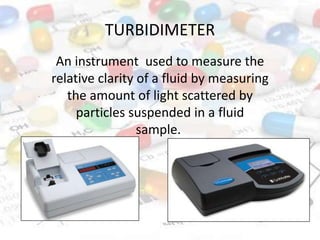
TURBIDIMETER
An instrument used to measure the
relative clarity of a fluid by measuring
the amount of light scattered by
particles suspended in a fluid
sample.
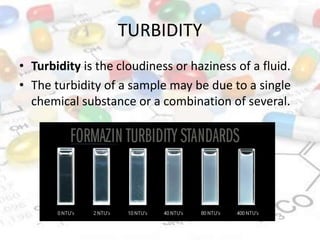
TURBIDITY
• Turbidity is the cloudiness or haziness of a fluid.
• The turbidity of a sample may be due to a single
chemical substance or a combination of several.
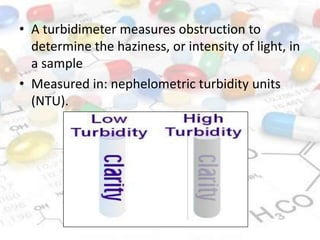
• A turbidimeter measures obstruction to
determine the haziness, or intensity of light, in
a sample
• Measured in: nephelometric turbidity units
(NTU).
PRINCIPLE
BY: SEENAM IFTIKHAR
PRINCIPLE
• Principle of Turbidimeter is established on the
basis of scattering or absorption of light by
solid suspensions or colloids in the solution.
When this light is processed through the
suspension, part of incident radiant energy is
dissolute by absorption, reflection and
reaction while remaining is transmitted.
SCATTERING OF LIGHT
There are two ways in which light can be
scattered:
• Elastic way of scattering
• Inelastic way of scattering
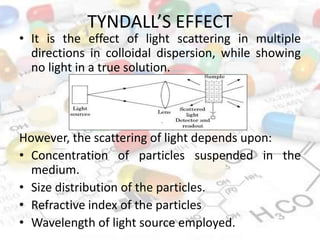
TYNDALL’S EFFECT
• It is the effect of light scattering in multiple
directions in colloidal dispersion, while showing
no light in a true solution.
However, the scattering of light depends upon:
• Concentration of particles suspended in the
medium.
• Size distribution of the particles.
• Refractive index of the particles
• Wavelength of light source employed.
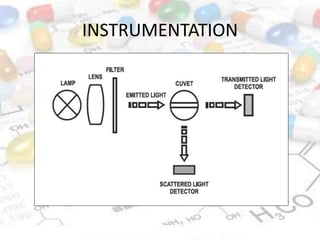
INSTRUMENTATION
BY: AISHA AMJAD
INSTRUMENTATION
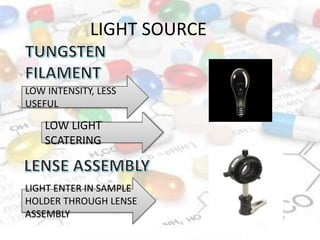
LIGHT SOURCE
LOW INTENSITY, LESS
USEFUL
LOW LIGHT
SCATERING
LIGHT ENTER IN SAMPLE
HOLDER THROUGH LENSE
ASSEMBLY
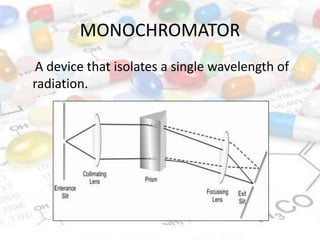
MONOCHROMATOR
A device that isolates a single wavelength of
radiation.
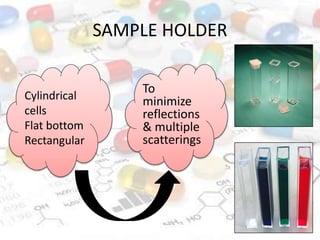
SAMPLE HOLDER
Cylindrical
cells
Flat bottom
Rectangular
To
minimize
reflections
& multiple
scatterings
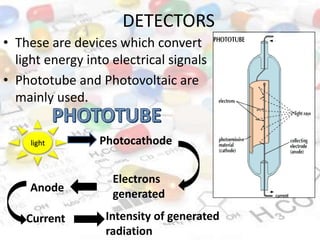
DETECTORS
• These are devices which convert
light energy into electrical signals
• Phototube and Photovoltaic are
mainly used.
light Photocathode
Electrons
generated
Anode
Current Intensity of generated
radiation
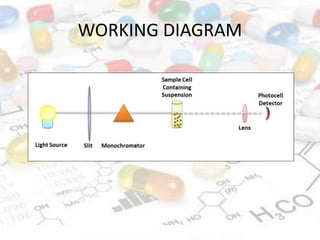
WORKING DIAGRAM
TURBIDIMETRY
VS
NEPHELOMETRY
BY: ASRA FATIMA
WHAT IS NEPHELOMETER?
Nephelometer is an instrument for
measuring the concentration of substances
in suspension by means of light scattering
by suspended particles.
SIMILARITIES IN TURBIDIMETER
AND NEPHELOMETER:
ON THE BASIS OF PRINCIPLE:
Both works on absorption and scattering
of incident light.
They both do not follow beer-Lambert
law.
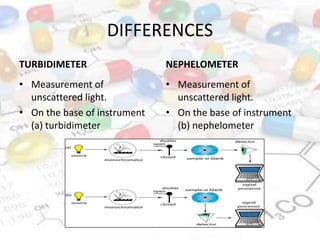
DIFFERENCES
TURBIDIMETER
• Measurement of
unscattered light.
• On the base of instrument
(a) turbidimeter
NEPHELOMETER
• Measurement of
unscattered light.
• On the base of instrument
(b) nephelometer
TURBIDIMETRIC
TITRATIONS
BY: AREEBA SALEEM
TURBIDIMETRIC TITRATIONS
The Turbidmetric titrations are those in
which turbidance is used to locate end
point using a titrant that gives precipitate.
SURFACTANT TITRATIONS
Anionic titrated
with Cationic
Colloidal
precipitate is
formed
Solution becomes
turbid
GRAPHICAL REPREENTATION
 Absorbance VS Volume
An increase in absorbance occurs as
more and more of precipitant is
formed.
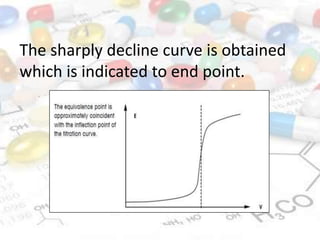
The sharply decline curve is obtained
which is indicated to end point.
APPLICATIONS
BY: HAZIQA IFFRIN & FARAH DEEBAH
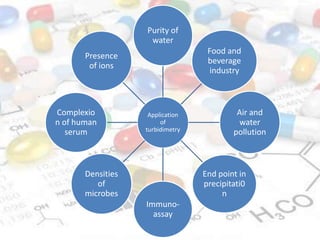
Application
of
turbidimetry
Purity of
water
Food and
beverage
industry
Air and
water
pollution
End point in
precipitati0
n
Immuno-
assay
Densities
of
microbes
Complexio
n of human
serum
Presence
of ions
ADVANTAGES
&
DISADVANTAGES
BY: HAZIQA IFFRIN & FARAH DEEBAH
ADVANTAGES
• Turbidimeter is significantly used in the
treatment of surface water including plants
throughout the world.
• Its apparatus is quit cheap as compared to
others.
• An absolute analysis of water is given by this
instrument without any zero error.
• Contamination of food can also be detected
by turbidimeters.
DISADVANTAGES
• Detection of particle size is not possible.
• When light enters along with the sample so it
is also detected by the detector and interferes
by giving false reading.
• Due to intact air in the sample, bubbles are
formed that gives wrong signals.

Turbidimetry