SPECTROPHOTOMETRY
AND COLORIMETRY
INTRODUCTION
 Spectroscopy is the use of light (EMR) to
study matter. Light is passed through a
substance, and the amount of light
absorbed is determined. This can help us
determine
– The type of bonds present in the
compound/substance
– The concentration of the substance
INTRODUCTION CONT’D
 Spectroscopy is the study of how light
interacts with matter.
 It is the study of the electromagnetic
radiation emitted or absorbed by a
chemical species
INTRODUCTION CONT’D
 Spectroscopy is the study of how light
interacts with matter.
 It is the study of the electromagnetic
radiation emitted or absorbed by a
chemical species
SPECTROSCOPY
INTRODUCTION CONT’D
 Photometric analysis is the analytical
technique by which the concentration of a
solute in a solution is determined by
measuring the intensity of the light
transmitted by the solution
Colourimetry and spectrophotometry are
the most widely used photometric
techniques.
INTRODUCTION CONT’D
Spectrophotometry is used to measure the
concentration of solutes in a solution by
measuring the amount of light that is absorbed
by the solution.
For each analyte, there is an ideal wavelength for
which spectrophotometric readings should be
taken.
The ideal wavelength is the one at which
absorbance is greatest.
INTRODUCTION CONT’D
If there is too much or too little an analyte, the
spectrophotometer can not read the absorbance
accurately
Spectrophotometry deals with visible light, near-
ultraviolet and near infrared
Ultraviolet and visible spectrophotometry are the
methods of choice in most laboratories.
 Modern spectrophotometers are quick, accurate
and reliable and make only small demand son
time and skills of the operator
INTRODUCTION CONT’D
INTRODUCTION CONT’D
Spectrophotometer: An instrument that
measures the amount of light absorbed by a
substance by measuring the intensity of the light
that is not absorbed (% transmittance)
 Spectrophotometry is the technique used for the
characterization, identification and quantitative
estimation of solutes in a solution by measuring
the amount of light absorbed by the solution
INTRODUCTION CONT’D
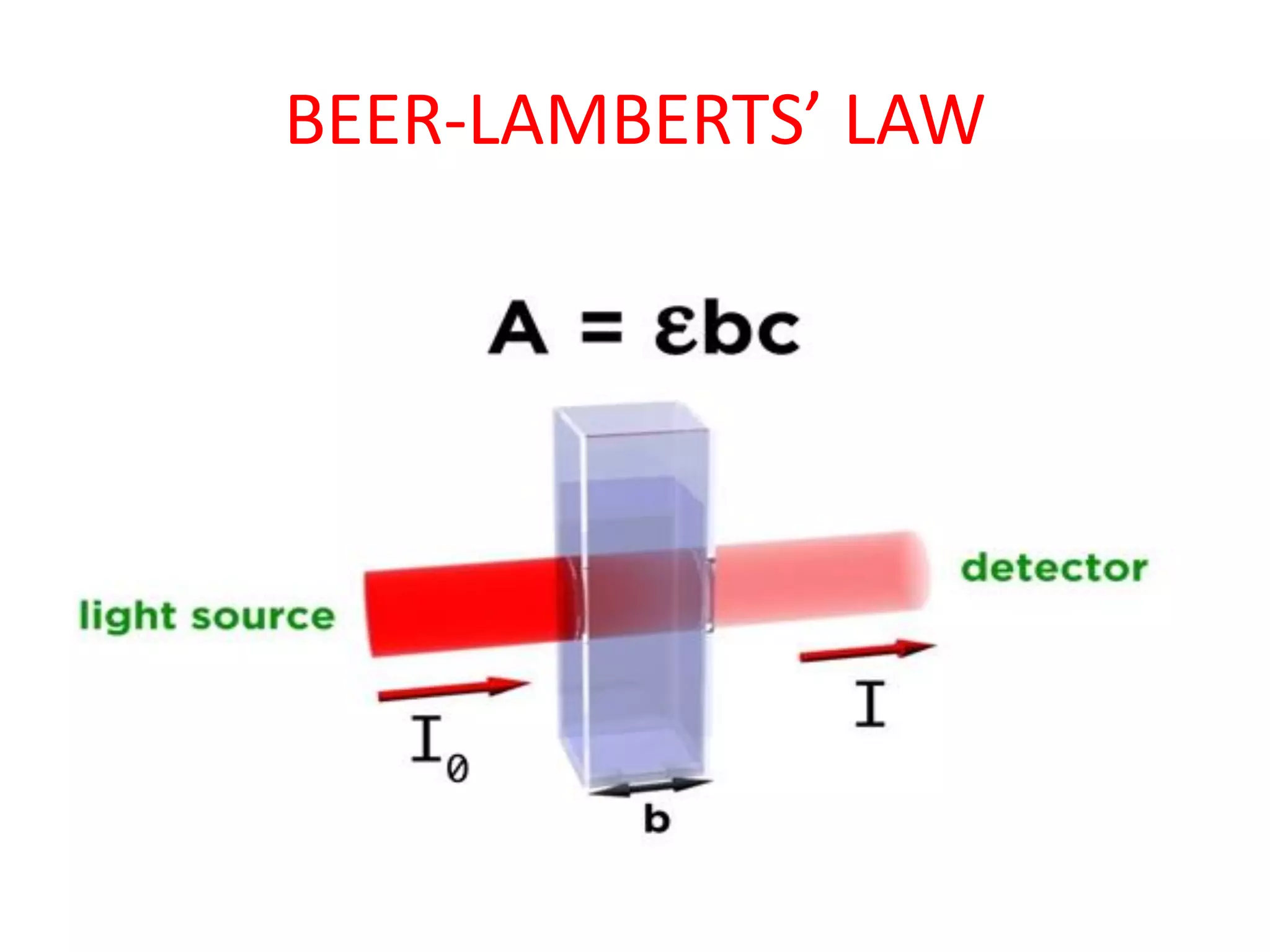
Path length (l): Distance the light travels
through the solution
Io: Intensity of incident light
I: intensity of light after it has passed
through the solution
(emitted/transmitted light)
INTRODUCTION CONT’D
Transmittace (T): This is a measure of the fraction
of light that passes through the sample. It is the
ratio of I to Io
 The percentage transmittance (%T) could also be
used: %T = T x 100
Absorbance (A): this is the amount of light
absorbed by the sample
 A = -logT = - log
𝐼
𝐼𝑜
INTRODUCTION CONT’D
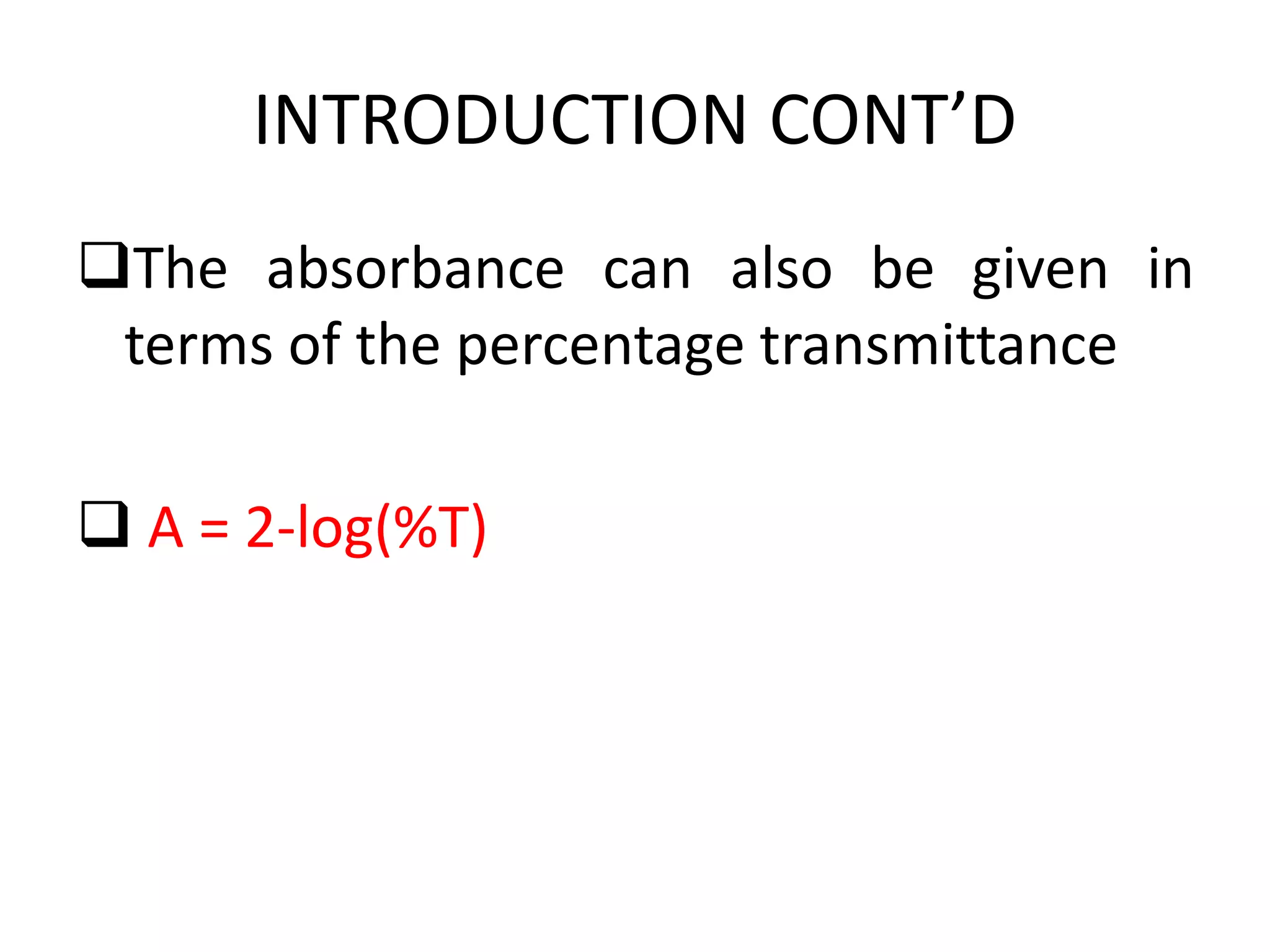
The absorbance can also be given in
terms of the percentage transmittance
 A = 2-log(%T)
INTRODUCTION CONT’D
Absorption Spectrum: This is a plot of the
absorbance versus the wavelength of the
incident light
INTRODUCTION CONT’D
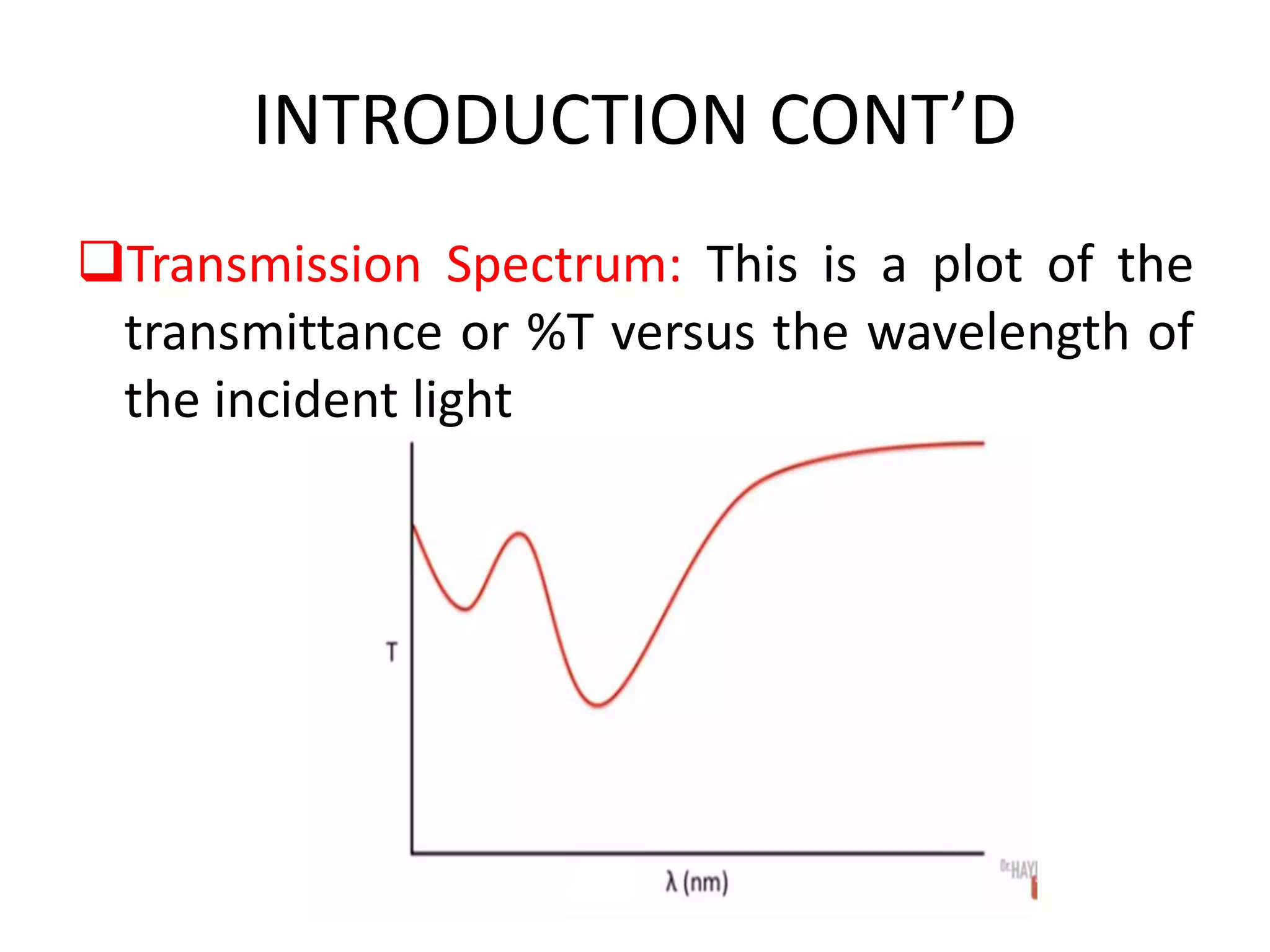
Transmission Spectrum: This is a plot of the
transmittance or %T versus the wavelength of
the incident light
COLORIMETRY
 Light falling on a coloured solution is either
absorbed or transmitted. A coloured solution
absorbs all the colours of white light and
selectively transmits only one colour. This is its
own colour.
COLORIMETRY
COLOURIMETRY
TYPES OF SPECTROPHOTOMERS
 There are three types of spectrophotomers;
visible light absorption spectrophotometer,
infrared absorption spectrophotometer and
ultraviolet absorption spectrophotometer
TYPES OF SPECTROPHOTOMERS
 Visible spectrophotometers can use
incandescent, halogen, LED or a combination
of these sources.
The use visible light (white light) of
wavelength 350nm to 700nm
These spectrophotometers vary in accuracy
 Plastic and glass cuvettes can be used for
visible spectroscopy
TYPES OF SPECTROPHOTOMERS
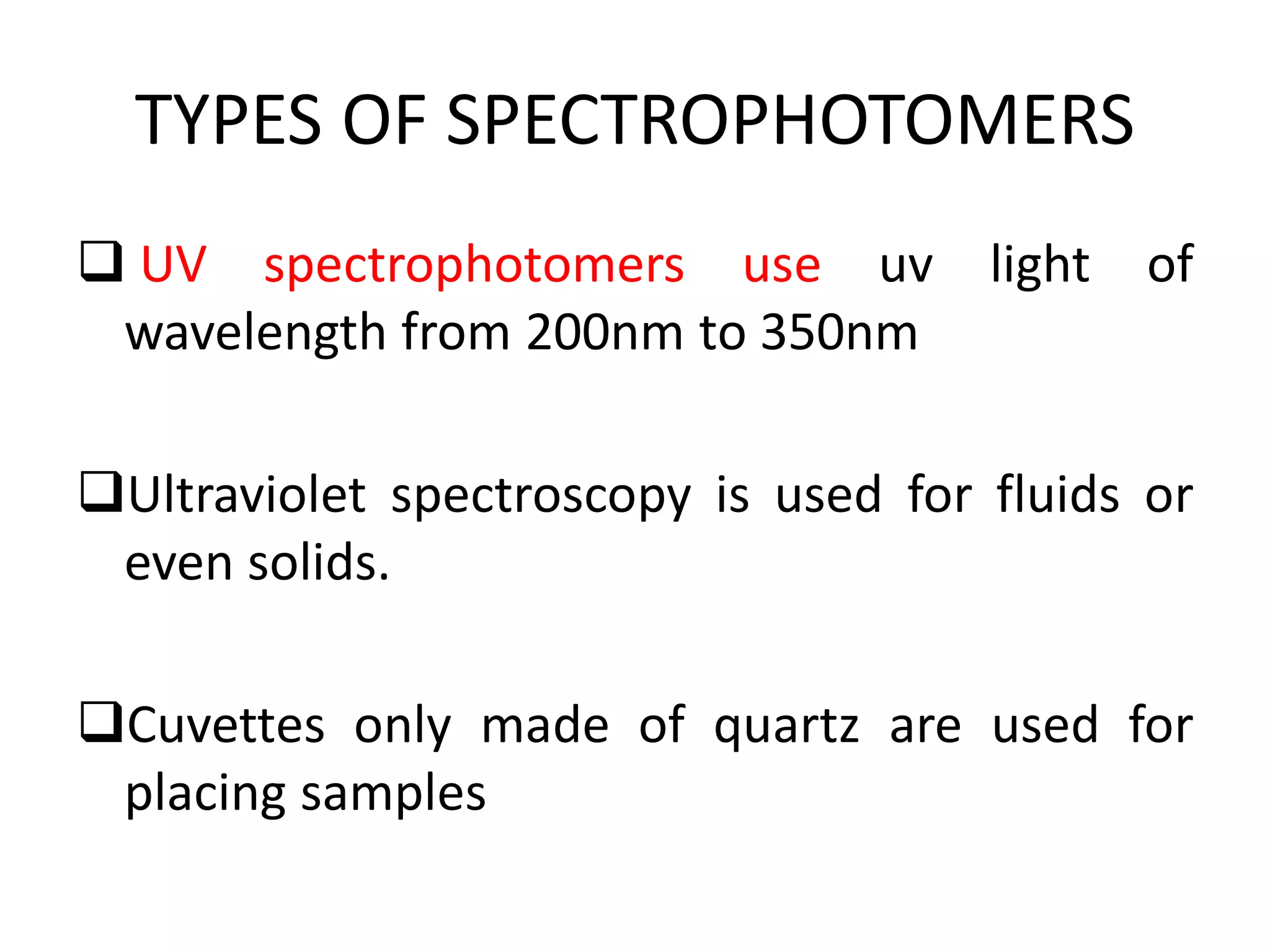
 UV spectrophotomers use uv light of
wavelength from 200nm to 350nm
Ultraviolet spectroscopy is used for fluids or
even solids.
Cuvettes only made of quartz are used for
placing samples
TYPES OF SPECTROPHOTOMERS
 Infrared red spectroscopy helps to study
different structures of molecules and their
vibrations.
Different chemical structures vibrate in different
ways due to vibration energy associated with
each wavelength. For example mild range and
near infrared (higher energy infrared) tend to
cause rotational vibrations and harmonic
vibrations respectively.
TYPES OF SPECTROPHOTOMERS
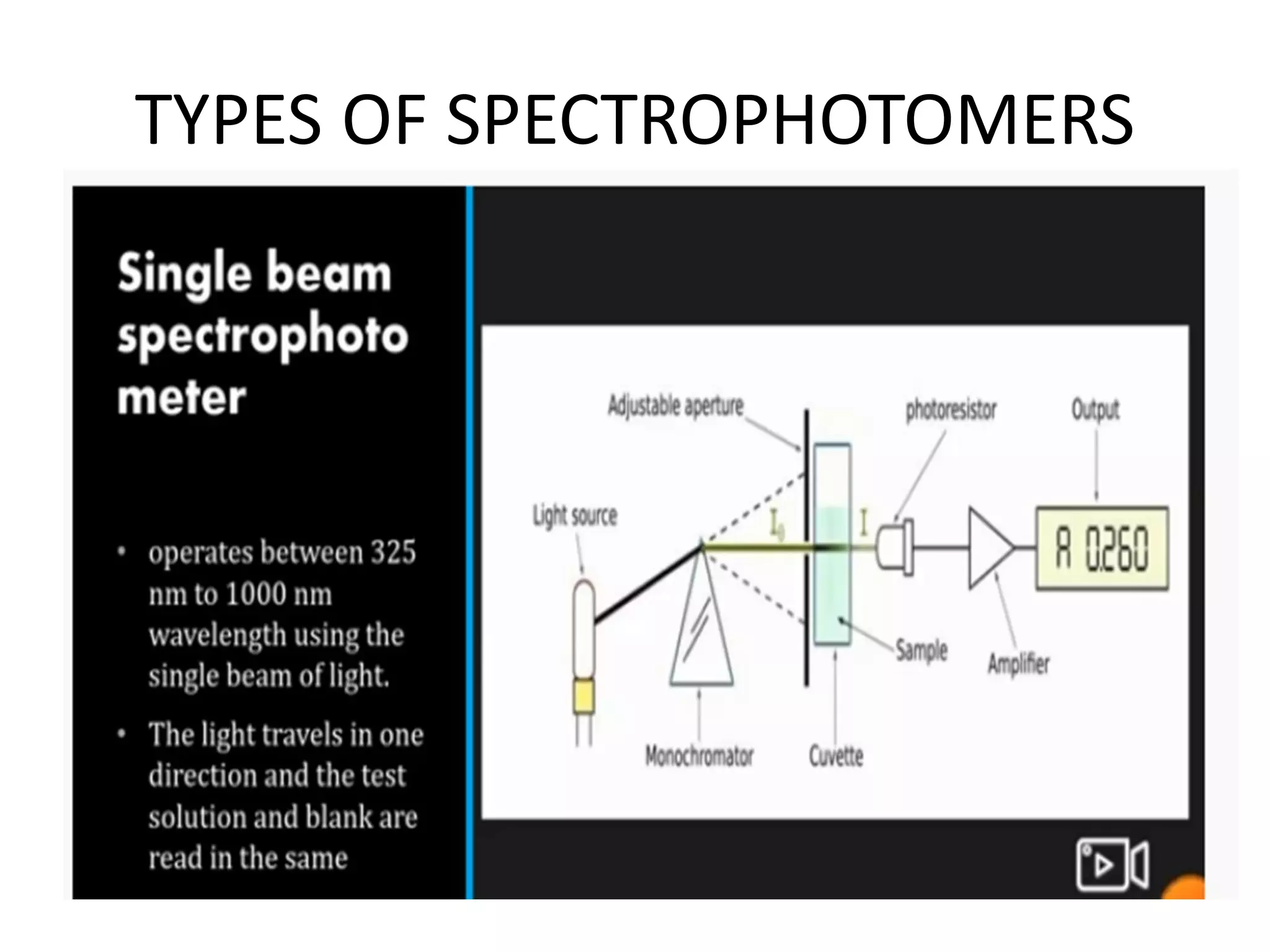
 Single Beam Spectrophotometer: Light passes
through the sample. To measure the intensity
of the incident light, the sample must be
removed so that light can pass through it.
 This type of spectrophotometer is less
expensive and less complicated.
TYPES OF SPECTROPHOTOMERS
 Double Beam Spectrophotometer: The light
source is split into two separate beams before it
reaches the sample. From these, one passes
through the sample and the other passes through
the standard (reference).
The absorbance of the standard and test solution
can be measured at the same time
 Any number of test solutions can be analyzed
against the same standard.
TYPES OF SPECTROPHOTOMERS
 Double Beam Spectrophotometer: The light
source is split into two separate beams before
it reaches the sample. From these, one passes
through the sample and the other passes
through the standard (reference).
SPECTROPHOTOMERS
INSTRUMENTATION
SPECTROPHOTOMERS
INSTRUMENTATION
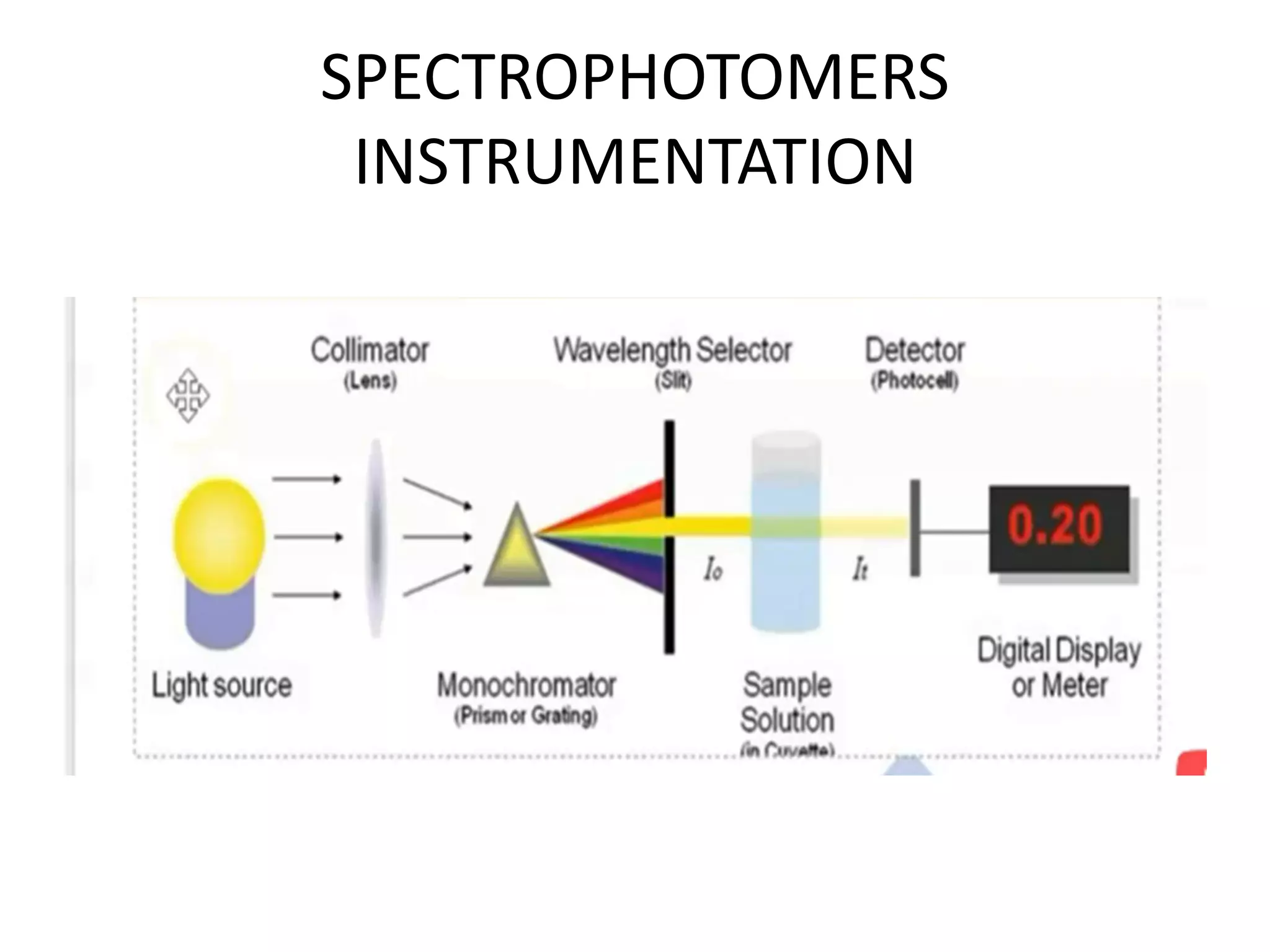
A: LIGHT SOURCE (SOURCES OF RADIATION):
These are materials which can be excited to high
energy states by a high voltage electric
discharge. As they return to lower energy states
(or ground states), they emit photons of
characteristics energy. An ideal source of
radiation should emit a continuous spectrum of
high, uniform intensity over the entire
wavelength range of interest.
The spectrophotometer operates the visible,
infrared and ultraviolet radiation
SPECTROPHOTOMERS
INSTRUMENTATION
A: LIGHT SOURCE (SOURCES OF RADIATION):
Light sources are materials which provide a
sufficient amount of light suitable for making a
measurement.
The light source typically yields a high output of
polychromatic light over a wide rang of the
spectrum
The spectrophotometer operates the visible,
infrared and ultraviolet radiation
SPECTROPHOTOMERS
INSTRUMENTATION
A: LIGHT SOURCE (SOURCES OF RADIATION):
(i) Sources of Visible Radiation: A tungsten filament
lamp is used as a source of visible and near infrared
radiation. The tungsten lamp is the most common
light source used in spectrophotometers. The
filament is heated by a stabilized dc supply or by a
storage battery. The tungsten filament emits
continuous radiation in the region between 350nm
and 2500nm. The tungsten lamp is generally useful
for measuring moderately dilute solutions in which
the change in color intensity varies significantly
with changes in concentration. The tungsten lamp
has a long half-life of about 1200 hours
SPECTROPHOTOMERS
INSTRUMENTATION
A: LIGHT SOURCE (SOURCES OF RADIATION):
(ii) Sources of Ultraviolet Radiation: Commonly
used sources are the hydrogen lamp and the
deuterium lamp. Their range is approximately
200-450nm. Deuterium lamps are generally
more stable and have a long half life of about
500 hours
SPECTROPHOTOMERS
INSTRUMENTATION
A: LIGHT SOURCE (SOURCES OF RADIATION):
(iii) Sources of infrared Radiation: Nernst
Glower Filament and Globar are the most
satisfactory sources of infrared radiation.
SPECTROPHOTOMERS
INSTRUMENTATION
B: LENS (COLLIMETER): Focuses light and
transmits a straight beam of light.
SPECTROPHOTOMERS
INSTRUMENTATION
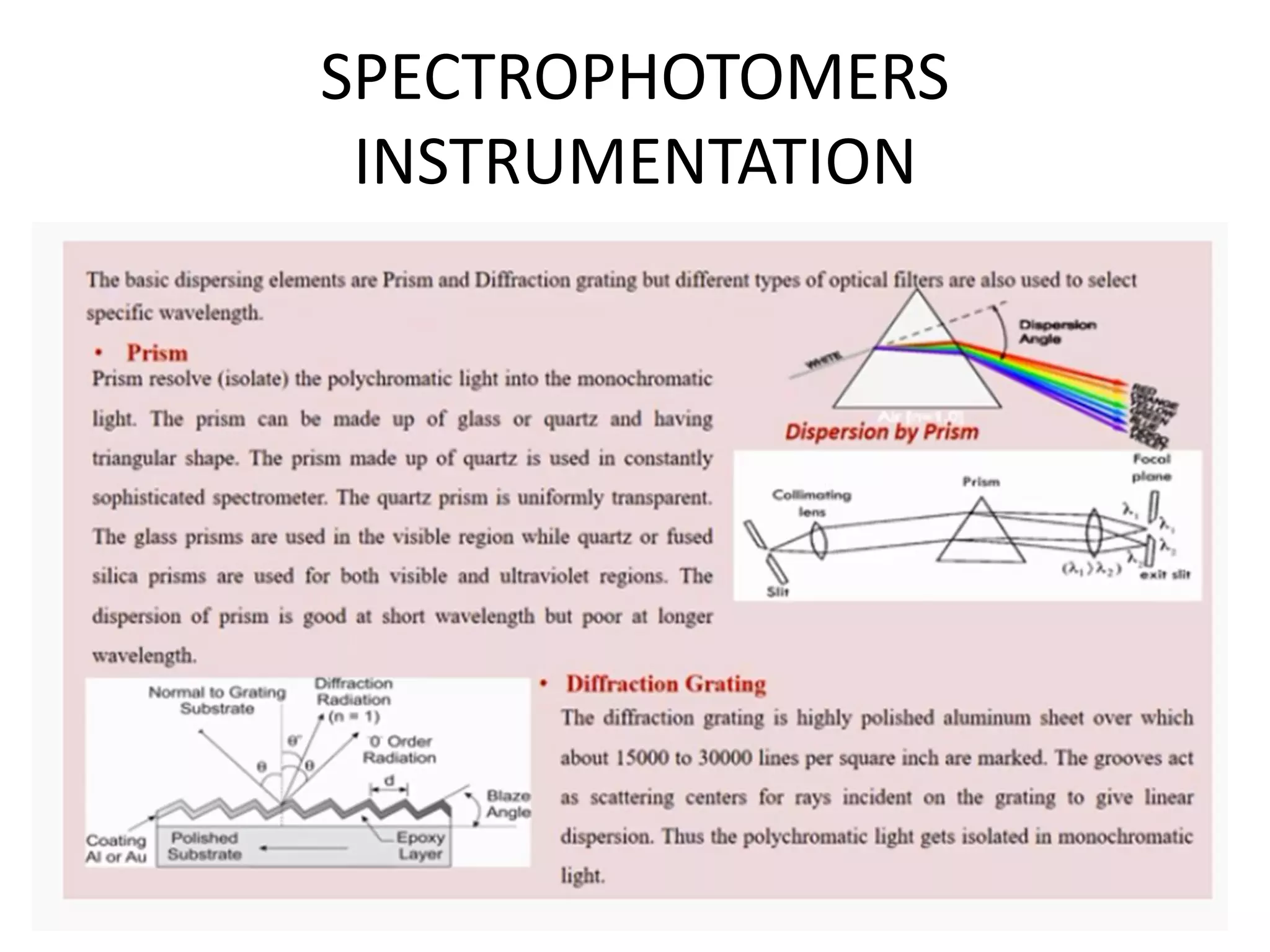
C: MONOCHROMATOR: A prism that splits light into
several component wavelengths (prism) and
transmits a narrow range of light wavelengths from
a wide variety.
A monochromator resolves polychromatic radiation
into its individual wavelengths and isolates these
wavelengths into very narrow bands.
In modern spectrophotometers, a prism or
diffraction grating is used as the monochromator to
produce the desired wavelength.
SPECTROPHOTOMERS
INSTRUMENTATION
SPECTROPHOTOMERS
INSTRUMENTATION
SPECTROPHOTOMERS
INSTRUMENTATION
SPECTROPHOTOMERS
INSTRUMENTATION
D: WAVELENGTH SELECTOR: A slit that transmits
a specific wavelength (the desired wavelength).
The lens, monochromator and slits form an
optical system which concentrates the light,
increases its spectral purity and focusses it on a
sample.
SPECTROPHOTOMERS
INSTRUMENTATION
E: CUVETTE: A cuvette is a small square tube sealed at one
end, having straight sides, made of plastic, glass or quartz. Its
function is to hold the sample. Cuvettes meant for the visible
region are made of ordinary glass and sometimes quartz.
Cuvettes of various shapes are available, it may be cylindrical
and rectangular
Cuvettes should be as clear as possible, without impurities
that may affect the spectroscopic reading. Glass cuvettes are
used for the visible region. Cuvettes made of quartz or fused
silica are used in both the ultraviolet and visible regions. For
the IR region and for organic analysis, a cuvette made of NaCl
is used. Generally cuvettes of 1cm path length are used
SPECTROPHOTOMERS
INSTRUMENTATION
F: LIGHT DETECTOR: Detects transmitted light,
amplifies it and converts it to an electrical signal which
is fed into a meter(galvanometer) or a digital display
(recorder). Most photosensitive detectors depend on
the photoelectric effect. The current (electrical signal)
detected is proportional to the light intensity.
The photocell and photo tube are the most commonly
used photodetectors; producing current proportional
to the intensity of light striking them.
Phototube detectors are commonly used in the UV and
visible regions.
SPECTROPHOTOMERS
INSTRUMENTATION
G: DIGITAL DISPLAY: A metre that shows data.
The detector can be ammeters, amplifiers,
potentiometers, analogue meter, computer etc
which translate the electric signal into a form
that can easily be interpreted (read out).
WORKING OF THE
SPECTROPHOTOMETER
WORKING OF THE
SPECTROPHOTOMETER
 The instrument is switched on
The light source generates light of a particular
wavelength
 The light passes through the dispersion devices
that separate light into its component
wavelengths
The monochromator produces monochromatic
light (beam splitter split it into two beams for
double beam spectrophotometers, one for the
standard and one for the sample)
 Slits then isolate the wavelengths needed for
measurement
WORKING OF THE
SPECTROPHOTOMETER
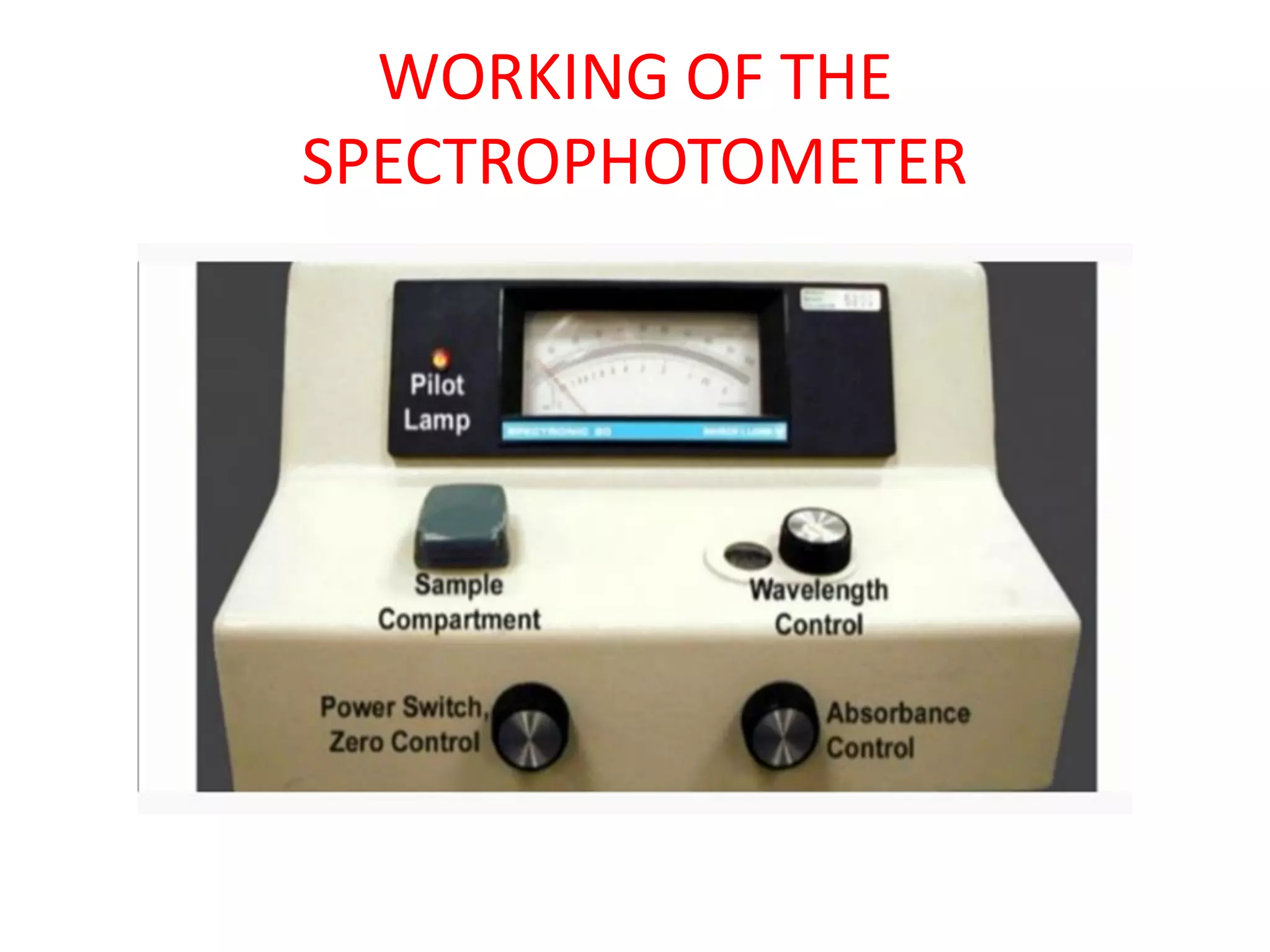
The desired wavelength is adjusted/selected
using the wavelength control knob
 The zero percent transmission is adjusted
with the help of the zero setting knob
 the cell/cuvette is filled with a solvent
(distilled water) or blank and placed in the
sample compartment
 100%T or zero absorbance is adjusted. The
instrument gets calibrated.
WORKING OF THE
SPECTROPHOTOMETER
WORKING OF THE
SPECTROPHOTOMETER
 The blank is removed, the unknown sample in the
cuvette is placed in the compartment.
 The monochromatic light falls on the sample
Some part of the monochromatic light is absorbed by
the sample and the remaining is transmitted
 The intensity of the transmitted light is detected by
light detector and converted into an electric current
This is read by the galvanometer and displayed in
digital form which is read by a read out device e.g. a
digital metre.
This is the absorbance or optical density of the solution
analyzed.
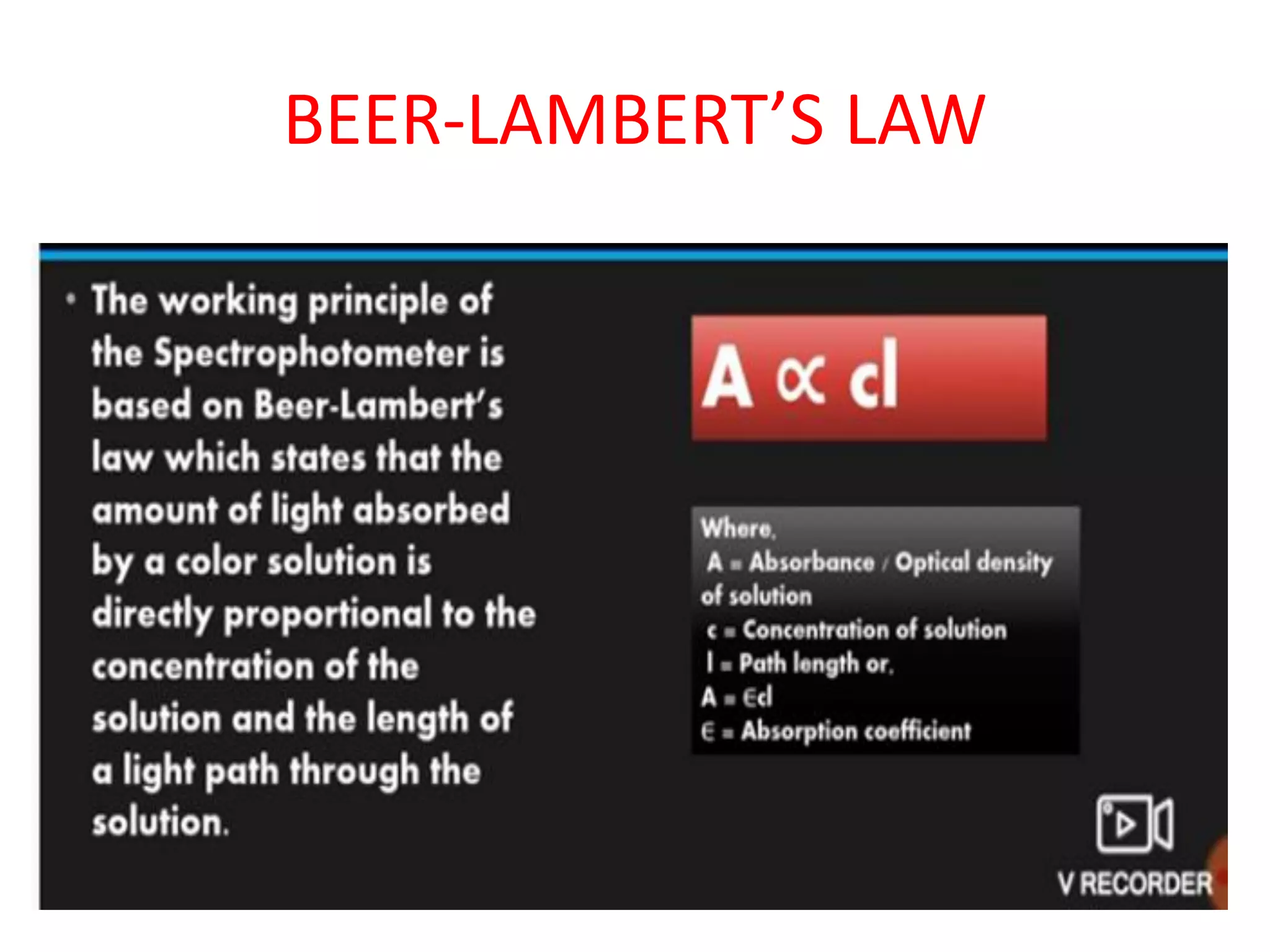
BEER-LAMBERT’S LAW
BEER-LAMBERT’S LAW
BEER-LAMBERT’S LAW
BEER-LAMBERTS LAW
BEER-LAMBERTS’ LAW
BEER’S LAMBERTS LAW
BEER LAMBERTS LAW
Extrapolation and Calculation
FACTORS THAT AFFECT
SPECTROPHOTOMETER MEASUREMENTS
1. Coloured Molecules: If a molecule does not
strongly absorb any wavelength of visible
light, it will appear clear in solution. It can
not be measured. It can only be measured if
an indicator is added. Indicators change
colour upon reaction with a colourless
molecule.
2. Concentration: There must not be too much
or too little of the sample in the solution.
FACTORS THAT AFFECT
SPECTROPHOTOMETER MEASUREMENTS
3. Light Path: The distance the light passes through a
sample affects the measurement. Use a cuvette with a
specific diameter (thickness). Usually a 1cm light path
cuvette is used.
4. Calibration: The spectrophotometer must be calibrated
using a blank solution reference before taking
measurements. A balnk contains every thing in your
sample tube except the molecule/analyte you intend to
measure. The spectrophotomer must be recalibrated
every time it is set to a diferent wavelength.
FACTORS THAT AFFECT
SPECTROPHOTOMETER MEASUREMENTS
5. Detection limit of the spectrophotometer:
Readings can not be obtained at concentrations
that are too low or too high. You may have to
calculate the absorbance at very low %T
readings. You may have to dilute your sample
further if it is too concentrated to be measured.
APPLICATIONS OF
SPECTROPHOTOMETRY
APPLICATIONS OF
SPECTROPHOTOMETRY
APPLICATIONS OF
SPECTROPHOTOMETRY
APPLICATIONS OF
SPECTROPHOTOMETRY
COLORIMETRY VS SPECTROPHOTOMETRY

Spectrophotometry and colorimetry.pdf

  • 1.
  • 2.
    INTRODUCTION  Spectroscopy isthe use of light (EMR) to study matter. Light is passed through a substance, and the amount of light absorbed is determined. This can help us determine – The type of bonds present in the compound/substance – The concentration of the substance
  • 3.
    INTRODUCTION CONT’D  Spectroscopyis the study of how light interacts with matter.  It is the study of the electromagnetic radiation emitted or absorbed by a chemical species
  • 4.
    INTRODUCTION CONT’D  Spectroscopyis the study of how light interacts with matter.  It is the study of the electromagnetic radiation emitted or absorbed by a chemical species
  • 5.
  • 6.
    INTRODUCTION CONT’D  Photometricanalysis is the analytical technique by which the concentration of a solute in a solution is determined by measuring the intensity of the light transmitted by the solution Colourimetry and spectrophotometry are the most widely used photometric techniques.
  • 7.
    INTRODUCTION CONT’D Spectrophotometry isused to measure the concentration of solutes in a solution by measuring the amount of light that is absorbed by the solution. For each analyte, there is an ideal wavelength for which spectrophotometric readings should be taken. The ideal wavelength is the one at which absorbance is greatest.
  • 8.
    INTRODUCTION CONT’D If thereis too much or too little an analyte, the spectrophotometer can not read the absorbance accurately Spectrophotometry deals with visible light, near- ultraviolet and near infrared Ultraviolet and visible spectrophotometry are the methods of choice in most laboratories.  Modern spectrophotometers are quick, accurate and reliable and make only small demand son time and skills of the operator
  • 9.
  • 10.
    INTRODUCTION CONT’D Spectrophotometer: Aninstrument that measures the amount of light absorbed by a substance by measuring the intensity of the light that is not absorbed (% transmittance)  Spectrophotometry is the technique used for the characterization, identification and quantitative estimation of solutes in a solution by measuring the amount of light absorbed by the solution
  • 11.
    INTRODUCTION CONT’D Path length(l): Distance the light travels through the solution Io: Intensity of incident light I: intensity of light after it has passed through the solution (emitted/transmitted light)
  • 12.
    INTRODUCTION CONT’D Transmittace (T):This is a measure of the fraction of light that passes through the sample. It is the ratio of I to Io  The percentage transmittance (%T) could also be used: %T = T x 100 Absorbance (A): this is the amount of light absorbed by the sample  A = -logT = - log 𝐼 𝐼𝑜
  • 13.
    INTRODUCTION CONT’D The absorbancecan also be given in terms of the percentage transmittance  A = 2-log(%T)
  • 14.
    INTRODUCTION CONT’D Absorption Spectrum:This is a plot of the absorbance versus the wavelength of the incident light
  • 15.
    INTRODUCTION CONT’D Transmission Spectrum:This is a plot of the transmittance or %T versus the wavelength of the incident light
  • 16.
    COLORIMETRY  Light fallingon a coloured solution is either absorbed or transmitted. A coloured solution absorbs all the colours of white light and selectively transmits only one colour. This is its own colour.
  • 17.
  • 18.
  • 19.
    TYPES OF SPECTROPHOTOMERS There are three types of spectrophotomers; visible light absorption spectrophotometer, infrared absorption spectrophotometer and ultraviolet absorption spectrophotometer
  • 20.
    TYPES OF SPECTROPHOTOMERS Visible spectrophotometers can use incandescent, halogen, LED or a combination of these sources. The use visible light (white light) of wavelength 350nm to 700nm These spectrophotometers vary in accuracy  Plastic and glass cuvettes can be used for visible spectroscopy
  • 21.
    TYPES OF SPECTROPHOTOMERS UV spectrophotomers use uv light of wavelength from 200nm to 350nm Ultraviolet spectroscopy is used for fluids or even solids. Cuvettes only made of quartz are used for placing samples
  • 22.
    TYPES OF SPECTROPHOTOMERS Infrared red spectroscopy helps to study different structures of molecules and their vibrations. Different chemical structures vibrate in different ways due to vibration energy associated with each wavelength. For example mild range and near infrared (higher energy infrared) tend to cause rotational vibrations and harmonic vibrations respectively.
  • 23.
    TYPES OF SPECTROPHOTOMERS Single Beam Spectrophotometer: Light passes through the sample. To measure the intensity of the incident light, the sample must be removed so that light can pass through it.  This type of spectrophotometer is less expensive and less complicated.
  • 24.
  • 25.
    TYPES OF SPECTROPHOTOMERS Double Beam Spectrophotometer: The light source is split into two separate beams before it reaches the sample. From these, one passes through the sample and the other passes through the standard (reference). The absorbance of the standard and test solution can be measured at the same time  Any number of test solutions can be analyzed against the same standard.
  • 26.
  • 27.
    TYPES OF SPECTROPHOTOMERS Double Beam Spectrophotometer: The light source is split into two separate beams before it reaches the sample. From these, one passes through the sample and the other passes through the standard (reference).
  • 28.
  • 29.
    SPECTROPHOTOMERS INSTRUMENTATION A: LIGHT SOURCE(SOURCES OF RADIATION): These are materials which can be excited to high energy states by a high voltage electric discharge. As they return to lower energy states (or ground states), they emit photons of characteristics energy. An ideal source of radiation should emit a continuous spectrum of high, uniform intensity over the entire wavelength range of interest. The spectrophotometer operates the visible, infrared and ultraviolet radiation
  • 30.
    SPECTROPHOTOMERS INSTRUMENTATION A: LIGHT SOURCE(SOURCES OF RADIATION): Light sources are materials which provide a sufficient amount of light suitable for making a measurement. The light source typically yields a high output of polychromatic light over a wide rang of the spectrum The spectrophotometer operates the visible, infrared and ultraviolet radiation
  • 31.
    SPECTROPHOTOMERS INSTRUMENTATION A: LIGHT SOURCE(SOURCES OF RADIATION): (i) Sources of Visible Radiation: A tungsten filament lamp is used as a source of visible and near infrared radiation. The tungsten lamp is the most common light source used in spectrophotometers. The filament is heated by a stabilized dc supply or by a storage battery. The tungsten filament emits continuous radiation in the region between 350nm and 2500nm. The tungsten lamp is generally useful for measuring moderately dilute solutions in which the change in color intensity varies significantly with changes in concentration. The tungsten lamp has a long half-life of about 1200 hours
  • 32.
    SPECTROPHOTOMERS INSTRUMENTATION A: LIGHT SOURCE(SOURCES OF RADIATION): (ii) Sources of Ultraviolet Radiation: Commonly used sources are the hydrogen lamp and the deuterium lamp. Their range is approximately 200-450nm. Deuterium lamps are generally more stable and have a long half life of about 500 hours
  • 33.
    SPECTROPHOTOMERS INSTRUMENTATION A: LIGHT SOURCE(SOURCES OF RADIATION): (iii) Sources of infrared Radiation: Nernst Glower Filament and Globar are the most satisfactory sources of infrared radiation.
  • 34.
    SPECTROPHOTOMERS INSTRUMENTATION B: LENS (COLLIMETER):Focuses light and transmits a straight beam of light.
  • 35.
    SPECTROPHOTOMERS INSTRUMENTATION C: MONOCHROMATOR: Aprism that splits light into several component wavelengths (prism) and transmits a narrow range of light wavelengths from a wide variety. A monochromator resolves polychromatic radiation into its individual wavelengths and isolates these wavelengths into very narrow bands. In modern spectrophotometers, a prism or diffraction grating is used as the monochromator to produce the desired wavelength.
  • 36.
  • 37.
  • 38.
  • 39.
    SPECTROPHOTOMERS INSTRUMENTATION D: WAVELENGTH SELECTOR:A slit that transmits a specific wavelength (the desired wavelength). The lens, monochromator and slits form an optical system which concentrates the light, increases its spectral purity and focusses it on a sample.
  • 40.
    SPECTROPHOTOMERS INSTRUMENTATION E: CUVETTE: Acuvette is a small square tube sealed at one end, having straight sides, made of plastic, glass or quartz. Its function is to hold the sample. Cuvettes meant for the visible region are made of ordinary glass and sometimes quartz. Cuvettes of various shapes are available, it may be cylindrical and rectangular Cuvettes should be as clear as possible, without impurities that may affect the spectroscopic reading. Glass cuvettes are used for the visible region. Cuvettes made of quartz or fused silica are used in both the ultraviolet and visible regions. For the IR region and for organic analysis, a cuvette made of NaCl is used. Generally cuvettes of 1cm path length are used
  • 41.
    SPECTROPHOTOMERS INSTRUMENTATION F: LIGHT DETECTOR:Detects transmitted light, amplifies it and converts it to an electrical signal which is fed into a meter(galvanometer) or a digital display (recorder). Most photosensitive detectors depend on the photoelectric effect. The current (electrical signal) detected is proportional to the light intensity. The photocell and photo tube are the most commonly used photodetectors; producing current proportional to the intensity of light striking them. Phototube detectors are commonly used in the UV and visible regions.
  • 42.
    SPECTROPHOTOMERS INSTRUMENTATION G: DIGITAL DISPLAY:A metre that shows data. The detector can be ammeters, amplifiers, potentiometers, analogue meter, computer etc which translate the electric signal into a form that can easily be interpreted (read out).
  • 43.
  • 44.
    WORKING OF THE SPECTROPHOTOMETER The instrument is switched on The light source generates light of a particular wavelength  The light passes through the dispersion devices that separate light into its component wavelengths The monochromator produces monochromatic light (beam splitter split it into two beams for double beam spectrophotometers, one for the standard and one for the sample)  Slits then isolate the wavelengths needed for measurement
  • 45.
    WORKING OF THE SPECTROPHOTOMETER Thedesired wavelength is adjusted/selected using the wavelength control knob  The zero percent transmission is adjusted with the help of the zero setting knob  the cell/cuvette is filled with a solvent (distilled water) or blank and placed in the sample compartment  100%T or zero absorbance is adjusted. The instrument gets calibrated.
  • 46.
  • 47.
    WORKING OF THE SPECTROPHOTOMETER The blank is removed, the unknown sample in the cuvette is placed in the compartment.  The monochromatic light falls on the sample Some part of the monochromatic light is absorbed by the sample and the remaining is transmitted  The intensity of the transmitted light is detected by light detector and converted into an electric current This is read by the galvanometer and displayed in digital form which is read by a read out device e.g. a digital metre. This is the absorbance or optical density of the solution analyzed.
  • 48.
  • 49.
  • 50.
  • 51.
  • 52.
  • 53.
  • 54.
  • 55.
  • 56.
    FACTORS THAT AFFECT SPECTROPHOTOMETERMEASUREMENTS 1. Coloured Molecules: If a molecule does not strongly absorb any wavelength of visible light, it will appear clear in solution. It can not be measured. It can only be measured if an indicator is added. Indicators change colour upon reaction with a colourless molecule. 2. Concentration: There must not be too much or too little of the sample in the solution.
  • 57.
    FACTORS THAT AFFECT SPECTROPHOTOMETERMEASUREMENTS 3. Light Path: The distance the light passes through a sample affects the measurement. Use a cuvette with a specific diameter (thickness). Usually a 1cm light path cuvette is used. 4. Calibration: The spectrophotometer must be calibrated using a blank solution reference before taking measurements. A balnk contains every thing in your sample tube except the molecule/analyte you intend to measure. The spectrophotomer must be recalibrated every time it is set to a diferent wavelength.
  • 58.
    FACTORS THAT AFFECT SPECTROPHOTOMETERMEASUREMENTS 5. Detection limit of the spectrophotometer: Readings can not be obtained at concentrations that are too low or too high. You may have to calculate the absorbance at very low %T readings. You may have to dilute your sample further if it is too concentrated to be measured.
  • 59.
  • 60.
  • 61.
  • 62.
  • 63.