PRESENTED BY :
Sushma P. R
2nd M. Sc. Biotech
Brindavan college
PRESENTED TO :
Mrs. Divya
Dept. of Chemistry
Brindavan College
INTRODUCTION
 Compounds absorbs light radiation of a specific
wavelength.
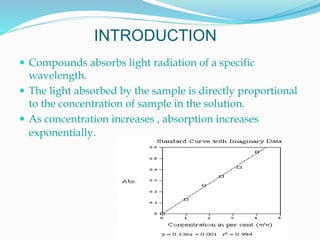
 The light absorbed by the sample is directly proportional
to the concentration of sample in the solution.
 As concentration increases , absorption increases
exponentially.
SPECTRPHOTOMETRY
 A method in which the absorption or transmission
properties of a material is quantitatively measured as
a function of wavelength.
 The basic principle behind this method is that :
“Each compound absorbs or transmits light over a
certain range of wavelength”
 A spectrophotometer is an instrument that measures
the amount of photons absorbed by a sample after it
is passed through its solution.
 With the spectrophotometer , the amount of a
known chemical substance can be determined by
measuring the absorbance.
Spectrophotometer can be classified into two different
types :
 SINGLE BEAM SPECTRMETER :
To measure the intensity of the incident light the
sample must be removed so that the reference can be
placed each time. This type of spectrometer is usually
less expensive and less complicated.
 DOUBLE BEAM SPECTOMETER:
In this type, before it reaches the sample, the light
source is split into two separate beams. From these one
passes through the sample and second one is used for
reference. This gives an advantage because the
reference reading and sample reading can take place at
the same time.
Based on the wavelength of light used it can be classified into :
 VISIBLE SPECTROMETER
Uses visible range (400 – 700nm) of electromagnetic radiation
spectrum.
Visible spectrophotometers vary in accuracy. Plastic and
glass cuvettes can be used for visible light spectroscopy.
 UV SPECTOMETER
Uses light over the UV range (180 - 400 nm).
UV spectroscopy is used for fluids, and even solids. Cuvettes, only
made of quartz, are used for placing the samples.
 IR SPECTROPHOTOMETER
Uses light over infra red range (700 -15000) of electromagnetic
radiation spectra.
DEVICE AND MECHANISM
 The spectrophotometer, in general, consists of two
devices. They are the following :
1. SPECTROMETER :
A device that produce, typically disperse and measure
the light.
2. PHOTOMETER :
Indicates the photoelectric dictator that measures the
light.
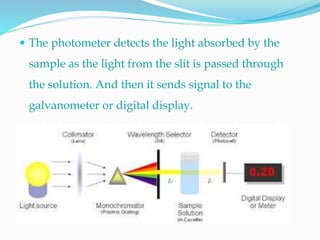
 The spectrometer consists of the following parts :
1. Light source : it produce a desired range of
wavelength of light.
2. Collimator : transmits a straight beam of light.
3. Monochromator : split the light into its
component wavelength.
4. Wavelength selector : transmits only the desired
wavelength.
 The photometer detects the light absorbed by the
sample as the light from the slit is passed through
the solution. And then it sends signal to the
galvanometer or digital display.
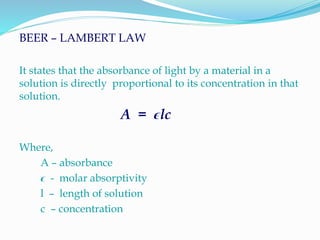
BEER – LAMBERT LAW
It states that the absorbance of light by a material in a
solution is directly proportional to its concentration in that
solution.
A = ϵlc
Where,
A – absorbance
ϵ - molar absorptivity
l – length of solution
c – concentration
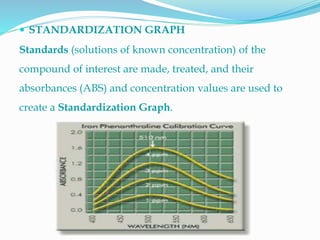
 STANDARDIZATION GRAPH
Standards (solutions of known concentration) of the
compound of interest are made, treated, and their
absorbances (ABS) and concentration values are used to
create a Standardization Graph.
 Absorption spectra :
A spectrum of electromagnetic radiation
transmitted through a substance, showing dark lines
or bands due to absorption at specific wavelengths.
APPLICATIONS
1. Concentration measurement
2. Detection of impurities
3. Chemical kinetics
4. Detection of functional group
5. Molecular weight determination
REFERENCES
 Fundamentals of UV –Visible spectrophotometry ,
Tony Owen, 1996
 UNIT : spectrophotometry : Clinical chemistry lab
manual
 www.wikipedia.com
 www.colorado.edu
 www.chemwiki.com
 www.chemguide.co.uk
 www.slideshare.com
Spectrophotometry

Spectrophotometry

  • 1.
    PRESENTED BY : SushmaP. R 2nd M. Sc. Biotech Brindavan college PRESENTED TO : Mrs. Divya Dept. of Chemistry Brindavan College
  • 2.
    INTRODUCTION  Compounds absorbslight radiation of a specific wavelength.  The light absorbed by the sample is directly proportional to the concentration of sample in the solution.  As concentration increases , absorption increases exponentially.
  • 3.
    SPECTRPHOTOMETRY  A methodin which the absorption or transmission properties of a material is quantitatively measured as a function of wavelength.  The basic principle behind this method is that : “Each compound absorbs or transmits light over a certain range of wavelength”
  • 4.
     A spectrophotometeris an instrument that measures the amount of photons absorbed by a sample after it is passed through its solution.  With the spectrophotometer , the amount of a known chemical substance can be determined by measuring the absorbance.
  • 5.
    Spectrophotometer can beclassified into two different types :  SINGLE BEAM SPECTRMETER : To measure the intensity of the incident light the sample must be removed so that the reference can be placed each time. This type of spectrometer is usually less expensive and less complicated.
  • 6.
     DOUBLE BEAMSPECTOMETER: In this type, before it reaches the sample, the light source is split into two separate beams. From these one passes through the sample and second one is used for reference. This gives an advantage because the reference reading and sample reading can take place at the same time.
  • 7.
    Based on thewavelength of light used it can be classified into :  VISIBLE SPECTROMETER Uses visible range (400 – 700nm) of electromagnetic radiation spectrum. Visible spectrophotometers vary in accuracy. Plastic and glass cuvettes can be used for visible light spectroscopy.  UV SPECTOMETER Uses light over the UV range (180 - 400 nm). UV spectroscopy is used for fluids, and even solids. Cuvettes, only made of quartz, are used for placing the samples.  IR SPECTROPHOTOMETER Uses light over infra red range (700 -15000) of electromagnetic radiation spectra.
  • 8.
    DEVICE AND MECHANISM The spectrophotometer, in general, consists of two devices. They are the following : 1. SPECTROMETER : A device that produce, typically disperse and measure the light. 2. PHOTOMETER : Indicates the photoelectric dictator that measures the light.
  • 9.
     The spectrometerconsists of the following parts : 1. Light source : it produce a desired range of wavelength of light. 2. Collimator : transmits a straight beam of light. 3. Monochromator : split the light into its component wavelength. 4. Wavelength selector : transmits only the desired wavelength.
  • 10.
     The photometerdetects the light absorbed by the sample as the light from the slit is passed through the solution. And then it sends signal to the galvanometer or digital display.
  • 12.
    BEER – LAMBERTLAW It states that the absorbance of light by a material in a solution is directly proportional to its concentration in that solution. A = ϵlc Where, A – absorbance ϵ - molar absorptivity l – length of solution c – concentration
  • 13.
     STANDARDIZATION GRAPH Standards(solutions of known concentration) of the compound of interest are made, treated, and their absorbances (ABS) and concentration values are used to create a Standardization Graph.
  • 14.
     Absorption spectra: A spectrum of electromagnetic radiation transmitted through a substance, showing dark lines or bands due to absorption at specific wavelengths.
  • 16.
    APPLICATIONS 1. Concentration measurement 2.Detection of impurities 3. Chemical kinetics 4. Detection of functional group 5. Molecular weight determination
  • 17.
    REFERENCES  Fundamentals ofUV –Visible spectrophotometry , Tony Owen, 1996  UNIT : spectrophotometry : Clinical chemistry lab manual  www.wikipedia.com  www.colorado.edu  www.chemwiki.com  www.chemguide.co.uk  www.slideshare.com