ENG   THE SPEAKING
103     PROCESS
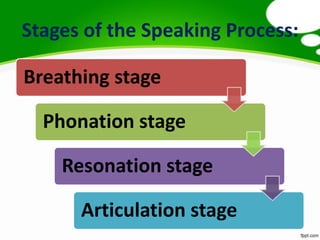
Stages of the Speaking Process:

Breathing stage

  Phonation stage

    Resonation stage

      Articulation stage
BREATHING
  STAGE
Breathing, which is
primarily concerned with
    maintaining life, is
    secondarily a force
assisting in vocalization.
It consists of two phases
     --- inhalation and
          exhalation.
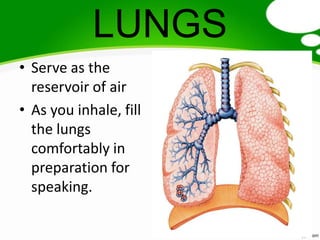
LUNGS
• Serve as the
  reservoir of air
• As you inhale, fill
  the lungs
  comfortably in
  preparation for
  speaking.
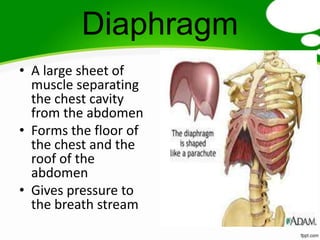
Diaphragm
• A large sheet of
  muscle separating
  the chest cavity
  from the abdomen
• Forms the floor of
  the chest and the
  roof of the
  abdomen
• Gives pressure to
  the breath stream
BREATHING EXERCISE:
• 1. Sit up straight. Exhale.
• 2. Inhale and, at the same time, relax the belly muscles. Feel as though the
  belly is filling with air.
• 3. After filling the belly, keep inhaling. Fill up the middle of your chest. Feel
  your chest and rib cage expand.
• 4. Hold the breath in for a moment, then begin to exhale as slowly as
  possible.
• 5. As the air is slowly let out, relax your chest and rib cage. Begin to pull
  your belly in to force out the remaining breath.
• 6. Close your eyes, and concentrate on your breathing.
• 7. Relax your face and mind.
• 8. Let everything go.
• 9. Practice about 5 minutes.
PHONATION
  STAGE
Phonation takes place when
voice is produced in speaking as
 the expiratory air stream from
 the lungs goes up through the
   trachea or windpipe to the
             larynx.
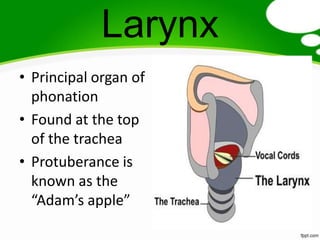
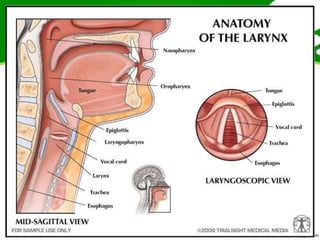
Larynx
• Principal organ of
  phonation
• Found at the top
  of the trachea
• Protuberance is
  known as the
  “Adam’s apple”
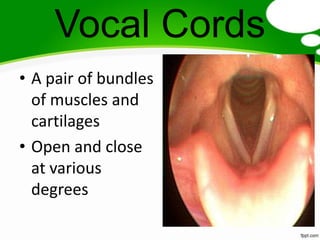
Vocal Cords
• A pair of bundles
  of muscles and
  cartilages
• Open and close
  at various
  degrees
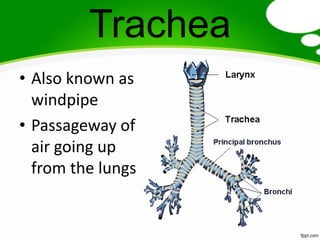
Trachea
• Also known as
  windpipe
• Passageway of
  air going up
  from the lungs
PHONATION EXERCISE
• Think about blowing out birthday
  candles.
• Begin to blow and then turn the breath
  into an "ooo" sound on a comfortable
  pitch. Feel the tone begin in the
  breathing muscles.
• Repeat
RESONATION
  STAGE
The voice produced in phonation is
   weak. It becomes strong and rich
 only when amplified and modified by
 the human resonators. Resonation is
the process of voice amplification and
             modification.
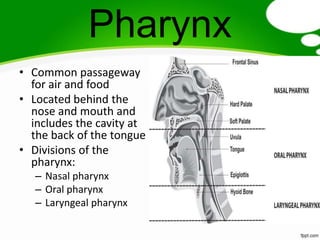
Pharynx
• Common passageway
  for air and food
• Located behind the
  nose and mouth and
  includes the cavity at
  the back of the tongue
• Divisions of the
  pharynx:
   – Nasal pharynx
   – Oral pharynx
   – Laryngeal pharynx
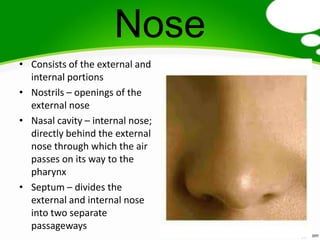
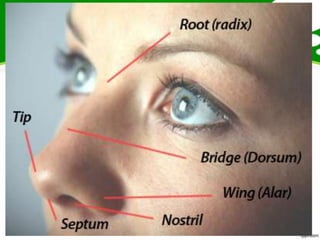
Nose
• Consists of the external and
  internal portions
• Nostrils – openings of the
  external nose
• Nasal cavity – internal nose;
  directly behind the external
  nose through which the air
  passes on its way to the
  pharynx
• Septum – divides the
  external and internal nose
  into two separate
  passageways
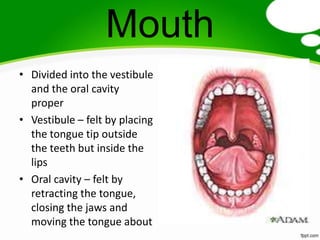
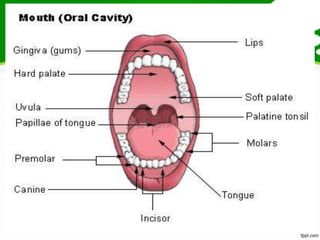
Mouth
• Divided into the vestibule
  and the oral cavity
  proper
• Vestibule – felt by placing
  the tongue tip outside
  the teeth but inside the
  lips
• Oral cavity – felt by
  retracting the tongue,
  closing the jaws and
  moving the tongue about
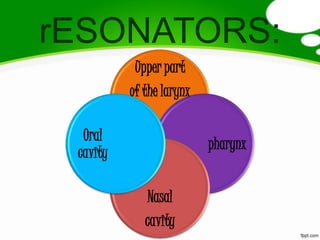
rESONATORS:
           Upper part
          of the larynx

  Oral
                          pharynx
 cavity

              Nasal
             cavity
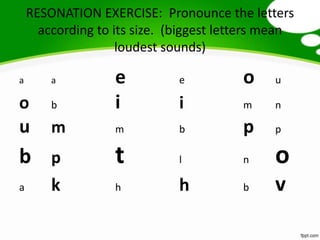
RESONATION EXERCISE: Pronounce the letters
      according to its size. (biggest letters mean
                    loudest sounds)

a       a          e          e          o    u

o       b          i          i          m    n

u       m          m          b          p    p

b       p          t          l          n    o
a       k          h          h          b    v
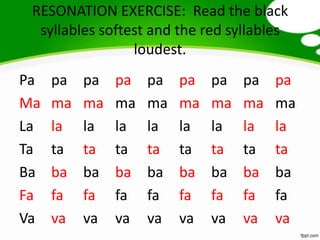
RESONATION EXERCISE: Read the black
  syllables softest and the red syllables
                 loudest.
Pa   pa   pa   pa   pa   pa   pa   pa   pa
Ma   ma   ma   ma   ma   ma   ma   ma   ma
La   la   la   la   la   la   la   la   la
Ta   ta   ta   ta   ta   ta   ta   ta   ta
Ba   ba   ba   ba   ba   ba   ba   ba   ba
Fa   fa   fa   fa   fa   fa   fa   fa   fa
Va   va   va   va   va   va   va   va   va
ARTICULATION
   STAGE
Articulation occurs when the
tone produced in the larynx is
changed into specific sounds.
   This is the result of the
movement of the articulators
    towards the points of
         articulation.
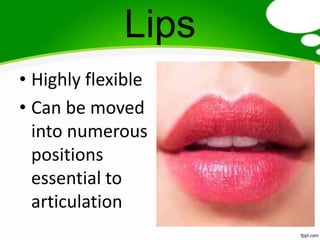
Lips
• Highly flexible
• Can be moved
  into numerous
  positions
  essential to
  articulation
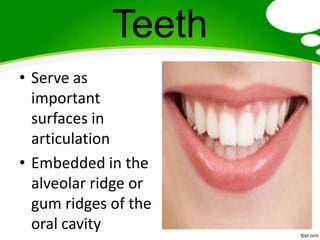
Teeth
• Serve as
  important
  surfaces in
  articulation
• Embedded in the
  alveolar ridge or
  gum ridges of the
  oral cavity
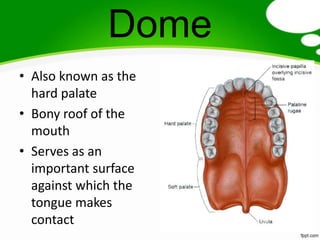
Dome
• Also known as the
  hard palate
• Bony roof of the
  mouth
• Serves as an
  important surface
  against which the
  tongue makes
  contact
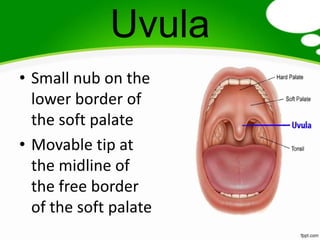
Uvula
• Small nub on the
  lower border of
  the soft palate
• Movable tip at
  the midline of
  the free border
  of the soft palate
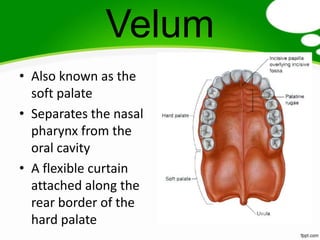
Velum
• Also known as the
  soft palate
• Separates the nasal
  pharynx from the
  oral cavity
• A flexible curtain
  attached along the
  rear border of the
  hard palate
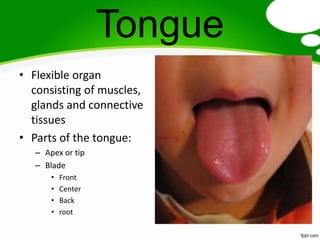
Tongue
• Flexible organ
  consisting of muscles,
  glands and connective
  tissues
• Parts of the tongue:
   – Apex or tip
   – Blade
       •   Front
       •   Center
       •   Back
       •   root
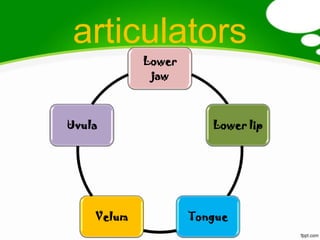
articulators
            Lower
             jaw


Uvula                  Lower lip


    Velum           Tongue
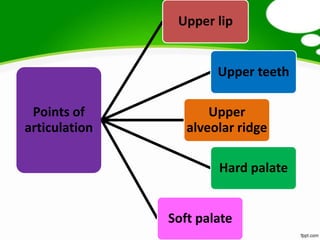
Upper lip


                       Upper teeth

 Points of            Upper
articulation      alveolar ridge

                       Hard palate


               Soft palate
ARTICULATION EXERCISE

Speech mechanism

  • 1.
    ENG THE SPEAKING 103 PROCESS
  • 2.
    Stages of theSpeaking Process: Breathing stage Phonation stage Resonation stage Articulation stage
  • 3.
  • 4.
    Breathing, which is primarilyconcerned with maintaining life, is secondarily a force assisting in vocalization. It consists of two phases --- inhalation and exhalation.
  • 5.
    LUNGS • Serve asthe reservoir of air • As you inhale, fill the lungs comfortably in preparation for speaking.
  • 6.
    Diaphragm • A largesheet of muscle separating the chest cavity from the abdomen • Forms the floor of the chest and the roof of the abdomen • Gives pressure to the breath stream
  • 7.
    BREATHING EXERCISE: • 1.Sit up straight. Exhale. • 2. Inhale and, at the same time, relax the belly muscles. Feel as though the belly is filling with air. • 3. After filling the belly, keep inhaling. Fill up the middle of your chest. Feel your chest and rib cage expand. • 4. Hold the breath in for a moment, then begin to exhale as slowly as possible. • 5. As the air is slowly let out, relax your chest and rib cage. Begin to pull your belly in to force out the remaining breath. • 6. Close your eyes, and concentrate on your breathing. • 7. Relax your face and mind. • 8. Let everything go. • 9. Practice about 5 minutes.
  • 8.
  • 9.
    Phonation takes placewhen voice is produced in speaking as the expiratory air stream from the lungs goes up through the trachea or windpipe to the larynx.
  • 10.
    Larynx • Principal organof phonation • Found at the top of the trachea • Protuberance is known as the “Adam’s apple”
  • 12.
    Vocal Cords • Apair of bundles of muscles and cartilages • Open and close at various degrees
  • 13.
    Trachea • Also knownas windpipe • Passageway of air going up from the lungs
  • 14.
    PHONATION EXERCISE • Thinkabout blowing out birthday candles. • Begin to blow and then turn the breath into an "ooo" sound on a comfortable pitch. Feel the tone begin in the breathing muscles. • Repeat
  • 15.
  • 16.
    The voice producedin phonation is weak. It becomes strong and rich only when amplified and modified by the human resonators. Resonation is the process of voice amplification and modification.
  • 17.
    Pharynx • Common passageway for air and food • Located behind the nose and mouth and includes the cavity at the back of the tongue • Divisions of the pharynx: – Nasal pharynx – Oral pharynx – Laryngeal pharynx
  • 18.
    Nose • Consists ofthe external and internal portions • Nostrils – openings of the external nose • Nasal cavity – internal nose; directly behind the external nose through which the air passes on its way to the pharynx • Septum – divides the external and internal nose into two separate passageways
  • 20.
    Mouth • Divided intothe vestibule and the oral cavity proper • Vestibule – felt by placing the tongue tip outside the teeth but inside the lips • Oral cavity – felt by retracting the tongue, closing the jaws and moving the tongue about
  • 22.
    rESONATORS: Upper part of the larynx Oral pharynx cavity Nasal cavity
  • 23.
    RESONATION EXERCISE: Pronouncethe letters according to its size. (biggest letters mean loudest sounds) a a e e o u o b i i m n u m m b p p b p t l n o a k h h b v
  • 24.
    RESONATION EXERCISE: Readthe black syllables softest and the red syllables loudest. Pa pa pa pa pa pa pa pa pa Ma ma ma ma ma ma ma ma ma La la la la la la la la la Ta ta ta ta ta ta ta ta ta Ba ba ba ba ba ba ba ba ba Fa fa fa fa fa fa fa fa fa Va va va va va va va va va
  • 25.
  • 26.
    Articulation occurs whenthe tone produced in the larynx is changed into specific sounds. This is the result of the movement of the articulators towards the points of articulation.
  • 27.
    Lips • Highly flexible •Can be moved into numerous positions essential to articulation
  • 28.
    Teeth • Serve as important surfaces in articulation • Embedded in the alveolar ridge or gum ridges of the oral cavity
  • 29.
    Dome • Also knownas the hard palate • Bony roof of the mouth • Serves as an important surface against which the tongue makes contact
  • 30.
    Uvula • Small nubon the lower border of the soft palate • Movable tip at the midline of the free border of the soft palate
  • 31.
    Velum • Also knownas the soft palate • Separates the nasal pharynx from the oral cavity • A flexible curtain attached along the rear border of the hard palate
  • 32.
    Tongue • Flexible organ consisting of muscles, glands and connective tissues • Parts of the tongue: – Apex or tip – Blade • Front • Center • Back • root
  • 33.
    articulators Lower jaw Uvula Lower lip Velum Tongue
  • 34.
    Upper lip Upper teeth Points of Upper articulation alveolar ridge Hard palate Soft palate
  • 35.
  • 36.