Phonology
Teaching
Language Arts
Prepared by: Gureysha Hassan
Introduction
• Definition of the topic phonology with
examples
• Expanded details of the topic – phonology
with examples
• The topic in relation to the impacts in a
language learning classroom
• Conclusion with reference.
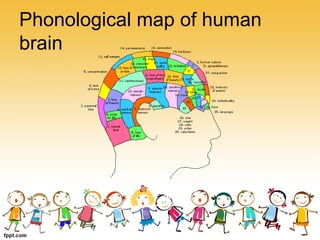
Phonological map of human
brain
Introduction of phonology
• Phonology is the study of the sound systems of
languages.
• Phonology is the study of the way sounds
functions in languages.
• Phonology is the patterns of sounds
• Phonology tells us how various sounds form
patterns to create phonemes and their
allophones.
The term refers to the patterns
of phonetic elements such as….
• Phone-- is the minimal unit of speech
• Phoneme– is the smallest
• Allophone– is a variant of a phoneme.
Phonology
The sound system involves:
 the actual pronunciation of words which can be broken
up into the smallest units of pronunciation, known as
a segment or a phoneme.
 Eg: The words pat, chat and fat.
Change of a phoneme in a word creates a different
word ( Eg. . /kæp tæp læp/).
Errors in pronunciation can be either allophonic or
phonological for eg. Pat is heard as bat by the
listener.
Categories of phonology
• Sounds and phonemes
• Vowels and consonants
• Hearing
• Physical demonstration
• Discrimination eg. Ship /sheep
orfeet, seat
Features of speech
• Stress
•Intonation
•Rhythm
•Tone
•Pitch
•Syllable structure
Importance
• The way in which foreign languages links
phonemes together, physically carries out
sequences of sounds in stressed and
unstressed position in speech,
• shapes words and build up word
combination and gives them rhythm in
sentence and longer stretches.
(Lehtonenetal 1977 9-10)
Impacts of phonology in a language
learning classroom
• Incorrectly articulated consonants will affect the
production of vowels, as vowels will affect
consonants
• Some words are spelled differently and
pronounced the same eg. I and eye
• In addition some vowels are spelled the same
way they are written but are pronounced
differently eg. Blood/spoon
• This is one of the most problematic
problems for young learners face in the
classrooms
Some activities
• To teach or practice the differences between
spelling and pronunciation can be taught:
• Using rhyming words
• Cards
• Fill in the blanks
• Finding silent letters
• Minimal pair eg. Cab/cap, rot/lot…
Conclusion
• In conclusion I would say that we (as teachers)
should have a good knowledge of understanding
on how to articulate ( English sounds) correctly
in order to teach our students
• Need to be a good listener
• Knowledge of phonology effect and major
allophones.
• Pronunciation of both mother tongue and
the target language
References
• Slide share
• Ashby, p (1995) speech sounds London
Routlodge
• Bradford, B Intonation in context
Cambridge– Cambridge University
• www. Academia.edu
Fun Facts About Phonology
• By first grade most children understand
about 10,000 words. (Anglin, 1993,as cited in
Siegler, & Akibali, 2005).
• By fifth grade children understand about
40,000 words. ( Anglin, 1993, as cited in Siegler, & Alibali,
2005).
 ppt on phonology

ppt on phonology

  • 1.
  • 2.
    Introduction • Definition ofthe topic phonology with examples • Expanded details of the topic – phonology with examples • The topic in relation to the impacts in a language learning classroom • Conclusion with reference.
  • 3.
  • 4.
    Introduction of phonology •Phonology is the study of the sound systems of languages. • Phonology is the study of the way sounds functions in languages. • Phonology is the patterns of sounds • Phonology tells us how various sounds form patterns to create phonemes and their allophones.
  • 5.
    The term refersto the patterns of phonetic elements such as…. • Phone-- is the minimal unit of speech • Phoneme– is the smallest • Allophone– is a variant of a phoneme.
  • 6.
    Phonology The sound systeminvolves:  the actual pronunciation of words which can be broken up into the smallest units of pronunciation, known as a segment or a phoneme.  Eg: The words pat, chat and fat. Change of a phoneme in a word creates a different word ( Eg. . /kæp tæp læp/). Errors in pronunciation can be either allophonic or phonological for eg. Pat is heard as bat by the listener.
  • 7.
    Categories of phonology •Sounds and phonemes • Vowels and consonants • Hearing • Physical demonstration • Discrimination eg. Ship /sheep orfeet, seat
  • 8.
    Features of speech •Stress •Intonation •Rhythm •Tone •Pitch •Syllable structure
  • 9.
    Importance • The wayin which foreign languages links phonemes together, physically carries out sequences of sounds in stressed and unstressed position in speech, • shapes words and build up word combination and gives them rhythm in sentence and longer stretches. (Lehtonenetal 1977 9-10)
  • 10.
    Impacts of phonologyin a language learning classroom • Incorrectly articulated consonants will affect the production of vowels, as vowels will affect consonants • Some words are spelled differently and pronounced the same eg. I and eye • In addition some vowels are spelled the same way they are written but are pronounced differently eg. Blood/spoon
  • 11.
    • This isone of the most problematic problems for young learners face in the classrooms
  • 12.
    Some activities • Toteach or practice the differences between spelling and pronunciation can be taught: • Using rhyming words • Cards • Fill in the blanks • Finding silent letters • Minimal pair eg. Cab/cap, rot/lot…
  • 13.
    Conclusion • In conclusionI would say that we (as teachers) should have a good knowledge of understanding on how to articulate ( English sounds) correctly in order to teach our students • Need to be a good listener • Knowledge of phonology effect and major allophones. • Pronunciation of both mother tongue and the target language
  • 14.
    References • Slide share •Ashby, p (1995) speech sounds London Routlodge • Bradford, B Intonation in context Cambridge– Cambridge University • www. Academia.edu
  • 15.
    Fun Facts AboutPhonology • By first grade most children understand about 10,000 words. (Anglin, 1993,as cited in Siegler, & Akibali, 2005). • By fifth grade children understand about 40,000 words. ( Anglin, 1993, as cited in Siegler, & Alibali, 2005).