







This document provides an overview of the major and minor branches of linguistics. The major branches discussed are phonology, morphology, syntax, and semantics. Phonology is the study of sound structure in language. Morphology studies word formation. Syntax deals with the arrangement of words. Semantics is the study of meaning. The minor branches covered are phonetics, sociolinguistics, psycholinguistics, and pragmatics. Phonetics focuses on speech sounds. Sociolinguistics examines the relationship between language and society. Psycholinguistics studies language processing in the brain. Pragmatics relates to practical language use. Examples are provided for some branches.
1: a personaccomplished in languages
especially : one who speaks several languages
2: a person who specializes in linguistics
What is a linguist ?
4.
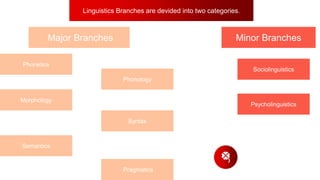
Linguistics Branches aredevided into two categories.
Major Branches Minor Branches
Phonology
Sociolinguistics
Semantics
Pragmatics
Syntax
Morphology
Phonetics
Psycholinguistics
6.
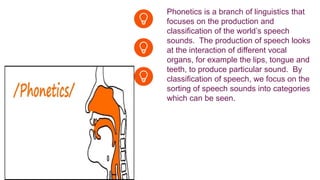
Phonetics is abranch of linguistics that
focuses on the production and
classification of the world’s speech
sounds. The production of speech looks
at the interaction of different vocal
organs, for example the lips, tongue and
teeth, to produce particular sound. By
classification of speech, we focus on the
sorting of speech sounds into categories
which can be seen.
9.
Morphology – theinternal structure of words.
Morphology is the study of the internal structure of words and
forms a core part of linguistic study today.
What is a word?
Smallest independent units of language
Independent:
do not depend on other words.
can be separated from other units.
can change position.
The man looked at the horses.
s is the plural marker, dependent on the noun horse to receive meaning
Horses is a word: can occur in other positions or stand on its own.
10.
Syntax is thearrangement of words
and phrases in a specific order. If you
change the position of even one word,
it’s possible to change the meaning of
the entire sentence.
15.
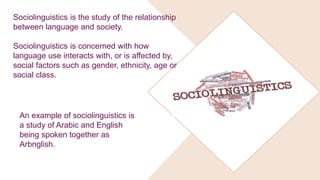
Sociolinguistics is thestudy of the relationship
between language and society.
Sociolinguistics is concerned with how
language use interacts with, or is affected by,
social factors such as gender, ethnicity, age or
social class.
An example of sociolinguistics is
a study of Arabic and English
being spoken together as
Arbnglish.
16.
Psycholinguistics is thestudy of the
mental aspects of language and
speech. It is primarily concerned with
the ways in which language is
represented and processed in the
brain.
An example of
psycholinguistics is a study of
how certain words represent
traumatic events for some
people.
17.
Phonology is thestudy of sound structure in
language.
Morphology is a study and description of word formation
(such as inflection, derivation, and compounding) in
language.
Syntax deals with the formal properties of
languages.
Semantics is the study of meaning or relationship of
meanings of a sign or set of signs especially connotative
meaning.
18.
Pragmatics is relatingto matters of fact or practical affairs often to the
exclusion of intellectual or artistic matters.
Phonetics is the system of speech sounds of a
language or group of languages.
Sociolinguistics is the study of linguistic behavior as
determined by sociocultural factors.
Psycholinguistics is the study of the mental faculties involved in
the perception, production, and acquisition of language.