Phonetics and Phonology
Lesson 2: Sounds articulation process.
• Speech production (voiced and unvoiced
sounds).
• The organs of speech.
• The Places of articulatory gesture.
• The manner of articulation.
By: Israel Reyes
Speech production
Voiced Sounds Unvoiced Sounds
It is when your vocal
chords are vibrating,
producing a sound.
It is when there is no
vocal chords vibration.
They are apart.
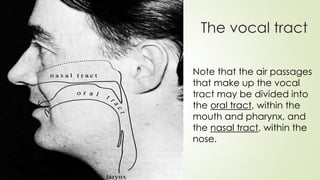
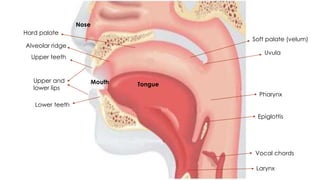
The vocal tract
Note that the air passages
that make up the vocal
tract may be divided into
the oral tract, within the
mouth and pharynx, and
the nasal tract, within the
nose.
Upper and
lower lips
Upper teeth
Lower teeth
Alveolar ridge
Hard palate
Soft palate (velum)
Uvula
Pharynx
Vocal chords
Larynx
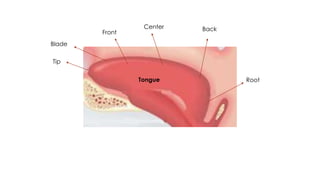
Tongue
Nose
Mouth
Epiglottis
Tip
Blade
Front
Center Back
RootTongue
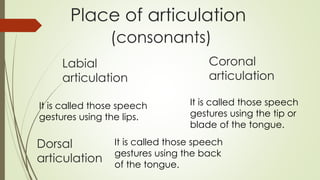
Place of articulation
(consonants)
Labial
articulation
Coronal
articulation
Dorsal
articulation
It is called those speech
gestures using the lips.
It is called those speech
gestures using the tip or
blade of the tongue.
It is called those speech
gestures using the back
of the tongue.
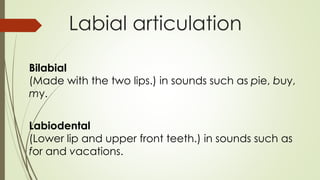
Bilabial
(Made with the two lips.) in sounds such as pie, buy,
my.
Labiodental
(Lower lip and upper front teeth.) in sounds such as
for and vacations.
Labial articulation
Coronal articulation
Dental
(Tongue tip or blade and upper front teeth.) in sounds
such as thigh and those.
Alveolar
(Tongue tip or blade and the alveolar ridge.) in sounds
such as tie, die, night, sight, zeal, lie.
Retroflex
(Tongue tip and the back of the alveolar ridge.) in
sounds such as ire, hour, air.
Palatal
(Front of the tongue and hard palate.) in sounds such
as you, yet.
Note: This kind of sound is sometimes classified as
coronal articulations and sometimes as dorsal
articulations.
Dorsal articulation
Velar
(Back of the tongue and soft palate.) in sounds
such as those that occur at the end of hack,
hag, hang.
Manner of articulation
Stop
(Complete closure of the articulators involved so that
the airstream cannot escape through the mouth.)
There are two possible types of stop:
Oral stop
The soft palate is raised so that the nasal tract is blocked
off, then the airstream will be completely obstructed.
Pressure in the mouth will build up and an oral stop will be
formed. This sound are called plosives. This kind of sound
occurs in the consonants in the words pie, buy, tie, dye,
key, guy.
Nasal stop
If the air is stopped in the oral cavity but the soft palate
is down so that air can go out through the nose, the
sound produced is a nasal stop. Sounds of this kind
occur at the beginning of the words my and night, and
at the end of the word sang.
Fricative
(Close approximation of two articulators so that
the airstream is partially obstructed and
turbulent airflow is produced.) The consonants in
for, thigh, thy, sigh, zoo, and shy are examples of
fricative sounds.
Approximant
(A gesture in which one articulator is close to
another, but without the vocal tract being
narrowed to such an extent that a turbulent
airstream is produced.)in sounds such as young,
we.
Lateral (Approximant)
(Obstruction of the airstream at a point along the
center of the oral tract, with incomplete closure
between one or both sides of the tongue and the
roof of the mouth.) Like in the word lie
Affricative
(Close approximation of two articulators so that
the airstream is partially obstructed and
escapes with slight friction through the mouth) It
is in sounds such as chair, church, just.
Closure
Thank you

Sounds articulation process

  • 1.
    Phonetics and Phonology Lesson2: Sounds articulation process. • Speech production (voiced and unvoiced sounds). • The organs of speech. • The Places of articulatory gesture. • The manner of articulation. By: Israel Reyes
  • 2.
    Speech production Voiced SoundsUnvoiced Sounds It is when your vocal chords are vibrating, producing a sound. It is when there is no vocal chords vibration. They are apart.
  • 3.
    The vocal tract Notethat the air passages that make up the vocal tract may be divided into the oral tract, within the mouth and pharynx, and the nasal tract, within the nose.
  • 4.
    Upper and lower lips Upperteeth Lower teeth Alveolar ridge Hard palate Soft palate (velum) Uvula Pharynx Vocal chords Larynx Tongue Nose Mouth Epiglottis
  • 5.
  • 6.
    Place of articulation (consonants) Labial articulation Coronal articulation Dorsal articulation Itis called those speech gestures using the lips. It is called those speech gestures using the tip or blade of the tongue. It is called those speech gestures using the back of the tongue.
  • 7.
    Bilabial (Made with thetwo lips.) in sounds such as pie, buy, my. Labiodental (Lower lip and upper front teeth.) in sounds such as for and vacations. Labial articulation
  • 8.
    Coronal articulation Dental (Tongue tipor blade and upper front teeth.) in sounds such as thigh and those. Alveolar (Tongue tip or blade and the alveolar ridge.) in sounds such as tie, die, night, sight, zeal, lie.
  • 9.
    Retroflex (Tongue tip andthe back of the alveolar ridge.) in sounds such as ire, hour, air. Palatal (Front of the tongue and hard palate.) in sounds such as you, yet. Note: This kind of sound is sometimes classified as coronal articulations and sometimes as dorsal articulations.
  • 10.
    Dorsal articulation Velar (Back ofthe tongue and soft palate.) in sounds such as those that occur at the end of hack, hag, hang.
  • 11.
    Manner of articulation Stop (Completeclosure of the articulators involved so that the airstream cannot escape through the mouth.) There are two possible types of stop: Oral stop The soft palate is raised so that the nasal tract is blocked off, then the airstream will be completely obstructed. Pressure in the mouth will build up and an oral stop will be formed. This sound are called plosives. This kind of sound occurs in the consonants in the words pie, buy, tie, dye, key, guy.
  • 12.
    Nasal stop If theair is stopped in the oral cavity but the soft palate is down so that air can go out through the nose, the sound produced is a nasal stop. Sounds of this kind occur at the beginning of the words my and night, and at the end of the word sang.
  • 13.
    Fricative (Close approximation oftwo articulators so that the airstream is partially obstructed and turbulent airflow is produced.) The consonants in for, thigh, thy, sigh, zoo, and shy are examples of fricative sounds. Approximant (A gesture in which one articulator is close to another, but without the vocal tract being narrowed to such an extent that a turbulent airstream is produced.)in sounds such as young, we.
  • 14.
    Lateral (Approximant) (Obstruction ofthe airstream at a point along the center of the oral tract, with incomplete closure between one or both sides of the tongue and the roof of the mouth.) Like in the word lie Affricative (Close approximation of two articulators so that the airstream is partially obstructed and escapes with slight friction through the mouth) It is in sounds such as chair, church, just.
  • 15.
  • 16.