TOPIC 3
PHONOLOGY: THE SOUNDS
    OF LANGUAGE

  Speech Organs And
      Articulations
Phonology
The study of the sound systems of
languages, and of the general properties
displayed by these systems
(the contrast in sound [phoneme] ) which
make the difference within the
language.

                                The Lecturer©
Phonology vs Phonetics

Phonology is concerned with the
 functional properties of speech sounds

Phonetics is concerned with the physical
 aspects of speech sounds


                                   wikipedia©
SPEECH ORGANS AND
         ARTICULATION
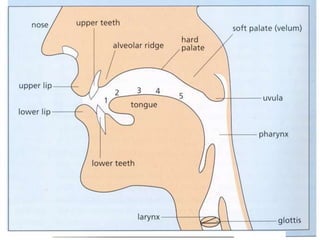
There are seven main articulators;
1. Pharynx
2. Velum/Soft Palate
3. Hard Palate
4. Alveolar Ridge
5. Upper Teeth
6. Lower Teeth
7. Lips
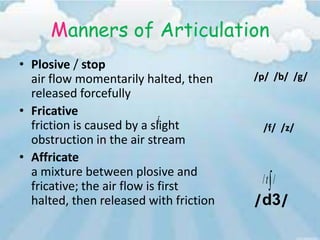
Manners of Articulation
• Plosive / stop
  air flow momentarily halted, then     /p/ /b/ /g/
  released forcefully
• Fricative
  friction is caused by a slight         /f/ /z/
  obstruction in the air stream
• Affricate
  a mixture between plosive and
                                         /t /
  fricative; the air flow is first
  halted, then released with friction   /d3/
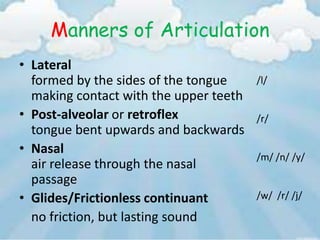
Manners of Articulation
• Lateral
  formed by the sides of the tongue     /l/
  making contact with the upper teeth
• Post-alveolar or retroflex            /r/
  tongue bent upwards and backwards
• Nasal
                                        /m/ /n/ /y/
  air release through the nasal
  passage
• Glides/Frictionless continuant        /w/ /r/ /j/

  no friction, but lasting sound
Voice production..

• organs of speech - in the mouth and throat.
• air pushed out from the lungs through the
larynx and epiglottis vibrates the vocal cords-
• producing a continuous tone whose pitch can
be changed by varying the shape of the larynx.
• Consonants - modified by the tongue and lips,
are formed when air is emitted suddenly or when
it is cut off firmly.
• Voice production occurs in the larynx.
• During breathing the vocal cords are held
apart, but as speech commences, the
cartilages of the larynx are drawn together by
the action of muscles and a "chink" is created.
• The tension of the vibrating cords, changed
by the tilting of the cartilages, alters the pitch
of the spoken sound. High notes are produced
by the vibration of tight vocal cords and low
notes are produced by vibrating loose cords.


Chink - a small narrow crack or opening
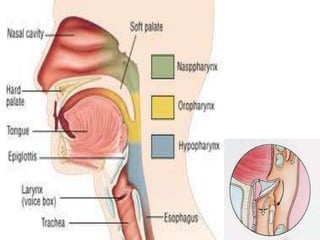
Pharynx
• Pharyngeal sound
• A tube above the larynx.
• Divided into two at the top;
  – the back of the mouth
  – the beginning of the way through the nasal cavity
   (above the mouth, behind the nose)
• the symbol in IPA (International Phonetic
Alphabet) is ʕ

                                           The Lecturer©
                                             Wikipedia ©
Velum/Soft Palate

• Velar consonant.
• Often in speech, the velum is raised so that air
  cannot escape through the nose.
• When the /k/ and the /g/ (velar consonants)
  sound is produced, the tongue is in contact
  with the lower side of the velum.
HardPalate
              Hard Palate

• Roof of the mouth.
    • interaction between
• TheRoof of the mouth. the tongue and the
    • The interaction between formation
  hard palate is essential in thethe tongue
  ofand the hard palate issound. in the
      /t/, /d/, /j/, and /ɟ/ essential
    formation of /t/, /d/ and /j/ sound.
Alveolar Ridge
• Alveolar sound.
• Between the top front teeth and the hard
  palate.
• It’s surface is covered with little ridge.
• The sound produced is called alveolar
  – /t/ and /d/
Teeth (Upper and Lower)
• Most speakers have teeth to the sides of their
  mouth.
• The back is almost to the soft palate.
• The tongue is in contact for many speech
  sounds.
• Dental sound;
   /t/, /d/, /n/, and /l/
Lips
• Pressed together (bilabial)
  /p/
• Brought into contact with teeth (labiodentals)
  /f/, /v/
• Rounded
  /u/
Larynx (Adam’s apple)
• A very complex and dependent articulators
• The vibration of larynx can be detected while
  producing the sound /z/
Nose and Nasal Cavity


   • Nasal consonant
     /m/ and /n/
Jaws

• Being called as articulators because of the
  movement of the jaws
• Jaws not like other articulators – don’t make
  contact with other articulators.