Types of
research
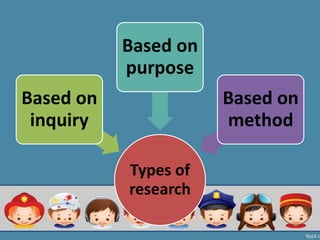
Types of
research
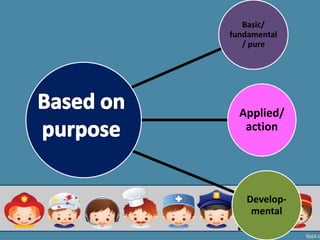
Based on
inquiry
Based on
purpose
Based on
method
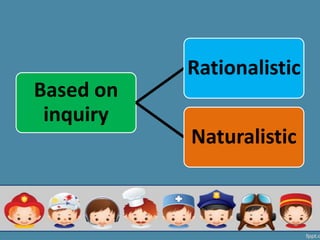
Based on
inquiry
Rationalistic
Naturalistic
Rationalistic Inquiries
Begin with an existing theory
Formal instruments are used
Findings are generalized
Problem is converted into dependent and
independent variables after which the
researcher develops strategies and instruments
to control relationships between and among
naturally occurring variables.
Naturalistic Inquiries
State that we must
understand the framework
within which the subjects under
study interpret their
environment to be able to
understand human behavior
The individual’s thoughts,
values, perceptions and actions
are studied.
Basic/
fundamental
/ pure
Applied/
action
Develop-
mental
Basic Research
Directed towards
developing new or fuller
scientific knowledge or
understanding of the
subject rather than its
practical application
Researcher’s intellect is
triggered and social
implications of existing
social problems are
uncovered.
Applied Research
Also known as action research
Directed towards the practical application of
knowledge
Theory may be supported, modified or revised.
New theory may even be provided.
Covers mostly social science areas
Entails large-scale studies with subsequent
problems on data collection
Developmental Research
Refers to the systematic work drawing on
existing knowledge gained from research
and/or practical experience that is directed to
producing new materials, products and
devices; to installing new processes, systems
and services; and to improving substantially
those already produced or installed
Often used in engineering and technology
areas
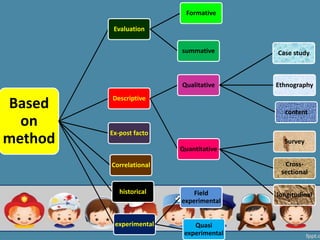
Based
on
method
Evaluation
Formative
summative
Descriptive
Qualitative
Case study
Ethnography
content
Quantitative
Survey
Cross-
sectional
longitudinal
Ex-post facto
Correlational
historical
experimental
Field
experimental
Quasi
experimental
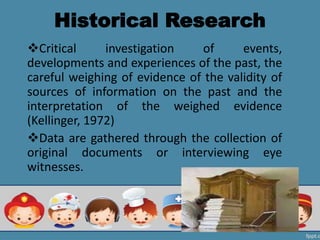
Historical Research
Critical investigation of events,
developments and experiences of the past, the
careful weighing of evidence of the validity of
sources of information on the past and the
interpretation of the weighed evidence
(Kellinger, 1972)
Data are gathered through the collection of
original documents or interviewing eye
witnesses.
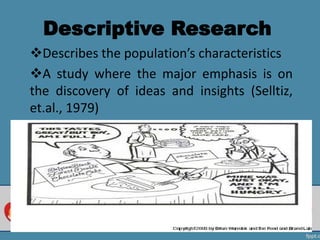
Descriptive Research
Describes the population’s characteristics
A study where the major emphasis is on
the discovery of ideas and insights (Selltiz,
et.al., 1979)
Correlational Research
Involves the
collection of two or
more sets of data
from a group of
subjects with the
attempt to determine
the subsequent
relationship between
those sets of data
(Tuckman, 1972)
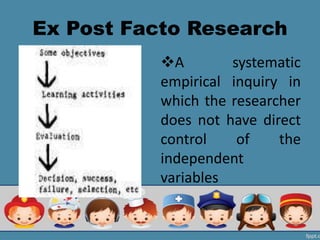
Ex Post Facto Research
A systematic
empirical inquiry in
which the researcher
does not have direct
control of the
independent
variables
Evaluation Research
Judges the value, worth or merit of an
existing program
Formative and summative evaluation are
applied in training programs, textbooks,
manuals or curricula.
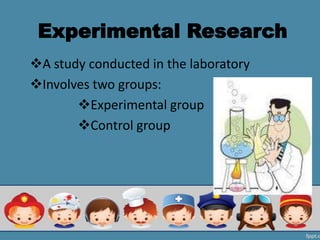
Experimental Research
A study conducted in the laboratory
Involves two groups:
Experimental group
Control group
Research types

Research types