Public
Speaking
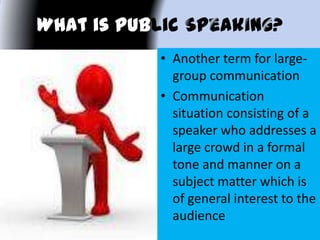
What is Public k
• Another term for large-
group communication
• Communication
situation consisting of a
speaker who addresses a
large crowd in a formal
tone and manner on a
subject matter which is
of general interest to the
audience
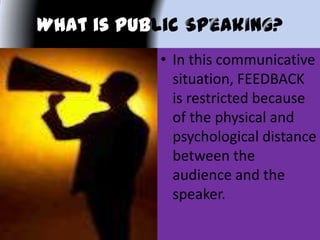
What is Public k
• In this communicative
situation, FEEDBACK
is restricted because
of the physical and
psychological distance
between the
audience and the
speaker.
What is Public k
• It also lacks the
spontaneity and
flexibility of a
face-to-face
situation.
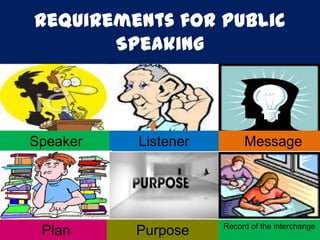
Requirements for Public
Speaking
Speaker Listener Message
Plan Purpose Record of the interchange
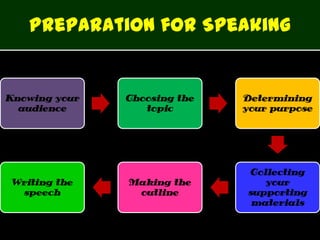
Preparation for Speaking
Knowing your
audience
Choosing the
topic
Determining
your purpose
Collecting
your
supporting
materials
Making the
outline
Writing the
speech
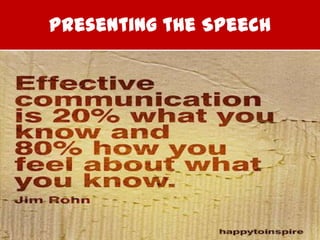
Presenting the Speech
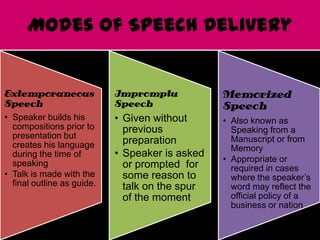
Modes of Speech Delivery
Extemporaneous
Speech
• Speaker builds his
compositions prior to
presentation but
creates his language
during the time of
speaking
• Talk is made with the
final outline as guide.
Impromptu
Speech
• Given without
previous
preparation
• Speaker is asked
or prompted for
some reason to
talk on the spur
of the moment
Memorized
Speech
• Also known as
Speaking from a
Manuscript or from
Memory
• Appropriate or
required in cases
where the speaker’s
word may reflect the
official policy of a
business or nation
You must
complement your
message with your
body during
delivery.
Specifically, be
aware of your:
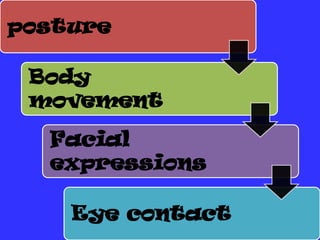
posture
Body
movement
Facial
expressions
Eye contact
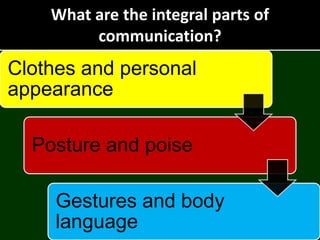
What are the integral parts of
communication?
Clothes and personal
appearance
Posture and poise
Gestures and body
language
Clothes and
Personal
Appearance
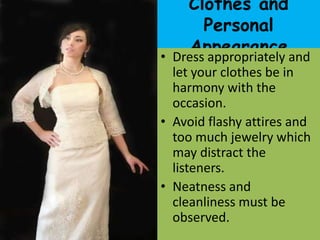
• Dress appropriately and
let your clothes be in
harmony with the
occasion.
• Avoid flashy attires and
too much jewelry which
may distract the
listeners.
• Neatness and
cleanliness must be
observed.
Posture and
Poise
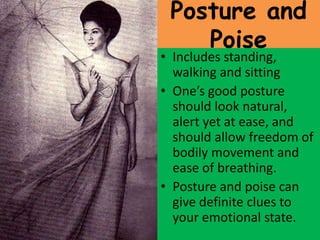
• Includes standing,
walking and sitting
• One’s good posture
should look natural,
alert yet at ease, and
should allow freedom of
bodily movement and
ease of breathing.
• Posture and poise can
give definite clues to
your emotional state.
Gestures and
Body Language
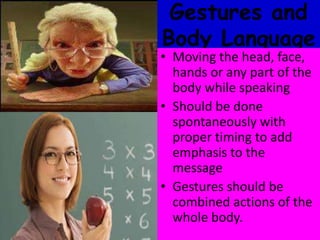
• Moving the head, face,
hands or any part of the
body while speaking
• Should be done
spontaneously with
proper timing to add
emphasis to the
message
• Gestures should be
combined actions of the
whole body.
Basic Hand
Gestures
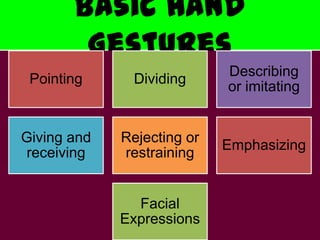
Pointing Dividing
Describing
or imitating
Giving and
receiving
Rejecting or
restraining
Emphasizing
Facial
Expressions
Tips
and
Techniques:
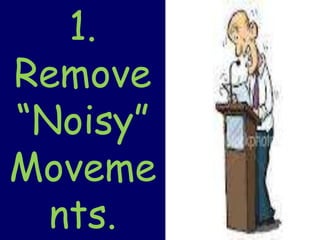
1.
Remove
“Noisy”
Moveme
nts.
is as much to be gained
from removing nervous
and distracting
movements as there is
from adding conscious
gestures. It may seem
counter-intuitive, but
this is “addition by
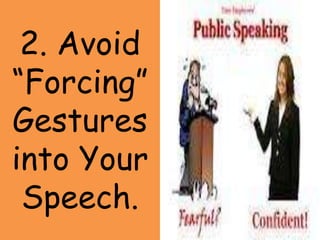
2. Avoid
“Forcing”
Gestures
into Your
Speech.
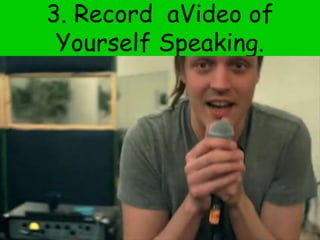
3. Record aVideo of
Yourself Speaking.
Public speaking
Public speaking

Public speaking

  • 1.
  • 3.
    What is Publick • Another term for large- group communication • Communication situation consisting of a speaker who addresses a large crowd in a formal tone and manner on a subject matter which is of general interest to the audience
  • 4.
    What is Publick • In this communicative situation, FEEDBACK is restricted because of the physical and psychological distance between the audience and the speaker.
  • 5.
    What is Publick • It also lacks the spontaneity and flexibility of a face-to-face situation.
  • 6.
    Requirements for Public Speaking SpeakerListener Message Plan Purpose Record of the interchange
  • 7.
    Preparation for Speaking Knowingyour audience Choosing the topic Determining your purpose Collecting your supporting materials Making the outline Writing the speech
  • 8.
  • 9.
    Modes of SpeechDelivery Extemporaneous Speech • Speaker builds his compositions prior to presentation but creates his language during the time of speaking • Talk is made with the final outline as guide. Impromptu Speech • Given without previous preparation • Speaker is asked or prompted for some reason to talk on the spur of the moment Memorized Speech • Also known as Speaking from a Manuscript or from Memory • Appropriate or required in cases where the speaker’s word may reflect the official policy of a business or nation
  • 10.
    You must complement your messagewith your body during delivery. Specifically, be aware of your:
  • 11.
  • 12.
    What are theintegral parts of communication? Clothes and personal appearance Posture and poise Gestures and body language
  • 13.
    Clothes and Personal Appearance • Dressappropriately and let your clothes be in harmony with the occasion. • Avoid flashy attires and too much jewelry which may distract the listeners. • Neatness and cleanliness must be observed.
  • 14.
    Posture and Poise • Includesstanding, walking and sitting • One’s good posture should look natural, alert yet at ease, and should allow freedom of bodily movement and ease of breathing. • Posture and poise can give definite clues to your emotional state.
  • 15.
    Gestures and Body Language •Moving the head, face, hands or any part of the body while speaking • Should be done spontaneously with proper timing to add emphasis to the message • Gestures should be combined actions of the whole body.
  • 16.
    Basic Hand Gestures Pointing Dividing Describing orimitating Giving and receiving Rejecting or restraining Emphasizing Facial Expressions
  • 17.
  • 18.
  • 19.
    is as muchto be gained from removing nervous and distracting movements as there is from adding conscious gestures. It may seem counter-intuitive, but this is “addition by
  • 20.
  • 21.
    3. Record aVideoof Yourself Speaking.