NOUNS
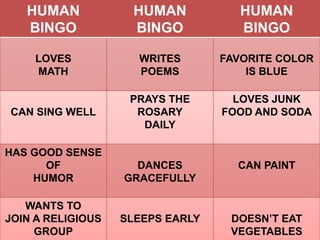
HUMAN
BINGO
HUMAN
BINGO
HUMAN
BINGO
LOVES
MATH
WRITES
POEMS
FAVORITE COLOR
IS BLUE
CAN SING WELL
PRAYS THE
ROSARY
DAILY
LOVES JUNK
FOOD AND SODA
HAS GOOD SENSE
OF
HUMOR
DANCES
GRACEFULLY
CAN PAINT
WANTS TO
JOIN A RELIGIOUS
GROUP
SLEEPS EARLY DOESN’T EAT
VEGETABLES
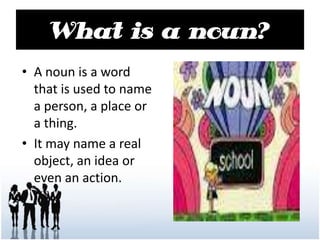
What is a noun?
• A noun is a word
that is used to name
a person, a place or
a thing.
• It may name a real
object, an idea or
even an action.
Properties
of Nouns
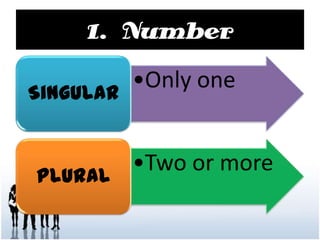
1. Number
•Only oneSingular
•Two or morePlural
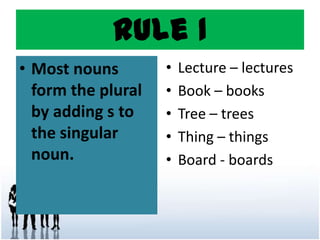
Rule 1
• Most nouns
form the plural
by adding s to
the singular
noun.
• Lecture – lectures
• Book – books
• Tree – trees
• Thing – things
• Board - boards
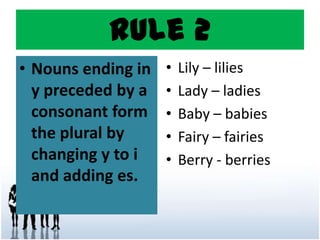
Rule 2
• Nouns ending in
y preceded by a
consonant form
the plural by
changing y to i
and adding es.
• Lily – lilies
• Lady – ladies
• Baby – babies
• Fairy – fairies
• Berry - berries
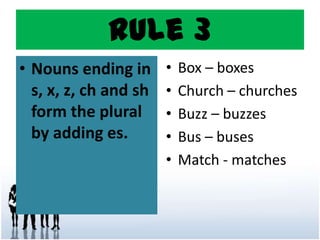
Rule 3
• Nouns ending in
s, x, z, ch and sh
form the plural
by adding es.
• Box – boxes
• Church – churches
• Buzz – buzzes
• Bus – buses
• Match - matches
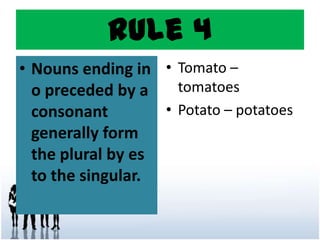
Rule 4
• Nouns ending in
o preceded by a
consonant
generally form
the plural by es
to the singular.
• Tomato –
tomatoes
• Potato – potatoes
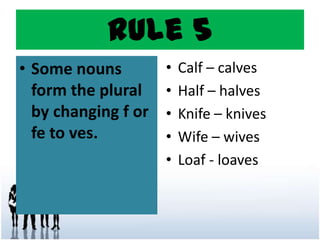
Rule 5
• Some nouns
form the plural
by changing f or
fe to ves.
• Calf – calves
• Half – halves
• Knife – knives
• Wife – wives
• Loaf - loaves
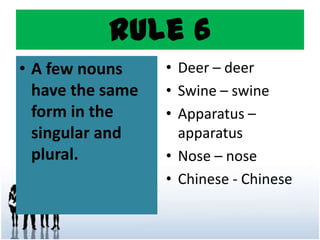
Rule 6
• A few nouns
have the same
form in the
singular and
plural.
• Deer – deer
• Swine – swine
• Apparatus –
apparatus
• Nose – nose
• Chinese - Chinese
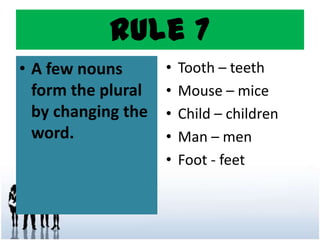
Rule 7
• A few nouns
form the plural
by changing the
word.
• Tooth – teeth
• Mouse – mice
• Child – children
• Man – men
• Foot - feet
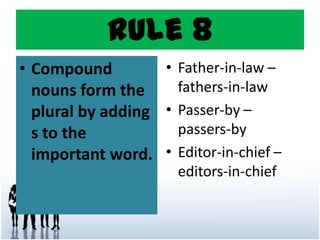
Rule 8
• Compound
nouns form the
plural by adding
s to the
important word.
• Father-in-law –
fathers-in-law
• Passer-by –
passers-by
• Editor-in-chief –
editors-in-chief
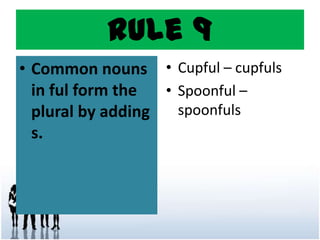
Rule 9
• Common nouns
in ful form the
plural by adding
s.
• Cupful – cupfuls
• Spoonful –
spoonfuls
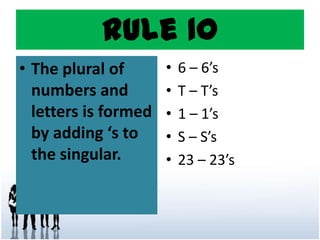
Rule 10
• The plural of
numbers and
letters is formed
by adding ‘s to
the singular.
• 6 – 6’s
• T – T’s
• 1 – 1’s
• S – S’s
• 23 – 23’s
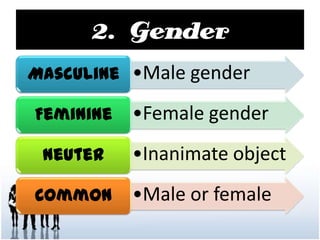
2. Gender
•Male genderMasculine
•Female genderFeminine
•Inanimate objectNeuter
•Male or femaleCommon
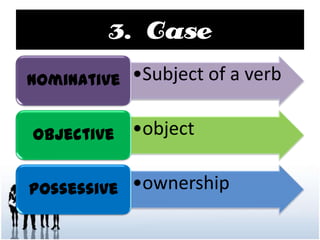
3. Case
•Subject of a verbNominative
•objectObjective
•ownershipPossessive
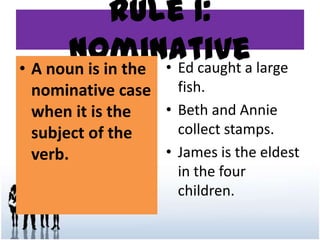
Rule 1:
Nominative• A noun is in the
nominative case
when it is the
subject of the
verb.
• Ed caught a large
fish.
• Beth and Annie
collect stamps.
• James is the eldest
in the four
children.
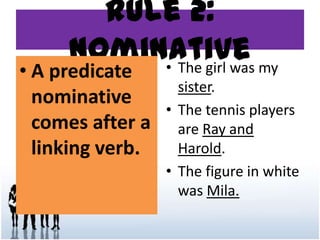
Rule 2:
Nominative
• A predicate
nominative
comes after a
linking verb.
• The girl was my
sister.
• The tennis players
are Ray and
Harold.
• The figure in white
was Mila.
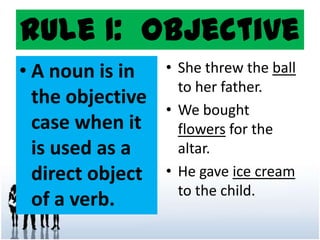
Rule 1: Objective
• A noun is in
the objective
case when it
is used as a
direct object
of a verb.
• She threw the ball
to her father.
• We bought
flowers for the
altar.
• He gave ice cream
to the child.
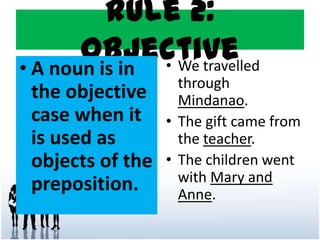
Rule 2:
Objective• A noun is in
the objective
case when it
is used as
objects of the
preposition.
• We travelled
through
Mindanao.
• The gift came from
the teacher.
• The children went
with Mary and
Anne.
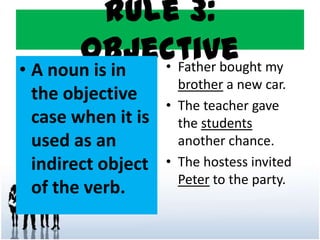
Rule 3:
Objective
• A noun is in
the objective
case when it is
used as an
indirect object
of the verb.
• Father bought my
brother a new car.
• The teacher gave
the students
another chance.
• The hostess invited
Peter to the party.
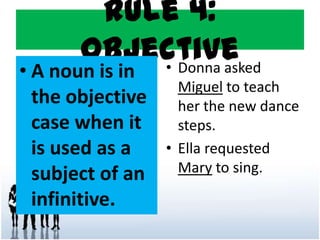
Rule 4:
Objective
• A noun is in
the objective
case when it
is used as a
subject of an
infinitive.
• Donna asked
Miguel to teach
her the new dance
steps.
• Ella requested
Mary to sing.
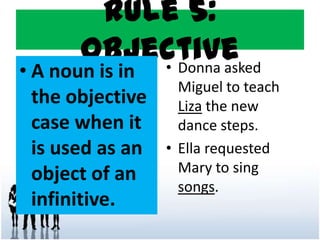
Rule 5:
Objective
• A noun is in
the objective
case when it
is used as an
object of an
infinitive.
• Donna asked
Miguel to teach
Liza the new
dance steps.
• Ella requested
Mary to sing
songs.
Rule 6:
Objective
• A noun is in
the objective
case when it
is used as an
objective
complement.
• They called my
baby Gab.
• The priest
baptized him
Gabriel Yvann.
Rule 7:
Objective• A noun is in
the objective
case when it is
used as a
retained
object after a
passive verb.
• Henry was given the
prize.
• Dogs were fed meat
after the party.
• The girls were given
invitations last
week.
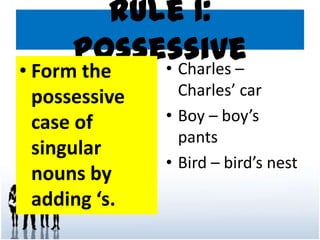
Rule 1:
Possessive
• Form the
possessive
case of
singular
nouns by
adding ‘s.
• Charles –
Charles’ car
• Boy – boy’s
pants
• Bird – bird’s nest
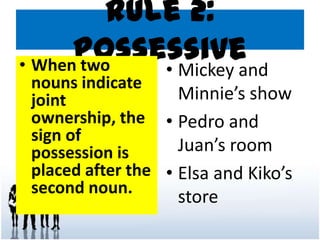
Rule 2:
Possessive• When two
nouns indicate
joint
ownership, the
sign of
possession is
placed after the
second noun.
• Mickey and
Minnie’s show
• Pedro and
Juan’s room
• Elsa and Kiko’s
store
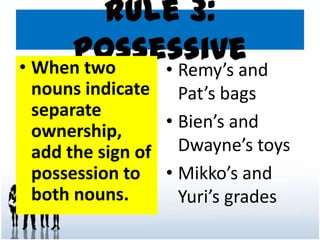
Rule 3:
Possessive• When two
nouns indicate
separate
ownership,
add the sign of
possession to
both nouns.
• Remy’s and
Pat’s bags
• Bien’s and
Dwayne’s toys
• Mikko’s and
Yuri’s grades
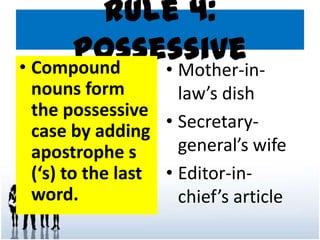
Rule 4:
Possessive• Compound
nouns form
the possessive
case by adding
apostrophe s
(‘s) to the last
word.
• Mother-in-
law’s dish
• Secretary-
general’s wife
• Editor-in-
chief’s article
Nouns

Nouns

  • 1.
  • 2.
    HUMAN BINGO HUMAN BINGO HUMAN BINGO LOVES MATH WRITES POEMS FAVORITE COLOR IS BLUE CANSING WELL PRAYS THE ROSARY DAILY LOVES JUNK FOOD AND SODA HAS GOOD SENSE OF HUMOR DANCES GRACEFULLY CAN PAINT WANTS TO JOIN A RELIGIOUS GROUP SLEEPS EARLY DOESN’T EAT VEGETABLES
  • 3.
    What is anoun? • A noun is a word that is used to name a person, a place or a thing. • It may name a real object, an idea or even an action.
  • 4.
  • 5.
  • 6.
    Rule 1 • Mostnouns form the plural by adding s to the singular noun. • Lecture – lectures • Book – books • Tree – trees • Thing – things • Board - boards
  • 7.
    Rule 2 • Nounsending in y preceded by a consonant form the plural by changing y to i and adding es. • Lily – lilies • Lady – ladies • Baby – babies • Fairy – fairies • Berry - berries
  • 8.
    Rule 3 • Nounsending in s, x, z, ch and sh form the plural by adding es. • Box – boxes • Church – churches • Buzz – buzzes • Bus – buses • Match - matches
  • 9.
    Rule 4 • Nounsending in o preceded by a consonant generally form the plural by es to the singular. • Tomato – tomatoes • Potato – potatoes
  • 10.
    Rule 5 • Somenouns form the plural by changing f or fe to ves. • Calf – calves • Half – halves • Knife – knives • Wife – wives • Loaf - loaves
  • 11.
    Rule 6 • Afew nouns have the same form in the singular and plural. • Deer – deer • Swine – swine • Apparatus – apparatus • Nose – nose • Chinese - Chinese
  • 12.
    Rule 7 • Afew nouns form the plural by changing the word. • Tooth – teeth • Mouse – mice • Child – children • Man – men • Foot - feet
  • 13.
    Rule 8 • Compound nounsform the plural by adding s to the important word. • Father-in-law – fathers-in-law • Passer-by – passers-by • Editor-in-chief – editors-in-chief
  • 14.
    Rule 9 • Commonnouns in ful form the plural by adding s. • Cupful – cupfuls • Spoonful – spoonfuls
  • 15.
    Rule 10 • Theplural of numbers and letters is formed by adding ‘s to the singular. • 6 – 6’s • T – T’s • 1 – 1’s • S – S’s • 23 – 23’s
  • 16.
    2. Gender •Male genderMasculine •FemalegenderFeminine •Inanimate objectNeuter •Male or femaleCommon
  • 17.
    3. Case •Subject ofa verbNominative •objectObjective •ownershipPossessive
  • 18.
    Rule 1: Nominative• Anoun is in the nominative case when it is the subject of the verb. • Ed caught a large fish. • Beth and Annie collect stamps. • James is the eldest in the four children.
  • 19.
    Rule 2: Nominative • Apredicate nominative comes after a linking verb. • The girl was my sister. • The tennis players are Ray and Harold. • The figure in white was Mila.
  • 20.
    Rule 1: Objective •A noun is in the objective case when it is used as a direct object of a verb. • She threw the ball to her father. • We bought flowers for the altar. • He gave ice cream to the child.
  • 21.
    Rule 2: Objective• Anoun is in the objective case when it is used as objects of the preposition. • We travelled through Mindanao. • The gift came from the teacher. • The children went with Mary and Anne.
  • 22.
    Rule 3: Objective • Anoun is in the objective case when it is used as an indirect object of the verb. • Father bought my brother a new car. • The teacher gave the students another chance. • The hostess invited Peter to the party.
  • 23.
    Rule 4: Objective • Anoun is in the objective case when it is used as a subject of an infinitive. • Donna asked Miguel to teach her the new dance steps. • Ella requested Mary to sing.
  • 24.
    Rule 5: Objective • Anoun is in the objective case when it is used as an object of an infinitive. • Donna asked Miguel to teach Liza the new dance steps. • Ella requested Mary to sing songs.
  • 25.
    Rule 6: Objective • Anoun is in the objective case when it is used as an objective complement. • They called my baby Gab. • The priest baptized him Gabriel Yvann.
  • 26.
    Rule 7: Objective• Anoun is in the objective case when it is used as a retained object after a passive verb. • Henry was given the prize. • Dogs were fed meat after the party. • The girls were given invitations last week.
  • 27.
    Rule 1: Possessive • Formthe possessive case of singular nouns by adding ‘s. • Charles – Charles’ car • Boy – boy’s pants • Bird – bird’s nest
  • 28.
    Rule 2: Possessive• Whentwo nouns indicate joint ownership, the sign of possession is placed after the second noun. • Mickey and Minnie’s show • Pedro and Juan’s room • Elsa and Kiko’s store
  • 29.
    Rule 3: Possessive• Whentwo nouns indicate separate ownership, add the sign of possession to both nouns. • Remy’s and Pat’s bags • Bien’s and Dwayne’s toys • Mikko’s and Yuri’s grades
  • 30.
    Rule 4: Possessive• Compound nounsform the possessive case by adding apostrophe s (‘s) to the last word. • Mother-in- law’s dish • Secretary- general’s wife • Editor-in- chief’s article