SPEECH SOUNDS INTRODUCTION
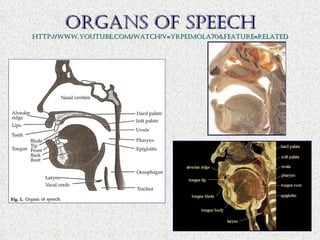
Organs of speech http://www.youtube.com/watch?v=yrpeIMolA70&feature=related
Description & Classification of  Speech Sounds A complete description should include: the  production ,  transmission , and  reception  stages. The most convenient and brief descriptive technique continues to rely on  articulatory  criteria ( consonants ) or on  auditory  judgements ( vowels ), or on a combination of both.
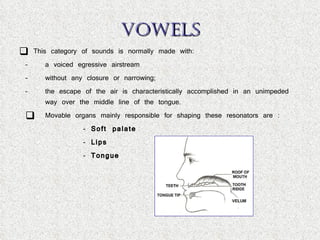
VOWELS This category of sounds is normally made with: a voiced egressive airstream without any closure or narrowing;  the escape of the air is characteristically accomplished in an unimpeded way over the middle line of the tongue. Movable organs mainly responsible for shaping these resonators are :  Soft palate Lips Tongue
VOWELS A description of vowel-like sounds must, therefore, note: The position of the soft palate (raised) The kind of aperture formed by the lips (degrees of spreading or rounding) The part of the tongue which is raised highest The degree of raising (confirmed by X-ray photography)
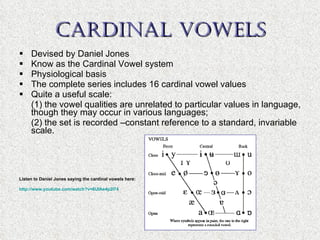
CARDINAL VOWELS Devised by Daniel Jones Know as the Cardinal Vowel system Physiological basis The complete series includes 16 cardinal vowel values Quite a useful scale:  (1) the vowel qualities are unrelated to particular values in language, though they may occur in various languages;  (2) the set is recorded –constant reference to a standard, invariable scale. Listen to Daniel Jones saying the cardinal vowels here: http ://www.youtube.com/watch?v=6UIAe4p2I74
ARTICULATORY CLASSIFICATION OF VOWELS Although precise descriptions of vowels are better done auditorily, nevertheless it is convenient to have available a rough scheme of articulatory classification.  Such a scheme is represented by the vowel diagram on the chart of the IPA.
CONSONANTS In the case of consonantal articulations, a description must provide answers to the following questions: Is the airstream set in motion by the lungs or by some other means? ( pulmonic or non-pulmonic ) Is the airstream forced outwards or sucked inwards? ( egressive or ingressive ) Do the vocal folds vibrate or not? ( voiced or voiceless ) Is the soft palate raised, directing the airstream wholly through the mouth, or lowered, allowing the passage of air through the nose? ( oral, or nasal or nasalized ) At what point or points and between what organs does closure or narrowing take place? ( place of articulation ) What is the type of closure or narrowing at the point of articulation? ( manner of articulation )
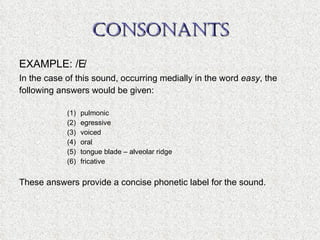
CONSONANTS EXAMPLE: /  / In the case of this sound, occurring medially in the word  easy , the following answers would be given: pulmonic egressive voiced oral tongue blade – alveolar ridge fricative These answers provide a concise phonetic label for the sound.
CONSONANTS EGRESSIVE PULMONIC CONSONANTS Most speech sounds are made with egressive lung air  (as we are breathing out) .  Virtually all English sounds are so made.
CONSONANTS VOICING At any place of articulation, a consonantal articulation may involve the vibration of the vocal folds, i.e. may be voiced or voiceless.
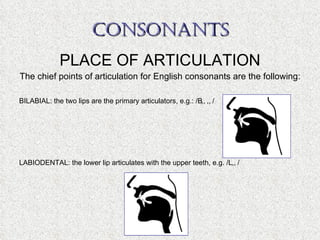
CONSONANTS PLACE OF ARTICULATION The chief points of articulation for English consonants are the following: BILABIAL: the two lips are the primary articulators, e.g.: /  ,  ,  / LABIODENTAL: the lower lip articulates with the upper teeth, e.g. /  ,  /
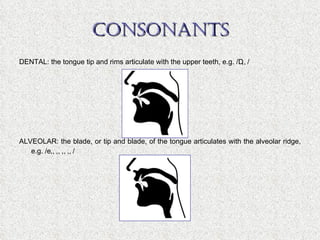
CONSONANTS DENTAL: the tongue tip and rims articulate with the upper teeth, e.g. /  ,  / ALVEOLAR: the blade, or tip and blade, of the tongue articulates with the alveolar ridge, e.g. /  ,  ,  ,  ,  /
CONSONANTS POST-ALVEOLAR: the tip of the tongue articulates with the rear part of the alveolar ridge, e.g. /  / PALATO-ALVEOLAR: the blade, or the tip and blade, of the tongue articulates with the alveolar ridge and there is at the same time a raising of the front of the tongue towards the hard palate, e.g. /  ,  ,  ,  /
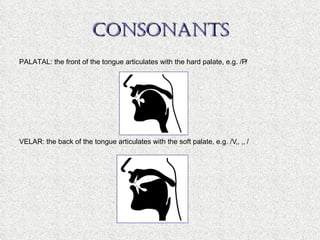
CONSONANTS PALATAL: the front of the tongue articulates with the hard palate, e.g. /  / VELAR: the back of the tongue articulates with the soft palate, e.g. /  ,  ,  /
CONSONANTS GLOTTAL: an obstruction, or a narrowing causing friction but not vibration, between the    vocal folds, e.g. /  / For some consonantal sounds there may be a secondary place of articulation in addition to the primary.  E.g.: dark lateral  
CONSONANTS MANNER OF ARTICULATION The obstruction made by the organs may be total, intermittent, parcial, or merely constitute a narrowing sufficient to cause friction. The chief types of articulation, in decreasing degrees of closure, are as follows: COMPLETE CLOSURE: - PLOSIVE: a complete closure at some point in the vocal tract, behind which the air pressure builds up and can be released explosively, e.g. /  ,  ,  ,  ,  ,  ,  / - AFFRICATE: a complete closure at some point in the mouth, behind which the air pressure builds up; the separation of organs is slow compared with that of a plosive, so that more extended friction is a characteristic second element of the sound, e.g. /  ,  / - NASAL: a complete closure at some point in the mouth but, the soft palate being lowered, the air escapes through the nose, e.g. /  ,  ,  /
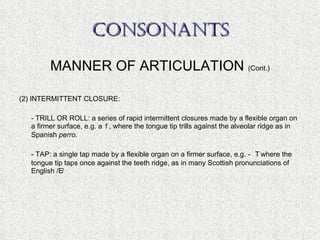
CONSONANTS MANNER OF ARTICULATION  (Cont.) (2) INTERMITTENT CLOSURE: - TRILL OR ROLL: a series of rapid intermittent closures made by a flexible organ on a firmer surface, e.g.   , where the tongue tip trills against the alveolar ridge as in Spanish  perro . - TAP: a single tap made by a flexible organ on a firmer surface, e.g.    where the tongue tip taps once against the teeth ridge, as in many Scottish pronunciations of English /  /
CONSONANTS MANNER OF ARTICULATION  (Cont.) (3) PARTIAL CLOSURE: - LATERAL: a partial (but firm) closure is made at some point in the mouth, the airstream being allowed to escape on one or both sides of the contact. E.g.   ,  (4) NARROWING: - FRICATIVE: two organs approximate to such an extent that the airstream passes between them with friction, e.g.   ,  ,  ,  ,  ,  ,  ,  ,  (5) NARROWING WITHOUT FRICTION: - APPROXIMANT (OR FRICTIONLESS CONTINUANT): a narrowing is made in the mouth but the narrowing is not quite sufficient to cause friction. E.g.    in  red
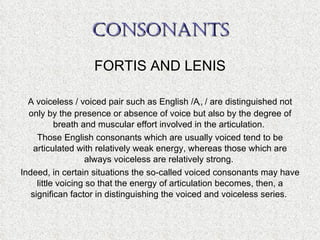
CONSONANTS FORTIS AND LENIS A voiceless / voiced pair such as English /  ,  / are distinguished not only by the presence or absence of voice but also by the degree of breath and muscular effort involved in the articulation.  Those English consonants which are usually voiced tend to be articulated with relatively weak energy, whereas those which are always voiceless are relatively strong.  Indeed, in certain situations the so-called voiced consonants may have little voicing so that the energy of articulation becomes, then, a significan factor in distinguishing the voiced and voiceless series.
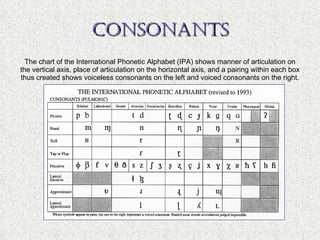
CONSONANTS The chart of the International Phonetic Alphabet (IPA) shows manner of articulation on the vertical axis, place of articulation on the horizontal axis, and a pairing within each box thus created shows voiceless consonants on the left and voiced consonants on the right.

Speech sounds

  • 1.
  • 2.
    Organs of speechhttp://www.youtube.com/watch?v=yrpeIMolA70&feature=related
  • 3.
    Description & Classificationof Speech Sounds A complete description should include: the production , transmission , and reception stages. The most convenient and brief descriptive technique continues to rely on articulatory criteria ( consonants ) or on auditory judgements ( vowels ), or on a combination of both.
  • 4.
    VOWELS This categoryof sounds is normally made with: a voiced egressive airstream without any closure or narrowing; the escape of the air is characteristically accomplished in an unimpeded way over the middle line of the tongue. Movable organs mainly responsible for shaping these resonators are : Soft palate Lips Tongue
  • 5.
    VOWELS A descriptionof vowel-like sounds must, therefore, note: The position of the soft palate (raised) The kind of aperture formed by the lips (degrees of spreading or rounding) The part of the tongue which is raised highest The degree of raising (confirmed by X-ray photography)
  • 6.
    CARDINAL VOWELS Devisedby Daniel Jones Know as the Cardinal Vowel system Physiological basis The complete series includes 16 cardinal vowel values Quite a useful scale: (1) the vowel qualities are unrelated to particular values in language, though they may occur in various languages; (2) the set is recorded –constant reference to a standard, invariable scale. Listen to Daniel Jones saying the cardinal vowels here: http ://www.youtube.com/watch?v=6UIAe4p2I74
  • 7.
    ARTICULATORY CLASSIFICATION OFVOWELS Although precise descriptions of vowels are better done auditorily, nevertheless it is convenient to have available a rough scheme of articulatory classification. Such a scheme is represented by the vowel diagram on the chart of the IPA.
  • 8.
    CONSONANTS In thecase of consonantal articulations, a description must provide answers to the following questions: Is the airstream set in motion by the lungs or by some other means? ( pulmonic or non-pulmonic ) Is the airstream forced outwards or sucked inwards? ( egressive or ingressive ) Do the vocal folds vibrate or not? ( voiced or voiceless ) Is the soft palate raised, directing the airstream wholly through the mouth, or lowered, allowing the passage of air through the nose? ( oral, or nasal or nasalized ) At what point or points and between what organs does closure or narrowing take place? ( place of articulation ) What is the type of closure or narrowing at the point of articulation? ( manner of articulation )
  • 9.
    CONSONANTS EXAMPLE: / / In the case of this sound, occurring medially in the word easy , the following answers would be given: pulmonic egressive voiced oral tongue blade – alveolar ridge fricative These answers provide a concise phonetic label for the sound.
  • 10.
    CONSONANTS EGRESSIVE PULMONICCONSONANTS Most speech sounds are made with egressive lung air (as we are breathing out) . Virtually all English sounds are so made.
  • 11.
    CONSONANTS VOICING Atany place of articulation, a consonantal articulation may involve the vibration of the vocal folds, i.e. may be voiced or voiceless.
  • 12.
    CONSONANTS PLACE OFARTICULATION The chief points of articulation for English consonants are the following: BILABIAL: the two lips are the primary articulators, e.g.: /  ,  ,  / LABIODENTAL: the lower lip articulates with the upper teeth, e.g. /  ,  /
  • 13.
    CONSONANTS DENTAL: thetongue tip and rims articulate with the upper teeth, e.g. /  ,  / ALVEOLAR: the blade, or tip and blade, of the tongue articulates with the alveolar ridge, e.g. /  ,  ,  ,  ,  /
  • 14.
    CONSONANTS POST-ALVEOLAR: thetip of the tongue articulates with the rear part of the alveolar ridge, e.g. /  / PALATO-ALVEOLAR: the blade, or the tip and blade, of the tongue articulates with the alveolar ridge and there is at the same time a raising of the front of the tongue towards the hard palate, e.g. /  ,  ,  ,  /
  • 15.
    CONSONANTS PALATAL: thefront of the tongue articulates with the hard palate, e.g. /  / VELAR: the back of the tongue articulates with the soft palate, e.g. /  ,  ,  /
  • 16.
    CONSONANTS GLOTTAL: anobstruction, or a narrowing causing friction but not vibration, between the vocal folds, e.g. /  / For some consonantal sounds there may be a secondary place of articulation in addition to the primary. E.g.: dark lateral 
  • 17.
    CONSONANTS MANNER OFARTICULATION The obstruction made by the organs may be total, intermittent, parcial, or merely constitute a narrowing sufficient to cause friction. The chief types of articulation, in decreasing degrees of closure, are as follows: COMPLETE CLOSURE: - PLOSIVE: a complete closure at some point in the vocal tract, behind which the air pressure builds up and can be released explosively, e.g. /  ,  ,  ,  ,  ,  ,  / - AFFRICATE: a complete closure at some point in the mouth, behind which the air pressure builds up; the separation of organs is slow compared with that of a plosive, so that more extended friction is a characteristic second element of the sound, e.g. /  ,  / - NASAL: a complete closure at some point in the mouth but, the soft palate being lowered, the air escapes through the nose, e.g. /  ,  ,  /
  • 18.
    CONSONANTS MANNER OFARTICULATION (Cont.) (2) INTERMITTENT CLOSURE: - TRILL OR ROLL: a series of rapid intermittent closures made by a flexible organ on a firmer surface, e.g.  , where the tongue tip trills against the alveolar ridge as in Spanish perro . - TAP: a single tap made by a flexible organ on a firmer surface, e.g.  where the tongue tip taps once against the teeth ridge, as in many Scottish pronunciations of English /  /
  • 19.
    CONSONANTS MANNER OFARTICULATION (Cont.) (3) PARTIAL CLOSURE: - LATERAL: a partial (but firm) closure is made at some point in the mouth, the airstream being allowed to escape on one or both sides of the contact. E.g.  ,  (4) NARROWING: - FRICATIVE: two organs approximate to such an extent that the airstream passes between them with friction, e.g.  ,  ,  ,  ,  ,  ,  ,  ,  (5) NARROWING WITHOUT FRICTION: - APPROXIMANT (OR FRICTIONLESS CONTINUANT): a narrowing is made in the mouth but the narrowing is not quite sufficient to cause friction. E.g.  in red
  • 20.
    CONSONANTS FORTIS ANDLENIS A voiceless / voiced pair such as English /  ,  / are distinguished not only by the presence or absence of voice but also by the degree of breath and muscular effort involved in the articulation. Those English consonants which are usually voiced tend to be articulated with relatively weak energy, whereas those which are always voiceless are relatively strong. Indeed, in certain situations the so-called voiced consonants may have little voicing so that the energy of articulation becomes, then, a significan factor in distinguishing the voiced and voiceless series.
  • 21.
    CONSONANTS The chartof the International Phonetic Alphabet (IPA) shows manner of articulation on the vertical axis, place of articulation on the horizontal axis, and a pairing within each box thus created shows voiceless consonants on the left and voiced consonants on the right.