Spectrophotometry at
a Glance

Presented by:
Nasir Nazeer
Introduction








Spectrophotometry is the quantitative measurement of the reflection or
transmission properties of a material as a function of wavelength. It is more
specific than the general term electromagnetic spectroscopy in that
spectrophotometry deals with visible light, near-ultraviolet, and nearinfrared, but does not cover time-resolved spectroscopic techniques.
Spectrophotometry involves the use of a spectrophotometer. A
spectrophotometer is a photometer that can measure intensity as a function
of the light source wavelength. Important features of spectrophotometers
are spectral bandwidth and linear range of absorption or reflectance
measurement.
The spectrophotometer has well been called the workhorse of the modern
laboratory. In particular, ultraviolet and visible spectrophotometry is the
method of choice in most laboratories concerned with the identification and
measurement of wide range of products and processes.
Modern spectrophotometers are quick, accurate and reliable and make only
small demands on the time and skills of the operator.
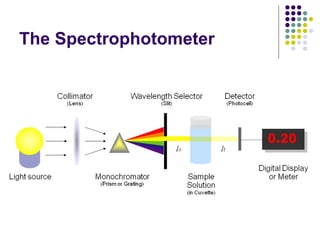
The Spectrophotometer
Spectrophotometric Analysis






Spectrophotometric techniques are used to
measure the concentration of solutes in solution by
measuring the amount of light that is absorbed by
the solution in a cuvette placed in the
spectrophotometer.
The spectrophotometer can measure the amount
of light or electromagnetic radiation (of certain
frequency) transmitted or absorbed by the solution.
If there is too much or too little analyte,
spectrophotometer cannot read the absorbance
accurately.
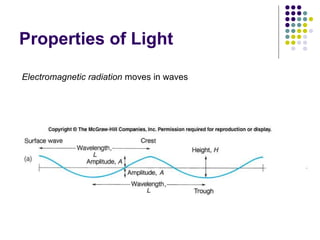
Properties of Light
Electromagnetic radiation moves in waves
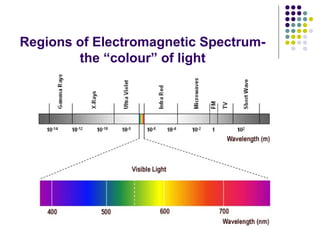
Regions of Electromagnetic Spectrumthe “colour” of light
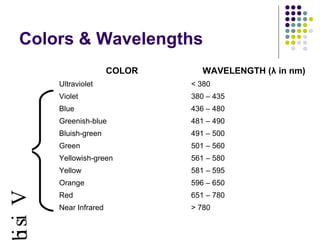
Colors & Wavelengths
COLOR

WAVELENGTH (λ in nm)
< 380

Violet

380 – 435

Blue

436 – 480

Greenish-blue

481 – 490

Bluish-green

491 – 500

Green

501 – 560

Yellowish-green

561 – 580

Yellow

581 – 595

Orange

i si V

Ultraviolet

596 – 650

Red

651 – 780

Near Infrared

> 780
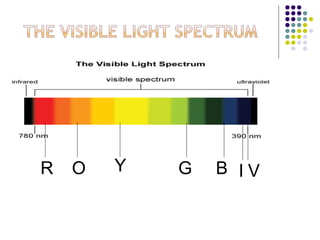
R

O

Y

G

B IV
The absorption process
How does matter absorb radiation


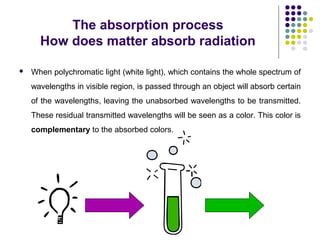
When polychromatic light (white light), which contains the whole spectrum of
wavelengths in visible region, is passed through an object will absorb certain
of the wavelengths, leaving the unabsorbed wavelengths to be transmitted.
These residual transmitted wavelengths will be seen as a color. This color is
complementary to the absorbed colors.
Classes of
Spectrophotometers
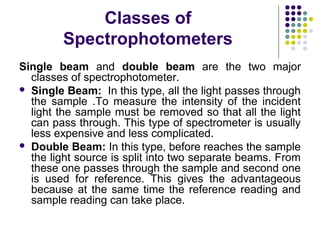
Single beam and double beam are the two major
classes of spectrophotometer.
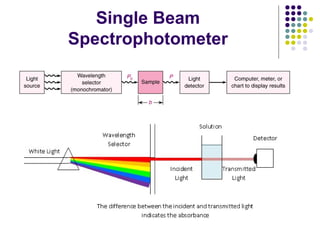
 Single Beam: In this type, all the light passes through
the sample .To measure the intensity of the incident
light the sample must be removed so that all the light
can pass through. This type of spectrometer is usually
less expensive and less complicated.
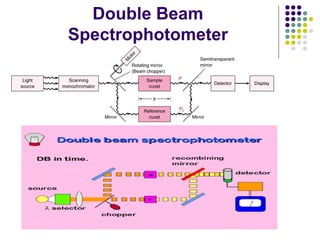
 Double Beam: In this type, before reaches the sample
the light source is split into two separate beams. From
these one passes through the sample and second one
is used for reference. This gives the advantageous
because at the same time the reference reading and
sample reading can take place.
Single Beam
Spectrophotometer
Double Beam
Spectrophotometer
Different types of
Spectrophotometers


Visible Light:
Visible spectrophotometers use incandescent, halogen, LED, or a
combination of these sources and these spectrophotometers vary in
accuracy. Plastic and glass cuvettes can be used for visible light
spectroscopy.



Ultraviolet Light:
UV spectroscopy is used for fluids, and even for solids. Cuvettes, only
made of quartz, are used for placing the samples.



Infrared Light:
IR spectroscopy, which helps to study different structures of
molecules and its vibrations. Different chemical structures vibrate in different
ways due to variation of energy associated with each wave length. For
example, mid-range and near infrared (higher energy) infrared tends to
cause rotational vibrations and harmonic vibrations respectively.
Different types of Lamps used
in Spectrophotometer


Visible spectrophotometer




Contains a tungsten lamp that produces white light. Tungsten
ght
lamp consists of a Tungsten filament, enclosed in a glass
envelop with the wavelength range of 330 to 900nm, are used for
visible region. They are generally useful for measuring
moderately dilute solutions in which change in color intensity
varies significantly with the change in solute. It has long life about
1200hr

Ultraviolet spectrophotometer


Contains a Deuterium/ Hydrogen lamp that produces light in
the UV light part of the spectrum. It ranges about 200 to 450nm
in wavelength. This lamp is generally more stable.
How a Spectrophotometer
works?







Shines a beam of light on a sample.
The molecules in the sample interact with the light waves in 3 ways:
 Absorb the energy
 Reflect the energy
 Transmit the energy between and through the atoms and
molecules of the sample.
The spectrophotometer measures the amount of light transmitted
through the sample (Transmittance).
By using an equation (Beers law), it converts the transmittance data
to an absorbance value.
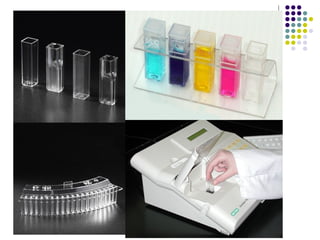
Cuvettes are made from plastic, glass, or quartz.
a.
Use quartz cuvettes for UV work.
b.
Glass, plastic or quartz are acceptable in visible work.
c.
There are inexpensive plastic cuvettes that may be suitable for
some UV work.
2. Cuvettes are expensive and fragile (except for “disposable”
plastic ones). Use them properly and carefully.
1.

Do not scratch cuvettes; do not store them in wire
racks or clean with brushes or abrasives.
b. Do not allow samples to sit in a cuvette for a long
period of time.
c. Wash cuvettes immediately after use.
a.
Beer’s Law
 The

intensity of a ray of monochromatic light
decreases exponentially as the concentration
of the absorbing medium increases.

 More

dissolved substance = more absorption
and less transmittance
Beer’s Law
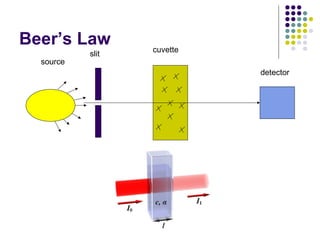
source

slit

cuvette
detector
How absorbance is
calculated?
Lambert's law is expressed by
 I/Io = T
 where I is the intensity of the transmitted light, Io is the intensity
of the incident light, and T is the Transmittance. It is customary to
express transmittance as a percentage:
%T = I/Io x100
 A combination of the two laws (known jointly as the BeerLambert Law) defines the relationship between absorbance
 (A) and transmittance (T).
 A = log Io/I = log 100/T = ε c b
ε : is molar absorptivity ( L.mol-1. cm-1)
b : is path length (cm)
c : concentration (M)















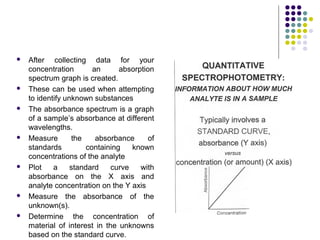
After collecting data for your
concentration
an
absorption
spectrum graph is created.
These can be used when attempting
to identify unknown substances
The absorbance spectrum is a graph
of a sample’s absorbance at different
wavelengths.
Measure
the
absorbance
of
standards
containing
known
concentrations of the analyte
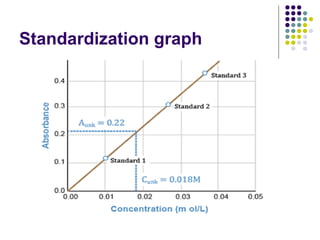
Plot
a
standard
curve
with
absorbance on the X axis and
analyte concentration on the Y axis
Measure the absorbance of the
unknown(s).
Determine the concentration of
material of interest in the unknowns
based on the standard curve.
Standardization graph
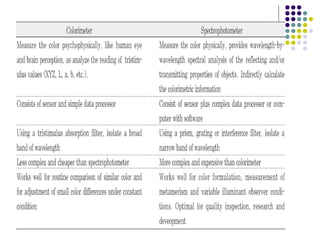
Difference between
Spectrophotometer and Colorimeter


A colorimeter measures the
absorbance
of
a
particular
wavelength by a solution. It is
usually used to determine the
concentration of a known solute in
a known solvent through the
application of the Beer-Lambert
law.



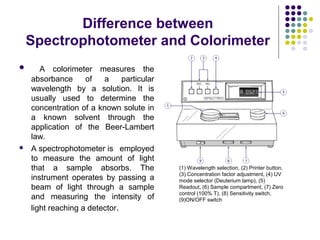
A spectrophotometer is employed
to measure the amount of light
that a sample absorbs. The
instrument operates by passing a
beam of light through a sample
and measuring the intensity of
light reaching a detector.

(1) Wavelength selection, (2) Printer button,
(3) Concentration factor adjustment, (4) UV
mode selector (Deuterium lamp), (5)
Readout, (6) Sample compartment, (7) Zero
control (100% T), (8) Sensitivity switch,
(9)ON/OFF switch
Spectrophoto meter

Spectrophoto meter

  • 1.
  • 2.
    Introduction     Spectrophotometry is thequantitative measurement of the reflection or transmission properties of a material as a function of wavelength. It is more specific than the general term electromagnetic spectroscopy in that spectrophotometry deals with visible light, near-ultraviolet, and nearinfrared, but does not cover time-resolved spectroscopic techniques. Spectrophotometry involves the use of a spectrophotometer. A spectrophotometer is a photometer that can measure intensity as a function of the light source wavelength. Important features of spectrophotometers are spectral bandwidth and linear range of absorption or reflectance measurement. The spectrophotometer has well been called the workhorse of the modern laboratory. In particular, ultraviolet and visible spectrophotometry is the method of choice in most laboratories concerned with the identification and measurement of wide range of products and processes. Modern spectrophotometers are quick, accurate and reliable and make only small demands on the time and skills of the operator.
  • 3.
  • 4.
    Spectrophotometric Analysis    Spectrophotometric techniquesare used to measure the concentration of solutes in solution by measuring the amount of light that is absorbed by the solution in a cuvette placed in the spectrophotometer. The spectrophotometer can measure the amount of light or electromagnetic radiation (of certain frequency) transmitted or absorbed by the solution. If there is too much or too little analyte, spectrophotometer cannot read the absorbance accurately.
  • 5.
    Properties of Light Electromagneticradiation moves in waves
  • 6.
    Regions of ElectromagneticSpectrumthe “colour” of light
  • 7.
    Colors & Wavelengths COLOR WAVELENGTH(λ in nm) < 380 Violet 380 – 435 Blue 436 – 480 Greenish-blue 481 – 490 Bluish-green 491 – 500 Green 501 – 560 Yellowish-green 561 – 580 Yellow 581 – 595 Orange i si V Ultraviolet 596 – 650 Red 651 – 780 Near Infrared > 780
  • 8.
  • 9.
    The absorption process Howdoes matter absorb radiation  When polychromatic light (white light), which contains the whole spectrum of wavelengths in visible region, is passed through an object will absorb certain of the wavelengths, leaving the unabsorbed wavelengths to be transmitted. These residual transmitted wavelengths will be seen as a color. This color is complementary to the absorbed colors.
  • 10.
    Classes of Spectrophotometers Single beamand double beam are the two major classes of spectrophotometer.  Single Beam: In this type, all the light passes through the sample .To measure the intensity of the incident light the sample must be removed so that all the light can pass through. This type of spectrometer is usually less expensive and less complicated.  Double Beam: In this type, before reaches the sample the light source is split into two separate beams. From these one passes through the sample and second one is used for reference. This gives the advantageous because at the same time the reference reading and sample reading can take place.
  • 11.
  • 12.
  • 13.
    Different types of Spectrophotometers  VisibleLight: Visible spectrophotometers use incandescent, halogen, LED, or a combination of these sources and these spectrophotometers vary in accuracy. Plastic and glass cuvettes can be used for visible light spectroscopy.  Ultraviolet Light: UV spectroscopy is used for fluids, and even for solids. Cuvettes, only made of quartz, are used for placing the samples.  Infrared Light: IR spectroscopy, which helps to study different structures of molecules and its vibrations. Different chemical structures vibrate in different ways due to variation of energy associated with each wave length. For example, mid-range and near infrared (higher energy) infrared tends to cause rotational vibrations and harmonic vibrations respectively.
  • 14.
    Different types ofLamps used in Spectrophotometer  Visible spectrophotometer   Contains a tungsten lamp that produces white light. Tungsten ght lamp consists of a Tungsten filament, enclosed in a glass envelop with the wavelength range of 330 to 900nm, are used for visible region. They are generally useful for measuring moderately dilute solutions in which change in color intensity varies significantly with the change in solute. It has long life about 1200hr Ultraviolet spectrophotometer  Contains a Deuterium/ Hydrogen lamp that produces light in the UV light part of the spectrum. It ranges about 200 to 450nm in wavelength. This lamp is generally more stable.
  • 15.
    How a Spectrophotometer works?     Shinesa beam of light on a sample. The molecules in the sample interact with the light waves in 3 ways:  Absorb the energy  Reflect the energy  Transmit the energy between and through the atoms and molecules of the sample. The spectrophotometer measures the amount of light transmitted through the sample (Transmittance). By using an equation (Beers law), it converts the transmittance data to an absorbance value.
  • 16.
    Cuvettes are madefrom plastic, glass, or quartz. a. Use quartz cuvettes for UV work. b. Glass, plastic or quartz are acceptable in visible work. c. There are inexpensive plastic cuvettes that may be suitable for some UV work. 2. Cuvettes are expensive and fragile (except for “disposable” plastic ones). Use them properly and carefully. 1. Do not scratch cuvettes; do not store them in wire racks or clean with brushes or abrasives. b. Do not allow samples to sit in a cuvette for a long period of time. c. Wash cuvettes immediately after use. a.
  • 18.
    Beer’s Law  The intensityof a ray of monochromatic light decreases exponentially as the concentration of the absorbing medium increases.  More dissolved substance = more absorption and less transmittance
  • 19.
  • 20.
    How absorbance is calculated? Lambert'slaw is expressed by  I/Io = T  where I is the intensity of the transmitted light, Io is the intensity of the incident light, and T is the Transmittance. It is customary to express transmittance as a percentage: %T = I/Io x100  A combination of the two laws (known jointly as the BeerLambert Law) defines the relationship between absorbance  (A) and transmittance (T).  A = log Io/I = log 100/T = ε c b ε : is molar absorptivity ( L.mol-1. cm-1) b : is path length (cm) c : concentration (M) 
  • 21.
           After collecting datafor your concentration an absorption spectrum graph is created. These can be used when attempting to identify unknown substances The absorbance spectrum is a graph of a sample’s absorbance at different wavelengths. Measure the absorbance of standards containing known concentrations of the analyte Plot a standard curve with absorbance on the X axis and analyte concentration on the Y axis Measure the absorbance of the unknown(s). Determine the concentration of material of interest in the unknowns based on the standard curve.
  • 22.
  • 23.
    Difference between Spectrophotometer andColorimeter  A colorimeter measures the absorbance of a particular wavelength by a solution. It is usually used to determine the concentration of a known solute in a known solvent through the application of the Beer-Lambert law.  A spectrophotometer is employed to measure the amount of light that a sample absorbs. The instrument operates by passing a beam of light through a sample and measuring the intensity of light reaching a detector. (1) Wavelength selection, (2) Printer button, (3) Concentration factor adjustment, (4) UV mode selector (Deuterium lamp), (5) Readout, (6) Sample compartment, (7) Zero control (100% T), (8) Sensitivity switch, (9)ON/OFF switch