Spectrophotometry
The spectrophotometer is an
instrument used to measure the
intensity of wavelengths in a
spectrum of light.
Spectroscopy :
• . It is a branch of science which deals with the
study of interaction of electromagnetic
radiation with matter.
• During such interactions the energy is either
absorbed or emitted by the matter in discrete
amount is called as quanta
• Electromagnetic radiation may be considered
as a simple harmonic wave propagated from a
source and travelling in a straight line except
when reflected or refracted.
Wavelength :
• It is the distance between two successive
maxima on an electromagnetic waves.
• Usually the wavelength is expressed in cm or
in angstrom
rad
Frequency :
• The number of complete wavelength units
passing through a given point in unit time is
called the frequency of radiation.
• It is generally expressed in cycle per second or
in hertz.
Wave number:
• It is the number of waves per centimeter in
vacuum.
Interactions of radiation with matter.
• The entire range over which the
electromagnetic radiation exits is known as
electromagnetic spectrum.
• 200- 400nm = u.v region.
• 400-750nm= visible region.
• 750-1500nm= IR region.
The colour of the object arises from the
selective absorption of certain wavelength of
incident light.
Terminology used in absorption
measurements:
• The ‘JOINT COMMITTEE ON NOMENCLATURE
IN APPLIED SPECTROSCOPY’ has worked to
develop standard nomenclature for various
quantities in spectroscopic measurements.
1. Radiant energy :
• It is defined as the energy transmitted as
electromagnetic radiation.
• It is characterised by the wavelength and
frequency.
Radiant power, P:
• Energy per unit time is called as power.
• Radiant power is the rate at which energy is
transported in a beam of radiant energy.
• The radiant power incident upon a cell is given
the symbol Po. And the transmitted by a cell is
P.
Transmittance,T:
• It is the ratio of radiant power transmitted by
a sample to the radiant power incident upon
the sample , both being measured at the same
spectral position.
• It is usually expressed as percent
transmittance.
Absorbance ,A:
• The absorbance is the logarithm to the base
10 of the reciprocal of the transmittance,T.
• Absorbance is also defined as the logarithm to
the base 10 of the ratio of the radiant power
incident upon the sample to the radiant
power transmitted by the sample.
Absorptivity ,a:
Absorptivity is defined as the ratio of the
absorbance to the product of the length of
optical path b, and the concentration of the
sample ,C.
a=A/bC.
• Absorptivity is the measure of the ability of
sample to absorb light.
Molar absorptivity
• Molecular absorptivity is the product of
absorptivity and molecular weight of the
material.
Path length,b:
• It is the internal thickness of cell in which the
test sample is taken.
• It was formerly denoted by l.
LAMBERT
BEER”S L
LAMBERTS
&
BEER”S LAW
“When a monochromatic beam
of light is allow to pass through
the transparent medium the rate
of decrease of intensity with the
Thickness (db) of medium is
directly proportional to the
intensity of incident light”.(A =
a.b)
Lamberts law
Problems ;
Instrumentation.
1. Radiant sources:
• A stable continuous source of radiant energy
covering the region of spectra of visible and
U.V region is used.
• Radiation sources must fulfill the following
requirements:
1. It must be stable.
2. It must produce sufficient intensity of
radiation so that the transmitted intensity
can be detected.
3. It must supply continuous spectrum of
radiation over the entire wavelength.
• A tungsten lamp is commonly used as a source of
radiation.
• In the visible region (400-800nm) , a tungsten
filament is most widely used.
• Its construction is similar to house hold lamp.
• It consist of a tungsten wire which is heated in a
controlled atmosphere.
• To avoid fluctuations in readings it is necessary
that the lamp should provide constant radiant
energy .
• ??????
• It is achieved by employing a constant power
supply to the lamp.
Filters and monochromators:
• A radiation source is generally emitting a
continuous spectra i.e. it gives all possible
wavelength of the region .
• However, a narrow band of wavelength is always
necessary in calorimetric and spectrophotometric
analysis.
• Therefore , it is necessary to have device which
will select a narrow band from wavelength of
continuous spectra.
• For this purpose , filters and monochromators are
used.
• Both filter and monochromator allow the light
of required wavelength to pass through but
absorbs the light of other wavelength .
Filters
are of two types:
1. Absorption filters
2. Interference filters
Absorption filters:
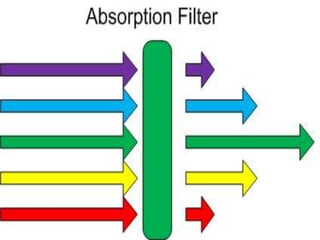
• These filters work by selective abbsorption of
unwanted wavelengths i.e. these filters limit
the radiation by absorbing ertain portion of
light spectrum.
• Absorption filters are generally cheaper than
interference filters.
Interference filters:
• These filters generally provide somewhat
narrower band width than absorption filters.
• When a ray of light is incident upon it , a part
of light reflects back whereas the remaining
light is transmitted.
Monochromators:
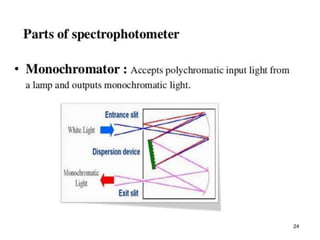
• A monochromator is a device which converts a
polychromatic radiation to monochromatic
radiation.
• Usually a monochromator consist of ;
1. Entrance and exit slit: to restrict unwanted
radiation.
2. Lenses or mirrors: to focus radiation.
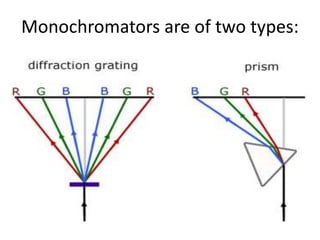
3. The dispersing medium(like prism and
diffracting grating): to isolate the wavelength.
Monochromators are of two types:
Cuvette or sample container:
• The cell holding the sample should be
transparent to the wavelength region .this cell
is called as cuvette.
• The cuvette is made up of quartz or glass.
• The thickness of cuvette is 1cm and it is used
for sample and solvent.
Detector
• A detector is a device which converts radiant
energy into electrical energy.
• Generally , 3 types of detectors are used to
detect radiation:
1. Photovoltaic cells.
2. Phototubes .
3. Photomultiplier tubes.
1. Photovoltaic cell:
• It is also called barrier –layer cell or photronic
cell.
• This cell operates without the use of battery.
• The photovoltaic cell consist of metal base plate
,thin layer of semiconductor and thin layer of
transparent silver and gold metal layer.
• When the radiation are incident the electrons are
generated at transparent and semiconductor
layer junction.
• Because of accomodation of
electrons electric voltage is
generated therefore photovoltaic
current flow through the circuit
which is recorded by galvanometer.
• The photocurrent is directly
proportional to the intensity of
incident light.
• It is used only for visible region.
2. Phototube:
• A phototube consist of an evacuated glass bulb.
• A light sensitive cathode in the form of half
cylinder or circle.
• The inner surface of cathode is coated with light
sensitive material.
• A metal ring is inserted near the center of bulb
which act as anode.
• When the radiation is
Incident upon the cathode
Photoelectrons are emitted.
• Thus electrons are attracted towards anode
and create electric current which flows
through the circuit.
• Te current is measured by read out system.
• Phototube are more sensitive than
photovoltaic cell.
3.Photomultiplier tube.
• It is more sensitive than phototube .
• It is mostly used in spectrophotometer.
Single beam photoelectric
calorimeter:
• The basic components of single beam
photoelectric calorimeter are :
1. A source of light such as tungsten filament lamp
with concave reflector and collimating lens.
2. An adjustable diaphraghms or slit
3. A filter
4. A cuvette
5. A detector such as photovoltaic cell
6. A recorder such as galvanometer.
SINGLE BEAM SPECTROSCOPY
◼The photometer is an instrument which is
used to measure radinat power of light .
◼Spectrophotometer is an instrument use to
measure the absorbance or tranmittance of a
solution as a function of wavelenght.l
◼T he single beam spectrophotometer are
particularly suitable for the quantitative
analysis that involves an absorbance
measurement at a single wavelength in both
visible and u.v region.
◼A very widely used spectrophotometer primarily
foer the visible region( 340-625nm)is the Bausch
and Lomb Spectronic- 20 fitted with a blue
sensitive phototube.
◼Its range can be extended to 950 nm by the use of
a red-sensitive phototube and a red-transmitting
filter.
◼The reflecting grating has convergent beam but
not in a collimated light beam
◼ The vaccum phototube is used as a radiation dedector
◼ The signal from the dedector is amplified and the meter in
the bridge circuit is graduated in linear scale divisions from 0
to 100 % tranmittance as well as in non-linear absorbance
unit.
◼ The rotation of the grating drum turns the grating which
gives namely wave-length adjustment, 0 adjustment and
100 % adjustment.
◼ This spectro photo meter is an in expensive and easily
operated instrument.
◼The spectro photo meter is an instrument
used to measure absorbance or transmissioin
of a solution as a function of a wave length.
PRINCIPLES
INSTRUMENTATION
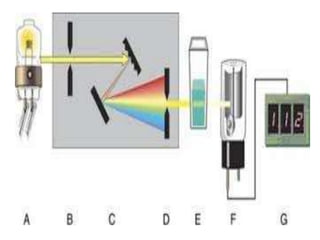
◼It consist of following instruments
◼1. Source
◼2. Monochromater
◼3. SampleCell i.e cuvette
◼4. Detector i.e phototube
RADIANT SOURCE
◼U.V region is used. A stable continious source
of radiant energy covering the region of
spectra of visible and
◼A tungsten lamp is comm0nly used a source
of raditation
MONO CHROMATOR
◼ It is device which converts a polychromatic
radiation to monochromatic radiation.
◼ It consist of :
◼ 1.entrance & exit slit
◼ To restrict unwanted radiation and help to
control the spectral purity of the radiation
emitted from the monochromator
◼ 2.Lenses
◼ To make the beam parallel or to focus radiation
and to isolate the wave length from the
polychromatic radiation of the source
SAMPLE CELL
◼1.The instrument contain transparent
container called cuvette which is made of
quartz.
◼2.The thickness of cuvette is 1 cm and it may
be rectangular or cylindrical and it used for
sample and solvent
DETECTOR
◼It is used for measuring radiant energy transmitted
through the sample in the form of electrical signal
◼Which is passed through the read out system
PHOTOTUBE
◼ The cell is also known as photoemissive tubes
◼ A phototube consist of evacuated glass bulb
◼ A light sensitive cathode in the form of half
cylinder or circle
◼ The inner surface of cathode is coated with light
sensitive material
◼ A metal ring is inserted near the centre of bulb
which act a Anode when the radiation is incident
upon the cathod photo electrons are emitted
◼
◼This electrons are attracted towards anode
and create electric current which flow trough
the circuit
◼The current is amplify and measured by read
out device
◼Phototube are more sensitive than
photovoltic cell.
Main Difference – Colorimeter
vs. Spectrophotometer
• Colorimeters and spectrophotometers are
both used to measure colour-absorbing
properties of substances. The main
difference between colorimeter and
spectrophotometer is that colorimeter is a
device which measures absorbance of specific
colours,whereas a spectrometer measures
transmittance or reflectance as a function of
wavelength.
DOUBLE BEAM
SPECTROPHOTOMETE
R
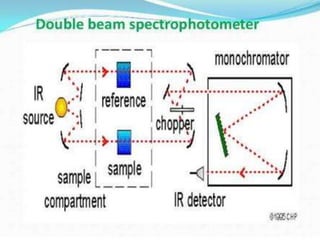
•One part of the monochromatic
beam is made to pass through the
sample solution and them falls on
the working photocell.
•The other part of the
monochromatic beam is made to
pass through the blank or
reference solution and then falls
on the reference photocell.
• The two photocells are
connected to the comparison
circuit.
• The compariaon circuit reads
directly the absorbance of the
solution.
ADVANTAGES OF THE BEAM
INSTRUMENT:
•1.The instrument automatically
compensate for the absorbance by the
blank solution.
•2.The continuous replacement of the
blank with the sample is not
necessary as required in single beam
instrument.
•3.Since two beam of same radiant
power are used at a time for sample
and reference and two identical
balanced photocells are used,readings
are independent of the fluctuation of
the main power supply.
•4.Since the null method is uses for the
instrument readings are not affected
by variations in the sensitivity of the
photocells.
•5.It provide rapid scanning over a
wide wavelength region and use a
recorder.
•6.The instrument is very useful for
qualitative analysis in which the total
spectrum is required.
colorimeter spectrophotometer
1.Uses filters. 1. Uses monochromator.
2.It uses narrow
band of
wavelength.
2. usese single
wavelength.
Difference between Colorimeter and
spectrophotometer
3.It uses only in
visible region.
3.It uses in U.V and
visible regions.
4.It operates at the
wavelength of the
filter available.
4. It operates at
any wavelength
simply by rotation
of the prism or
grating.
5.It uses photovoltic
cell as detector. It
ssensitivity is less.
5. It uses phototube
as detector.its
sensitivity is high.
6.It gives less
accurate results.
6.It gives accurate
results.
7.It is less
expensive.
7.It is expensive.
8.It is less
informative,since
broad band of
wavelength used.
8.It is much
informative,since
narrow band of
wavelength used.
▶ The absorbance is proportional to the
concentration i.e. to the no. of particales that are
effective in absorbing radiation at specified
wavelength.
▶ This is easily extended to the solution containing
two or more than two components as absorbing
species.
▶ Each component absorb independently.
Additivity of absorbance
▶ If absorption spectrum (S1) of a
system of two chromophores is
available & if absorption spectrum (S2)
of one out of these two chromophores
is known then S2 can be substracted
from S1 , to get pure absorption
spectrum of another chromophore.
▶ The (S1-S2) spectrum is usefull of
identification of unknown chromophore
of the system.
Simultaneous
spectrophotometric
determination
▶ This tecnique is used to measure the absorbance
of a mixture of coloured solution without
separating them.
▶ This involves the simultaneous determination of
the conc. Of two or more components in a given
solution by measuring the absorbance at two or
more wavelenghts.
▶ It is based on the following requirements.
▶ 1. There is no chemical interaction between the
absorbing components.
▶ 2. Each component acts independantly i.e. each
one absorbs as if others are not present.
▶ 3.Beer’s laws obeyed by each component at its
wavelenght (λmax).
▶ 4. λmax values of components are differed
widely.
▶ 5. The absorbance of each component in the
mixture is additive i.e. the observed total
absorbance A at any wavelenght is the sum of
absorbances of ‘n’ components present in the
mixture.
▶ 6. The value of molar absorptivities of each
component of the mixture at any fixed wavelenght
are calculated from absorptive measurements of
solution cantaining the single component.
SPECTROPHOTOMETRIC
TITRATIONS
▶ Titration in which absorbance of a solution is used
to determine the end point are called
spectrophotometric titrations.
▶ Both filter photometers and spectrophotometers
can be used for photometric titrations.
▶ Titration those carried with the help of
spectrophotometer are called spectrophotometric
titrations.
▶ Titration those carried with a photometer are
called photometric titration.
Instrumentation
▶ Usually , sphotometer or spectrophotometer are
modified to insert the titration vessel or cell in the
light path , or a special titration cell is used.
▶ Since beer’s law is obeyed for monochromatic
radiation, spectrophotometers are preferred over
the filter photometers for these titrations.
▶ There are two method of photometric titration.
▶ In the one method, the titration is carried out in a
titration flask on the usual laboratory bench.
▶ The absorbance is measured by taking the
fraction of the titrand from the titration flask &
placing it in the absorptive cell.
▶ Of coures, the fraction are returned completely
each time to the titration flask.
▶ Though this is the simplest method of titration, it is
inconvenient for carrying out the titration.
▶ In another method the titration is carried out inside
the absorptive cell.
▶ If the titration is carried out inside the cell , a
modified cell of 5 to 100 ml capacity is used
instead of cuvette.
▶ This cell is placed in the cell compartment of the
photometer or spectrophotometer.
▶ The cell is made up of perspex sheet.
▶ Since perspex is not transparent to ultraviolet light.
Perspex sheet
▶ The two holes are made in the cell to
accommodate circular quartz windows.
▶ These two window are fitted in such a way that the
beam of light is passes through their center to the
photoelectric cell.
▶ The cell also has two small holes one for
introducing the tip of a microburette & other for
introducing a micristirrer.
▶ The hole arrangement of the cell,except the
windows , is covered with black paper.
Arrangement of spectrophotometric
titration
Titration curves
▶ A photometric titraion curve is a plot of
absorbance against the volume of titrant
added.
▶ This graph consist of two straight line with
differing slopes.
▶ One line occurs before the end point and the
other line occurs beyond the end point.
▶ In many titrations a marked curvature is
observed in the equivalent point region.
▶ The end point is taken as the intersection of
extrapolated straight-line portion.
▶ The shape of the titration curve varies with the
absorbing species in the solution.
▶ The general shape of many typical photometric
titration curves, representing titration system
without added indicator substances.
1 st graph
▶ It represents a type of titration in which
only the titrand (solution being titrated)
absorbs at certain wavelenght , while
the titrant and reaction product do not
absorb.
▶ In such a case the absorbance does
not change after equivalence point.
2 nd
▶ It represent a type of titration in which
only the titrand absorbs at certain
wavelenght , while the product do not
absorb.
▶ There is no change in absorbance at
the wavelenght where only the titrant
absorbs upto the equivalence point.
3 rd
▶ It represents a type of titration in which only
the reaction products absorb strongly at the
particular wavelenght , while the titrant and
reactant do not absorb at this wavelenght.
▶ During the course of titration there is gradual
increase in the conc. Of the absorbing
product, since it accumulates as the titration
proceeds.
▶ Hence absorbance increases till the
equivalence point is reached.
▶ After the equivalence point the absorbance
remains constant , because nothing is added
which absorbs light.
4
▶ It represent a type of titration in which
bhot the reactant and titrand absorb at
a particular wavelenght ,but titrant
absorbs less than the reactant.
▶ The product does not absorb and
hence there will be decrease in the
absorbance as the titration prpceeds.
▶ Moreover, the coloured analyte (the
substance to be analysed) gets
transformed into a colourless product
by a coloured titrant.
Advantages of
photometric titration
▶ The method is useful to solution with lower &
higher ionic strenght or in non aqueous
solvent.
▶ The method can be used to highly coloured
solution which cannot be determined by the
usual visual indicators.
▶ The slight change in colour are readily
detected by the spectrophotometer & hence
end point determination is sharp and accurate.
▶ These titration can be applied to a large no. of
non absorbing constituents since only one
absorber is necessary among the reactant or
reaction product.
▶ This titration technique is particularly suitable
to titration reaction where a relatively large
degree of reaction incompletion exists at the
equivalence point.
Application
Quantitative analysis
Qualitative analysis
▶ 1.structure of organic compounds –
▶ Spectrophotometric technique can be used to
determine the structural problem of organic
molecules.
▶ Example-
▶ For isatin two structures of the forms lactim and
lactam have been proposed for the molecular
formula C8H5O2N.
Quantitative analysis
▶ The spectrophotometric study of inorganic
complexes is very important because,
▶ (a) it distinguishes between, cis and trans isomers
of complex.
▶ (b) it help to study the equilibrium between the
octahedral, tetrahedral, square planar and the
five-coordinate configuration.
Structure of inorganic complexes
▶ The geometrical isomerism of complexs can be
easily distinguished from their visible absorption
spectra.
▶ Example-
▶ The cis isomer of [Co(en)2 F2]NO3 is violet where
as the trans isomer is green.
Geometrical isomerism
▶ The change in colour in cis [Ni (trisethylene
diamine) (H2O)2]²+ from blue to yellow on adding
inert salt to the solution has been shown from
absorption spectra to involve an equilibrium
between octahedral and planar configurations.
Octahedral – planar equilibrium
▶ Sacconi has studied the effect of temp on schiff
base complexes.
▶ This study gives information about the equilibrium
between planar and tetrahedral configuration.
▶ The tetrahedral complexes exhibits two
characteristic bands at 7200 (TB1) and 11200cm-
1 (TB2).
▶ The planar configuration exhibits one
characteristic band at 16000cm-1 (PB).
Planar-tetrahedral equilibrium
▶ It is observed that with increase in temp the
intensity of TB1 and TB2 band increases but that
of PB decreases.
▶ This shown that the equilibrium shifts from planar
to tetrhedral complexe with increasing temp.
▶ 1.A] position and intensity of absorption band
and chromophore –
▶ The term chromophore can be define as any
group in the molecule which exhibits absorption of
electromagnetic radiation in the visible or UV
reagion.
Qualitative analysis
▶ Two type of chromophore-
▶ 1.the chromophore In which the group is having π
electron and during absorption of radiation they
undergo π-π* transition & show coresponding
absorption band in the spectrum.
▶ Example-ethylenes, acetylenes etc.
▶ 2.the chromophore in which the group is having π
electron and n (non-bonding) electrons &during
absorption of radiation they undergo π→π* and
n→π* tansition and show coresponding
absorption bands in the spectrum.
▶ Example-carbonyl , azo compounds, nitro
compounds etc.
▶ Auxochrome is a group which it self does not act
as a chromophore but when attached to a
chromophore it shifts the absorption maximum
(λmax) toward longer wavelenght along with an
increase in the intensity of absorption.
▶ Example- group include –OH, -NH2,-OR, -NHR & -
NR2).
Auxochrome
▶ The presence of auxochrome in the molecule that
cantain chromophore which causes the absorptive
maximum to shift or to change wavelenght is
called as bathochrom sheet.
▶ It is related to the electron donating properties of
auxochrome.
Bathochromic or red shift
▶ It involves the shift of absorption maximum
towards shorter wavelenght because of the
removal of conjugation in a system or by change
of solvent.
▶ Example-aniline shows absorption maximum at
280nm whereas in acidic medium it shifts at 200
nm.
▶
Hypsochromic shift or blue shift
▶ The shape of the titration curve varies with the
absorbing species in the solution.
▶ The general shape of many typical photometric
titration curves, representing titration system
without added indicator substances.
▶ This effect shows an increase in the intensity of
absorption and usually brought about by
introduction of an auxochrome in the molecule
under study.
Hyperchromic shift
▶ This effect shows a decrease in intensity of
absorption and usually brought about introduction
of certain group in the molecule under study and
these group distort the geometry of the given
molecule.
Hypochromic shift

Spectrophotometry

  • 1.
    Spectrophotometry The spectrophotometer isan instrument used to measure the intensity of wavelengths in a spectrum of light.
  • 3.
    Spectroscopy : • .It is a branch of science which deals with the study of interaction of electromagnetic radiation with matter. • During such interactions the energy is either absorbed or emitted by the matter in discrete amount is called as quanta
  • 5.
    • Electromagnetic radiationmay be considered as a simple harmonic wave propagated from a source and travelling in a straight line except when reflected or refracted.
  • 6.
    Wavelength : • Itis the distance between two successive maxima on an electromagnetic waves. • Usually the wavelength is expressed in cm or in angstrom
  • 7.
  • 8.
    Frequency : • Thenumber of complete wavelength units passing through a given point in unit time is called the frequency of radiation. • It is generally expressed in cycle per second or in hertz.
  • 10.
    Wave number: • Itis the number of waves per centimeter in vacuum.
  • 11.
    Interactions of radiationwith matter. • The entire range over which the electromagnetic radiation exits is known as electromagnetic spectrum.
  • 12.
    • 200- 400nm= u.v region. • 400-750nm= visible region. • 750-1500nm= IR region. The colour of the object arises from the selective absorption of certain wavelength of incident light.
  • 13.
    Terminology used inabsorption measurements: • The ‘JOINT COMMITTEE ON NOMENCLATURE IN APPLIED SPECTROSCOPY’ has worked to develop standard nomenclature for various quantities in spectroscopic measurements.
  • 14.
    1. Radiant energy: • It is defined as the energy transmitted as electromagnetic radiation. • It is characterised by the wavelength and frequency.
  • 17.
    Radiant power, P: •Energy per unit time is called as power. • Radiant power is the rate at which energy is transported in a beam of radiant energy. • The radiant power incident upon a cell is given the symbol Po. And the transmitted by a cell is P.
  • 19.
    Transmittance,T: • It isthe ratio of radiant power transmitted by a sample to the radiant power incident upon the sample , both being measured at the same spectral position. • It is usually expressed as percent transmittance.
  • 20.
    Absorbance ,A: • Theabsorbance is the logarithm to the base 10 of the reciprocal of the transmittance,T. • Absorbance is also defined as the logarithm to the base 10 of the ratio of the radiant power incident upon the sample to the radiant power transmitted by the sample.
  • 21.
    Absorptivity ,a: Absorptivity isdefined as the ratio of the absorbance to the product of the length of optical path b, and the concentration of the sample ,C. a=A/bC. • Absorptivity is the measure of the ability of sample to absorb light.
  • 22.
    Molar absorptivity • Molecularabsorptivity is the product of absorptivity and molecular weight of the material.
  • 23.
    Path length,b: • Itis the internal thickness of cell in which the test sample is taken. • It was formerly denoted by l.
  • 24.
  • 25.
    “When a monochromaticbeam of light is allow to pass through the transparent medium the rate of decrease of intensity with the Thickness (db) of medium is directly proportional to the intensity of incident light”.(A = a.b) Lamberts law
  • 28.
  • 29.
  • 30.
    1. Radiant sources: •A stable continuous source of radiant energy covering the region of spectra of visible and U.V region is used. • Radiation sources must fulfill the following requirements: 1. It must be stable. 2. It must produce sufficient intensity of radiation so that the transmitted intensity can be detected. 3. It must supply continuous spectrum of radiation over the entire wavelength.
  • 31.
    • A tungstenlamp is commonly used as a source of radiation. • In the visible region (400-800nm) , a tungsten filament is most widely used. • Its construction is similar to house hold lamp. • It consist of a tungsten wire which is heated in a controlled atmosphere. • To avoid fluctuations in readings it is necessary that the lamp should provide constant radiant energy . • ?????? • It is achieved by employing a constant power supply to the lamp.
  • 32.
    Filters and monochromators: •A radiation source is generally emitting a continuous spectra i.e. it gives all possible wavelength of the region . • However, a narrow band of wavelength is always necessary in calorimetric and spectrophotometric analysis. • Therefore , it is necessary to have device which will select a narrow band from wavelength of continuous spectra. • For this purpose , filters and monochromators are used.
  • 33.
    • Both filterand monochromator allow the light of required wavelength to pass through but absorbs the light of other wavelength . Filters are of two types: 1. Absorption filters 2. Interference filters
  • 34.
    Absorption filters: • Thesefilters work by selective abbsorption of unwanted wavelengths i.e. these filters limit the radiation by absorbing ertain portion of light spectrum. • Absorption filters are generally cheaper than interference filters.
  • 37.
  • 38.
    • These filtersgenerally provide somewhat narrower band width than absorption filters. • When a ray of light is incident upon it , a part of light reflects back whereas the remaining light is transmitted.
  • 39.
    Monochromators: • A monochromatoris a device which converts a polychromatic radiation to monochromatic radiation. • Usually a monochromator consist of ; 1. Entrance and exit slit: to restrict unwanted radiation. 2. Lenses or mirrors: to focus radiation. 3. The dispersing medium(like prism and diffracting grating): to isolate the wavelength.
  • 41.
  • 42.
    Cuvette or samplecontainer: • The cell holding the sample should be transparent to the wavelength region .this cell is called as cuvette. • The cuvette is made up of quartz or glass. • The thickness of cuvette is 1cm and it is used for sample and solvent.
  • 43.
    Detector • A detectoris a device which converts radiant energy into electrical energy. • Generally , 3 types of detectors are used to detect radiation: 1. Photovoltaic cells. 2. Phototubes . 3. Photomultiplier tubes.
  • 44.
    1. Photovoltaic cell: •It is also called barrier –layer cell or photronic cell. • This cell operates without the use of battery. • The photovoltaic cell consist of metal base plate ,thin layer of semiconductor and thin layer of transparent silver and gold metal layer. • When the radiation are incident the electrons are generated at transparent and semiconductor layer junction.
  • 45.
    • Because ofaccomodation of electrons electric voltage is generated therefore photovoltaic current flow through the circuit which is recorded by galvanometer. • The photocurrent is directly proportional to the intensity of incident light. • It is used only for visible region.
  • 47.
  • 48.
    • A phototubeconsist of an evacuated glass bulb. • A light sensitive cathode in the form of half cylinder or circle. • The inner surface of cathode is coated with light sensitive material. • A metal ring is inserted near the center of bulb which act as anode. • When the radiation is Incident upon the cathode Photoelectrons are emitted.
  • 49.
    • Thus electronsare attracted towards anode and create electric current which flows through the circuit. • Te current is measured by read out system. • Phototube are more sensitive than photovoltaic cell.
  • 50.
    3.Photomultiplier tube. • Itis more sensitive than phototube . • It is mostly used in spectrophotometer.
  • 51.
    Single beam photoelectric calorimeter: •The basic components of single beam photoelectric calorimeter are : 1. A source of light such as tungsten filament lamp with concave reflector and collimating lens. 2. An adjustable diaphraghms or slit 3. A filter 4. A cuvette 5. A detector such as photovoltaic cell 6. A recorder such as galvanometer.
  • 53.
  • 54.
    ◼The photometer isan instrument which is used to measure radinat power of light . ◼Spectrophotometer is an instrument use to measure the absorbance or tranmittance of a solution as a function of wavelenght.l ◼T he single beam spectrophotometer are particularly suitable for the quantitative analysis that involves an absorbance measurement at a single wavelength in both visible and u.v region.
  • 55.
    ◼A very widelyused spectrophotometer primarily foer the visible region( 340-625nm)is the Bausch and Lomb Spectronic- 20 fitted with a blue sensitive phototube. ◼Its range can be extended to 950 nm by the use of a red-sensitive phototube and a red-transmitting filter. ◼The reflecting grating has convergent beam but not in a collimated light beam
  • 56.
    ◼ The vaccumphototube is used as a radiation dedector ◼ The signal from the dedector is amplified and the meter in the bridge circuit is graduated in linear scale divisions from 0 to 100 % tranmittance as well as in non-linear absorbance unit. ◼ The rotation of the grating drum turns the grating which gives namely wave-length adjustment, 0 adjustment and 100 % adjustment. ◼ This spectro photo meter is an in expensive and easily operated instrument.
  • 57.
    ◼The spectro photometer is an instrument used to measure absorbance or transmissioin of a solution as a function of a wave length. PRINCIPLES
  • 58.
    INSTRUMENTATION ◼It consist offollowing instruments ◼1. Source ◼2. Monochromater ◼3. SampleCell i.e cuvette ◼4. Detector i.e phototube
  • 59.
    RADIANT SOURCE ◼U.V regionis used. A stable continious source of radiant energy covering the region of spectra of visible and ◼A tungsten lamp is comm0nly used a source of raditation
  • 60.
    MONO CHROMATOR ◼ Itis device which converts a polychromatic radiation to monochromatic radiation. ◼ It consist of : ◼ 1.entrance & exit slit ◼ To restrict unwanted radiation and help to control the spectral purity of the radiation emitted from the monochromator ◼ 2.Lenses ◼ To make the beam parallel or to focus radiation and to isolate the wave length from the polychromatic radiation of the source
  • 61.
    SAMPLE CELL ◼1.The instrumentcontain transparent container called cuvette which is made of quartz. ◼2.The thickness of cuvette is 1 cm and it may be rectangular or cylindrical and it used for sample and solvent
  • 62.
    DETECTOR ◼It is usedfor measuring radiant energy transmitted through the sample in the form of electrical signal ◼Which is passed through the read out system
  • 63.
    PHOTOTUBE ◼ The cellis also known as photoemissive tubes ◼ A phototube consist of evacuated glass bulb ◼ A light sensitive cathode in the form of half cylinder or circle ◼ The inner surface of cathode is coated with light sensitive material ◼ A metal ring is inserted near the centre of bulb which act a Anode when the radiation is incident upon the cathod photo electrons are emitted ◼
  • 64.
    ◼This electrons areattracted towards anode and create electric current which flow trough the circuit ◼The current is amplify and measured by read out device ◼Phototube are more sensitive than photovoltic cell.
  • 67.
    Main Difference –Colorimeter vs. Spectrophotometer • Colorimeters and spectrophotometers are both used to measure colour-absorbing properties of substances. The main difference between colorimeter and spectrophotometer is that colorimeter is a device which measures absorbance of specific colours,whereas a spectrometer measures transmittance or reflectance as a function of wavelength.
  • 68.
  • 69.
    •One part ofthe monochromatic beam is made to pass through the sample solution and them falls on the working photocell. •The other part of the monochromatic beam is made to pass through the blank or reference solution and then falls on the reference photocell.
  • 70.
    • The twophotocells are connected to the comparison circuit. • The compariaon circuit reads directly the absorbance of the solution.
  • 71.
    ADVANTAGES OF THEBEAM INSTRUMENT: •1.The instrument automatically compensate for the absorbance by the blank solution. •2.The continuous replacement of the blank with the sample is not necessary as required in single beam instrument.
  • 72.
    •3.Since two beamof same radiant power are used at a time for sample and reference and two identical balanced photocells are used,readings are independent of the fluctuation of the main power supply. •4.Since the null method is uses for the instrument readings are not affected by variations in the sensitivity of the photocells.
  • 73.
    •5.It provide rapidscanning over a wide wavelength region and use a recorder. •6.The instrument is very useful for qualitative analysis in which the total spectrum is required.
  • 75.
    colorimeter spectrophotometer 1.Uses filters.1. Uses monochromator. 2.It uses narrow band of wavelength. 2. usese single wavelength. Difference between Colorimeter and spectrophotometer
  • 76.
    3.It uses onlyin visible region. 3.It uses in U.V and visible regions. 4.It operates at the wavelength of the filter available. 4. It operates at any wavelength simply by rotation of the prism or grating.
  • 77.
    5.It uses photovoltic cellas detector. It ssensitivity is less. 5. It uses phototube as detector.its sensitivity is high. 6.It gives less accurate results. 6.It gives accurate results.
  • 78.
    7.It is less expensive. 7.Itis expensive. 8.It is less informative,since broad band of wavelength used. 8.It is much informative,since narrow band of wavelength used.
  • 85.
    ▶ The absorbanceis proportional to the concentration i.e. to the no. of particales that are effective in absorbing radiation at specified wavelength. ▶ This is easily extended to the solution containing two or more than two components as absorbing species. ▶ Each component absorb independently. Additivity of absorbance
  • 86.
    ▶ If absorptionspectrum (S1) of a system of two chromophores is available & if absorption spectrum (S2) of one out of these two chromophores is known then S2 can be substracted from S1 , to get pure absorption spectrum of another chromophore. ▶ The (S1-S2) spectrum is usefull of identification of unknown chromophore of the system.
  • 89.
  • 90.
    ▶ This tecniqueis used to measure the absorbance of a mixture of coloured solution without separating them. ▶ This involves the simultaneous determination of the conc. Of two or more components in a given solution by measuring the absorbance at two or more wavelenghts. ▶ It is based on the following requirements.
  • 91.
    ▶ 1. Thereis no chemical interaction between the absorbing components. ▶ 2. Each component acts independantly i.e. each one absorbs as if others are not present. ▶ 3.Beer’s laws obeyed by each component at its wavelenght (λmax). ▶ 4. λmax values of components are differed widely.
  • 92.
    ▶ 5. Theabsorbance of each component in the mixture is additive i.e. the observed total absorbance A at any wavelenght is the sum of absorbances of ‘n’ components present in the mixture. ▶ 6. The value of molar absorptivities of each component of the mixture at any fixed wavelenght are calculated from absorptive measurements of solution cantaining the single component.
  • 94.
    SPECTROPHOTOMETRIC TITRATIONS ▶ Titration inwhich absorbance of a solution is used to determine the end point are called spectrophotometric titrations.
  • 95.
    ▶ Both filterphotometers and spectrophotometers can be used for photometric titrations. ▶ Titration those carried with the help of spectrophotometer are called spectrophotometric titrations. ▶ Titration those carried with a photometer are called photometric titration. Instrumentation
  • 96.
    ▶ Usually ,sphotometer or spectrophotometer are modified to insert the titration vessel or cell in the light path , or a special titration cell is used. ▶ Since beer’s law is obeyed for monochromatic radiation, spectrophotometers are preferred over the filter photometers for these titrations.
  • 97.
    ▶ There aretwo method of photometric titration. ▶ In the one method, the titration is carried out in a titration flask on the usual laboratory bench. ▶ The absorbance is measured by taking the fraction of the titrand from the titration flask & placing it in the absorptive cell. ▶ Of coures, the fraction are returned completely each time to the titration flask. ▶ Though this is the simplest method of titration, it is inconvenient for carrying out the titration.
  • 98.
    ▶ In anothermethod the titration is carried out inside the absorptive cell. ▶ If the titration is carried out inside the cell , a modified cell of 5 to 100 ml capacity is used instead of cuvette. ▶ This cell is placed in the cell compartment of the photometer or spectrophotometer. ▶ The cell is made up of perspex sheet. ▶ Since perspex is not transparent to ultraviolet light.
  • 99.
  • 100.
    ▶ The twoholes are made in the cell to accommodate circular quartz windows. ▶ These two window are fitted in such a way that the beam of light is passes through their center to the photoelectric cell. ▶ The cell also has two small holes one for introducing the tip of a microburette & other for introducing a micristirrer. ▶ The hole arrangement of the cell,except the windows , is covered with black paper.
  • 101.
  • 103.
  • 104.
    ▶ A photometrictitraion curve is a plot of absorbance against the volume of titrant added. ▶ This graph consist of two straight line with differing slopes. ▶ One line occurs before the end point and the other line occurs beyond the end point. ▶ In many titrations a marked curvature is observed in the equivalent point region. ▶ The end point is taken as the intersection of extrapolated straight-line portion.
  • 105.
    ▶ The shapeof the titration curve varies with the absorbing species in the solution. ▶ The general shape of many typical photometric titration curves, representing titration system without added indicator substances.
  • 106.
  • 107.
    ▶ It representsa type of titration in which only the titrand (solution being titrated) absorbs at certain wavelenght , while the titrant and reaction product do not absorb. ▶ In such a case the absorbance does not change after equivalence point.
  • 108.
  • 109.
    ▶ It representa type of titration in which only the titrand absorbs at certain wavelenght , while the product do not absorb. ▶ There is no change in absorbance at the wavelenght where only the titrant absorbs upto the equivalence point.
  • 110.
  • 111.
    ▶ It representsa type of titration in which only the reaction products absorb strongly at the particular wavelenght , while the titrant and reactant do not absorb at this wavelenght. ▶ During the course of titration there is gradual increase in the conc. Of the absorbing product, since it accumulates as the titration proceeds. ▶ Hence absorbance increases till the equivalence point is reached. ▶ After the equivalence point the absorbance remains constant , because nothing is added which absorbs light.
  • 112.
  • 113.
    ▶ It representa type of titration in which bhot the reactant and titrand absorb at a particular wavelenght ,but titrant absorbs less than the reactant. ▶ The product does not absorb and hence there will be decrease in the absorbance as the titration prpceeds. ▶ Moreover, the coloured analyte (the substance to be analysed) gets transformed into a colourless product by a coloured titrant.
  • 114.
  • 115.
    ▶ The methodis useful to solution with lower & higher ionic strenght or in non aqueous solvent. ▶ The method can be used to highly coloured solution which cannot be determined by the usual visual indicators. ▶ The slight change in colour are readily detected by the spectrophotometer & hence end point determination is sharp and accurate.
  • 116.
    ▶ These titrationcan be applied to a large no. of non absorbing constituents since only one absorber is necessary among the reactant or reaction product. ▶ This titration technique is particularly suitable to titration reaction where a relatively large degree of reaction incompletion exists at the equivalence point.
  • 117.
  • 118.
    ▶ 1.structure oforganic compounds – ▶ Spectrophotometric technique can be used to determine the structural problem of organic molecules. ▶ Example- ▶ For isatin two structures of the forms lactim and lactam have been proposed for the molecular formula C8H5O2N. Quantitative analysis
  • 119.
    ▶ The spectrophotometricstudy of inorganic complexes is very important because, ▶ (a) it distinguishes between, cis and trans isomers of complex. ▶ (b) it help to study the equilibrium between the octahedral, tetrahedral, square planar and the five-coordinate configuration. Structure of inorganic complexes
  • 120.
    ▶ The geometricalisomerism of complexs can be easily distinguished from their visible absorption spectra. ▶ Example- ▶ The cis isomer of [Co(en)2 F2]NO3 is violet where as the trans isomer is green. Geometrical isomerism
  • 121.
    ▶ The changein colour in cis [Ni (trisethylene diamine) (H2O)2]²+ from blue to yellow on adding inert salt to the solution has been shown from absorption spectra to involve an equilibrium between octahedral and planar configurations. Octahedral – planar equilibrium
  • 122.
    ▶ Sacconi hasstudied the effect of temp on schiff base complexes. ▶ This study gives information about the equilibrium between planar and tetrahedral configuration. ▶ The tetrahedral complexes exhibits two characteristic bands at 7200 (TB1) and 11200cm- 1 (TB2). ▶ The planar configuration exhibits one characteristic band at 16000cm-1 (PB). Planar-tetrahedral equilibrium
  • 123.
    ▶ It isobserved that with increase in temp the intensity of TB1 and TB2 band increases but that of PB decreases. ▶ This shown that the equilibrium shifts from planar to tetrhedral complexe with increasing temp.
  • 124.
    ▶ 1.A] positionand intensity of absorption band and chromophore – ▶ The term chromophore can be define as any group in the molecule which exhibits absorption of electromagnetic radiation in the visible or UV reagion. Qualitative analysis
  • 125.
    ▶ Two typeof chromophore- ▶ 1.the chromophore In which the group is having π electron and during absorption of radiation they undergo π-π* transition & show coresponding absorption band in the spectrum. ▶ Example-ethylenes, acetylenes etc. ▶ 2.the chromophore in which the group is having π electron and n (non-bonding) electrons &during absorption of radiation they undergo π→π* and n→π* tansition and show coresponding absorption bands in the spectrum. ▶ Example-carbonyl , azo compounds, nitro compounds etc.
  • 126.
    ▶ Auxochrome isa group which it self does not act as a chromophore but when attached to a chromophore it shifts the absorption maximum (λmax) toward longer wavelenght along with an increase in the intensity of absorption. ▶ Example- group include –OH, -NH2,-OR, -NHR & - NR2). Auxochrome
  • 127.
    ▶ The presenceof auxochrome in the molecule that cantain chromophore which causes the absorptive maximum to shift or to change wavelenght is called as bathochrom sheet. ▶ It is related to the electron donating properties of auxochrome. Bathochromic or red shift
  • 128.
    ▶ It involvesthe shift of absorption maximum towards shorter wavelenght because of the removal of conjugation in a system or by change of solvent. ▶ Example-aniline shows absorption maximum at 280nm whereas in acidic medium it shifts at 200 nm. ▶ Hypsochromic shift or blue shift
  • 129.
    ▶ The shapeof the titration curve varies with the absorbing species in the solution. ▶ The general shape of many typical photometric titration curves, representing titration system without added indicator substances.
  • 130.
    ▶ This effectshows an increase in the intensity of absorption and usually brought about by introduction of an auxochrome in the molecule under study. Hyperchromic shift
  • 131.
    ▶ This effectshows a decrease in intensity of absorption and usually brought about introduction of certain group in the molecule under study and these group distort the geometry of the given molecule. Hypochromic shift