

SIZE EXCLUSION CHROMATOGRAPHY (SEC)
PRESENTED BY : MR K V NANDA KUMAR
ASSOCIATE PROFESSOR,
DEPARTMENT OF PHARMACEUTICAL ANALYSIS,
KRISHNA TEJA PHARMACY COLLEGE, TIRUPATHI-517506
CONTENTS
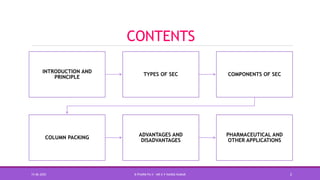
INTRODUCTION AND
PRINCIPLE
TYPES OF SEC COMPONENTS OF SEC
COLUMN PACKING
ADVANTAGES AND
DISADVANTAGES
PHARMACEUTICAL AND
OTHER APPLICATIONS
15-06-2020 B PHARM PA II - MR K V NANDA KUMAR 2
Also known as…
Molecular exclusion chromatography
Gel exclusion chromatography
Gel filtration chromatography
15-06-2020 B PHARM PA II - MR K V NANDA KUMAR 3
15-06-2020 B PHARM PA II - MR K V NANDA KUMAR 4
INTRODUCTION AND PRINCIPLE
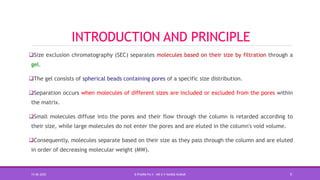
Size exclusion chromatography (SEC) separates molecules based on their size by filtration through a
gel.
The gel consists of spherical beads containing pores of a specific size distribution.
Separation occurs when molecules of different sizes are included or excluded from the pores within
the matrix.
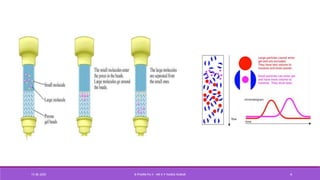
Small molecules diffuse into the pores and their flow through the column is retarded according to
their size, while large molecules do not enter the pores and are eluted in the column's void volume.
Consequently, molecules separate based on their size as they pass through the column and are eluted
in order of decreasing molecular weight (MW).
15-06-2020 B PHARM PA II - MR K V NANDA KUMAR 5
TYPES OF SEC
There are two basic types of size exclusion chromatography.
One is gel permeation chromatography (GPC), which uses a hydrophobic column
packing material and a non-aqueous mobile phase (organic solvent) to measure the
molecular weight distribution of synthetic polymers.
The other is gel filtration chromatography (GFC), which uses a hydrophilic packing
material and an aqueous mobile phase to separate, fractionate, or measure the
molecular weight distribution of molecules soluble in water, such as polysaccharides
and proteins.
15-06-2020 B PHARM PA II - MR K V NANDA KUMAR 6
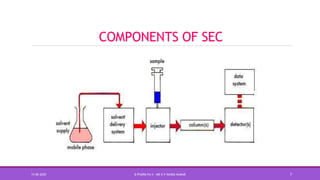
COMPONENTS OF SEC
15-06-2020 B PHARM PA II - MR K V NANDA KUMAR 7
COMPONENTS OF SEC
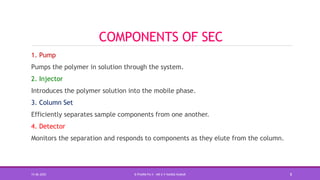
1. Pump
Pumps the polymer in solution through the system.
2. Injector
Introduces the polymer solution into the mobile phase.
3. Column Set
Efficiently separates sample components from one another.
4. Detector
Monitors the separation and responds to components as they elute from the column.
15-06-2020 B PHARM PA II - MR K V NANDA KUMAR 8
COLUMN PACKING
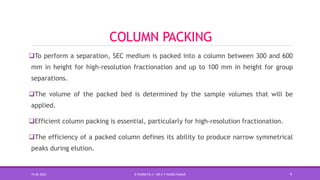
To perform a separation, SEC medium is packed into a column between 300 and 600
mm in height for high-resolution fractionation and up to 100 mm in height for group
separations.
The volume of the packed bed is determined by the sample volumes that will be
applied.
Efficient column packing is essential, particularly for high-resolution fractionation.
The efficiency of a packed column defines its ability to produce narrow symmetrical
peaks during elution.
15-06-2020 B PHARM PA II - MR K V NANDA KUMAR 9
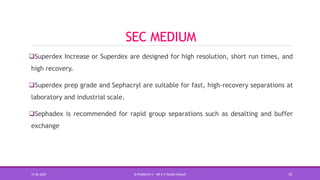
SEC MEDIUM
Superdex Increase or Superdex are designed for high resolution, short run times, and
high recovery.
Superdex prep grade and Sephacryl are suitable for fast, high-recovery separations at
laboratory and industrial scale.
Sephadex is recommended for rapid group separations such as desalting and buffer
exchange
15-06-2020 B PHARM PA II - MR K V NANDA KUMAR 10
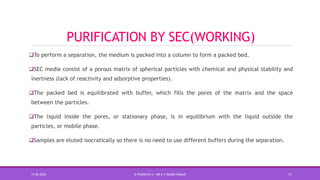
PURIFICATION BY SEC(WORKING)
To perform a separation, the medium is packed into a column to form a packed bed.
SEC media consist of a porous matrix of spherical particles with chemical and physical stability and
inertness (lack of reactivity and adsorptive properties).
The packed bed is equilibrated with buffer, which fills the pores of the matrix and the space
between the particles.
The liquid inside the pores, or stationary phase, is in equilibrium with the liquid outside the
particles, or mobile phase.
Samples are eluted isocratically so there is no need to use different buffers during the separation.
15-06-2020 B PHARM PA II - MR K V NANDA KUMAR 11
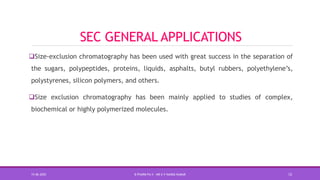
SEC GENERAL APPLICATIONS
Size-exclusion chromatography has been used with great success in the separation of
the sugars, polypeptides, proteins, liquids, asphalts, butyl rubbers, polyethylene’s,
polystyrenes, silicon polymers, and others.
Size exclusion chromatography has been mainly applied to studies of complex,
biochemical or highly polymerized molecules.
15-06-2020 B PHARM PA II - MR K V NANDA KUMAR 12
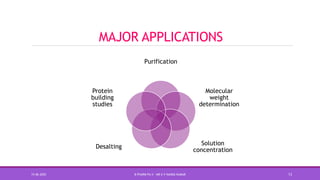
MAJOR APPLICATIONS
Purification
Molecular
weight
determination
Solution
concentration
Desalting
Protein
building
studies
15-06-2020 B PHARM PA II - MR K V NANDA KUMAR 13
PURIFICATION
The main application of exclusion chromatography is in the purification of biological
macromolecules.
Viruses, proteins, enzymes, hormones, antibodies, nucleic acids, and polysaccharides
have all been separated and purified by the use of appropriate gels or glass granules.
15-06-2020 B PHARM PA II - MR K V NANDA KUMAR 14
MOLECULAR WEIGHT DETERMINATION
The effluent volumes of globular proteins are largely determined by their molecular
weight.
It has been shown, that over a considerable molecular weight range, the effluent
volume is approximately a linear function of the logarithm of the molecular weight.
15-06-2020 B PHARM PA II - MR K V NANDA KUMAR 15
SOLUTION CONCENTRATION
Solution of high molecular weight substances can be concentrated by the addition of
dry sephadex G-25 (coarse).
Water and low molecular weight substance remain in solution.
After ten minutes the gel is removed by centrifugation, leaving the high molecular
material in a solution whose concentration has increased but whose pH and ionic
strength are unaltered.
15-06-2020 B PHARM PA II - MR K V NANDA KUMAR 16
DESALTING
By use of a column of sephadex G-25, solutions of high molecular weight compounds
may be desalted.
The high molecular weight substances move with the void volume while the low
molecular weight components are distributed between the mobile phase and hence
move slowly.
15-06-2020 B PHARM PA II - MR K V NANDA KUMAR 17
PROTEIN BUILDING STUDIES
Exclusion chromatography is one of a number of methods commonly used to study the
reversible binding of a ligand to a macromolecular such as proteins including receptor
proteins.
A sample of the protein/ligand mixture is applied to a column of a suitable gel (e.g.
G-25) which has previously been equilibrated with a solution of the ligand of the same
concentration as that in the mixture.
15-06-2020 B PHARM PA II - MR K V NANDA KUMAR 18
15-06-2020 B PHARM PA II - MR K V NANDA KUMAR 19

Size exclusion chromatography

  • 1.
    SIZE EXCLUSION CHROMATOGRAPHY(SEC) PRESENTED BY : MR K V NANDA KUMAR ASSOCIATE PROFESSOR, DEPARTMENT OF PHARMACEUTICAL ANALYSIS, KRISHNA TEJA PHARMACY COLLEGE, TIRUPATHI-517506
  • 2.
    CONTENTS INTRODUCTION AND PRINCIPLE TYPES OFSEC COMPONENTS OF SEC COLUMN PACKING ADVANTAGES AND DISADVANTAGES PHARMACEUTICAL AND OTHER APPLICATIONS 15-06-2020 B PHARM PA II - MR K V NANDA KUMAR 2
  • 3.
    Also known as… Molecularexclusion chromatography Gel exclusion chromatography Gel filtration chromatography 15-06-2020 B PHARM PA II - MR K V NANDA KUMAR 3
  • 4.
    15-06-2020 B PHARMPA II - MR K V NANDA KUMAR 4
  • 5.
    INTRODUCTION AND PRINCIPLE Sizeexclusion chromatography (SEC) separates molecules based on their size by filtration through a gel. The gel consists of spherical beads containing pores of a specific size distribution. Separation occurs when molecules of different sizes are included or excluded from the pores within the matrix. Small molecules diffuse into the pores and their flow through the column is retarded according to their size, while large molecules do not enter the pores and are eluted in the column's void volume. Consequently, molecules separate based on their size as they pass through the column and are eluted in order of decreasing molecular weight (MW). 15-06-2020 B PHARM PA II - MR K V NANDA KUMAR 5
  • 6.
    TYPES OF SEC Thereare two basic types of size exclusion chromatography. One is gel permeation chromatography (GPC), which uses a hydrophobic column packing material and a non-aqueous mobile phase (organic solvent) to measure the molecular weight distribution of synthetic polymers. The other is gel filtration chromatography (GFC), which uses a hydrophilic packing material and an aqueous mobile phase to separate, fractionate, or measure the molecular weight distribution of molecules soluble in water, such as polysaccharides and proteins. 15-06-2020 B PHARM PA II - MR K V NANDA KUMAR 6
  • 7.
    COMPONENTS OF SEC 15-06-2020B PHARM PA II - MR K V NANDA KUMAR 7
  • 8.
    COMPONENTS OF SEC 1.Pump Pumps the polymer in solution through the system. 2. Injector Introduces the polymer solution into the mobile phase. 3. Column Set Efficiently separates sample components from one another. 4. Detector Monitors the separation and responds to components as they elute from the column. 15-06-2020 B PHARM PA II - MR K V NANDA KUMAR 8
  • 9.
    COLUMN PACKING To performa separation, SEC medium is packed into a column between 300 and 600 mm in height for high-resolution fractionation and up to 100 mm in height for group separations. The volume of the packed bed is determined by the sample volumes that will be applied. Efficient column packing is essential, particularly for high-resolution fractionation. The efficiency of a packed column defines its ability to produce narrow symmetrical peaks during elution. 15-06-2020 B PHARM PA II - MR K V NANDA KUMAR 9
  • 10.
    SEC MEDIUM Superdex Increaseor Superdex are designed for high resolution, short run times, and high recovery. Superdex prep grade and Sephacryl are suitable for fast, high-recovery separations at laboratory and industrial scale. Sephadex is recommended for rapid group separations such as desalting and buffer exchange 15-06-2020 B PHARM PA II - MR K V NANDA KUMAR 10
  • 11.
    PURIFICATION BY SEC(WORKING) Toperform a separation, the medium is packed into a column to form a packed bed. SEC media consist of a porous matrix of spherical particles with chemical and physical stability and inertness (lack of reactivity and adsorptive properties). The packed bed is equilibrated with buffer, which fills the pores of the matrix and the space between the particles. The liquid inside the pores, or stationary phase, is in equilibrium with the liquid outside the particles, or mobile phase. Samples are eluted isocratically so there is no need to use different buffers during the separation. 15-06-2020 B PHARM PA II - MR K V NANDA KUMAR 11
  • 12.
    SEC GENERAL APPLICATIONS Size-exclusionchromatography has been used with great success in the separation of the sugars, polypeptides, proteins, liquids, asphalts, butyl rubbers, polyethylene’s, polystyrenes, silicon polymers, and others. Size exclusion chromatography has been mainly applied to studies of complex, biochemical or highly polymerized molecules. 15-06-2020 B PHARM PA II - MR K V NANDA KUMAR 12
  • 13.
  • 14.
    PURIFICATION The main applicationof exclusion chromatography is in the purification of biological macromolecules. Viruses, proteins, enzymes, hormones, antibodies, nucleic acids, and polysaccharides have all been separated and purified by the use of appropriate gels or glass granules. 15-06-2020 B PHARM PA II - MR K V NANDA KUMAR 14
  • 15.
    MOLECULAR WEIGHT DETERMINATION Theeffluent volumes of globular proteins are largely determined by their molecular weight. It has been shown, that over a considerable molecular weight range, the effluent volume is approximately a linear function of the logarithm of the molecular weight. 15-06-2020 B PHARM PA II - MR K V NANDA KUMAR 15
  • 16.
    SOLUTION CONCENTRATION Solution ofhigh molecular weight substances can be concentrated by the addition of dry sephadex G-25 (coarse). Water and low molecular weight substance remain in solution. After ten minutes the gel is removed by centrifugation, leaving the high molecular material in a solution whose concentration has increased but whose pH and ionic strength are unaltered. 15-06-2020 B PHARM PA II - MR K V NANDA KUMAR 16
  • 17.
    DESALTING By use ofa column of sephadex G-25, solutions of high molecular weight compounds may be desalted. The high molecular weight substances move with the void volume while the low molecular weight components are distributed between the mobile phase and hence move slowly. 15-06-2020 B PHARM PA II - MR K V NANDA KUMAR 17
  • 18.
    PROTEIN BUILDING STUDIES Exclusionchromatography is one of a number of methods commonly used to study the reversible binding of a ligand to a macromolecular such as proteins including receptor proteins. A sample of the protein/ligand mixture is applied to a column of a suitable gel (e.g. G-25) which has previously been equilibrated with a solution of the ligand of the same concentration as that in the mixture. 15-06-2020 B PHARM PA II - MR K V NANDA KUMAR 18
  • 19.
    15-06-2020 B PHARMPA II - MR K V NANDA KUMAR 19