
ANALYTICAL CHEMISTRY-4
By-Deepak Sharma
HVHP
Institute of P.G
Studies and Research
Lecture – 04 Size Exclusion Chromatography
For M.Sc.
Analytical
Chemistry
Assistant Professor (Department of Chemistry)
M.Sc. (Analytical Chemistry), GATE, GSET, Research Scholar at HNGU
 Lecture Outline
Deepak Sharma
• Size Exclusion Chromatography
• Principle
• Component of SEC
• Material
• Instrumentation
• Advantage
 Size Exclusion Chromatography
Deepak Sharma
• Size-Exclusion Chromatography (SEC) is a chromatographic method
in which molecules in a solution are separated by their size, and in
some cases molecular weight.
• It is usually applied to large molecules or macromolecular complexes
such as proteins and industrial polymers.
• Typically, when an aqueous solution is used to transport the sample
through the column, the technique is known as gel-filtration
chromatography, versus the name gel-permeation chromatography,
which is used when an organic solvent is used as a mobile phase.
Deepak Sharma
• A mixture of molecules dissolved in liquid (the mobile phase) is
applied to a chromatography column which contains a solid support
in the form of microscopic spheres, or “beads” (the stationary
phase).
• The mass of beads within the column is often referred to as the
column bed.
• The beads act as “traps” or “sieves” and function to filter small
molecules which become temporarily trapped within the pores.
 Principle of SEC
Deepak Sharma
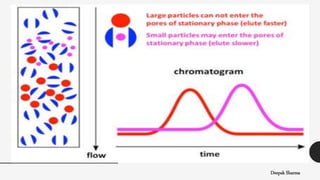
• Larger molecules are “excluded” from the beads .
• Large sample molecules cannot or can only partially penetrate the
pores, whereas smaller molecules can access most or all pores.
• Thus, large molecules elute first, smaller molecules elute later, while
molecules that can access all the pores elute last from the column.
• Particles of different sizes will elute(filter) through a stationary
phase at different rates.
 Principle of SEC
Deepak Sharma
 Components of SEC
• Stationary Phase
• The Mobile Phase
• The Columns
• The Pump
• Detectors
Deepak Sharma
 Stationary Phase
Deepak Sharma
• Stationary Phase Semi-permeable, porous beads with well- defined
range of pore sizes .
• Beads are crosslinked polymers
• Degree of crosslinking is controlled carefully to yield
• different pore sizes.
• Smaller pore sizes are used for rapid desalting of proteins or for
protein purification.
• Intermediate pore sizes are used to separate relatively small proteins
Deepak Sharma
• Soft gel e.g.- dextran(Sephadex), Polyacrylamide
– Used for gels Separation of proteins.
• Semi-rigid gel e.g.- bio beads
– Used for Separation of non-polar polymers in non-
polar solvents.
• Highly rigid e.g. - gels and glasses
– Separation of polar systems
 Stationary Phase
 Mobile phase
Deepak Sharma
• The liquid used to dissolve the biomolecules to make the mobile phase
is usually called a buffer.
• The mixture of biomolecules dissolved in the buffer is called the
sample.
• The choice of mobile phase to be used in any separation will depend
on the type of separation to be achieved and component to be
separated.
• The most common eluents in for polymers that dissolve at room
temperature.e.g.-Tetrahydrofuran (THF), Chloroform, Dimethyl
formamide.
 Mobile Phase
Deepak Sharma
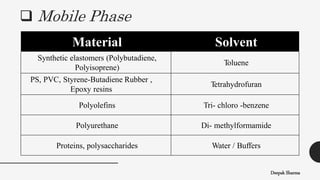
Material Solvent
Synthetic elastomers (Polybutadiene,
Polyisoprene)
Toluene
PS, PVC, Styrene-Butadiene Rubber ,
Epoxy resins
Tetrahydrofuran
Polyolefins Tri- chloro -benzene
Polyurethane Di- methylformamide
Proteins, polysaccharides Water / Buffers
 Columns
Deepak Sharma
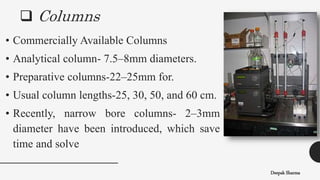
• Commercially Available Columns
• Analytical column- 7.5–8mm diameters.
• Preparative columns-22–25mm for.
• Usual column lengths-25, 30, 50, and 60 cm.
• Recently, narrow bore columns- 2–3mm
diameter have been introduced, which save
time and solve
 Selecting SEC column
Deepak Sharma
• Shorter columns save time and solvent.
• Small particles (typically 5 mm) provide a better
resolution.
• On the other hand, 5 mm (or even 3 mm) packings are
more sensitive towards contamination by samples
containing impurities.
• Particles as large as 20 mm have been recommended
for very high-molecular-weight polymers ion.
 Instrumentation of SEC
Deepak Sharma
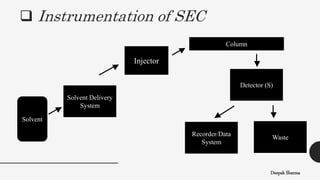
Solvent Delivery
System
Injector
Column
Solvent
Detector (S)
Recorder/Data
System
Waste
 Pump
Deepak Sharma
• A highly constant flow rate has to be maintained during the
• entire chromatogram. This is very important in SEC.
• A change of the flow rate of only 0.1% can cause an error in
molar mass of up to 10%.
• Most pumps can only reproduce the flow rate to 0.2–0.3%.
• In-line filters in the solvent reservoir may prevent particles
from coming into the pump heads, which might damage the
check valves or the pump seals.
• Types-)Syringe pumps, Reciprocating pumps
 Detector
Deepak Sharma
• Concentration sensitive detectors
Bulk Property Detectors- Refractive Index (RI) Detector
Solute Property Detectors- Ultraviolet (UV) Absorption Detector
Evaporative Detectors- Evaporative Light Scattering Detector
(ELSD)
• Molar mass sensitive detectors
Light Scattering Detectors
Low Angle Light Scattering (LALS) Detectors
Multiangle Light Scattering (MALS) detectors
 Detector
Deepak Sharma
• Other detectors
Flame Ionization Detector (FID)
A Mass Spectrometer
A Fourier Transform Infrared (FTIR) Spectrometer
 Advantages
Deepak Sharma
• Short analysis time.
• Well defined separation.
• Narrow bands and good sensitivity.
• There is no sample loss.
• Small amount of mobile phase required.
• The flow rate can be set.
• Limited number of peaks that can be resolved within
the short time scale of the GPC run.
• Filtrations must be performed before using the
instrument to prevent dust and other particulates from
ruining the columns and interfering with the detectors.
• The molecular masses of most of the chains will be
too close for the GPC separation to show anything
more than broad peaks
 Disadvantages
Deepak Sharma
 APPLICATION
• Proteins fractionation
• Purification
• Molecular weight determination.
• Separation of sugar, proteins, peptides, rubbers and others
on the basis of their size.
• This technique can be determine the quaternary structure
of purified proteins.
Deepak Sharma
 APPLICATION
• SEC is a widely used technique for the purification and
analysis of synthetic and biological polymers, such as
protein, polysaccharides and nucleic acid.
• Various species of RNA and viruses have been purified
using agarose gels.
• For Desalting
• For copolymerization studies
Deepak Sharma
Deepak Sharma
https://www.linkedin.com
/in/deepak-sharma-
a1399688
Name of Channel
Deepak Sharma

Lecture 04 size exclusion chromatography

  • 1.
    ANALYTICAL CHEMISTRY-4 By-Deepak Sharma HVHP Instituteof P.G Studies and Research Lecture – 04 Size Exclusion Chromatography For M.Sc. Analytical Chemistry Assistant Professor (Department of Chemistry) M.Sc. (Analytical Chemistry), GATE, GSET, Research Scholar at HNGU
  • 2.
     Lecture Outline DeepakSharma • Size Exclusion Chromatography • Principle • Component of SEC • Material • Instrumentation • Advantage
  • 3.
     Size ExclusionChromatography Deepak Sharma • Size-Exclusion Chromatography (SEC) is a chromatographic method in which molecules in a solution are separated by their size, and in some cases molecular weight. • It is usually applied to large molecules or macromolecular complexes such as proteins and industrial polymers. • Typically, when an aqueous solution is used to transport the sample through the column, the technique is known as gel-filtration chromatography, versus the name gel-permeation chromatography, which is used when an organic solvent is used as a mobile phase.
  • 4.
    Deepak Sharma • Amixture of molecules dissolved in liquid (the mobile phase) is applied to a chromatography column which contains a solid support in the form of microscopic spheres, or “beads” (the stationary phase). • The mass of beads within the column is often referred to as the column bed. • The beads act as “traps” or “sieves” and function to filter small molecules which become temporarily trapped within the pores.  Principle of SEC
  • 5.
    Deepak Sharma • Largermolecules are “excluded” from the beads . • Large sample molecules cannot or can only partially penetrate the pores, whereas smaller molecules can access most or all pores. • Thus, large molecules elute first, smaller molecules elute later, while molecules that can access all the pores elute last from the column. • Particles of different sizes will elute(filter) through a stationary phase at different rates.  Principle of SEC
  • 6.
  • 7.
     Components ofSEC • Stationary Phase • The Mobile Phase • The Columns • The Pump • Detectors Deepak Sharma
  • 8.
     Stationary Phase DeepakSharma • Stationary Phase Semi-permeable, porous beads with well- defined range of pore sizes . • Beads are crosslinked polymers • Degree of crosslinking is controlled carefully to yield • different pore sizes. • Smaller pore sizes are used for rapid desalting of proteins or for protein purification. • Intermediate pore sizes are used to separate relatively small proteins
  • 9.
    Deepak Sharma • Softgel e.g.- dextran(Sephadex), Polyacrylamide – Used for gels Separation of proteins. • Semi-rigid gel e.g.- bio beads – Used for Separation of non-polar polymers in non- polar solvents. • Highly rigid e.g. - gels and glasses – Separation of polar systems  Stationary Phase
  • 10.
     Mobile phase DeepakSharma • The liquid used to dissolve the biomolecules to make the mobile phase is usually called a buffer. • The mixture of biomolecules dissolved in the buffer is called the sample. • The choice of mobile phase to be used in any separation will depend on the type of separation to be achieved and component to be separated. • The most common eluents in for polymers that dissolve at room temperature.e.g.-Tetrahydrofuran (THF), Chloroform, Dimethyl formamide.
  • 11.
     Mobile Phase DeepakSharma Material Solvent Synthetic elastomers (Polybutadiene, Polyisoprene) Toluene PS, PVC, Styrene-Butadiene Rubber , Epoxy resins Tetrahydrofuran Polyolefins Tri- chloro -benzene Polyurethane Di- methylformamide Proteins, polysaccharides Water / Buffers
  • 12.
     Columns Deepak Sharma •Commercially Available Columns • Analytical column- 7.5–8mm diameters. • Preparative columns-22–25mm for. • Usual column lengths-25, 30, 50, and 60 cm. • Recently, narrow bore columns- 2–3mm diameter have been introduced, which save time and solve
  • 13.
     Selecting SECcolumn Deepak Sharma • Shorter columns save time and solvent. • Small particles (typically 5 mm) provide a better resolution. • On the other hand, 5 mm (or even 3 mm) packings are more sensitive towards contamination by samples containing impurities. • Particles as large as 20 mm have been recommended for very high-molecular-weight polymers ion.
  • 14.
     Instrumentation ofSEC Deepak Sharma Solvent Delivery System Injector Column Solvent Detector (S) Recorder/Data System Waste
  • 15.
     Pump Deepak Sharma •A highly constant flow rate has to be maintained during the • entire chromatogram. This is very important in SEC. • A change of the flow rate of only 0.1% can cause an error in molar mass of up to 10%. • Most pumps can only reproduce the flow rate to 0.2–0.3%. • In-line filters in the solvent reservoir may prevent particles from coming into the pump heads, which might damage the check valves or the pump seals. • Types-)Syringe pumps, Reciprocating pumps
  • 16.
     Detector Deepak Sharma •Concentration sensitive detectors Bulk Property Detectors- Refractive Index (RI) Detector Solute Property Detectors- Ultraviolet (UV) Absorption Detector Evaporative Detectors- Evaporative Light Scattering Detector (ELSD) • Molar mass sensitive detectors Light Scattering Detectors Low Angle Light Scattering (LALS) Detectors Multiangle Light Scattering (MALS) detectors
  • 17.
     Detector Deepak Sharma •Other detectors Flame Ionization Detector (FID) A Mass Spectrometer A Fourier Transform Infrared (FTIR) Spectrometer
  • 18.
     Advantages Deepak Sharma •Short analysis time. • Well defined separation. • Narrow bands and good sensitivity. • There is no sample loss. • Small amount of mobile phase required. • The flow rate can be set.
  • 19.
    • Limited numberof peaks that can be resolved within the short time scale of the GPC run. • Filtrations must be performed before using the instrument to prevent dust and other particulates from ruining the columns and interfering with the detectors. • The molecular masses of most of the chains will be too close for the GPC separation to show anything more than broad peaks  Disadvantages Deepak Sharma
  • 20.
     APPLICATION • Proteinsfractionation • Purification • Molecular weight determination. • Separation of sugar, proteins, peptides, rubbers and others on the basis of their size. • This technique can be determine the quaternary structure of purified proteins. Deepak Sharma
  • 21.
     APPLICATION • SECis a widely used technique for the purification and analysis of synthetic and biological polymers, such as protein, polysaccharides and nucleic acid. • Various species of RNA and viruses have been purified using agarose gels. • For Desalting • For copolymerization studies Deepak Sharma
  • 22.