Measures of relationships
•Cross tabulation and percentage difference
•Gamma
•Spearman’s rank order correlation co-efficient(Rho)
 This section examines the relationship
between variables.
E.g.
 Children grow, their weight increases
 Demand increases if price decreases
 Application of fertilizers increases crop yield
There may be,
 Direct-indirect relationship
 Positive-negative relationship
In examining the relationship between variables, we
have to consider certain questions:
 Is there relationship between variables?
 What is the degree and direction of their
relationship?
 Is the relationship a casual one?
 Is the relationship statistically significant?
Cross tabulation and percentage
difference
 It is used for Nominal variables which are
purely qualitative and can be categorized
only.
 E.g.Age, income, brand, religion, language
etc..
Procedure,
 Two way table is prepared.
 The value of one variable are put along one side
of the table.
 And the values of the other variable along the
other side of the table
 Each variable is categorized into two or more
categories; and the variables are cross-tabulated
for those sub categories.
 The percentages are computed for them.
 On the basis of the percentages, conclusions are
drawn.
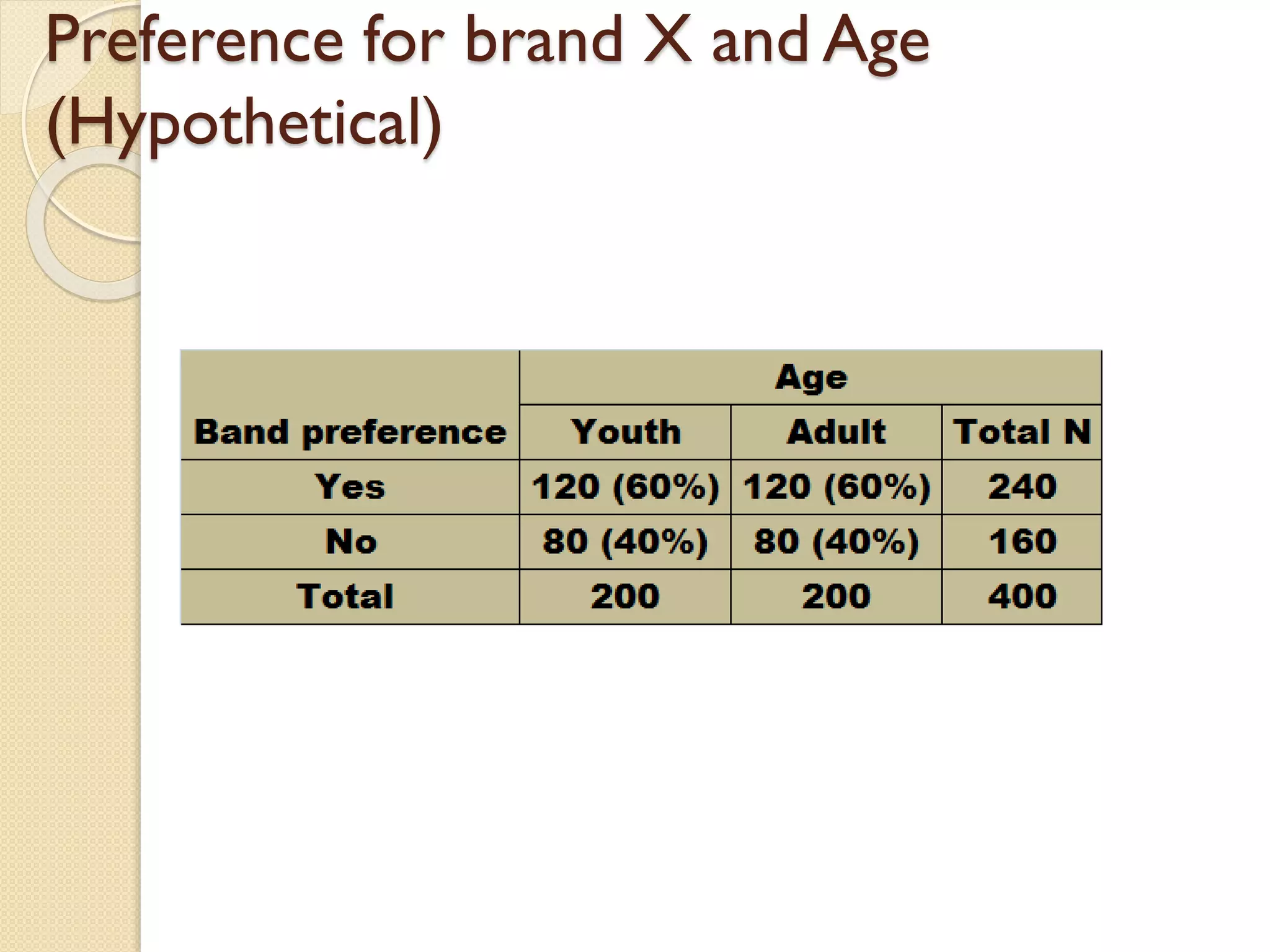
Preference for brand X and Age
(Hypothetical)
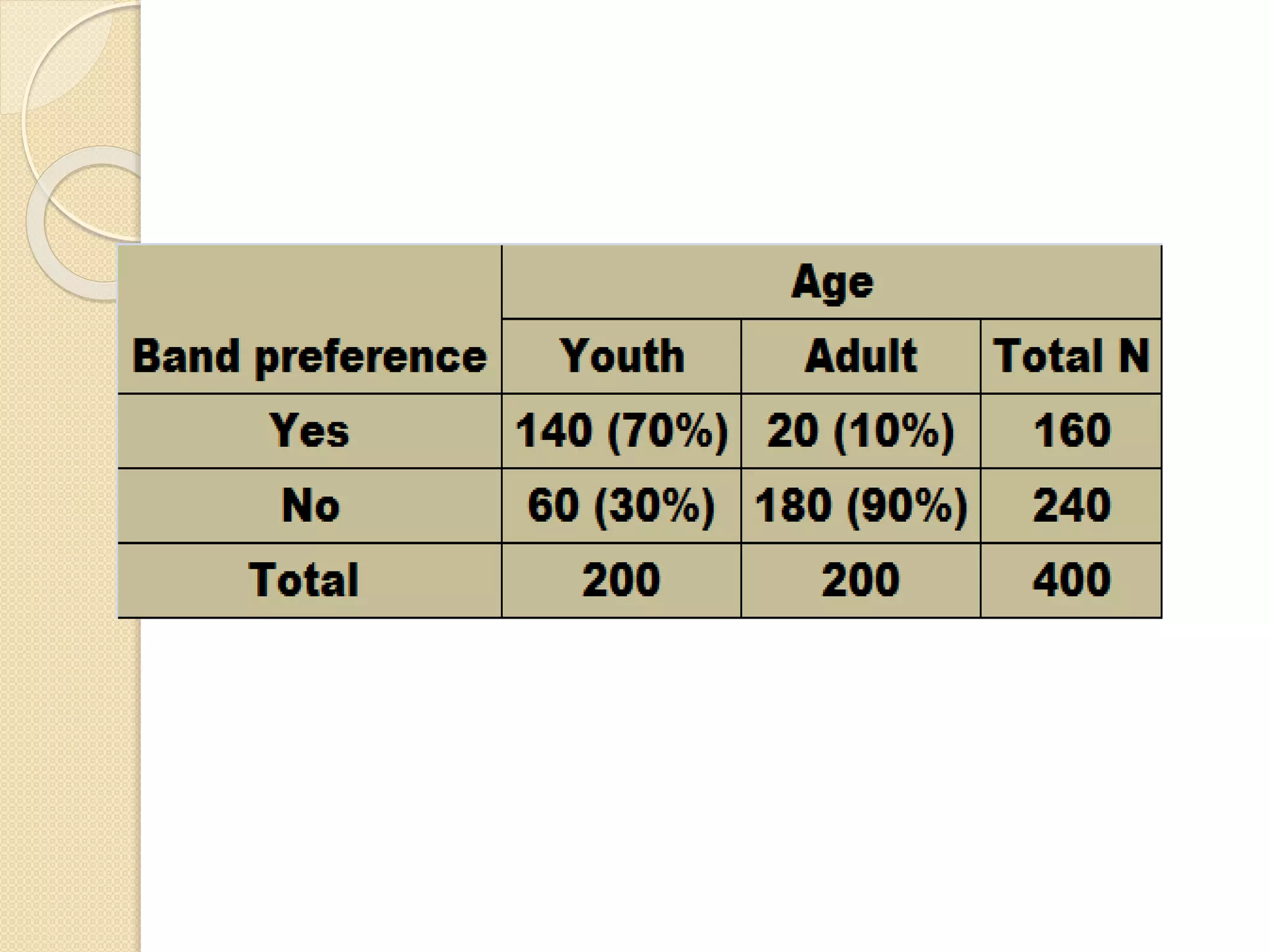
 The strength of relationship is determined
by the pattern of differences between the
values of variables.
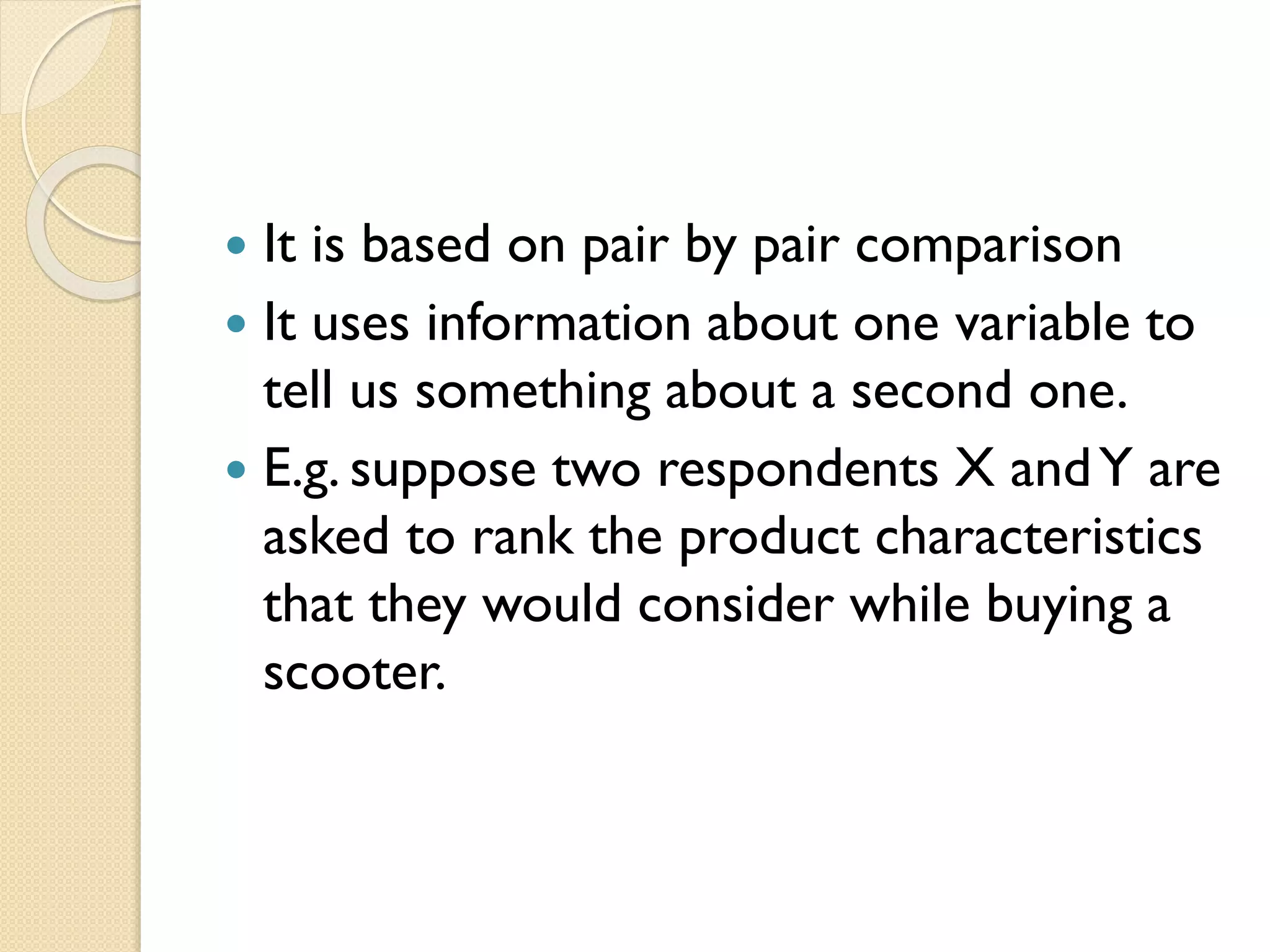
Gamma
 The ordinal level variables have rank
order differences .
 The most common ordinal variables are
Gamma & Spearman’s rank order
correlation coefficient.
 Gamma or G or ϒ
G= (ns – nd )/ (ns + nd )
 ns the number of similar pairs
 Nd the number of dissimilar pairs
 It is based on pair by pair comparison
 It uses information about one variable to
tell us something about a second one.
 E.g. suppose two respondents X andY are
asked to rank the product characteristics
that they would consider while buying a
scooter.
 After counting the number of similar and
dissimilar pairs, the level of association
between the two sets of ranks is
compared by the ratio of the
preponderant type of pairs.
 This value is ϒ
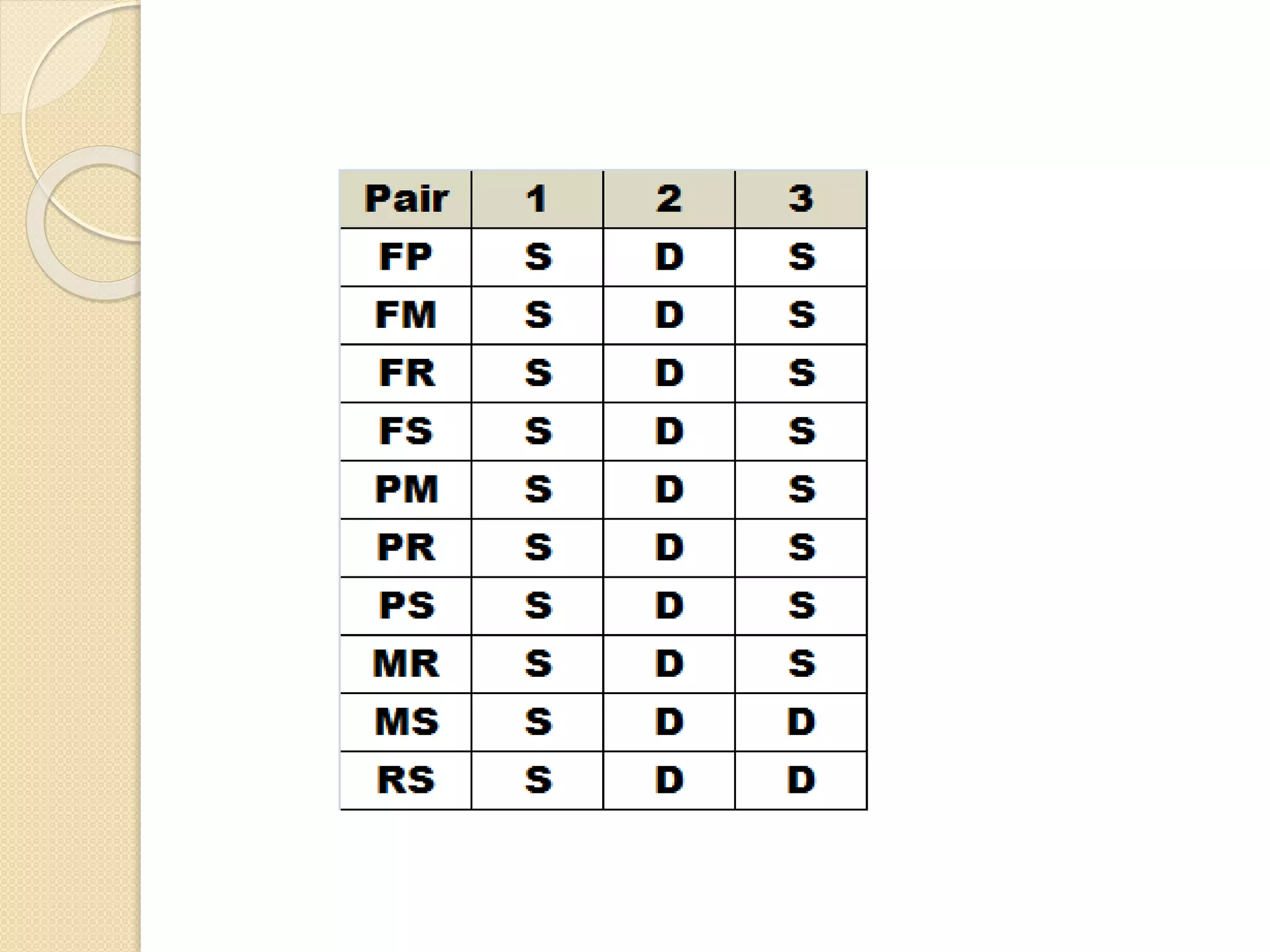
 .Characteristics Respondent X Respondent Y
Fuel efficiency -F 1 1
Price - P 2 2
Mechanical Efficiency - M 3 3
Riding comfort - R 4 4
Style- S 5 5
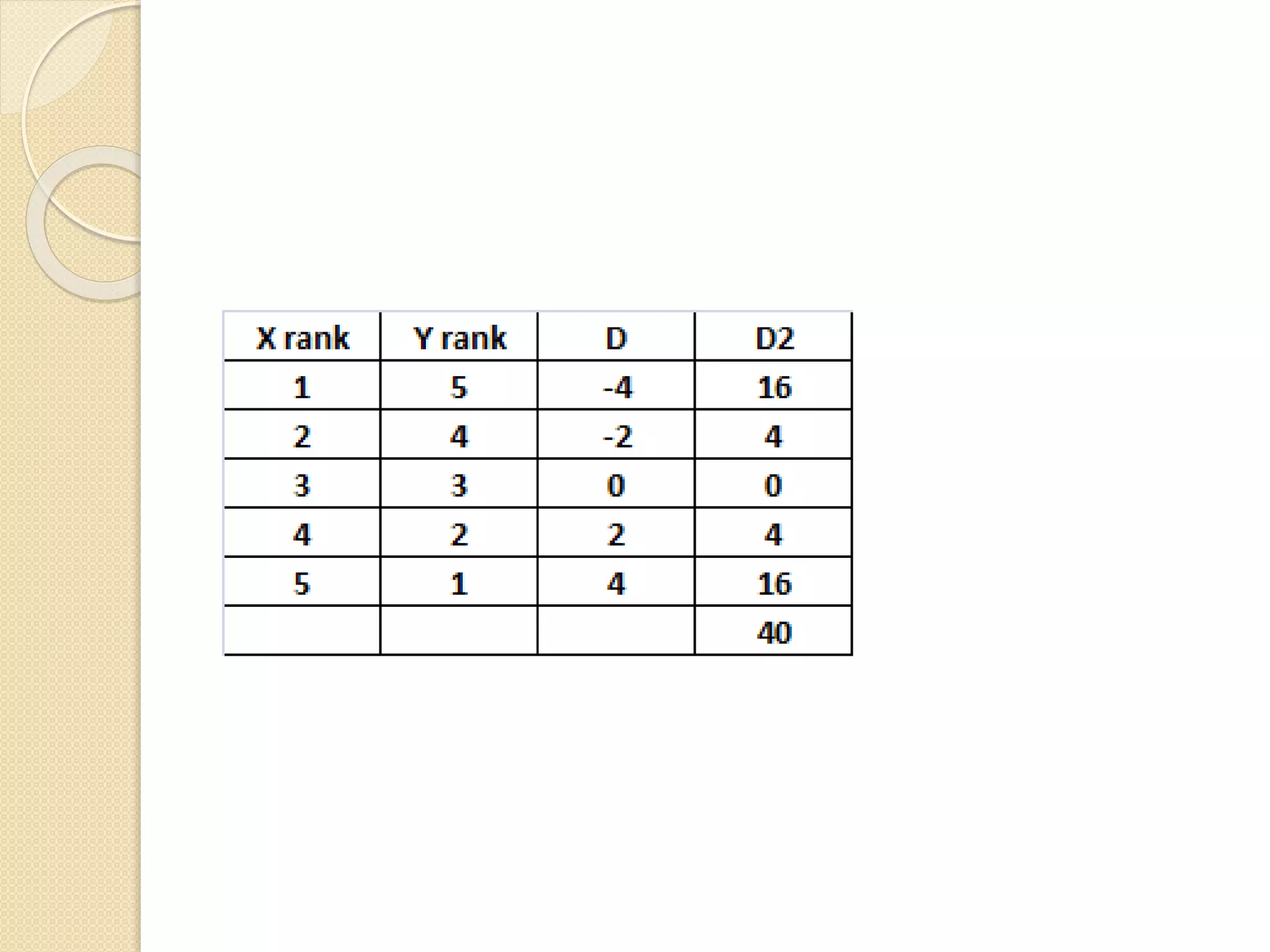
F 1 5
P 2 4
M 3 3
R 4 2
S 5 1
F 1 1
P 2 2
M 3 3
R 4 5
S 5 4
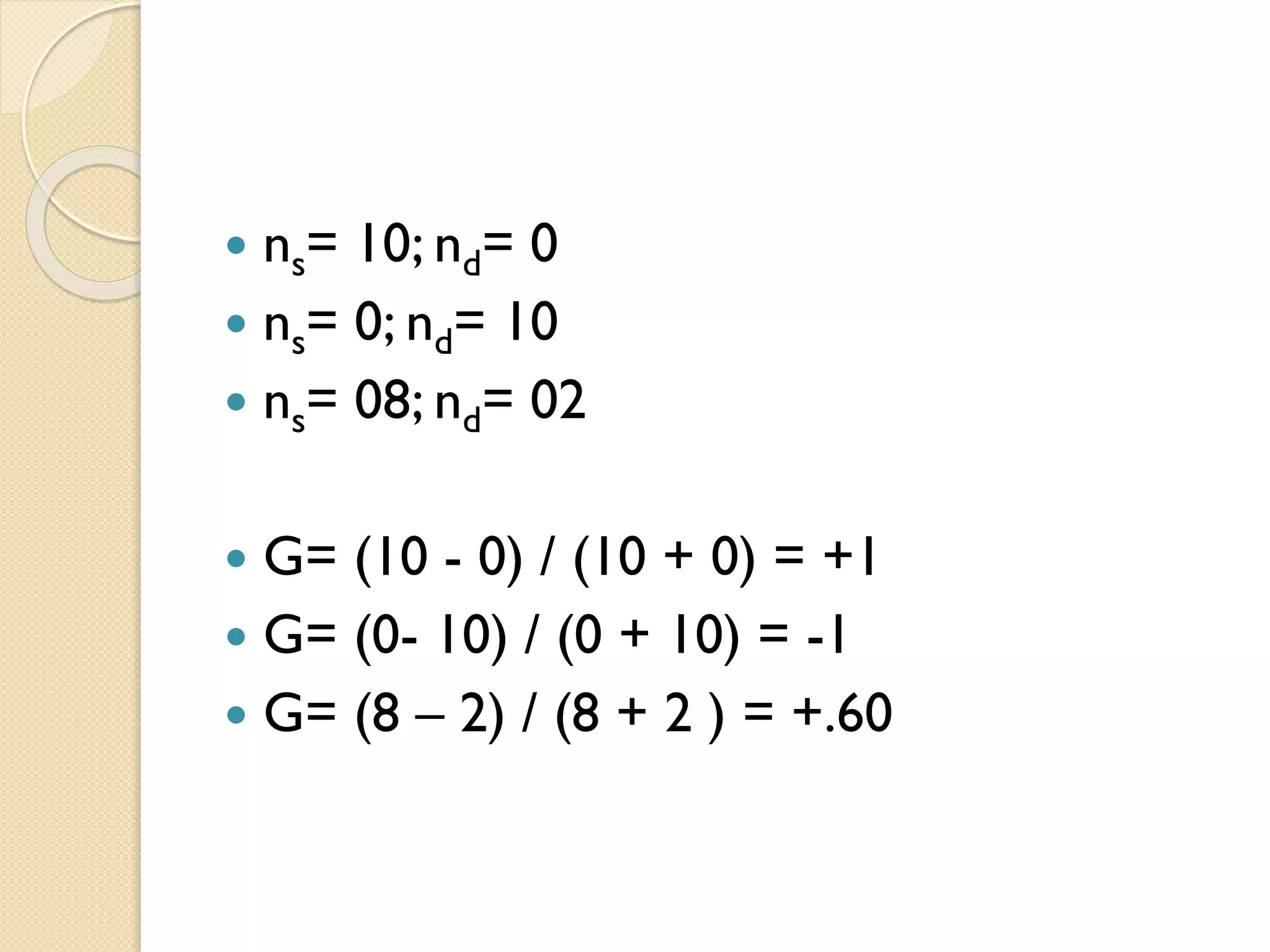
 ns= 10; nd= 0
 ns= 0; nd= 10
 ns= 08; nd= 02
 G= (10 - 0) / (10 + 0) = +1
 G= (0- 10) / (0 + 10) = -1
 G= (8 – 2) / (8 + 2 ) = +.60
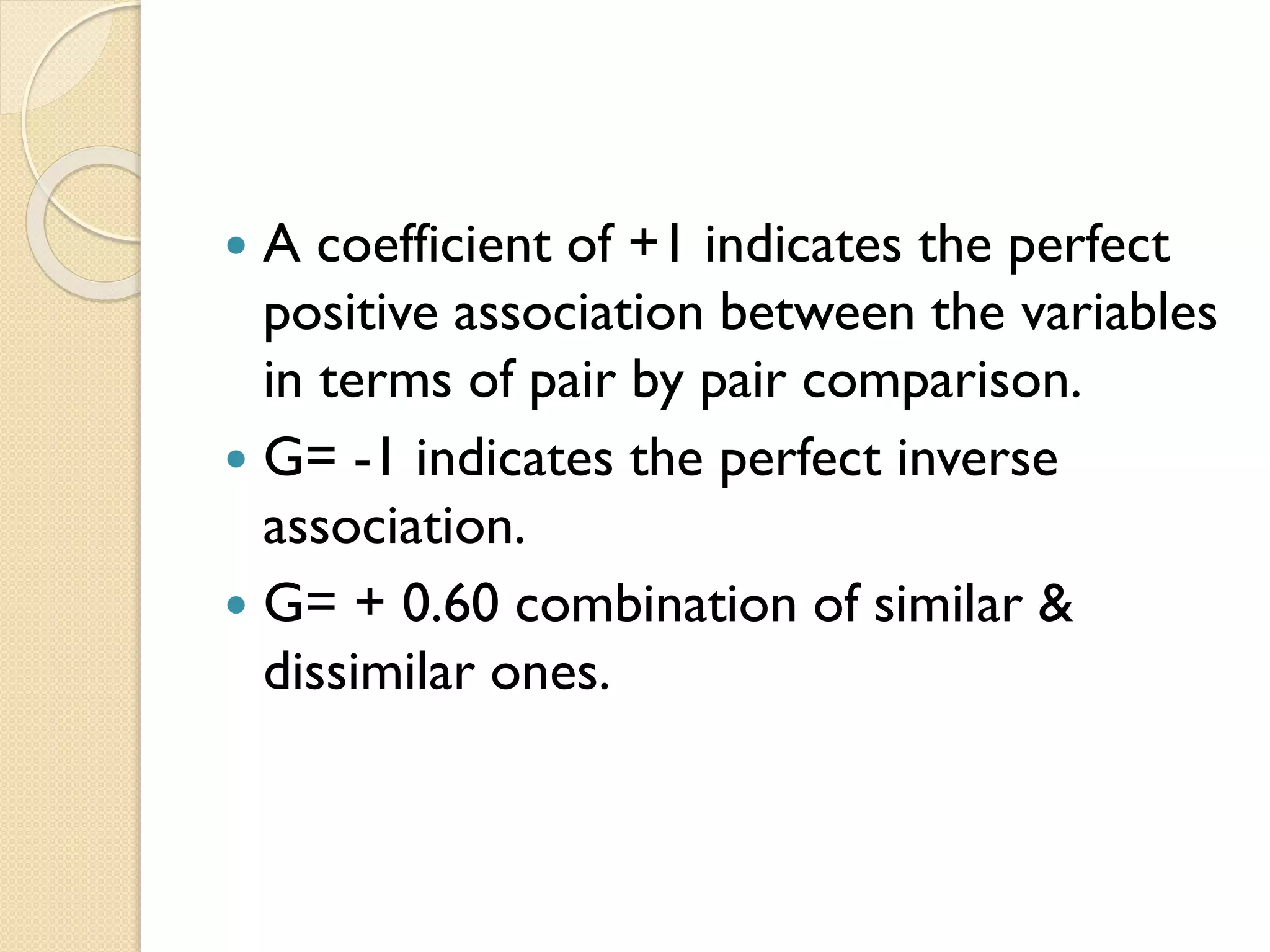
 A coefficient of +1 indicates the perfect
positive association between the variables
in terms of pair by pair comparison.
 G= -1 indicates the perfect inverse
association.
 G= + 0.60 combination of similar &
dissimilar ones.
Spearman’s rank order correlation
co-efficient Rho or e
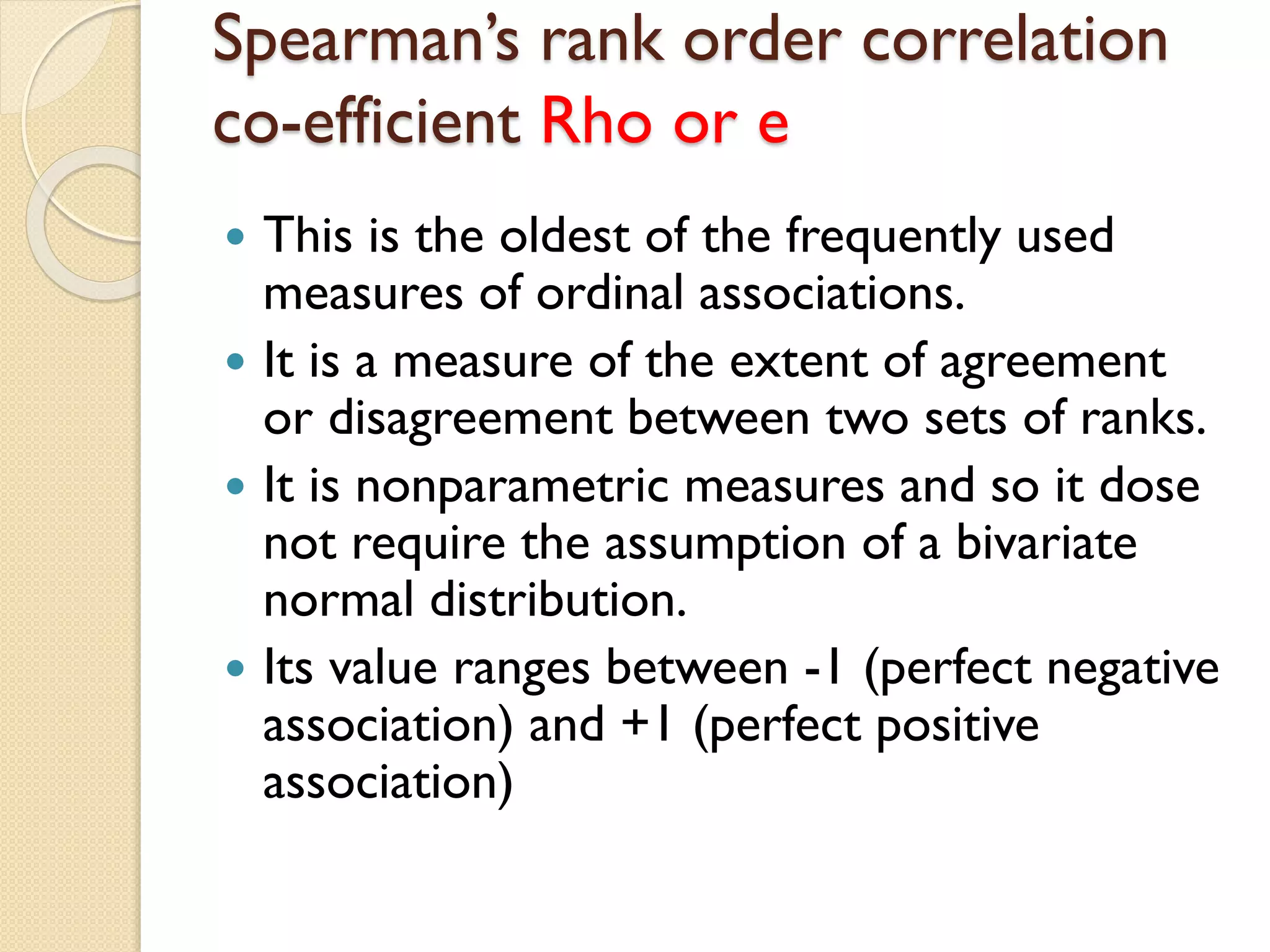
 This is the oldest of the frequently used
measures of ordinal associations.
 It is a measure of the extent of agreement
or disagreement between two sets of ranks.
 It is nonparametric measures and so it dose
not require the assumption of a bivariate
normal distribution.
 Its value ranges between -1 (perfect negative
association) and +1 (perfect positive
association)
 Rho or e = 1- [ (6∑D2 ) / n(n2 – 1) ]
 D= difference between X,Y ranks
assigned to the object.
 n= number of observation
 e= 1- [ (6∑D2 ) / n(n2 – 1) ]
=1-[(6*40)/ 5(52- 1) ]
= -1.0
This value – 1 indicates that there is perfect
negative association between the two sets
of ranks.
Correlation analysis
It involves three main aspects:
1. Measuring the degree of association
between two variables
2. Testing whether the relationship is
significant
3. Establishing the cause and effect
relationship if any.
 When two variables move in same
direction, their association is termed as
positive correlation.
 When they move in opposite direction,
their association is termed as negative
correlation.
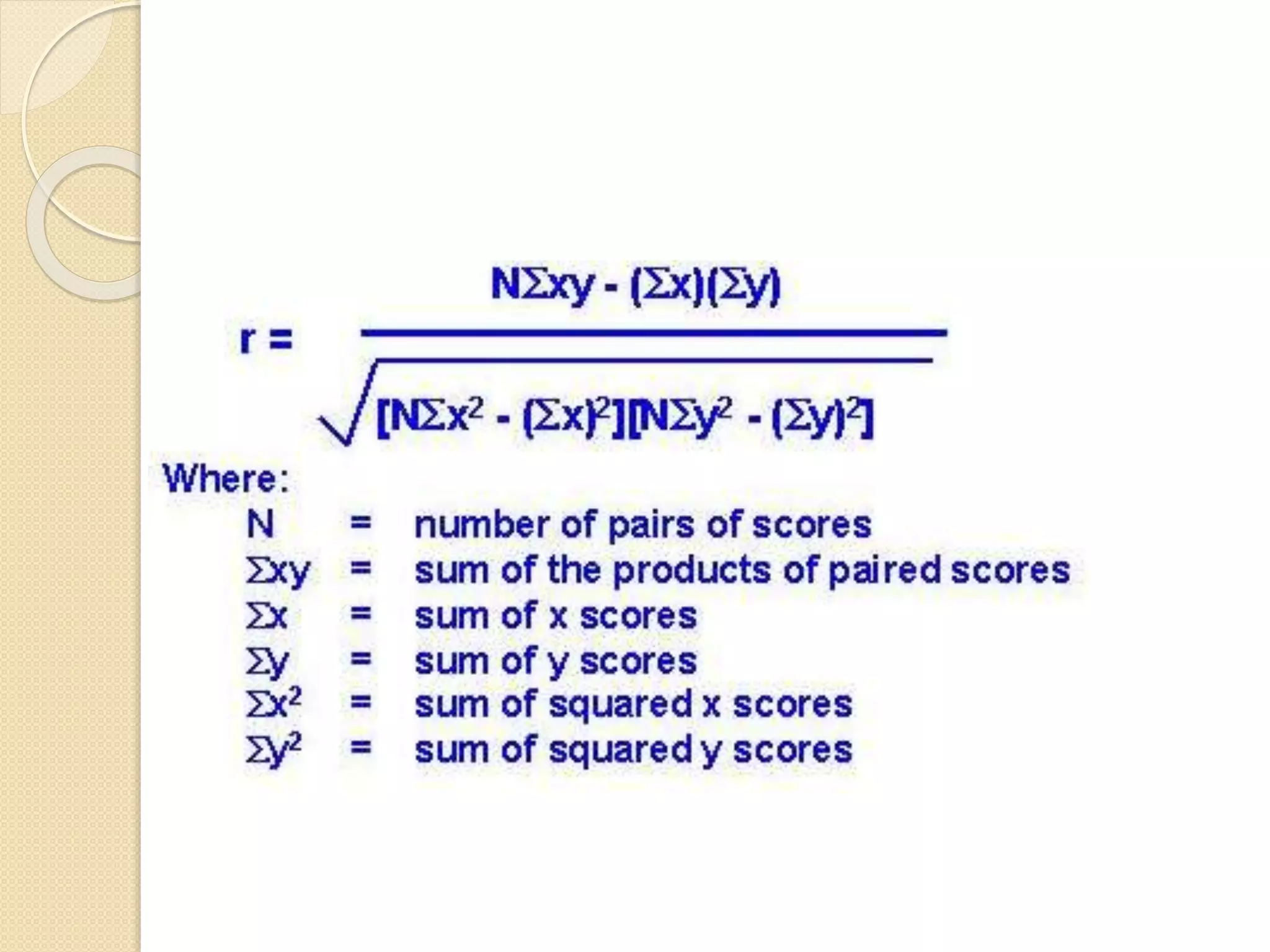
Karl pearson product moment
correlation coefficient r
 Most common measure
 This measure expresses both strength and
direction of linear correlation.
 This measure expresses both strength and
direction of linear correlation.
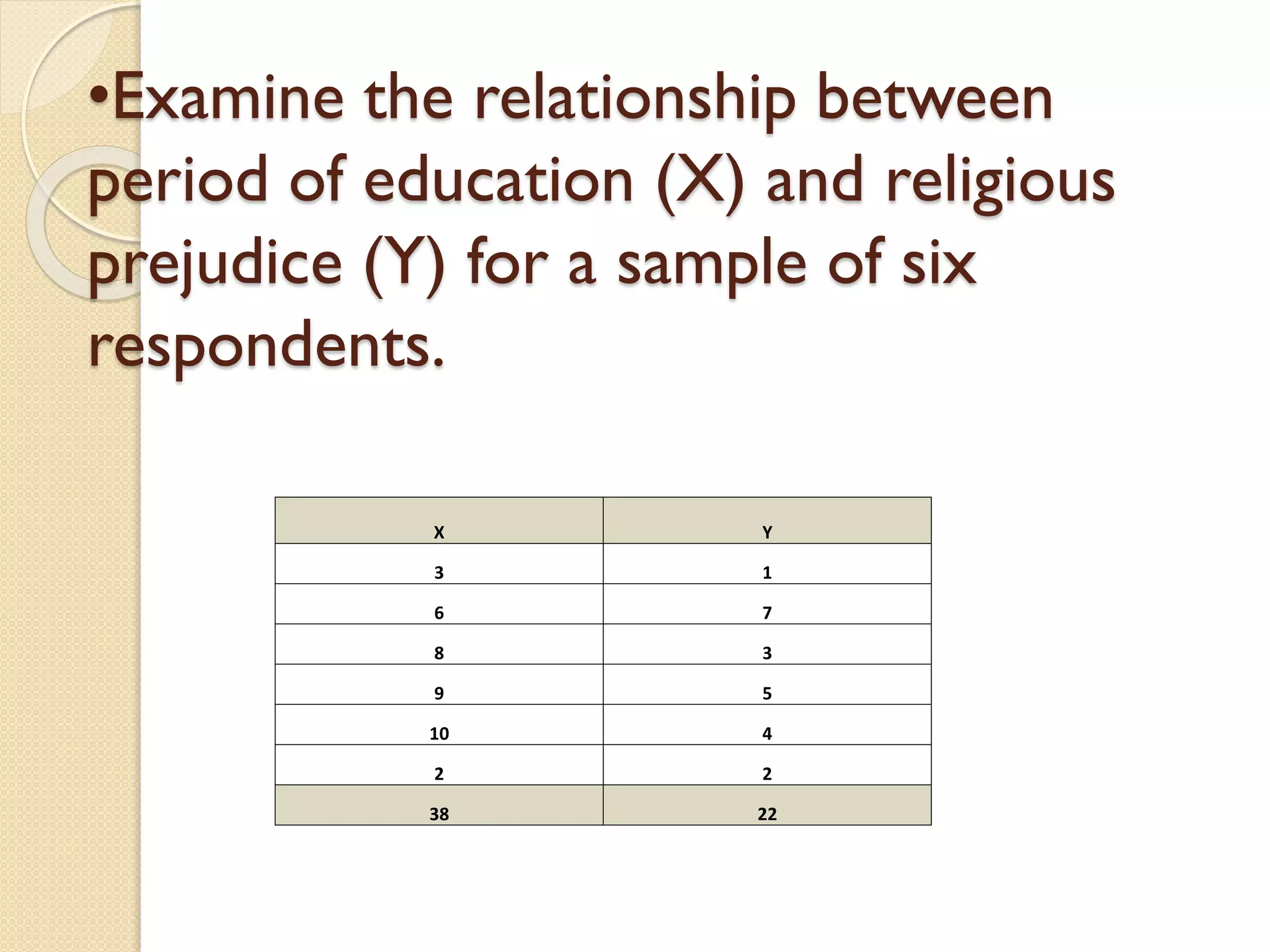
•Examine the relationship between
period of education (X) and religious
prejudice (Y) for a sample of six
respondents.
X Y
3 1
6 7
8 3
9 5
10 4
2 2
38 22
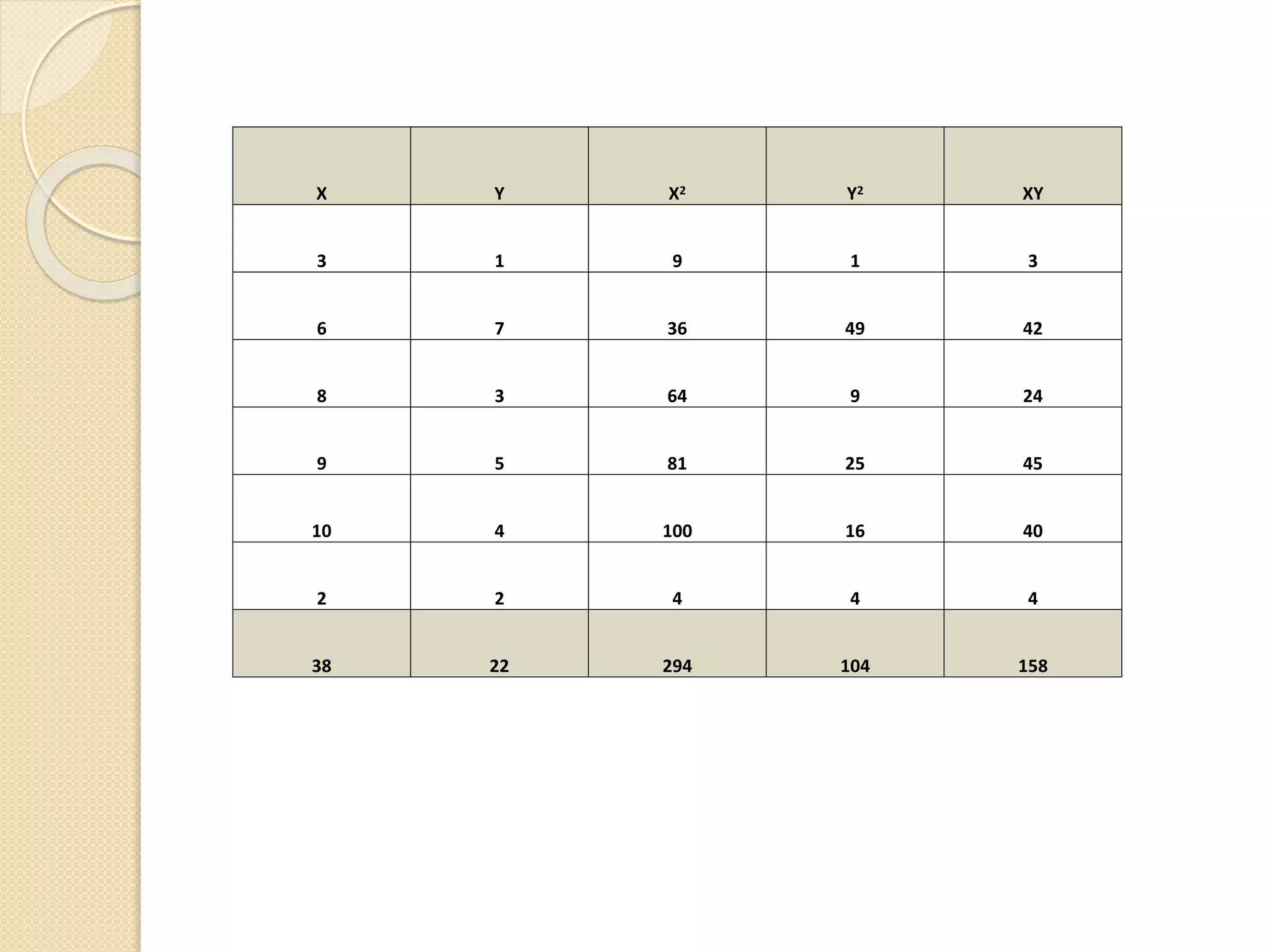
X Y X2 Y2 XY
3 1 9 1 3
6 7 36 49 42
8 3 64 9 24
9 5 81 25 45
10 4 100 16 40
2 2 4 4 4
38 22 294 104 158
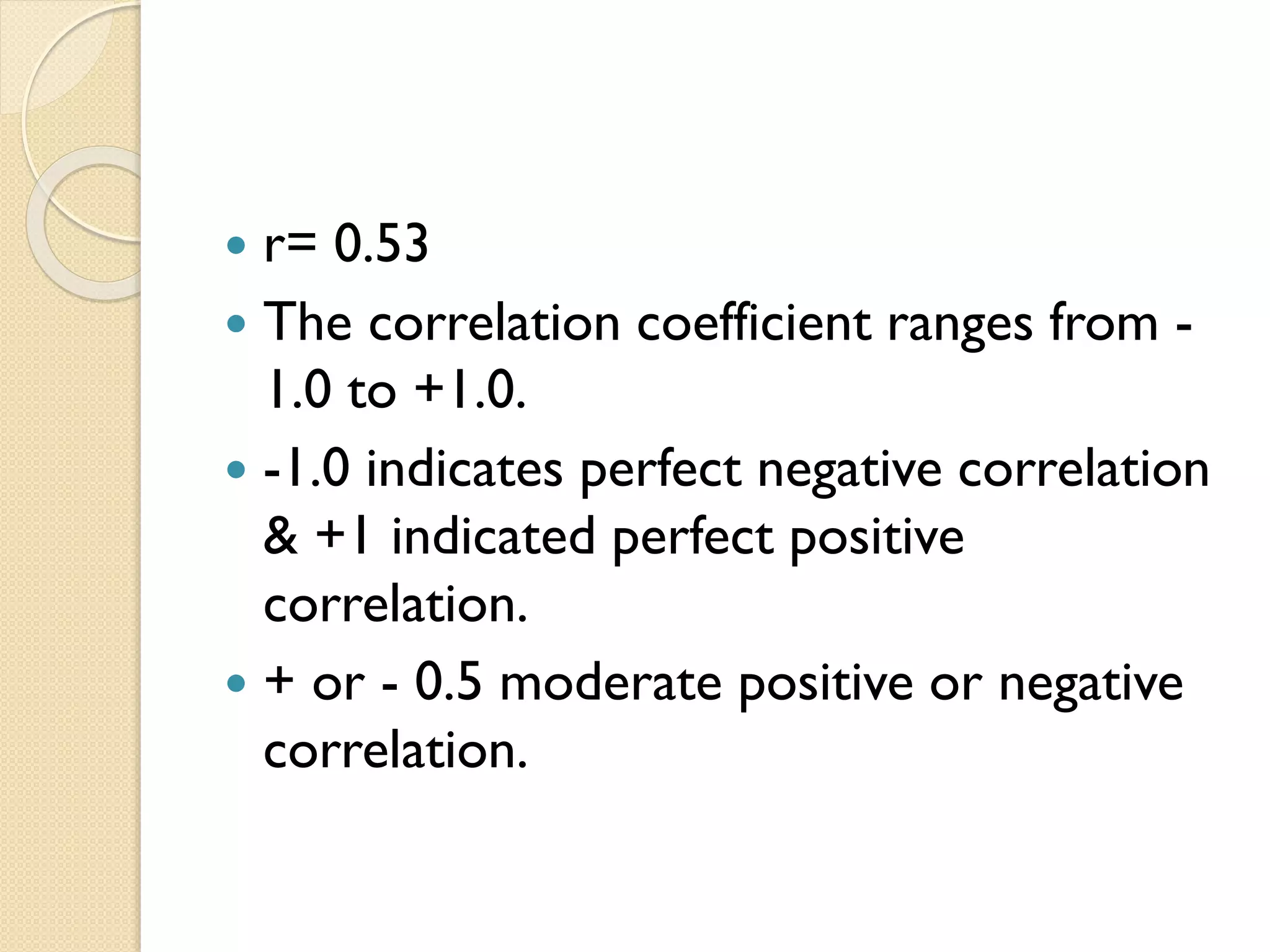
 r= 0.53
 The correlation coefficient ranges from -
1.0 to +1.0.
 -1.0 indicates perfect negative correlation
& +1 indicated perfect positive
correlation.
 + or - 0.5 moderate positive or negative
correlation.
Measures of relationships

Measures of relationships

  • 1.
    Measures of relationships •Crosstabulation and percentage difference •Gamma •Spearman’s rank order correlation co-efficient(Rho)
  • 2.
     This sectionexamines the relationship between variables. E.g.  Children grow, their weight increases  Demand increases if price decreases  Application of fertilizers increases crop yield There may be,  Direct-indirect relationship  Positive-negative relationship
  • 3.
    In examining therelationship between variables, we have to consider certain questions:  Is there relationship between variables?  What is the degree and direction of their relationship?  Is the relationship a casual one?  Is the relationship statistically significant?
  • 4.
    Cross tabulation andpercentage difference  It is used for Nominal variables which are purely qualitative and can be categorized only.  E.g.Age, income, brand, religion, language etc..
  • 5.
    Procedure,  Two waytable is prepared.  The value of one variable are put along one side of the table.  And the values of the other variable along the other side of the table  Each variable is categorized into two or more categories; and the variables are cross-tabulated for those sub categories.  The percentages are computed for them.  On the basis of the percentages, conclusions are drawn.
  • 6.
    Preference for brandX and Age (Hypothetical)
  • 8.
     The strengthof relationship is determined by the pattern of differences between the values of variables.
  • 9.
    Gamma  The ordinallevel variables have rank order differences .  The most common ordinal variables are Gamma & Spearman’s rank order correlation coefficient.  Gamma or G or ϒ G= (ns – nd )/ (ns + nd )  ns the number of similar pairs  Nd the number of dissimilar pairs
  • 10.
     It isbased on pair by pair comparison  It uses information about one variable to tell us something about a second one.  E.g. suppose two respondents X andY are asked to rank the product characteristics that they would consider while buying a scooter.
  • 11.
     After countingthe number of similar and dissimilar pairs, the level of association between the two sets of ranks is compared by the ratio of the preponderant type of pairs.  This value is ϒ
  • 12.
     .Characteristics RespondentX Respondent Y Fuel efficiency -F 1 1 Price - P 2 2 Mechanical Efficiency - M 3 3 Riding comfort - R 4 4 Style- S 5 5 F 1 5 P 2 4 M 3 3 R 4 2 S 5 1 F 1 1 P 2 2 M 3 3 R 4 5 S 5 4
  • 14.
     ns= 10;nd= 0  ns= 0; nd= 10  ns= 08; nd= 02  G= (10 - 0) / (10 + 0) = +1  G= (0- 10) / (0 + 10) = -1  G= (8 – 2) / (8 + 2 ) = +.60
  • 15.
     A coefficientof +1 indicates the perfect positive association between the variables in terms of pair by pair comparison.  G= -1 indicates the perfect inverse association.  G= + 0.60 combination of similar & dissimilar ones.
  • 16.
    Spearman’s rank ordercorrelation co-efficient Rho or e  This is the oldest of the frequently used measures of ordinal associations.  It is a measure of the extent of agreement or disagreement between two sets of ranks.  It is nonparametric measures and so it dose not require the assumption of a bivariate normal distribution.  Its value ranges between -1 (perfect negative association) and +1 (perfect positive association)
  • 17.
     Rho ore = 1- [ (6∑D2 ) / n(n2 – 1) ]  D= difference between X,Y ranks assigned to the object.  n= number of observation
  • 19.
     e= 1-[ (6∑D2 ) / n(n2 – 1) ] =1-[(6*40)/ 5(52- 1) ] = -1.0 This value – 1 indicates that there is perfect negative association between the two sets of ranks.
  • 20.
    Correlation analysis It involvesthree main aspects: 1. Measuring the degree of association between two variables 2. Testing whether the relationship is significant 3. Establishing the cause and effect relationship if any.
  • 21.
     When twovariables move in same direction, their association is termed as positive correlation.  When they move in opposite direction, their association is termed as negative correlation.
  • 22.
    Karl pearson productmoment correlation coefficient r  Most common measure  This measure expresses both strength and direction of linear correlation.  This measure expresses both strength and direction of linear correlation.
  • 24.
    •Examine the relationshipbetween period of education (X) and religious prejudice (Y) for a sample of six respondents. X Y 3 1 6 7 8 3 9 5 10 4 2 2 38 22
  • 25.
    X Y X2Y2 XY 3 1 9 1 3 6 7 36 49 42 8 3 64 9 24 9 5 81 25 45 10 4 100 16 40 2 2 4 4 4 38 22 294 104 158
  • 26.
     r= 0.53 The correlation coefficient ranges from - 1.0 to +1.0.  -1.0 indicates perfect negative correlation & +1 indicated perfect positive correlation.  + or - 0.5 moderate positive or negative correlation.