Correlation
Anthony J. Evans
Professor of Economics, ESCP Europe
www.anthonyjevans.com
(cc) Anthony J. Evans 2019 | http://creativecommons.org/licenses/by-nc-sa/3.0/
Introduction to Correlation
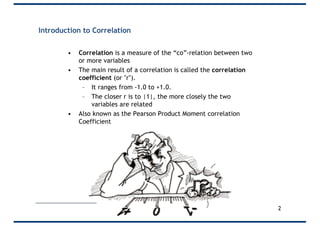
• Correlation is a measure of the “co”-relation between two
or more variables
• The main result of a correlation is called the correlation
coefficient (or "r").
– It ranges from -1.0 to +1.0.
– The closer r is to |1|, the more closely the two
variables are related
• Also known as the Pearson Product Moment correlation
Coefficient
2
Defining correlation
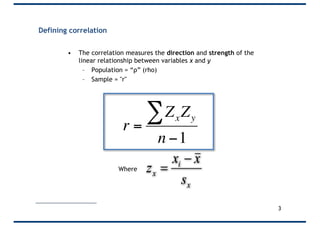
• The correlation measures the direction and strength of the
linear relationship between variables x and y
– Population = “ρ” (rho)
– Sample = "r"
x
i
x
s
xx
z
-
=Where
3€
r =
ZxZy∑
n −1
Correlation
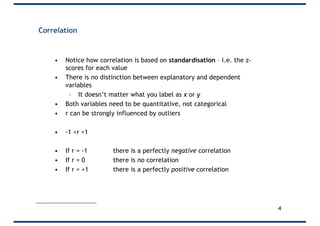
• Notice how correlation is based on standardisation – i.e. the z-
scores for each value
• There is no distinction between explanatory and dependent
variables
– It doesn’t matter what you label as x or y
• Both variables need to be quantitative, not categorical
• r can be strongly influenced by outliers
• -1 <r <1
• If r = -1 there is a perfectly negative correlation
• If r = 0 there is no correlation
• If r = +1 there is a perfectly positive correlation
4
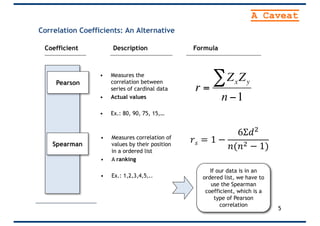
Description
• Measures correlation of
values by their position
in a ordered list
• A ranking
• Ex.: 1,2,3,4,5,..
Spearman
FormulaCoefficient
If our data is in an
ordered list, we have to
use the Spearman
coefficient, which is a
type of Pearson
correlation
Correlation Coefficients: An Alternative
A Caveat
Pearson
• Measures the
correlation between
series of cardinal data
• Actual values
• Ex.: 80, 90, 75, 15,…
5
€
r =
ZxZy∑
n −1
𝑟 𝑠 = 1 −
6Σ𝑑)
𝑛(𝑛) − 1)
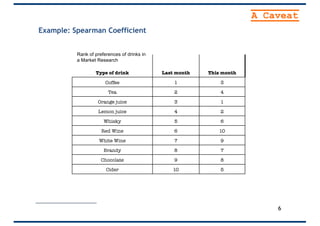
Example: Spearman Coefficient
Type of drink Last month This month
Coffee 1 3
Tea 2 4
Orange juice 3 1
Lemon juice 4 2
Whisky 5 6
Red Wine 6 10
White Wine 7 9
Brandy 8 7
Chocolate 9 8
Cider 10 5
Rank of preferences of drinks in
a Market Research
6
A Caveat
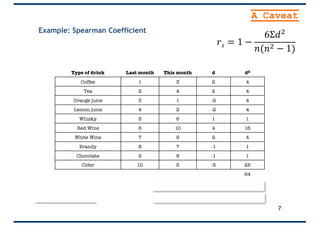
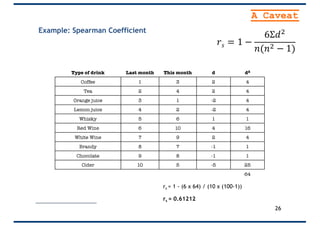
Example: Spearman Coefficient
Rs = 1 - (6 x 64) / (10 x (100-1))
Rs = 0.61212
Type of drink Last month This month d d2
Coffee 1 3 2 4
Tea 2 4 2 4
Orange juice 3 1 -2 4
Lemon juice 4 2 -2 4
Whisky 5 6 1 1
Red Wine 6 10 4 16
White Wine 7 9 2 4
Brandy 8 7 -1 1
Chocolate 9 8 -1 1
Cider 10 5 -5 25
64
7
A Caveat
𝑟 𝑠 = 1 −
6Σ𝑑)
𝑛(𝑛) − 1)
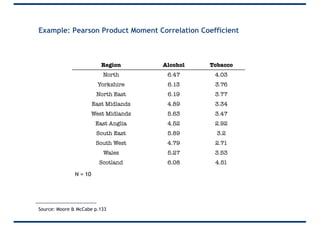
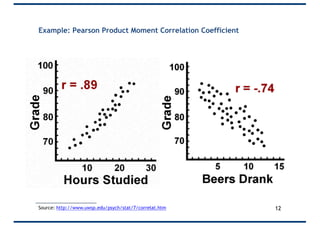
Example: Pearson Product Moment Correlation Coefficient
Region Alcohol Tobacco
North 6.47 4.03
Yorkshire 6.13 3.76
North East 6.19 3.77
East Midlands 4.89 3.34
West Midlands 5.63 3.47
East Anglia 4.52 2.92
South East 5.89 3.2
South West 4.79 2.71
Wales 5.27 3.53
Scotland 6.08 4.51
Source: Moore & McCabe p.133
N = 10
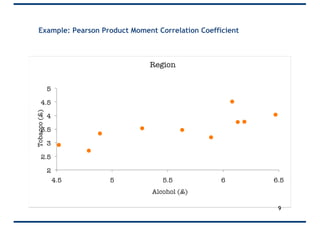
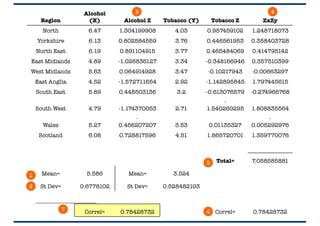
Example: Pearson Product Moment Correlation Coefficient
9
1
2
3 4
5
67
Region
Alcohol
(X) Alcohol Z Tobacco (Y) Tobacco Z ZxZy
North 6.47 1.304199908 4.03 0.957459102 1.248718073
Yorkshire 6.13 0.802584559 3.76 0.446561953 0.358403728
North East 6.19 0.891104915 3.77 0.465484069 0.414795142
East Midlands 4.89 -1.026836127 3.34 -0.348166946 0.357510399
West Midlands 5.63 0.064914928 3.47 -0.10217943 -0.00663297
East Anglia 4.52 -1.572711654 2.92 -1.142895845 1.797445615
South East 5.89 0.448503136 3.2 -0.613076579 -0.274966768
South West 4.79 -1.174370053 2.71
-
1.540260295 1.808835564
Wales 5.27
-
0.466207207 3.53 0.01135327
-
0.005292976
Scotland 6.08 0.728817596 4.51 1.865720701 1.359770076
Total= 7.058585881
Mean= 5.586 Mean= 3.524
St Dev= 0.6778102 St Dev= 0.528482103
Correl= 0.78428732 Correl= 0.78428732
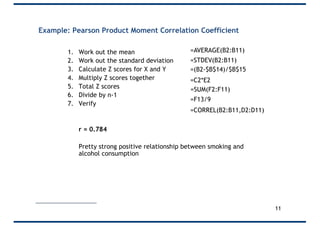
Example: Pearson Product Moment Correlation Coefficient
1. Work out the mean
2. Work out the standard deviation
3. Calculate Z scores for X and Y
4. Multiply Z scores together
5. Total Z scores
6. Divide by n-1
7. Verify
r = 0.784
Pretty strong positive relationship between smoking and
alcohol consumption
=AVERAGE(B2:B11)
=STDEV(B2:B11)
=CORREL(B2:B11,D2:D11)
=(B2-$B$14)/$B$15
=C2*E2
=SUM(F2:F11)
=F13/9
11
Example: Pearson Product Moment Correlation Coefficient
Source: http://www.uwsp.edu/psych/stat/7/correlat.htm 12
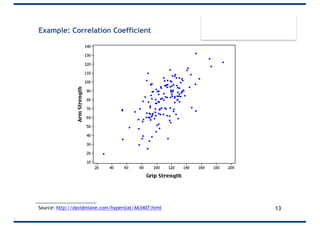
Example: Correlation Coefficient
Source: http://davidmlane.com/hyperstat/A63407.html
positive relationship
r = 0.63
13
x x
yy y
x
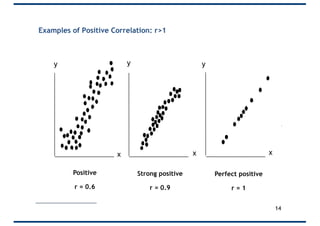
Positive
r = 0.6
Strong positive
r = 0.9
Perfect positive
r = 1
Examples of Positive Correlation: r>1
14
x x
yy y
x
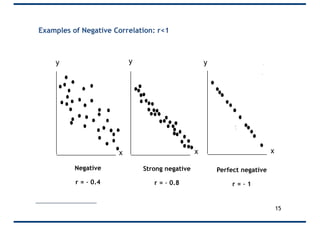
Negative
r = - 0.4
Strong negative
r = - 0.8
Perfect negative
r = - 1
Examples of Negative Correlation: r<1
15
Correlation Pitfalls
• Nonlinearity (as we’ve seen)
• Truncated Range
– i.e. wrongly categorised dataset
• Outliers
• Causation
– Correlation shows that two random variables are
related but doesn’t tell us anything about whether one
causes the other
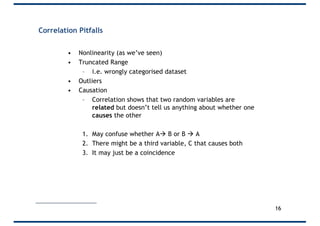
1. May confuse whether Aà B or B à A
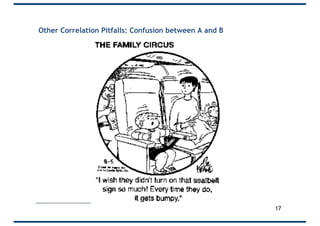
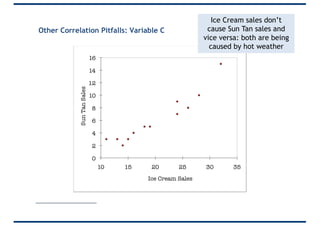
2. There might be a third variable, C that causes both
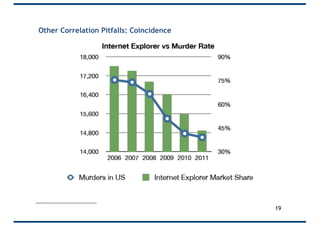
3. It may just be a coincidence
16
Other Correlation Pitfalls: Confusion between A and B
17
Other Correlation Pitfalls: Variable C
Ice Cream sales don’t
cause Sun Tan sales and
vice versa: both are being
caused by hot weather
19
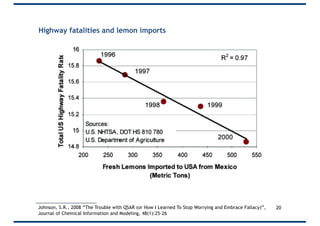
Other Correlation Pitfalls: Coincidence
Highway fatalities and lemon imports
20Johnson, S.R., 2008 “The Trouble with QSAR (or How I Learned To Stop Worrying and Embrace Fallacy)”,
Journal of Chemical Information and Modeling, 48(1):25-26
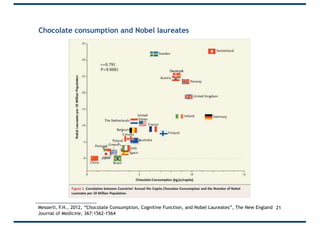
Chocolate consumption and Nobel laureates
21Messerli, F.H., 2012, “Chocolate Consumption, Cognitive Function, and Nobel Laureates”, The New England
Journal of Medicine, 367:1562-1564
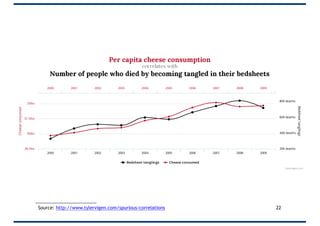
22Source: http://www.tylervigen.com/spurious-correlations
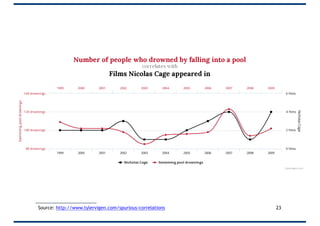
23Source: http://www.tylervigen.com/spurious-correlations
Summary
• You will almost always use cardinal data, and therefore you
should associate correlation with the Pearson Product
Moment Correlation Coefficient
• However retain the technique and intuition behind the
Spearman method in case you use ordered/ranked data
24
Solutions
25
Example: Spearman Coefficient
rs = 1 - (6 x 64) / (10 x (100-1))
rs = 0.61212
Type of drink Last month This month d d2
Coffee 1 3 2 4
Tea 2 4 2 4
Orange juice 3 1 -2 4
Lemon juice 4 2 -2 4
Whisky 5 6 1 1
Red Wine 6 10 4 16
White Wine 7 9 2 4
Brandy 8 7 -1 1
Chocolate 9 8 -1 1
Cider 10 5 -5 25
64
26
A Caveat
𝑟 𝑠 = 1 −
6Σ𝑑)
𝑛(𝑛) − 1)
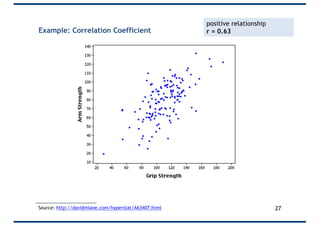
Example: Correlation Coefficient
Source: http://davidmlane.com/hyperstat/A63407.html
positive relationship
r = 0.63
27
• This presentation forms part of a free, online course
on analytics
• http://econ.anthonyjevans.com/courses/analytics/
28

Correlation

  • 1.
    Correlation Anthony J. Evans Professorof Economics, ESCP Europe www.anthonyjevans.com (cc) Anthony J. Evans 2019 | http://creativecommons.org/licenses/by-nc-sa/3.0/
  • 2.
    Introduction to Correlation •Correlation is a measure of the “co”-relation between two or more variables • The main result of a correlation is called the correlation coefficient (or "r"). – It ranges from -1.0 to +1.0. – The closer r is to |1|, the more closely the two variables are related • Also known as the Pearson Product Moment correlation Coefficient 2
  • 3.
    Defining correlation • Thecorrelation measures the direction and strength of the linear relationship between variables x and y – Population = “ρ” (rho) – Sample = "r" x i x s xx z - =Where 3€ r = ZxZy∑ n −1
  • 4.
    Correlation • Notice howcorrelation is based on standardisation – i.e. the z- scores for each value • There is no distinction between explanatory and dependent variables – It doesn’t matter what you label as x or y • Both variables need to be quantitative, not categorical • r can be strongly influenced by outliers • -1 <r <1 • If r = -1 there is a perfectly negative correlation • If r = 0 there is no correlation • If r = +1 there is a perfectly positive correlation 4
  • 5.
    Description • Measures correlationof values by their position in a ordered list • A ranking • Ex.: 1,2,3,4,5,.. Spearman FormulaCoefficient If our data is in an ordered list, we have to use the Spearman coefficient, which is a type of Pearson correlation Correlation Coefficients: An Alternative A Caveat Pearson • Measures the correlation between series of cardinal data • Actual values • Ex.: 80, 90, 75, 15,… 5 € r = ZxZy∑ n −1 𝑟 𝑠 = 1 − 6Σ𝑑) 𝑛(𝑛) − 1)
  • 6.
    Example: Spearman Coefficient Typeof drink Last month This month Coffee 1 3 Tea 2 4 Orange juice 3 1 Lemon juice 4 2 Whisky 5 6 Red Wine 6 10 White Wine 7 9 Brandy 8 7 Chocolate 9 8 Cider 10 5 Rank of preferences of drinks in a Market Research 6 A Caveat
  • 7.
    Example: Spearman Coefficient Rs= 1 - (6 x 64) / (10 x (100-1)) Rs = 0.61212 Type of drink Last month This month d d2 Coffee 1 3 2 4 Tea 2 4 2 4 Orange juice 3 1 -2 4 Lemon juice 4 2 -2 4 Whisky 5 6 1 1 Red Wine 6 10 4 16 White Wine 7 9 2 4 Brandy 8 7 -1 1 Chocolate 9 8 -1 1 Cider 10 5 -5 25 64 7 A Caveat 𝑟 𝑠 = 1 − 6Σ𝑑) 𝑛(𝑛) − 1)
  • 8.
    Example: Pearson ProductMoment Correlation Coefficient Region Alcohol Tobacco North 6.47 4.03 Yorkshire 6.13 3.76 North East 6.19 3.77 East Midlands 4.89 3.34 West Midlands 5.63 3.47 East Anglia 4.52 2.92 South East 5.89 3.2 South West 4.79 2.71 Wales 5.27 3.53 Scotland 6.08 4.51 Source: Moore & McCabe p.133 N = 10
  • 9.
    Example: Pearson ProductMoment Correlation Coefficient 9
  • 10.
    1 2 3 4 5 67 Region Alcohol (X) AlcoholZ Tobacco (Y) Tobacco Z ZxZy North 6.47 1.304199908 4.03 0.957459102 1.248718073 Yorkshire 6.13 0.802584559 3.76 0.446561953 0.358403728 North East 6.19 0.891104915 3.77 0.465484069 0.414795142 East Midlands 4.89 -1.026836127 3.34 -0.348166946 0.357510399 West Midlands 5.63 0.064914928 3.47 -0.10217943 -0.00663297 East Anglia 4.52 -1.572711654 2.92 -1.142895845 1.797445615 South East 5.89 0.448503136 3.2 -0.613076579 -0.274966768 South West 4.79 -1.174370053 2.71 - 1.540260295 1.808835564 Wales 5.27 - 0.466207207 3.53 0.01135327 - 0.005292976 Scotland 6.08 0.728817596 4.51 1.865720701 1.359770076 Total= 7.058585881 Mean= 5.586 Mean= 3.524 St Dev= 0.6778102 St Dev= 0.528482103 Correl= 0.78428732 Correl= 0.78428732
  • 11.
    Example: Pearson ProductMoment Correlation Coefficient 1. Work out the mean 2. Work out the standard deviation 3. Calculate Z scores for X and Y 4. Multiply Z scores together 5. Total Z scores 6. Divide by n-1 7. Verify r = 0.784 Pretty strong positive relationship between smoking and alcohol consumption =AVERAGE(B2:B11) =STDEV(B2:B11) =CORREL(B2:B11,D2:D11) =(B2-$B$14)/$B$15 =C2*E2 =SUM(F2:F11) =F13/9 11
  • 12.
    Example: Pearson ProductMoment Correlation Coefficient Source: http://www.uwsp.edu/psych/stat/7/correlat.htm 12
  • 13.
    Example: Correlation Coefficient Source:http://davidmlane.com/hyperstat/A63407.html positive relationship r = 0.63 13
  • 14.
    x x yy y x Positive r= 0.6 Strong positive r = 0.9 Perfect positive r = 1 Examples of Positive Correlation: r>1 14
  • 15.
    x x yy y x Negative r= - 0.4 Strong negative r = - 0.8 Perfect negative r = - 1 Examples of Negative Correlation: r<1 15
  • 16.
    Correlation Pitfalls • Nonlinearity(as we’ve seen) • Truncated Range – i.e. wrongly categorised dataset • Outliers • Causation – Correlation shows that two random variables are related but doesn’t tell us anything about whether one causes the other 1. May confuse whether Aà B or B à A 2. There might be a third variable, C that causes both 3. It may just be a coincidence 16
  • 17.
    Other Correlation Pitfalls:Confusion between A and B 17
  • 18.
    Other Correlation Pitfalls:Variable C Ice Cream sales don’t cause Sun Tan sales and vice versa: both are being caused by hot weather
  • 19.
  • 20.
    Highway fatalities andlemon imports 20Johnson, S.R., 2008 “The Trouble with QSAR (or How I Learned To Stop Worrying and Embrace Fallacy)”, Journal of Chemical Information and Modeling, 48(1):25-26
  • 21.
    Chocolate consumption andNobel laureates 21Messerli, F.H., 2012, “Chocolate Consumption, Cognitive Function, and Nobel Laureates”, The New England Journal of Medicine, 367:1562-1564
  • 22.
  • 23.
  • 24.
    Summary • You willalmost always use cardinal data, and therefore you should associate correlation with the Pearson Product Moment Correlation Coefficient • However retain the technique and intuition behind the Spearman method in case you use ordered/ranked data 24
  • 25.
  • 26.
    Example: Spearman Coefficient rs= 1 - (6 x 64) / (10 x (100-1)) rs = 0.61212 Type of drink Last month This month d d2 Coffee 1 3 2 4 Tea 2 4 2 4 Orange juice 3 1 -2 4 Lemon juice 4 2 -2 4 Whisky 5 6 1 1 Red Wine 6 10 4 16 White Wine 7 9 2 4 Brandy 8 7 -1 1 Chocolate 9 8 -1 1 Cider 10 5 -5 25 64 26 A Caveat 𝑟 𝑠 = 1 − 6Σ𝑑) 𝑛(𝑛) − 1)
  • 27.
    Example: Correlation Coefficient Source:http://davidmlane.com/hyperstat/A63407.html positive relationship r = 0.63 27
  • 28.
    • This presentationforms part of a free, online course on analytics • http://econ.anthonyjevans.com/courses/analytics/ 28