Spearman Rank Correlation
A measure of Rank Correlation
Group 3
The Spearman Correlation
• Spearman’s correlation is designed to measure
the relationship between variables measured on
an ordinal scale of measurement.
• Similar to Pearson’s Correlation, however it
uses ranks as opposed to actual values.
Assumptions
• The data is a bivariate random variable.
• The measurement scale is at least ordinal.
• Xi ,Yi is independent of Xj ,Yj where i ≠ j
Advantages
1. Less sensitive to bias due to the effect of
outliers
- Can be used to reduce the weight of outliers (large distances get
treated as a one-rank difference)
4. Does not require assumption of normality.
6. When the intervals between data points are
problematic, it is advisable to study the
rankings rather than the actual values.
Disadvantages
1.Calculations may become tedious. Additionally
ties are important and must be factored into
computation.
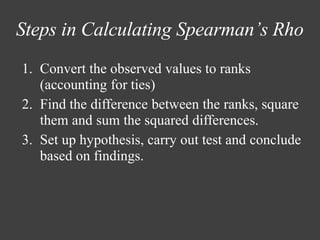
Steps in Calculating Spearman’s Rho
1. Convert the observed values to ranks
(accounting for ties)
2. Find the difference between the ranks, square
them and sum the squared differences.
3. Set up hypothesis, carry out test and conclude
based on findings.
Steps in Calculating Spearman’s Rho
1. If the null is rejected then calculate the
Spearman correlation coefficient to measure
the strength of the relationship between the
variables.
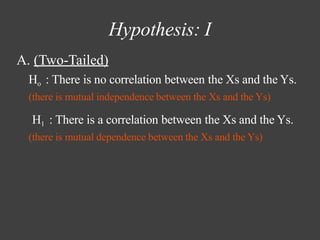
Hypothesis: I
A. (Two-Tailed)
Ho : There is no correlation between the Xs and the Ys.
(there is mutual independence between the Xs and the Ys)
H1 : There is a correlation between the Xs and the Ys.
(there is mutual dependence between the Xs and the Ys)
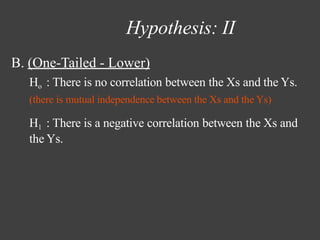
Hypothesis: II
B. (One-Tailed - Lower)
Ho : There is no correlation between the Xs and the Ys.
(there is mutual independence between the Xs and the Ys)
H1 : There is a negative correlation between the Xs and
the Ys.
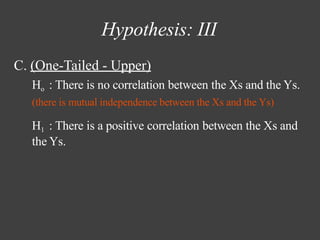
Hypothesis: III
C. (One-Tailed - Upper)
Ho : There is no correlation between the Xs and the Ys.
(there is mutual independence between the Xs and the Ys)
H1 : There is a positive correlation between the Xs and
the Ys.
Test Statistic
(Reject using the appropriate Z critical value)
36
1
n2
(n +1)2
(n −1)
For small samples (N < 40):
T=Σdi
2 =Σ[R(Xi) - R(Yi)]2
For large samples:
T −
1
(n3
− n)
Z*
= 16
Test Statistic
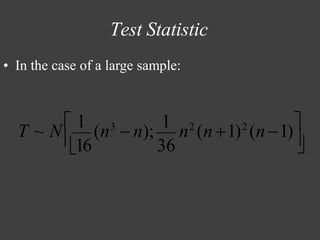
• In the case of a large sample:

16 36
T ~ N 1
(n3
− n);
1
n2
(n +1)2
(n −1)
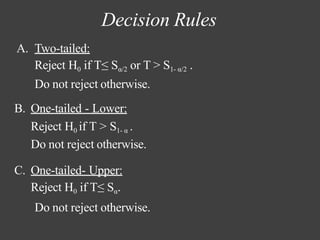
Decision Rules
A. Two-tailed:
Reject H0 if T≤ Sα/2 or T > S1- α/2 .
Do not reject otherwise.
B. One-tailed - Lower:
Reject H0 if T > S1- α .
Do not reject otherwise.
C. One-tailed- Upper:
Reject H0 if T≤ Sα.
Do not reject otherwise.
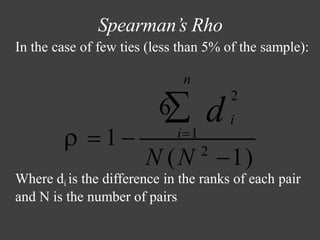
Spearman’s Rho
In the case of few ties (less than 5% of the sample):
2
N (N 2
−1)
Where di is the difference in the ranks of each pair
and N is the number of pairs
n
6
 i
d
 = 1 − i=1
Spearman’s Rho
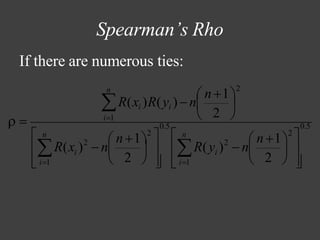
If there are numerous ties:
2
2
2
2
2
   
  



  
  


 


n

 i=1
i
n

 i=1
i
n
i=1
0.5
 n +1
2

R(y ) − n
0.5
 n +1
2
 
R(x ) −n
 n +1
2
R(xi )R(yi )−n
 =
Spearman’s Rho
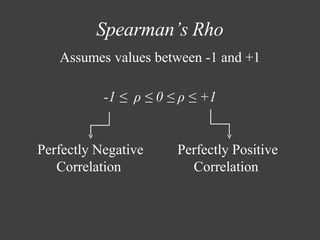
Assumes values between -1 and +1
-1 ≤ ρ ≤ 0 ≤ ρ ≤ +1
Perfectly Negative
Correlation
Perfectly Positive
Correlation
Example 1
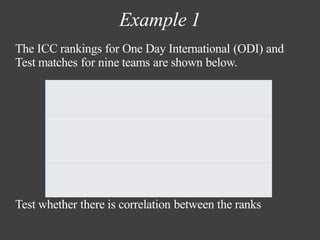
The ICC rankings for One Day International (ODI) and
Test matches for nine teams are shown below.
Test whether there is correlation between the ranks
Team Test Rank ODI Rank
Australia 1 1
India 2 3
South Africa 3 2
Sri Lanka 4 7
England 5 6
Pakistan 6 4
New Zealand 7 5
West Indies 8 8
Bangladesh 9 9
Example 1
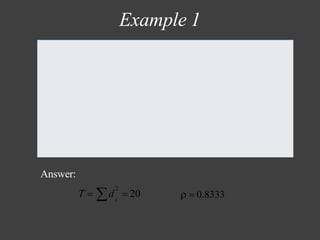
Team Test Rank ODI Rank d d2
Australia 1 1 0 0
India 2 3 1 1
South Africa 3 2 1 1
Sri Lanka 4 7 3 9
England 5 6 1 1
Pakistan 6 4 2 4
New Zealand 7 5 2 4
West Indies 8 8 0 0
Bangladesh 9 9 0 0
Total 20
Answer:
2
 i
d = 20
T =  = 3
Example 2
A composite rating is given by executives to
each college graduate joining a plastic
manufacturing firm. The executive ratings
represent the future potential of the college
graduate. The graduates then enter an in-plant
training programme and are given another
composite rating. The executive ratings and the
in-plant ratings are as follows:
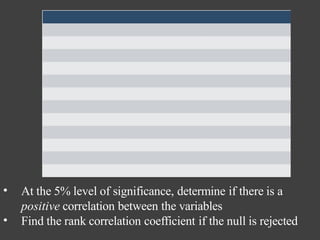
Graduate Executive rating (X) Training rating (Y)
A 8 4
B 10 4
C 9 4
D 4 3
E 12 6
F 11 9
G 11 9
H 7 6
I 8 6
J 13 9
K 10 5
L 12 9
•
•
At the 5% level of significance, determine if there is a
positive correlation between the variables
Find the rank correlation coefficient if the null is rejected
spearman correlation.pdf

spearman correlation.pdf

  • 1.
    Spearman Rank Correlation Ameasure of Rank Correlation Group 3
  • 2.
    The Spearman Correlation •Spearman’s correlation is designed to measure the relationship between variables measured on an ordinal scale of measurement. • Similar to Pearson’s Correlation, however it uses ranks as opposed to actual values.
  • 3.
    Assumptions • The datais a bivariate random variable. • The measurement scale is at least ordinal. • Xi ,Yi is independent of Xj ,Yj where i ≠ j
  • 4.
    Advantages 1. Less sensitiveto bias due to the effect of outliers - Can be used to reduce the weight of outliers (large distances get treated as a one-rank difference) 4. Does not require assumption of normality. 6. When the intervals between data points are problematic, it is advisable to study the rankings rather than the actual values.
  • 5.
    Disadvantages 1.Calculations may becometedious. Additionally ties are important and must be factored into computation.
  • 6.
    Steps in CalculatingSpearman’s Rho 1. Convert the observed values to ranks (accounting for ties) 2. Find the difference between the ranks, square them and sum the squared differences. 3. Set up hypothesis, carry out test and conclude based on findings.
  • 7.
    Steps in CalculatingSpearman’s Rho 1. If the null is rejected then calculate the Spearman correlation coefficient to measure the strength of the relationship between the variables.
  • 8.
    Hypothesis: I A. (Two-Tailed) Ho: There is no correlation between the Xs and the Ys. (there is mutual independence between the Xs and the Ys) H1 : There is a correlation between the Xs and the Ys. (there is mutual dependence between the Xs and the Ys)
  • 9.
    Hypothesis: II B. (One-Tailed- Lower) Ho : There is no correlation between the Xs and the Ys. (there is mutual independence between the Xs and the Ys) H1 : There is a negative correlation between the Xs and the Ys.
  • 10.
    Hypothesis: III C. (One-Tailed- Upper) Ho : There is no correlation between the Xs and the Ys. (there is mutual independence between the Xs and the Ys) H1 : There is a positive correlation between the Xs and the Ys.
  • 11.
    Test Statistic (Reject usingthe appropriate Z critical value) 36 1 n2 (n +1)2 (n −1) For small samples (N < 40): T=Σdi 2 =Σ[R(Xi) - R(Yi)]2 For large samples: T − 1 (n3 − n) Z* = 16
  • 12.
    Test Statistic • Inthe case of a large sample:  16 36 T ~ N 1 (n3 − n); 1 n2 (n +1)2 (n −1)
  • 13.
    Decision Rules A. Two-tailed: RejectH0 if T≤ Sα/2 or T > S1- α/2 . Do not reject otherwise. B. One-tailed - Lower: Reject H0 if T > S1- α . Do not reject otherwise. C. One-tailed- Upper: Reject H0 if T≤ Sα. Do not reject otherwise.
  • 14.
    Spearman’s Rho In thecase of few ties (less than 5% of the sample): 2 N (N 2 −1) Where di is the difference in the ranks of each pair and N is the number of pairs n 6  i d  = 1 − i=1
  • 15.
    Spearman’s Rho If thereare numerous ties: 2 2 2 2 2                       n   i=1 i n   i=1 i n i=1 0.5  n +1 2  R(y ) − n 0.5  n +1 2   R(x ) −n  n +1 2 R(xi )R(yi )−n  =
  • 16.
    Spearman’s Rho Assumes valuesbetween -1 and +1 -1 ≤ ρ ≤ 0 ≤ ρ ≤ +1 Perfectly Negative Correlation Perfectly Positive Correlation
  • 17.
    Example 1 The ICCrankings for One Day International (ODI) and Test matches for nine teams are shown below. Test whether there is correlation between the ranks Team Test Rank ODI Rank Australia 1 1 India 2 3 South Africa 3 2 Sri Lanka 4 7 England 5 6 Pakistan 6 4 New Zealand 7 5 West Indies 8 8 Bangladesh 9 9
  • 18.
    Example 1 Team TestRank ODI Rank d d2 Australia 1 1 0 0 India 2 3 1 1 South Africa 3 2 1 1 Sri Lanka 4 7 3 9 England 5 6 1 1 Pakistan 6 4 2 4 New Zealand 7 5 2 4 West Indies 8 8 0 0 Bangladesh 9 9 0 0 Total 20 Answer: 2  i d = 20 T =  = 3
  • 19.
    Example 2 A compositerating is given by executives to each college graduate joining a plastic manufacturing firm. The executive ratings represent the future potential of the college graduate. The graduates then enter an in-plant training programme and are given another composite rating. The executive ratings and the in-plant ratings are as follows:
  • 20.
    Graduate Executive rating(X) Training rating (Y) A 8 4 B 10 4 C 9 4 D 4 3 E 12 6 F 11 9 G 11 9 H 7 6 I 8 6 J 13 9 K 10 5 L 12 9 • • At the 5% level of significance, determine if there is a positive correlation between the variables Find the rank correlation coefficient if the null is rejected