Data Analysis Course
Multiple Linear Regression(Version-1)
Venkat Reddy
Data Analysis Course
•   Data analysis design document
•   Introduction to statistical data analysis
•   Descriptive statistics
•   Data exploration, validation & sanitization
•   Probability distributions examples and applications


                                                                Venkat Reddy
                                                          Data Analysis Course
•   Simple correlation and regression analysis

• Multiple liner regression analysis
•   Logistic regression analysis
•   Testing of hypothesis
•   Clustering and decision trees
•   Time series analysis and forecasting
•   Credit Risk Model building-1                                 2
•   Credit Risk Model building-2
Note
• This presentation is just class notes. The course notes for Data
  Analysis Training is by written by me, as an aid for myself.
• The best way to treat this is as a high-level summary; the
  actual session went more in depth and contained other


                                                                           Venkat Reddy
                                                                     Data Analysis Course
  information.
• Most of this material was written as informal notes, not
  intended for publication
• Please send questions/comments/corrections to
  venkat@trenwiseanalytics.com or 21.venkat@gmail.com
• Please check my website for latest version of this document
                                         -Venkat Reddy                      3
Contents
•   Why multiple regression?
•   The multiple regression model
•   Meaning of beta
•   Variance explained


                                                       Venkat Reddy
                                                 Data Analysis Course
•   Goodness of fit R sqared and Adj-R squared
•   The F value
•   Multicollinearity
•   Prediction


                                                        4
Why Multiple Regression
• Our real world is multivariable
• Multivariable analysis is a tool to determine the relative contribution
  of all factors


                                                                                  Venkat Reddy
                                                                            Data Analysis Course
• How do you estimate a country’s GDP? Single or multiple predictors
• Health is just dependent on smoking or drinking?
  • Diet, exercise, genetics, age, job, sleeping habits also play an
    important roll in deciding one’s health
  • We often want to describe the effect of smoking over and above
    these other variables.
                                                                                   5
Some Economics Models
Most of the real time models are multivariate

 Wage determination model
          
 w  f S , A, A2 , T , G, L,     

      p, a, a , Pc , y, i, w,  
 Profit


                                                      Venkat Reddy
                                                Data Analysis Course
                          2


 Investment
  I  I r , w, sk , t , D, P,  
 Money demand
 M
   
     M
       i,Y , c, E                                    6
 P   P
Multiple Regression Model

                              Y
                                  ˆ
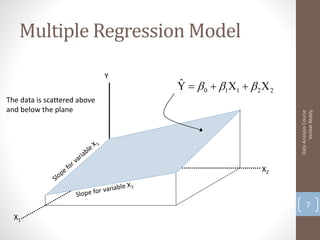
                                  Y   0  1X1   2 X 2
The data is scattered above
and below the plane


                                                                   Venkat Reddy
                                                             Data Analysis Course
                                                       X2


                                                                    7
  X1
Assumptions
Same as earlier

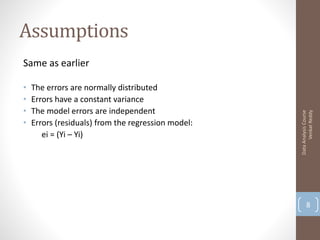
•   The errors are normally distributed
•   Errors have a constant variance
•   The model errors are independent


                                                          Venkat Reddy
                                                    Data Analysis Course
•   Errors (residuals) from the regression model:
       ei = (Yi – Yi)


                                                           8
Least Squares Estimation
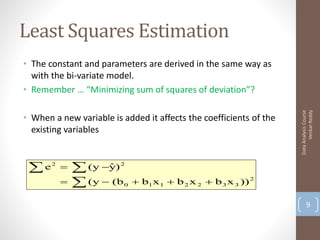
• The constant and parameters are derived in the same way as
  with the bi-variate model.
• Remember … “Minimizing sum of squares of deviation”?


                                                                          Venkat Reddy
                                                                    Data Analysis Course
• When a new variable is added it affects the coefficients of the
  existing variables


 e    2
               (y y)
                     ˆ   2


               (y  (b   0    b1 x 1  b 2 x 2  b 3 x 3 )) 2

                                                                           9
Meaning of beta


                                                                                                    Venkat Reddy
                                                                                              Data Analysis Course
•   The equation Yi = β0 + β1 Xi1 + β2 Xi2 + εi has the following interpretation.
•   Again, β0 is the intercept (the value of Y when both X1 and X2 are 0).
•   β1 is the slope for X1, so each unit increase in X1 increases Y on AVERAGE by β1 units.
•   β2 is the slope for X2, so each unit increase in X2 increases Y on AVERAGE by β2 units.       10
How good is my regression line?-Recap

• Take a regression line; Estimate y by substituting xi from data;
  Is it exactly same as yi?
• Remember no line is perfect
• There is always some error in the estimation


                                                                           Venkat Reddy
                                                                     Data Analysis Course
• Unless there is comprehensive dependency between predictor
  and response, there is always some part of response(Y) that
  can’t be explained by predictor (x)
• So, total variance in Y is divided into two parts,
  • Variance that can be explained by x, using regression
  • Variance that can’t be explained by x

                                                                         11
Explained and Unexplained Variation-Recap

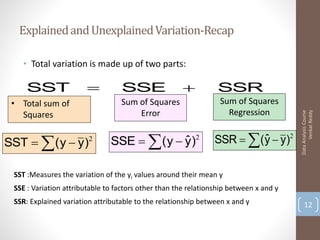
   • Total variation is made up of two parts:

    SST                          SSE                          SSR
 • Total sum of                   Sum of Squares                 Sum of Squares
                                      Error                        Regression


                                                                                             Venkat Reddy
                                                                                       Data Analysis Course
   Squares


SST   ( y  y)        2
                               SSE   ( y  y)
                                             ˆ            2
                                                                SSR   ( y  y)2
                                                                          ˆ

 SST :Measures the variation of the yi values around their mean y
 SSE : Variation attributable to factors other than the relationship between x and y
 SSR: Explained variation attributable to the relationship between x and y                 12
Coefficient of determination-Recap
 • A good fit will have
    • SSE (Minimum or Maximum?)
    • SSR (Minimum or Maximum?)
    • SSR/SSE(Minimum or Maximum?)
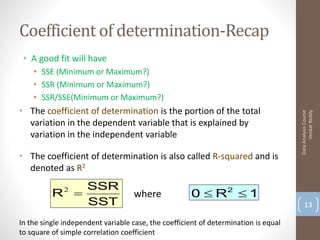
• The coefficient of determination is the portion of the total


                                                                                           Venkat Reddy
                                                                                     Data Analysis Course
  variation in the dependent variable that is explained by
  variation in the independent variable

• The coefficient of determination is also called R-squared and is
  denoted as R2
              SSR
          R  2
                                   where             0  R2  1
              SST                                                                        13

In the single independent variable case, the coefficient of determination is equal
to square of simple correlation coefficient
Lab
• Download death rate data from here
         •   The data (X1, X2, X3, X4, X5) are by city. Total 50 cities data
         •   X1 = death rate per 1000 residents
         •   X2 = doctor availability per 100,000 residents
         •   X3 = hospital availability per 100,000 residents
         •   X4 = annual per capita income in thousands of dollars
         •   X5 = population density people per square mile
         •   X6 = Number of cars per 500


                                                                                                   Venkat Reddy
                                                                                             Data Analysis Course
•   What is the mathematical equation between death rate & other variables
•   What are the coefficient signs? Are they intuitively correct?
•   How good is the regression line?
•   For a city Doctor availability per 100,000 residents is 112, hospital availability per
    100,000 residents is 316,annual per capita income in thousands of dollars is 10.39 ,
    population density people per square mile is 106. What is the expected death rate?
•   What happens to death rate when doctor availability increases?
•   Download SAT score data from here
•   What is the mathematical relation between SAT score and College GPA, High school
    GPA, Quality recommendation
                                                                                                 14
•   How good is the regression line?
Lab :R squared & Adj R squared
 •   Download the sample data from here
 •   Estimate x1 using x2 & x3 what is R squared
 •   Estimate x1 using x2, x3, x4, x5 what is R squared
 •   Estimate x1 using x2, x3, x4, x5,x6,x7 what is R squared


                                                                      Venkat Reddy
                                                                Data Analysis Course
 • X4, x5, x6,x7 are some random variables in this dataset


                                                                    15
R squared & Adj R squared
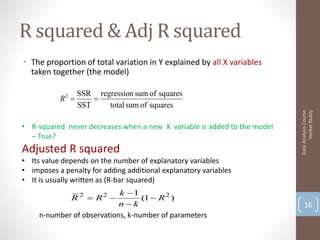
• The proportion of total variation in Y explained by all X variables
  taken together (the model)

                  SSR regression sum of squares
           R2        
                  SST    total sum of squares


                                                                                Venkat Reddy
                                                                          Data Analysis Course
• R-squared never decreases when a new X variable is added to the model
  – True?
Adjusted R squared
• Its value depends on the number of explanatory variables
• imposes a penalty for adding additional explanatory variables
• It is usually written as (R-bar squared)
                            k 1
              R 2  R2            (1  R 2 )
                            nk                                               16
     n-number of observations, k-number of parameters
R-squared vs adj R squared
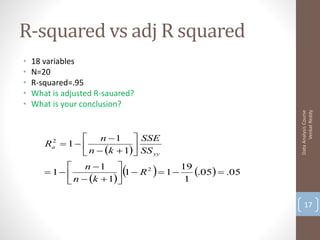
•   18 variables
•   N=20
•   R-squared=.95
•   What is adjusted R-sauared?
•   What is your conclusion?


                                                              Venkat Reddy
                                                        Data Analysis Course
                 n  1  SSE
       Ra  1  
        2

                 n  k  1  SS yy
                              
             n 1 
        1                     
                            1 R2  1
                                       19
                                          .05  .05
             n  k  1              1

                                                            17
The F statistics
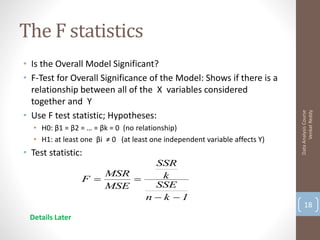
• Is the Overall Model Significant?
• F-Test for Overall Significance of the Model: Shows if there is a
  relationship between all of the X variables considered
  together and Y
• Use F test statistic; Hypotheses:


                                                                                   Venkat Reddy
                                                                             Data Analysis Course
   • H0: β1 = β2 = … = βk = 0 (no relationship)
   • H1: at least one βi ≠ 0 (at least one independent variable affects Y)
• Test statistic:
                             SSR
                     MSR       k
                 F      
                     MSE     SSE
                           n  k 1
                                                                                 18
 Details Later
Multiple variables…good or bad?
• Multiple regression is wonderful in that it allows you to
  consider the effect of multiple variables simultaneously.
• Multiple regression is extremely unpleasant because it allows
  you to consider the effect of multiple variables
  simultaneously.


                                                                        Venkat Reddy
                                                                  Data Analysis Course
• The relationships between the explanatory variables are the
  key to understanding multiple regression.


                                                                      19
Significance of coefficients?
• Check list
  •   F-test for model is significant or not –F value
  •   Does the model have the best available predictors for y? –Adj R
  •   Are all the terms in the model important for predicting y? P value
  •   Are all the predictor variables significant? P value


                                                                                 Venkat Reddy
                                                                           Data Analysis Course
  •   Note that when there is just one predictor, F-test test reduces to
      the F-test for testing in simple linear regression whether or not
      Beta1= 0


                                                                               20
Significance testing of individual
variables Beta
                      H 0 : i  0
To test
                      H a : i  0


                                                     Venkat Reddy
                                               Data Analysis Course
                           bi
Test statistic:       t
                         s (bi )
                       
                  t  t ( ; n  k  1)    or
                         2
Reject H0 if
                         
                  t  t ( ; n  k  1)
                          2
                                                   21
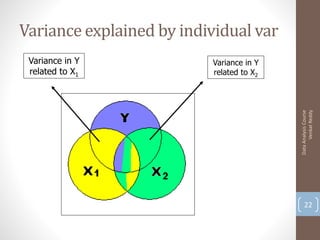
Variance explained by individual var
 Variance in Y            Variance in Y
 related to X1            related to X2


                                                Venkat Reddy
                                          Data Analysis Course
                                              22
What is P-values of a coefficient
• P value gives us an idea about the significance of each variable
• The p-values for the individual variables are computed AFTER
  accounting for the effects of all the other variables.
• Thus, the p-value shown for the variable is the p-value “after
  accounting to everything else”.


                                                                                Venkat Reddy
                                                                          Data Analysis Course
• That p-value basically compares the
  • fit of the regression “with everything except to the variable” vs
    the fit of the regression “with everything including the variable”.
  • There will be no decremant or minimal change in adj r squared if
    we remove the variable
• Note it is possible all the variables in a regression to produce
  great individual fits, and yet have none of the variables be
  individually significant.                                                   23
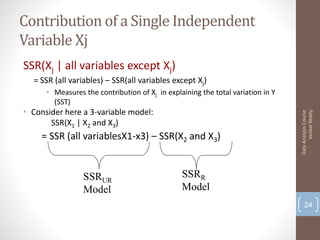
Contribution of a Single Independent
Variable Xj
SSR(Xj | all variables except Xj)
  = SSR (all variables) – SSR(all variables except Xj)
      • Measures the contribution of Xj in explaining the total variation in Y
        (SST)
• Consider here a 3-variable model:


                                                                                       Venkat Reddy
                                                                                 Data Analysis Course
       SSR(X1 | X2 and X3)
    = SSR (all variablesX1-x3) – SSR(X2 and X3)


                 SSRUR                          SSRR
                 Model                          Model
                                                                                     24
Lab
• In the death rate data what is the individual significance of effect of
  each variable?
• What is the least significant variable?
• With increase in number of cars does death rate increase or
  decrease?


                                                                                  Venkat Reddy
                                                                            Data Analysis Course
• Remove the least significant variable and fit a new regression line
• What is new R squared & adjusted r squared?
• Download CAT exam data from here
• What is r square & adj R square
• What is the best predictor for CAT score?
• As mathematics score increases 10 units what happens to CAT
  score?
• Remove “scinece” variable from the model & see maths effect –
  Multicollinearity                                                             25
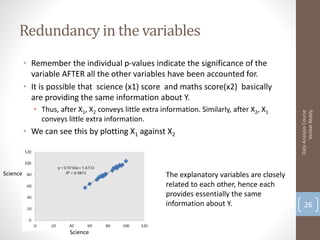
Redundancy in the variables
          • Remember the individual p-values indicate the significance of the
            variable AFTER all the other variables have been accounted for.
          • It is possible that science (x1) score and maths score(x2) basically
            are providing the same information about Y.
            • Thus, after X1, X2 conveys little extra information. Similarly, after X2, X1


                                                                                                     Venkat Reddy
                                                                                               Data Analysis Course
              conveys little extra information.
          • We can see this by plotting X1 against X2


Science                                                The explanatory variables are closely
                                                       related to each other, hence each
                                                       provides essentially the same
                                                       information about Y.                        26


                        Science
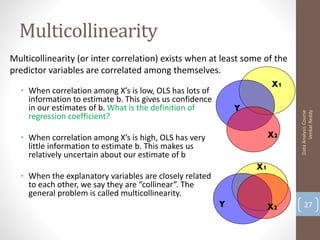
Multicollinearity
Multicollinearity (or inter correlation) exists when at least some of the
predictor variables are correlated among themselves.
                                                                       X1
  • When correlation among X’s is low, OLS has lots of
    information to estimate b. This gives us confidence
    in our estimates of b. What is the definition of          Y


                                                                                  Venkat Reddy
                                                                            Data Analysis Course
    regression coefficient?

  • When correlation among X’s is high, OLS has very                   X2
    little information to estimate b. This makes us
    relatively uncertain about our estimate of b
                                                                  X1
  • When the explanatory variables are closely related
    to each other, we say they are “collinear”. The
    general problem is called multicollinearity.
                                                          Y            X2       27
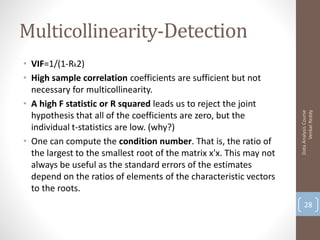
Multicollinearity-Detection
• VIF=1/(1-Rk2)
• High sample correlation coefficients are sufficient but not
  necessary for multicollinearity.
• A high F statistic or R squared leads us to reject the joint


                                                                           Venkat Reddy
                                                                     Data Analysis Course
  hypothesis that all of the coefficients are zero, but the
  individual t-statistics are low. (why?)
• One can compute the condition number. That is, the ratio of
  the largest to the smallest root of the matrix x'x. This may not
  always be useful as the standard errors of the estimates
  depend on the ratios of elements of the characteristic vectors
  to the roots.
                                                                         28
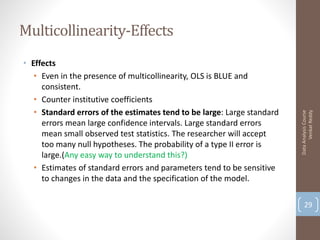
Multicollinearity-Effects
• Effects
   • Even in the presence of multicollinearity, OLS is BLUE and
     consistent.
   • Counter institutive coefficients
   • Standard errors of the estimates tend to be large: Large standard


                                                                               Venkat Reddy
                                                                         Data Analysis Course
     errors mean large confidence intervals. Large standard errors
     mean small observed test statistics. The researcher will accept
     too many null hypotheses. The probability of a type II error is
     large.(Any easy way to understand this?)
   • Estimates of standard errors and parameters tend to be sensitive
     to changes in the data and the specification of the model.

                                                                             29
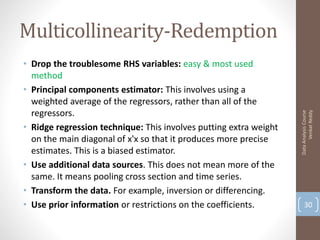
Multicollinearity-Redemption
• Drop the troublesome RHS variables: easy & most used
  method
• Principal components estimator: This involves using a
  weighted average of the regressors, rather than all of the
  regressors.


                                                                         Venkat Reddy
                                                                   Data Analysis Course
• Ridge regression technique: This involves putting extra weight
  on the main diagonal of x'x so that it produces more precise
  estimates. This is a biased estimator.
• Use additional data sources. This does not mean more of the
  same. It means pooling cross section and time series.
• Transform the data. For example, inversion or differencing.
• Use prior information or restrictions on the coefficients.           30
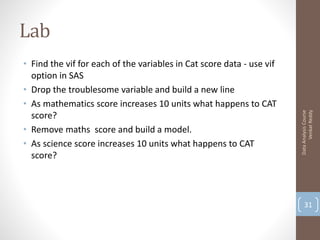
Lab
• Find the vif for each of the variables in Cat score data - use vif
  option in SAS
• Drop the troublesome variable and build a new line
• As mathematics score increases 10 units what happens to CAT


                                                                             Venkat Reddy
                                                                       Data Analysis Course
  score?
• Remove maths score and build a model.
• As science score increases 10 units what happens to CAT
  score?


                                                                           31
Stepwise Regression
• Forward selection
• Backward elimination
• Stepwise regression


                               Venkat Reddy
                         Data Analysis Course
• Details later


                             32
Venkat Reddy Konasani
Manager at Trendwise Analytics
venkat@TrendwiseAnalytics.com
21.venkat@gmail.com


                                       Venkat Reddy
                                 Data Analysis Course
+91 9886 768879


                                     33

Multiple regression

  • 1.
    Data Analysis Course MultipleLinear Regression(Version-1) Venkat Reddy
  • 2.
    Data Analysis Course • Data analysis design document • Introduction to statistical data analysis • Descriptive statistics • Data exploration, validation & sanitization • Probability distributions examples and applications Venkat Reddy Data Analysis Course • Simple correlation and regression analysis • Multiple liner regression analysis • Logistic regression analysis • Testing of hypothesis • Clustering and decision trees • Time series analysis and forecasting • Credit Risk Model building-1 2 • Credit Risk Model building-2
  • 3.
    Note • This presentationis just class notes. The course notes for Data Analysis Training is by written by me, as an aid for myself. • The best way to treat this is as a high-level summary; the actual session went more in depth and contained other Venkat Reddy Data Analysis Course information. • Most of this material was written as informal notes, not intended for publication • Please send questions/comments/corrections to venkat@trenwiseanalytics.com or 21.venkat@gmail.com • Please check my website for latest version of this document -Venkat Reddy 3
  • 4.
    Contents • Why multiple regression? • The multiple regression model • Meaning of beta • Variance explained Venkat Reddy Data Analysis Course • Goodness of fit R sqared and Adj-R squared • The F value • Multicollinearity • Prediction 4
  • 5.
    Why Multiple Regression •Our real world is multivariable • Multivariable analysis is a tool to determine the relative contribution of all factors Venkat Reddy Data Analysis Course • How do you estimate a country’s GDP? Single or multiple predictors • Health is just dependent on smoking or drinking? • Diet, exercise, genetics, age, job, sleeping habits also play an important roll in deciding one’s health • We often want to describe the effect of smoking over and above these other variables. 5
  • 6.
    Some Economics Models Mostof the real time models are multivariate Wage determination model  w  f S , A, A2 , T , G, L,       p, a, a , Pc , y, i, w,   Profit Venkat Reddy Data Analysis Course 2 Investment I  I r , w, sk , t , D, P,   Money demand M  M i,Y , c, E  6 P P
  • 7.
    Multiple Regression Model Y ˆ Y   0  1X1   2 X 2 The data is scattered above and below the plane Venkat Reddy Data Analysis Course X2 7 X1
  • 8.
    Assumptions Same as earlier • The errors are normally distributed • Errors have a constant variance • The model errors are independent Venkat Reddy Data Analysis Course • Errors (residuals) from the regression model: ei = (Yi – Yi) 8
  • 9.
    Least Squares Estimation •The constant and parameters are derived in the same way as with the bi-variate model. • Remember … “Minimizing sum of squares of deviation”? Venkat Reddy Data Analysis Course • When a new variable is added it affects the coefficients of the existing variables e 2   (y y) ˆ 2   (y  (b 0  b1 x 1  b 2 x 2  b 3 x 3 )) 2 9
  • 10.
    Meaning of beta Venkat Reddy Data Analysis Course • The equation Yi = β0 + β1 Xi1 + β2 Xi2 + εi has the following interpretation. • Again, β0 is the intercept (the value of Y when both X1 and X2 are 0). • β1 is the slope for X1, so each unit increase in X1 increases Y on AVERAGE by β1 units. • β2 is the slope for X2, so each unit increase in X2 increases Y on AVERAGE by β2 units. 10
  • 11.
    How good ismy regression line?-Recap • Take a regression line; Estimate y by substituting xi from data; Is it exactly same as yi? • Remember no line is perfect • There is always some error in the estimation Venkat Reddy Data Analysis Course • Unless there is comprehensive dependency between predictor and response, there is always some part of response(Y) that can’t be explained by predictor (x) • So, total variance in Y is divided into two parts, • Variance that can be explained by x, using regression • Variance that can’t be explained by x 11
  • 12.
    Explained and UnexplainedVariation-Recap • Total variation is made up of two parts: SST  SSE  SSR • Total sum of Sum of Squares Sum of Squares Error Regression Venkat Reddy Data Analysis Course Squares SST   ( y  y) 2 SSE   ( y  y) ˆ 2 SSR   ( y  y)2 ˆ SST :Measures the variation of the yi values around their mean y SSE : Variation attributable to factors other than the relationship between x and y SSR: Explained variation attributable to the relationship between x and y 12
  • 13.
    Coefficient of determination-Recap • A good fit will have • SSE (Minimum or Maximum?) • SSR (Minimum or Maximum?) • SSR/SSE(Minimum or Maximum?) • The coefficient of determination is the portion of the total Venkat Reddy Data Analysis Course variation in the dependent variable that is explained by variation in the independent variable • The coefficient of determination is also called R-squared and is denoted as R2 SSR R  2 where 0  R2  1 SST 13 In the single independent variable case, the coefficient of determination is equal to square of simple correlation coefficient
  • 14.
    Lab • Download deathrate data from here • The data (X1, X2, X3, X4, X5) are by city. Total 50 cities data • X1 = death rate per 1000 residents • X2 = doctor availability per 100,000 residents • X3 = hospital availability per 100,000 residents • X4 = annual per capita income in thousands of dollars • X5 = population density people per square mile • X6 = Number of cars per 500 Venkat Reddy Data Analysis Course • What is the mathematical equation between death rate & other variables • What are the coefficient signs? Are they intuitively correct? • How good is the regression line? • For a city Doctor availability per 100,000 residents is 112, hospital availability per 100,000 residents is 316,annual per capita income in thousands of dollars is 10.39 , population density people per square mile is 106. What is the expected death rate? • What happens to death rate when doctor availability increases? • Download SAT score data from here • What is the mathematical relation between SAT score and College GPA, High school GPA, Quality recommendation 14 • How good is the regression line?
  • 15.
    Lab :R squared& Adj R squared • Download the sample data from here • Estimate x1 using x2 & x3 what is R squared • Estimate x1 using x2, x3, x4, x5 what is R squared • Estimate x1 using x2, x3, x4, x5,x6,x7 what is R squared Venkat Reddy Data Analysis Course • X4, x5, x6,x7 are some random variables in this dataset 15
  • 16.
    R squared &Adj R squared • The proportion of total variation in Y explained by all X variables taken together (the model) SSR regression sum of squares R2   SST total sum of squares Venkat Reddy Data Analysis Course • R-squared never decreases when a new X variable is added to the model – True? Adjusted R squared • Its value depends on the number of explanatory variables • imposes a penalty for adding additional explanatory variables • It is usually written as (R-bar squared) k 1 R 2  R2  (1  R 2 ) nk 16 n-number of observations, k-number of parameters
  • 17.
    R-squared vs adjR squared • 18 variables • N=20 • R-squared=.95 • What is adjusted R-sauared? • What is your conclusion? Venkat Reddy Data Analysis Course  n  1  SSE Ra  1   2  n  k  1  SS yy   n 1   1    1 R2  1 19 .05  .05  n  k  1  1 17
  • 18.
    The F statistics •Is the Overall Model Significant? • F-Test for Overall Significance of the Model: Shows if there is a relationship between all of the X variables considered together and Y • Use F test statistic; Hypotheses: Venkat Reddy Data Analysis Course • H0: β1 = β2 = … = βk = 0 (no relationship) • H1: at least one βi ≠ 0 (at least one independent variable affects Y) • Test statistic: SSR MSR k F   MSE SSE n  k 1 18 Details Later
  • 19.
    Multiple variables…good orbad? • Multiple regression is wonderful in that it allows you to consider the effect of multiple variables simultaneously. • Multiple regression is extremely unpleasant because it allows you to consider the effect of multiple variables simultaneously. Venkat Reddy Data Analysis Course • The relationships between the explanatory variables are the key to understanding multiple regression. 19
  • 20.
    Significance of coefficients? •Check list • F-test for model is significant or not –F value • Does the model have the best available predictors for y? –Adj R • Are all the terms in the model important for predicting y? P value • Are all the predictor variables significant? P value Venkat Reddy Data Analysis Course • Note that when there is just one predictor, F-test test reduces to the F-test for testing in simple linear regression whether or not Beta1= 0 20
  • 21.
    Significance testing ofindividual variables Beta H 0 : i  0 To test H a : i  0 Venkat Reddy Data Analysis Course bi Test statistic: t s (bi )  t  t ( ; n  k  1) or 2 Reject H0 if  t  t ( ; n  k  1) 2 21
  • 22.
    Variance explained byindividual var Variance in Y Variance in Y related to X1 related to X2 Venkat Reddy Data Analysis Course 22
  • 23.
    What is P-valuesof a coefficient • P value gives us an idea about the significance of each variable • The p-values for the individual variables are computed AFTER accounting for the effects of all the other variables. • Thus, the p-value shown for the variable is the p-value “after accounting to everything else”. Venkat Reddy Data Analysis Course • That p-value basically compares the • fit of the regression “with everything except to the variable” vs the fit of the regression “with everything including the variable”. • There will be no decremant or minimal change in adj r squared if we remove the variable • Note it is possible all the variables in a regression to produce great individual fits, and yet have none of the variables be individually significant. 23
  • 24.
    Contribution of aSingle Independent Variable Xj SSR(Xj | all variables except Xj) = SSR (all variables) – SSR(all variables except Xj) • Measures the contribution of Xj in explaining the total variation in Y (SST) • Consider here a 3-variable model: Venkat Reddy Data Analysis Course SSR(X1 | X2 and X3) = SSR (all variablesX1-x3) – SSR(X2 and X3) SSRUR SSRR Model Model 24
  • 25.
    Lab • In thedeath rate data what is the individual significance of effect of each variable? • What is the least significant variable? • With increase in number of cars does death rate increase or decrease? Venkat Reddy Data Analysis Course • Remove the least significant variable and fit a new regression line • What is new R squared & adjusted r squared? • Download CAT exam data from here • What is r square & adj R square • What is the best predictor for CAT score? • As mathematics score increases 10 units what happens to CAT score? • Remove “scinece” variable from the model & see maths effect – Multicollinearity 25
  • 26.
    Redundancy in thevariables • Remember the individual p-values indicate the significance of the variable AFTER all the other variables have been accounted for. • It is possible that science (x1) score and maths score(x2) basically are providing the same information about Y. • Thus, after X1, X2 conveys little extra information. Similarly, after X2, X1 Venkat Reddy Data Analysis Course conveys little extra information. • We can see this by plotting X1 against X2 Science The explanatory variables are closely related to each other, hence each provides essentially the same information about Y. 26 Science
  • 27.
    Multicollinearity Multicollinearity (or intercorrelation) exists when at least some of the predictor variables are correlated among themselves. X1 • When correlation among X’s is low, OLS has lots of information to estimate b. This gives us confidence in our estimates of b. What is the definition of Y Venkat Reddy Data Analysis Course regression coefficient? • When correlation among X’s is high, OLS has very X2 little information to estimate b. This makes us relatively uncertain about our estimate of b X1 • When the explanatory variables are closely related to each other, we say they are “collinear”. The general problem is called multicollinearity. Y X2 27
  • 28.
    Multicollinearity-Detection • VIF=1/(1-Rk2) • Highsample correlation coefficients are sufficient but not necessary for multicollinearity. • A high F statistic or R squared leads us to reject the joint Venkat Reddy Data Analysis Course hypothesis that all of the coefficients are zero, but the individual t-statistics are low. (why?) • One can compute the condition number. That is, the ratio of the largest to the smallest root of the matrix x'x. This may not always be useful as the standard errors of the estimates depend on the ratios of elements of the characteristic vectors to the roots. 28
  • 29.
    Multicollinearity-Effects • Effects • Even in the presence of multicollinearity, OLS is BLUE and consistent. • Counter institutive coefficients • Standard errors of the estimates tend to be large: Large standard Venkat Reddy Data Analysis Course errors mean large confidence intervals. Large standard errors mean small observed test statistics. The researcher will accept too many null hypotheses. The probability of a type II error is large.(Any easy way to understand this?) • Estimates of standard errors and parameters tend to be sensitive to changes in the data and the specification of the model. 29
  • 30.
    Multicollinearity-Redemption • Drop thetroublesome RHS variables: easy & most used method • Principal components estimator: This involves using a weighted average of the regressors, rather than all of the regressors. Venkat Reddy Data Analysis Course • Ridge regression technique: This involves putting extra weight on the main diagonal of x'x so that it produces more precise estimates. This is a biased estimator. • Use additional data sources. This does not mean more of the same. It means pooling cross section and time series. • Transform the data. For example, inversion or differencing. • Use prior information or restrictions on the coefficients. 30
  • 31.
    Lab • Find thevif for each of the variables in Cat score data - use vif option in SAS • Drop the troublesome variable and build a new line • As mathematics score increases 10 units what happens to CAT Venkat Reddy Data Analysis Course score? • Remove maths score and build a model. • As science score increases 10 units what happens to CAT score? 31
  • 32.
    Stepwise Regression • Forwardselection • Backward elimination • Stepwise regression Venkat Reddy Data Analysis Course • Details later 32
  • 33.
    Venkat Reddy Konasani Managerat Trendwise Analytics venkat@TrendwiseAnalytics.com 21.venkat@gmail.com Venkat Reddy Data Analysis Course +91 9886 768879 33