The Spearman
Rank Order
Correlation
Coefficient
Desmond Ayim-Aboagye,
PhD
Association between two ordinally
scaled variables
The Spearman is also Pearson r
formula to rank-ordered data
– The Spearman rank order correlation coefficient, is used to examine the nature
of association found between two ordinally scaled variables.
– It is symbolized rs (occasionally p, or “rho”).
Difference
– The Pearson r is ideal for
measuring associations that are
linear (e.g., as X increases in value,
a corresponding increase in Y
occurs)
– The Spearman rs, when the
relationship is not linear.
Actors Judge 1’s
Ranking
Judge 2’s
Ranking D(diff) D²
Adam
Bill
Cara
Deena
Ernesto
Fran
Gerald
Helen
1
2
3
4
5
6
7
8
3
1
2
5
4
7
8
6
-2
1
1
-1
1
-1
-1
2
4
1
1
1
1
1
1
4
∑ 36 36 ∑D = 0 ∑D² =14
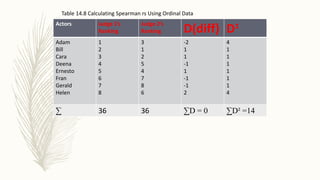
Table 14.8 Calculating Spearman rs Using Ordinal Data
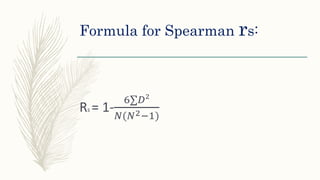
Formula for Spearman rs:
Rs = 1-
6∑𝐷²
𝑁(𝑁2−1)
Calculating
– Rs = 1-
6∑𝐷²
𝑁(𝑁2−1)
– Rs = 1-
6(14)
8[ 82−1 ]
– Rs = 1-
84
8(64−1)
– Rs = 1-
84
8(63)
– Rs = 1-
84
504
– Rs = 1- .1667
– Rs = .83.
Rejecting or accepting
Hypothesis
– Table B. 10 in Appendix B
– As usual we perform a two-tailed test at the 0.05 level
– So we read the row for N = 8 [sample size] and locate the critical value of .738
– Is the observed rs of .83 greater than or equal to the rs critical value of .738.
Yes we can reject the null hypothesis of no difference, or:
– rs (8) = .83 ≥ rs critical (8) = .738; Reject H0.

The spearman rank order correlation coefficient

  • 1.
    The Spearman Rank Order Correlation Coefficient DesmondAyim-Aboagye, PhD Association between two ordinally scaled variables
  • 2.
    The Spearman isalso Pearson r formula to rank-ordered data – The Spearman rank order correlation coefficient, is used to examine the nature of association found between two ordinally scaled variables. – It is symbolized rs (occasionally p, or “rho”).
  • 3.
    Difference – The Pearsonr is ideal for measuring associations that are linear (e.g., as X increases in value, a corresponding increase in Y occurs) – The Spearman rs, when the relationship is not linear.
  • 4.
    Actors Judge 1’s Ranking Judge2’s Ranking D(diff) D² Adam Bill Cara Deena Ernesto Fran Gerald Helen 1 2 3 4 5 6 7 8 3 1 2 5 4 7 8 6 -2 1 1 -1 1 -1 -1 2 4 1 1 1 1 1 1 4 ∑ 36 36 ∑D = 0 ∑D² =14 Table 14.8 Calculating Spearman rs Using Ordinal Data
  • 5.
    Formula for Spearmanrs: Rs = 1- 6∑𝐷² 𝑁(𝑁2−1)
  • 6.
    Calculating – Rs =1- 6∑𝐷² 𝑁(𝑁2−1) – Rs = 1- 6(14) 8[ 82−1 ] – Rs = 1- 84 8(64−1) – Rs = 1- 84 8(63) – Rs = 1- 84 504 – Rs = 1- .1667 – Rs = .83.
  • 7.
    Rejecting or accepting Hypothesis –Table B. 10 in Appendix B – As usual we perform a two-tailed test at the 0.05 level – So we read the row for N = 8 [sample size] and locate the critical value of .738 – Is the observed rs of .83 greater than or equal to the rs critical value of .738. Yes we can reject the null hypothesis of no difference, or: – rs (8) = .83 ≥ rs critical (8) = .738; Reject H0.