Spearman’s
Rank-Difference Correlation
K.THIYAGU, Assistant Professor, Department of Education,
Central University of Kerala, Kasaragod
The Spearman’s Rank Correlation Coefficient is the
non-parametric statistical measure
used to study the
strength of association
between the
two ranked variables.
This method is applied to the ordinal set of numbers, which
can be arranged in order, i.e. one after the other so that
ranks can be given to each.
Spearman’s Rank Correlation
It was developed by Charles Spearman; this it is
called the Spearman rank correlation.
Spearman's rank correlation coefficient denoted
by the Greek letter  (rho)
It assesses how well the relationship
between two variables can be
described using a monotonic function.
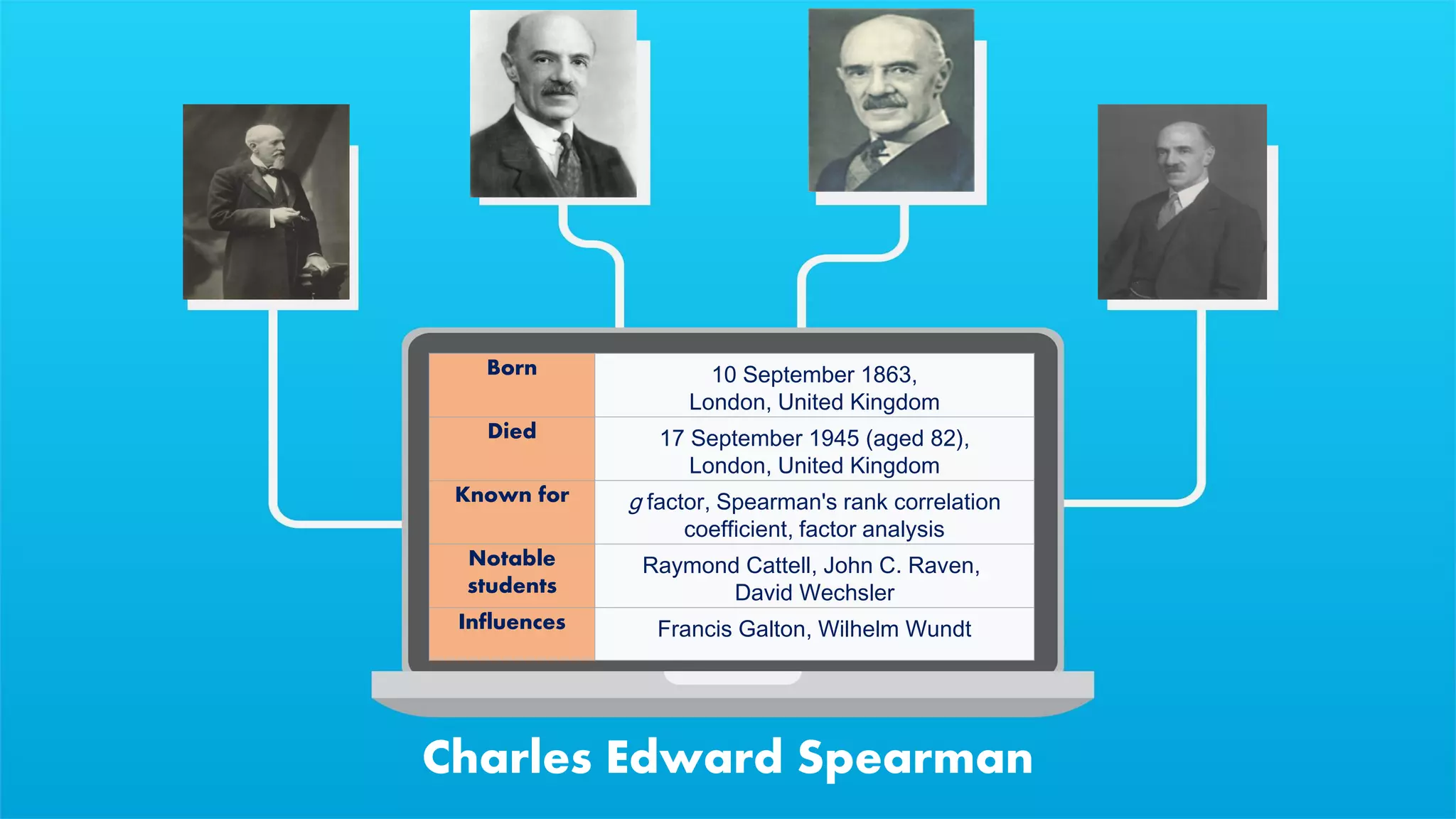
Charles Edward Spearman
Born 10 September 1863,
London, United Kingdom
Died 17 September 1945 (aged 82),
London, United Kingdom
Known for g factor, Spearman's rank correlation
coefficient, factor analysis
Notable
students
Raymond Cattell, John C. Raven,
David Wechsler
Influences Francis Galton, Wilhelm Wundt
While Pearson's correlation assesses linear relationships,
Spearman's correlation assesses monotonic relationships
(whether linear or not).
A monotonic relationship is a relationship that does one of the
following: (1) as the value of one variable increases, so does
the value of the other variable; or (2) as the value of one
variable increases, the other variable value decreases
Monotonic Relationships
Monotonic relationships are where:
• One variable increases and the other increases.
Or,
• One variable decreases and the other decreases.
Monotonic variables increase (or decrease) in the same
direction, but not always at the same rate.
Linear variables increase (or decrease) in the same
direction at the same rate.
If an increase in the independent variable
causes a decrease in the dependent
variable, this is called a monotonic inverse
relationship. An inverse relationship is the
same thing as a negative correlation.
A monotonic direct relationship is where
an increase in the independent variable
causes an increase in the dependent
variable. In other words, there’s a positive
correlation between the data.
D = Difference of ranks
N = Number of Observations
Formula for the Spearman’s Rank Correlation Co-efficient
When the ranks are repeated the formula is
where m1, m2, ..., are the number of
repetitions of ranks
Example
English
(mark)
Maths
(mark)
Rank
(English)
Rank
(maths)
d d2
56 66 9 4 5 25
75 70 3 2 1 1
45 40 10 10 0 0
71 60 4 7 -3 9
62 65 6 5 1 1
64 56 5 9 -4 16
58 59 8 8 0 0
80 77 1 1 0 0
76 67 2 3 -1 1
61 63 7 6 1 1
 It is easy to calculate.
 It is simple to understand.
 It can be applied to any type of data.
Qualitative or Quantitative. Hence
correlation with qualitative data such as
honesty, beauty can be found.
 This is most suitable in case there are two
attributes.
Merits
 It is only an approximately
calculate measure as actual
values are not used for
calculations.
 For large samples, it is not a
convenient method.
 Combined r of different
series cannot be obtained as
in case of mean and S.D.
 It cannot be treated further
algebraically.
Demerits
Thank You
K.THIYAGU, Assistant
Professor, Department of Education,
Central University of Kerala, Kasaragod

Spearman Rank Correlation - Thiyagu

  • 1.
    Spearman’s Rank-Difference Correlation K.THIYAGU, AssistantProfessor, Department of Education, Central University of Kerala, Kasaragod
  • 2.
    The Spearman’s RankCorrelation Coefficient is the non-parametric statistical measure used to study the strength of association between the two ranked variables. This method is applied to the ordinal set of numbers, which can be arranged in order, i.e. one after the other so that ranks can be given to each. Spearman’s Rank Correlation It was developed by Charles Spearman; this it is called the Spearman rank correlation. Spearman's rank correlation coefficient denoted by the Greek letter  (rho) It assesses how well the relationship between two variables can be described using a monotonic function.
  • 3.
    Charles Edward Spearman Born10 September 1863, London, United Kingdom Died 17 September 1945 (aged 82), London, United Kingdom Known for g factor, Spearman's rank correlation coefficient, factor analysis Notable students Raymond Cattell, John C. Raven, David Wechsler Influences Francis Galton, Wilhelm Wundt
  • 4.
    While Pearson's correlationassesses linear relationships, Spearman's correlation assesses monotonic relationships (whether linear or not). A monotonic relationship is a relationship that does one of the following: (1) as the value of one variable increases, so does the value of the other variable; or (2) as the value of one variable increases, the other variable value decreases Monotonic Relationships
  • 8.
    Monotonic relationships arewhere: • One variable increases and the other increases. Or, • One variable decreases and the other decreases. Monotonic variables increase (or decrease) in the same direction, but not always at the same rate. Linear variables increase (or decrease) in the same direction at the same rate.
  • 9.
    If an increasein the independent variable causes a decrease in the dependent variable, this is called a monotonic inverse relationship. An inverse relationship is the same thing as a negative correlation. A monotonic direct relationship is where an increase in the independent variable causes an increase in the dependent variable. In other words, there’s a positive correlation between the data.
  • 10.
    D = Differenceof ranks N = Number of Observations Formula for the Spearman’s Rank Correlation Co-efficient When the ranks are repeated the formula is where m1, m2, ..., are the number of repetitions of ranks
  • 11.
    Example English (mark) Maths (mark) Rank (English) Rank (maths) d d2 56 669 4 5 25 75 70 3 2 1 1 45 40 10 10 0 0 71 60 4 7 -3 9 62 65 6 5 1 1 64 56 5 9 -4 16 58 59 8 8 0 0 80 77 1 1 0 0 76 67 2 3 -1 1 61 63 7 6 1 1
  • 12.
     It iseasy to calculate.  It is simple to understand.  It can be applied to any type of data. Qualitative or Quantitative. Hence correlation with qualitative data such as honesty, beauty can be found.  This is most suitable in case there are two attributes. Merits
  • 13.
     It isonly an approximately calculate measure as actual values are not used for calculations.  For large samples, it is not a convenient method.  Combined r of different series cannot be obtained as in case of mean and S.D.  It cannot be treated further algebraically. Demerits
  • 14.
    Thank You K.THIYAGU, Assistant Professor,Department of Education, Central University of Kerala, Kasaragod