Correlation Coefficient ELESTA1
Correlation  Measure of relationship between two variables Ex.  Grades in English tends to be related with Foreign Language Height and weight
Nature of Correlation Magnitude/direction of the relationship Strength of the relationship Variance explained Significance of the relationship
Magnitude of the Relationship Positive relationship – as one variable increases the other variable also increases Ex. academic grades and intelligence Negative relationship – as one variable increases, the other decreases or vice versa Ex. procrastination and motivation Absence of relationship between variables – denoted by .00
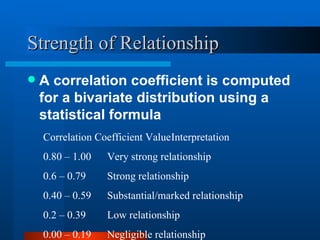
Strength of Relationship A correlation coefficient is computed for a bivariate distribution using a statistical formula Correlation Coefficient Value Interpretation 0.80 – 1.00 Very strong relationship 0.6 – 0.79 Strong relationship 0.40 – 0.59 Substantial/marked relationship 0.2 – 0.39 Low relationship 0.00 – 0.19 Negligible relationship
Variance How much of Y’s is explained/accounted for by X Proportion explained Square of the correlation coefficient value
Conditions in interpreting r Linear regression – the points in a scatterplot should tend to fall along a straight line The size of the r reflects the amount of variance that can be accounted for by a straight line Homosedasticity – tendency of the standard deviation (or variances) of the arrays to be equal.
Correlational Techniques Pearson Product-Moment correlation – (r) used for interval/ratio sets of variables Spearman Rank-order correlation – two sets of data are ordinal Phi coefficient – each of the variables is a dichotomy

Correlation coefficient

  • 1.
  • 2.
    Correlation Measureof relationship between two variables Ex. Grades in English tends to be related with Foreign Language Height and weight
  • 3.
    Nature of CorrelationMagnitude/direction of the relationship Strength of the relationship Variance explained Significance of the relationship
  • 4.
    Magnitude of theRelationship Positive relationship – as one variable increases the other variable also increases Ex. academic grades and intelligence Negative relationship – as one variable increases, the other decreases or vice versa Ex. procrastination and motivation Absence of relationship between variables – denoted by .00
  • 5.
    Strength of RelationshipA correlation coefficient is computed for a bivariate distribution using a statistical formula Correlation Coefficient Value Interpretation 0.80 – 1.00 Very strong relationship 0.6 – 0.79 Strong relationship 0.40 – 0.59 Substantial/marked relationship 0.2 – 0.39 Low relationship 0.00 – 0.19 Negligible relationship
  • 6.
    Variance How muchof Y’s is explained/accounted for by X Proportion explained Square of the correlation coefficient value
  • 7.
    Conditions in interpretingr Linear regression – the points in a scatterplot should tend to fall along a straight line The size of the r reflects the amount of variance that can be accounted for by a straight line Homosedasticity – tendency of the standard deviation (or variances) of the arrays to be equal.
  • 8.
    Correlational Techniques PearsonProduct-Moment correlation – (r) used for interval/ratio sets of variables Spearman Rank-order correlation – two sets of data are ordinal Phi coefficient – each of the variables is a dichotomy