According to Munn (1967) “Forgetting is the loss, temporary or
Permanent, of the ability to recall or recognize something learnt
Earlier.”

According to Drever (1952) “Forgetting means failure at any time
To recall an experience, when attempting to do so, or to perform an
Action previously learnt .
Types of Forgetting

NATURAL FORGETTING

MORBID or ABNORMAL FORGETTING

GENERAL FORGETTING

SPECIFIC FORGETTING

PHYSICAL FORGETTING

PSYCHOLOGICAL FORGETTING
Theories of Forgetting
 Theories of forgetting can be difficult to test as
 we may in fact not forget, but have trouble
 retrieving information from storage.

 Therefore it is possible that these theories can
 explain why we are unable to retrieve a
 memory or why it is distorted.
Theories of Forgetting
 Two factors involved in forgetting:


 Accessibility: The information available can be
 accessed at a specific time/place.

 Availability: The information is represented in
 the memory.
Theories of Forgetting
Freud: Repression, conscious process of
 burying memories to protect ego.

The emotions associated with the repressed
 memory may be recovered, or express
 themselves through:
Dream Analysis.
Hypnosis.
Free Association.
Theories of Forgetting
TRACE DECAY THEORY


Natural forgetting which takes place due to
 the decay of memory traces in the brain and
 due to time.

Criticism – does not explain why we dont
 forget how to ride a bicycle.
WHY FORGETTING TAKES PLACE
Forgetting in STM.
                      Trace Decay: Unless
                       information is refreshed or
                       rehearsed will
                       spontaneously fade or
                       decay over time.
                      Displacement: Only a
                       fixed number of slots in
                       memory capacity. New
                       information will displace
                       old when capacity is
                       reached.
                      Encoding failure:
                       Because of displacement,
                       this information never
                       reaches the LTM.
Forgetting in LTM.
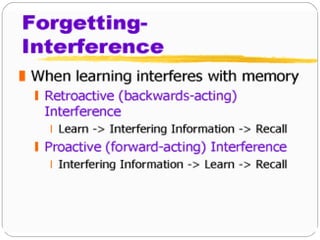
                 Interference: More information
                     will be stored and become
                     confused together.

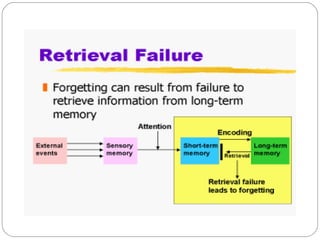
                 Retrieval Failure: Information
                     may be available but
                     temporarily inaccessible

                 Motivated forgetting: we may
                  actively work to forget
                  memories. Two basic forms are
                 suppression- a conscious form
                  of forgetting.
                 Repression- and unconscious
                  form of forgetting .
Theories of forgetting

Theories of forgetting

  • 1.
    According to Munn(1967) “Forgetting is the loss, temporary or Permanent, of the ability to recall or recognize something learnt Earlier.” According to Drever (1952) “Forgetting means failure at any time To recall an experience, when attempting to do so, or to perform an Action previously learnt .
  • 2.
    Types of Forgetting NATURALFORGETTING MORBID or ABNORMAL FORGETTING GENERAL FORGETTING SPECIFIC FORGETTING PHYSICAL FORGETTING PSYCHOLOGICAL FORGETTING
  • 3.
    Theories of Forgetting Theories of forgetting can be difficult to test as we may in fact not forget, but have trouble retrieving information from storage.  Therefore it is possible that these theories can explain why we are unable to retrieve a memory or why it is distorted.
  • 4.
    Theories of Forgetting Two factors involved in forgetting:  Accessibility: The information available can be accessed at a specific time/place.  Availability: The information is represented in the memory.
  • 5.
    Theories of Forgetting Freud:Repression, conscious process of burying memories to protect ego. The emotions associated with the repressed memory may be recovered, or express themselves through: Dream Analysis. Hypnosis. Free Association.
  • 6.
    Theories of Forgetting TRACEDECAY THEORY Natural forgetting which takes place due to the decay of memory traces in the brain and due to time. Criticism – does not explain why we dont forget how to ride a bicycle.
  • 8.
    WHY FORGETTING TAKESPLACE Forgetting in STM.  Trace Decay: Unless information is refreshed or rehearsed will spontaneously fade or decay over time.  Displacement: Only a fixed number of slots in memory capacity. New information will displace old when capacity is reached.  Encoding failure: Because of displacement, this information never reaches the LTM.
  • 9.
    Forgetting in LTM.  Interference: More information will be stored and become confused together.  Retrieval Failure: Information may be available but temporarily inaccessible  Motivated forgetting: we may actively work to forget memories. Two basic forms are  suppression- a conscious form of forgetting.  Repression- and unconscious form of forgetting .