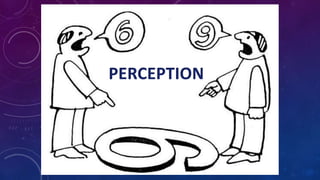
PERCEPTION
PERCEPTION
• Refers to the way in which inputs from the sense organs
are organized, analyzed and interpreted in a meaningful
way.
• It is a way in which we assign meaning to our
experiences
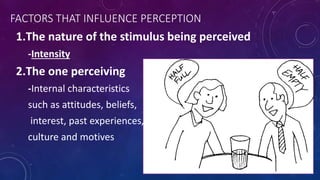
FACTORS THAT INFLUENCE PERCEPTION
1.The nature of the stimulus being perceived
-Intensity
2.The one perceiving
-Internal characteristics
such as attitudes, beliefs,
interest, past experiences,
culture and motives
ORGANIZATION IN PERCEPTION
“HOW CAN WE MAKE SENSE OF THE WORLD”
GESTALT LAWS OF ORGANIZATION
-Human mind has innate tendencies to impose order and
structure on the physical world to perceive sensory patterns as
well as organize wholes rather than as separate parts.
Gestalt principles describe the brain’s organization of sensory
building blocks into meaningful units and patterns.
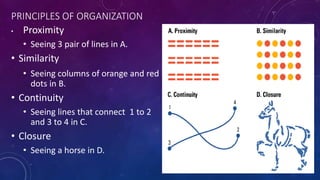
PRINCIPLES OF ORGANIZATION
• Proximity
• Seeing 3 pair of lines in A.
• Similarity
• Seeing columns of orange and red
dots in B.
• Continuity
• Seeing lines that connect 1 to 2
and 3 to 4 in C.
• Closure
• Seeing a horse in D.
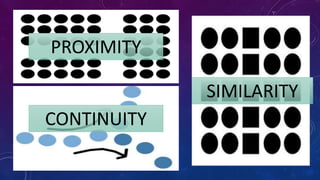
PROXIMITY
CONTINUITY
SIMILARITY
CLOSURE
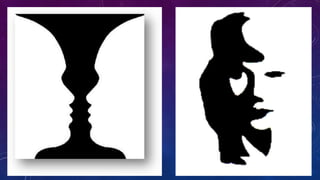
FIGURE AND GROUND: “WHAT STANDS OUT?”
• We tend to see things in a figure and ground
• FIGURE: refers to the object being perceived
• GROUND: refers to the background
PERCEPTUAL CONSTANCY
• The tendency to perceive things as relatively constant despite the
changes in the sensory input in the sense receptors.
• SIZE CONSTANCY- the tendency to perceive things as having the same
size despite the changes in the retinal images
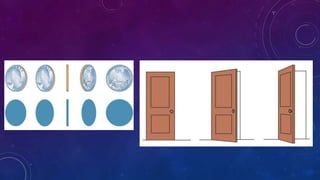
• SHAPE CONSTANCY- the tendency to perceive no changes in the
shape of an object
• COLOR CONSTANCY – the tendency to see color as the same even
though the amount of light changes
PERCEPTION OF DEPTH
• Depth perception allows us to accurately estimate distances
FACTORS THAT ALLOW US TO SEE DEPTH:
1. Monocular Cues
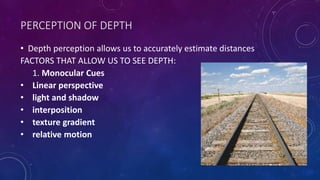
• Linear perspective
• light and shadow
• interposition
• texture gradient
• relative motion
• 2. BINOCULAR CUES- Visual cues to depth or distance that require
the use of both eyes.
• Convergence: Turning inward of the eyes, which occurs when they
focus on a nearby object.
• Retinal Disparity: The slight difference in lateral separation
between two objects as seen by the left eye and the right eye.
PERCEPTION OF MOVEMENT
• Visual perception of motion is based on change of position relative to
other objects
•Illusions of movement
• Apparent motion- a condition in which our senses get
tricked by the nature of stimuli presented
• Stroboscopic motion- animated film; the drawing themselves are
stationary but because of rapid presentation of one drawing
after another, the drawings appear to be moving.
ILLUSIONS AND HALLUCINATIONS
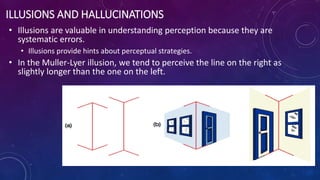
• Illusions are valuable in understanding perception because they are
systematic errors.
• Illusions provide hints about perceptual strategies.
• In the Muller-Lyer illusion, we tend to perceive the line on the right as
slightly longer than the one on the left.
EXTRASENSORY PERCEPTION - ESP
• Perception independent of sensation
• The ability to perceive something without ordinary sensory information
• This has not been scientifically demonstrated
• Perception through means other than sensory organs
• Precognition
• Psychokinesis
• Telepathy
• Clairvoyance
Perception - Psychology

Perception - Psychology

  • 1.
  • 2.
    PERCEPTION • Refers tothe way in which inputs from the sense organs are organized, analyzed and interpreted in a meaningful way. • It is a way in which we assign meaning to our experiences
  • 3.
    FACTORS THAT INFLUENCEPERCEPTION 1.The nature of the stimulus being perceived -Intensity 2.The one perceiving -Internal characteristics such as attitudes, beliefs, interest, past experiences, culture and motives
  • 4.
    ORGANIZATION IN PERCEPTION “HOWCAN WE MAKE SENSE OF THE WORLD” GESTALT LAWS OF ORGANIZATION -Human mind has innate tendencies to impose order and structure on the physical world to perceive sensory patterns as well as organize wholes rather than as separate parts. Gestalt principles describe the brain’s organization of sensory building blocks into meaningful units and patterns.
  • 5.
    PRINCIPLES OF ORGANIZATION •Proximity • Seeing 3 pair of lines in A. • Similarity • Seeing columns of orange and red dots in B. • Continuity • Seeing lines that connect 1 to 2 and 3 to 4 in C. • Closure • Seeing a horse in D.
  • 6.
  • 7.
  • 9.
    FIGURE AND GROUND:“WHAT STANDS OUT?” • We tend to see things in a figure and ground • FIGURE: refers to the object being perceived • GROUND: refers to the background
  • 13.
    PERCEPTUAL CONSTANCY • Thetendency to perceive things as relatively constant despite the changes in the sensory input in the sense receptors. • SIZE CONSTANCY- the tendency to perceive things as having the same size despite the changes in the retinal images • SHAPE CONSTANCY- the tendency to perceive no changes in the shape of an object • COLOR CONSTANCY – the tendency to see color as the same even though the amount of light changes
  • 15.
    PERCEPTION OF DEPTH •Depth perception allows us to accurately estimate distances FACTORS THAT ALLOW US TO SEE DEPTH: 1. Monocular Cues • Linear perspective • light and shadow • interposition • texture gradient • relative motion
  • 16.
    • 2. BINOCULARCUES- Visual cues to depth or distance that require the use of both eyes. • Convergence: Turning inward of the eyes, which occurs when they focus on a nearby object. • Retinal Disparity: The slight difference in lateral separation between two objects as seen by the left eye and the right eye.
  • 17.
    PERCEPTION OF MOVEMENT •Visual perception of motion is based on change of position relative to other objects •Illusions of movement • Apparent motion- a condition in which our senses get tricked by the nature of stimuli presented • Stroboscopic motion- animated film; the drawing themselves are stationary but because of rapid presentation of one drawing after another, the drawings appear to be moving.
  • 18.
    ILLUSIONS AND HALLUCINATIONS •Illusions are valuable in understanding perception because they are systematic errors. • Illusions provide hints about perceptual strategies. • In the Muller-Lyer illusion, we tend to perceive the line on the right as slightly longer than the one on the left.
  • 20.
    EXTRASENSORY PERCEPTION -ESP • Perception independent of sensation • The ability to perceive something without ordinary sensory information • This has not been scientifically demonstrated • Perception through means other than sensory organs • Precognition • Psychokinesis • Telepathy • Clairvoyance

Editor's Notes

  • #4 Intense stimulus is better perceived than those that are not intense. ex. A person shouts while everyone was listening to the tchr. It is not surprising that the attention would shift to the person shouting 2. Internal characteristics such as attitudes, beliefs, interest, past experiences, culture and motives all color the way a person looks and interpret things
  • #6 Proximity- items that are near each other is seen as a unit Similarity- items that follow a similar pattern is perceived as a unit Continuity- we have the tendency to perceive clusters or strings of individual elements as forming a single contour or path Closure- Incomplete figures are usually mentally filled in and seen as complete entity
  • #7 PROXIMITY= Nearness of objects Continuity= Series of points having unity
  • #8 Perception of a complete figure, even when there are gaps in sensory information
  • #10 We may look at the same thing and yet look at it in more than one way, shifting back and forth from figure to ground, or from ground to figure. We actively try to structure, organize and make sense of what we see.
  • #11 Figure and ground is essentially related to attention. What you focus on will determine what you will perceive
  • #21 Precognition - Able to perceive future events in advance Psychokinesis - Mentally manipulating or moving objects Telepathy - Direct transmission of thought or ideas from one person to another Clairvoyance - Perception of objects that do not stimulate sensory organs