1
PSYCHOLOGY
(9th Edition)
David Myers
PowerPoint Slides
Aneeq Ahmad
Henderson State University
Worth Publishers, © 2010
2
Sensation and
Perception
Chapter 6
3
Sensation
Sensing the World:
Some Basic Principles
 Thresholds
 Sensory Adaptation
Vision
 The Stimulus Input: Light Energy
 The Eye
 Visual Information Processing
 Color Vision
4
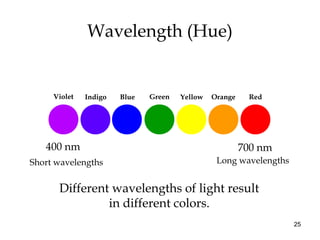
Hearing
 The Stimulus Input: Sound Waves
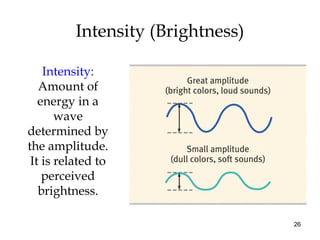
 The Ear
 Hearing Loss and Deaf Culture
Other Important Senses
 Touch
 Pain
 Taste
 Smell
5
Perceptual Organization
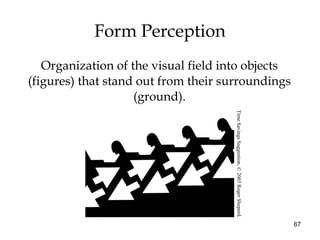
 Form Perception
 Depth Perception
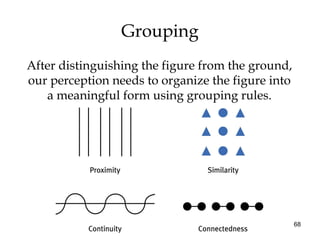
 Motion Perception
 Perceptual Constancy
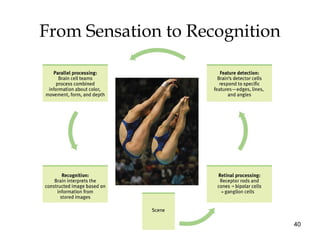
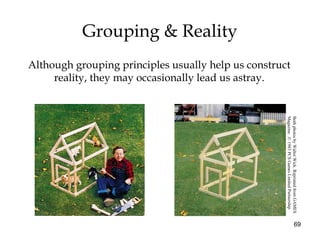
6
Perceptual Interpretation
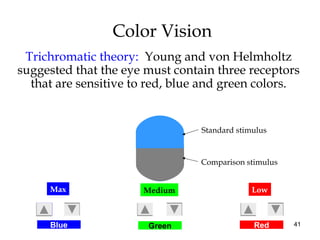
 Sensory Deprivation and Restored
Vision
 Perceptual Adaptation
 Perceptual Set
 Perception and the Human Factor
7
Is There Extrasensory Perception?
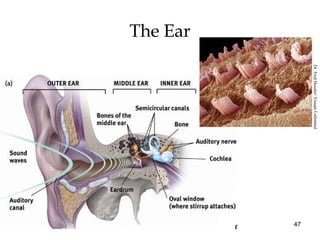
 Claims of ESP
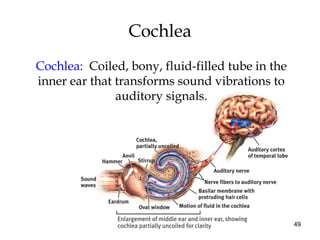
 Premonitions or Pretensions?
 Putting ESP to Experimental Test
8
Sensation & Perception
How do we construct our representations of the
external world?
To represent the world, we must detect physical
energy (a stimulus) from the environment and
convert it into neural signals. This is a process
called sensation.
When we select, organize, and interpret our
sensations, the process is called perception.
9
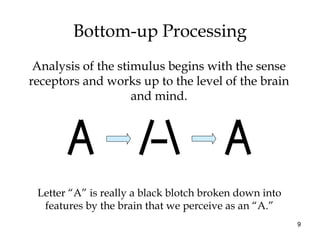
Bottom-up Processing
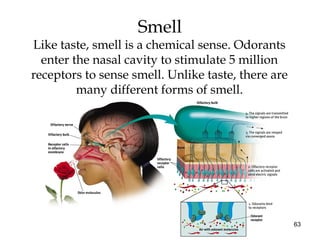
Analysis of the stimulus begins with the sense
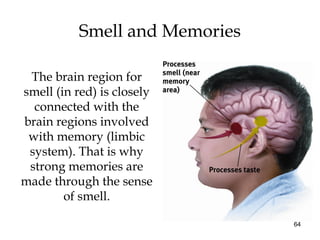
receptors and works up to the level of the brain
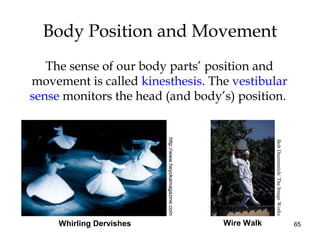
and mind.
Letter “A” is really a black blotch broken down into
features by the brain that we perceive as an “A.”
10
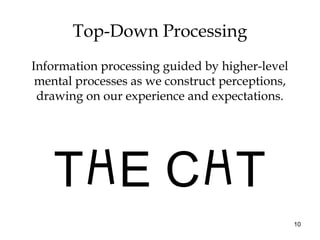
Top-Down Processing
Information processing guided by higher-level
mental processes as we construct perceptions,
drawing on our experience and expectations.
THE CHT
11
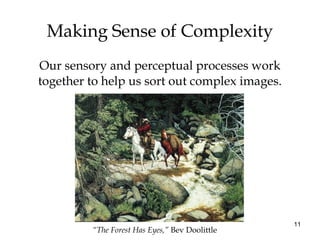
Our sensory and perceptual processes work
together to help us sort out complex images.
Making Sense of Complexity
“The Forest Has Eyes,” Bev Doolittle
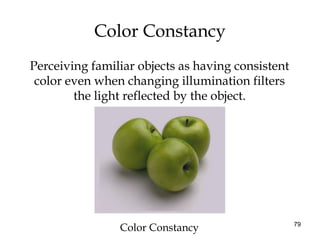
12
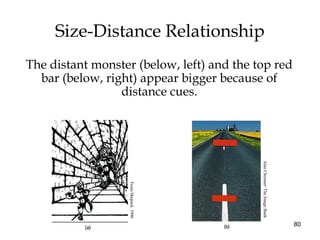
Sensing the World
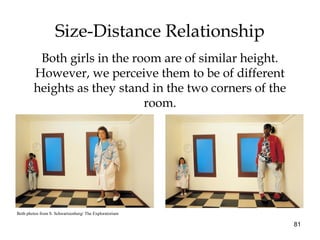
Senses are nature’s gift that suit an organism’s
needs.
A frog feeds on flying insects; a male silkworm
moth is sensitive to female sex-attractant odor; and
we as human beings are sensitive to sound
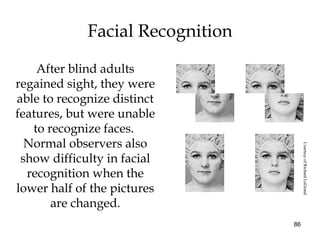
frequencies that represent the range of human
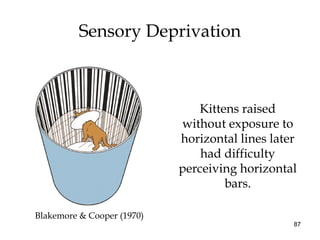
voice.
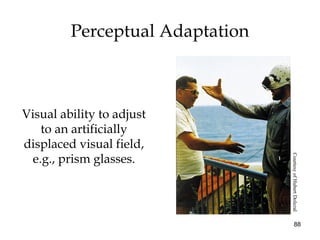
13
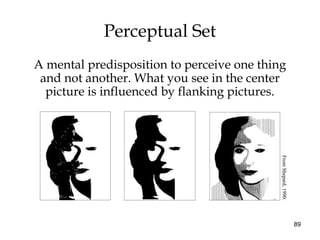
Exploring the Senses
What stimuli cross our threshold for
conscious awareness?
14
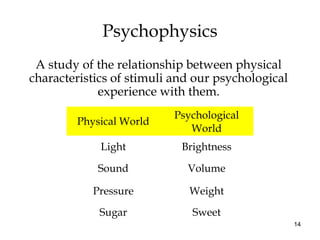
Psychophysics
A study of the relationship between physical
characteristics of stimuli and our psychological
experience with them.
Physical World
Psychological
World
Light Brightness
Sound Volume
Pressure Weight
Sugar Sweet
15
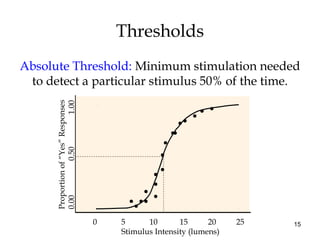
Thresholds
Absolute Threshold: Minimum stimulation needed
to detect a particular stimulus 50% of the time.
Proportionof“Yes”Responses
0.000.501.00
0 5 10 15 20 25
Stimulus Intensity (lumens)
16
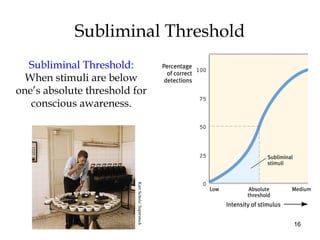
Subliminal Threshold
Subliminal Threshold:
When stimuli are below
one’s absolute threshold for
conscious awareness.
KurtScholz/Superstock
17
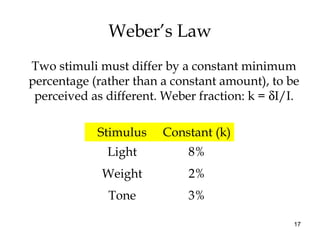
Weber’s Law
Two stimuli must differ by a constant minimum
percentage (rather than a constant amount), to be
perceived as different. Weber fraction: k = δI/I.
Stimulus Constant (k)
Light 8%
Weight 2%
Tone 3%
18
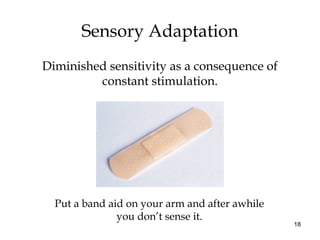
Sensory Adaptation
Diminished sensitivity as a consequence of
constant stimulation.
Put a band aid on your arm and after awhile
you don’t sense it.
19
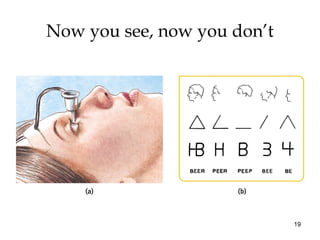
Now you see, now you don’t
20
Vision
21
Transduction
In sensation, the transformation of stimulus energy
(sights, sounds, smells) into neural impulses.
22
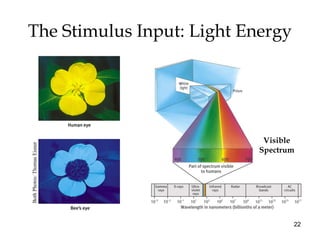
Visible
Spectrum
The Stimulus Input: Light EnergyBothPhotos:ThomasEisner
23
Physical Characteristics of Light
1. Wavelength (hue/color)
2. Intensity (brightness)
24
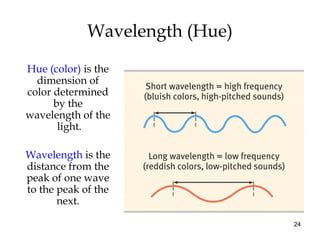
Wavelength (Hue)
Hue (color) is the
dimension of
color determined
by the
wavelength of the
light.
Wavelength is the
distance from the
peak of one wave
to the peak of the
next.
25
Wavelength (Hue)
Different wavelengths of light result
in different colors.
400 nm 700 nm
Long wavelengthsShort wavelengths
Violet Indigo Blue Green Yellow Orange Red
26
Intensity (Brightness)
Intensity:
Amount of
energy in a
wave
determined by
the amplitude.
It is related to
perceived
brightness.
27
Intensity (Brightness)
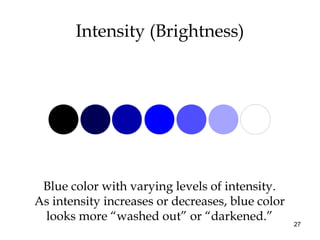
Blue color with varying levels of intensity.
As intensity increases or decreases, blue color
looks more “washed out” or “darkened.”
28
The Eye
29
Parts of the eye
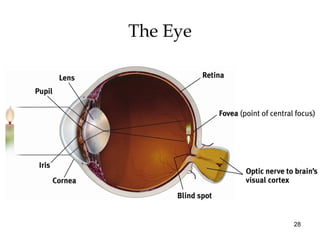
1. Cornea: Transparent tissue where light enters
the eye.
2. Iris: Muscle that expands and contracts to
change the size of the opening (pupil) for light.
3. Lens: Focuses the light rays on the retina.
4. Retina: Contains sensory receptors that process
visual information and sends it to the brain.
30
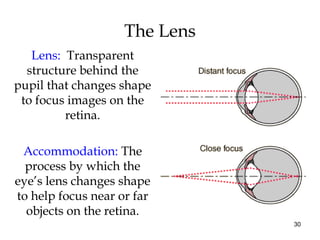
The Lens
Lens: Transparent
structure behind the
pupil that changes shape
to focus images on the
retina.
Accommodation: The
process by which the
eye’s lens changes shape
to help focus near or far
objects on the retina.
31
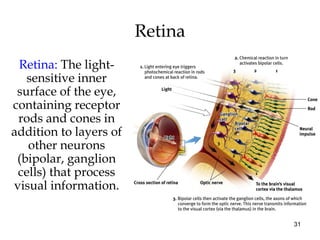
Retina
Retina: The light-
sensitive inner
surface of the eye,
containing receptor
rods and cones in
addition to layers of
other neurons
(bipolar, ganglion
cells) that process
visual information.
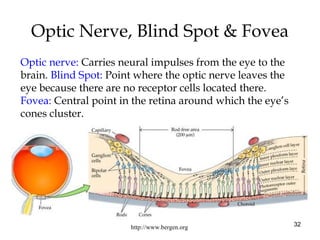
32
Optic Nerve, Blind Spot & Fovea
http://www.bergen.org
Optic nerve: Carries neural impulses from the eye to the
brain. Blind Spot: Point where the optic nerve leaves the
eye because there are no receptor cells located there.
Fovea: Central point in the retina around which the eye’s
cones cluster.
33
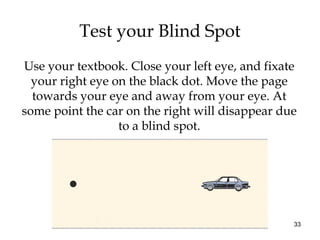
Test your Blind Spot
Use your textbook. Close your left eye, and fixate
your right eye on the black dot. Move the page
towards your eye and away from your eye. At
some point the car on the right will disappear due
to a blind spot.
34
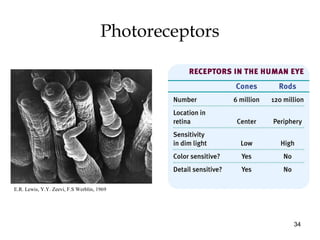
Photoreceptors
E.R. Lewis, Y.Y. Zeevi, F.S Werblin, 1969
35
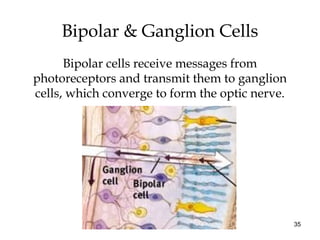
Bipolar & Ganglion Cells
Bipolar cells receive messages from
photoreceptors and transmit them to ganglion
cells, which converge to form the optic nerve.
36
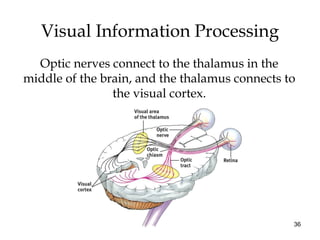
Visual Information Processing
Optic nerves connect to the thalamus in the
middle of the brain, and the thalamus connects to
the visual cortex.
37
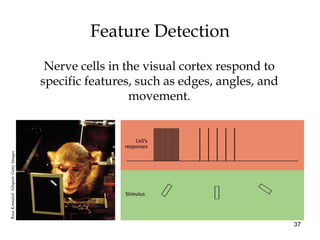
Feature Detection
Nerve cells in the visual cortex respond to
specific features, such as edges, angles, and
movement.
RossKinnaird/Allsport/GettyImages
38
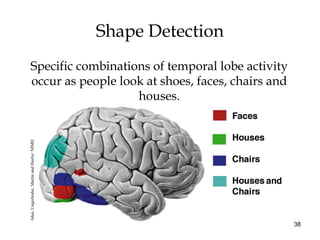
Shape Detection
Specific combinations of temporal lobe activity
occur as people look at shoes, faces, chairs and
houses.
Ishai,Ungerleider,MartinandHaxby/NIMH
39
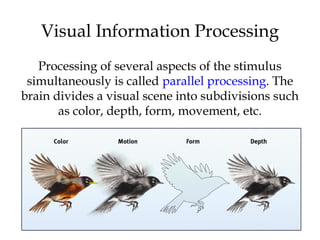
Visual Information Processing
Processing of several aspects of the stimulus
simultaneously is called parallel processing. The
brain divides a visual scene into subdivisions such
as color, depth, form, movement, etc.
40
From Sensation to Recognition
41
Color Vision
Trichromatic theory: Young and von Helmholtz
suggested that the eye must contain three receptors
that are sensitive to red, blue and green colors.
Blue Green Red
Medium LowMax
Standard stimulus
Comparison stimulus
42
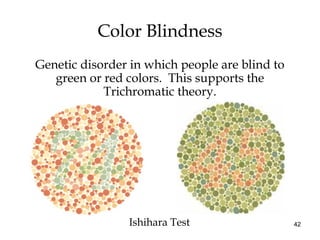
Color Blindness
Ishihara Test
Genetic disorder in which people are blind to
green or red colors. This supports the
Trichromatic theory.
43
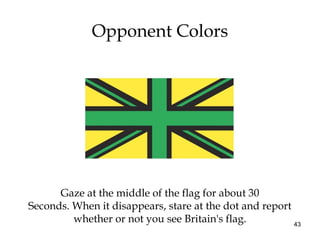
Opponent Colors
Gaze at the middle of the flag for about 30
Seconds. When it disappears, stare at the dot and report
whether or not you see Britain's flag.
44
Hearing
45
Hearing
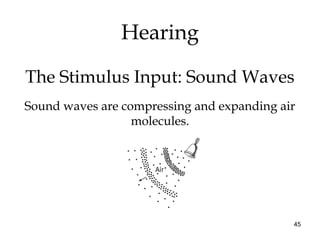
The Stimulus Input: Sound Waves
Sound waves are compressing and expanding air
molecules.
46
Sound Characteristics
1. Frequency (pitch)
2. Intensity (loudness)
47
The Ear
Dr.FredHossler/VisualsUnlimited
48
The Ear
Outer Ear: Collects and sends sounds to the
eardrum.
Middle Ear: Chamber between eardrum and
cochlea containing three tiny bones (hammer,
anvil, stirrup) that concentrate the vibrations
of the eardrum on the cochlea’s oval window.
Inner Ear: Innermost part of the ear,
containing the cochlea, semicircular canals,
and vestibular sacs.
49
Cochlea
Cochlea: Coiled, bony, fluid-filled tube in the
inner ear that transforms sound vibrations to
auditory signals.
50
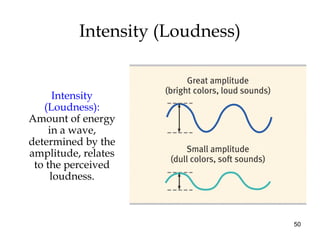
Intensity (Loudness)
Intensity
(Loudness):
Amount of energy
in a wave,
determined by the
amplitude, relates
to the perceived
loudness.
51
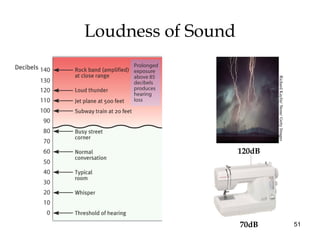
Loudness of Sound
70dB
120dB
RichardKaylin/Stone/GettyImages
52
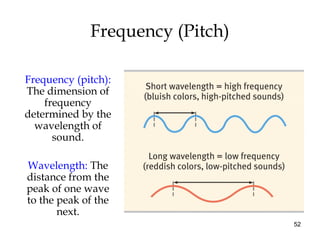
Frequency (Pitch)
Frequency (pitch):
The dimension of
frequency
determined by the
wavelength of
sound.
Wavelength: The
distance from the
peak of one wave
to the peak of the
next.
53
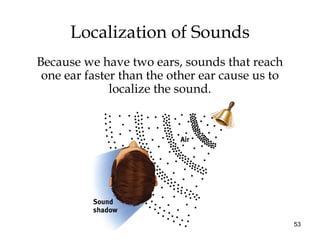
Localization of Sounds
Because we have two ears, sounds that reach
one ear faster than the other ear cause us to
localize the sound.
54
Localization of Sound
1. Intensity differences
2. Time differences
Time differences as small as 1/100,000 of a second
can cause us to localize sound. The head acts as a
“shadow” or partial sound barrier.
55
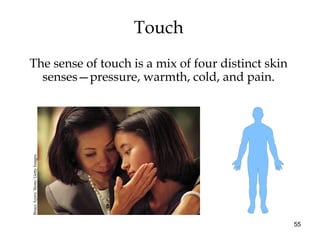
Touch
The sense of touch is a mix of four distinct skin
senses—pressure, warmth, cold, and pain.
BruceAyers/Stone/GettyImages
56
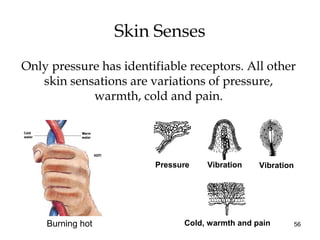
Skin Senses
Only pressure has identifiable receptors. All other
skin sensations are variations of pressure,
warmth, cold and pain.
Burning hot
Pressure Vibration Vibration
Cold, warmth and pain
57
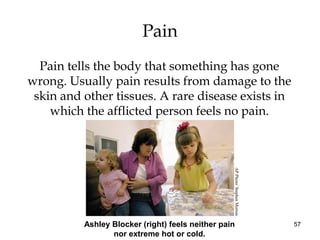
Pain
Pain tells the body that something has gone
wrong. Usually pain results from damage to the
skin and other tissues. A rare disease exists in
which the afflicted person feels no pain.
Ashley Blocker (right) feels neither pain
nor extreme hot or cold. APPhoto/StephenMorton
58
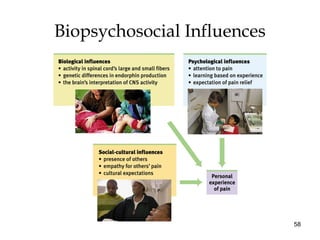
Biopsychosocial Influences
59
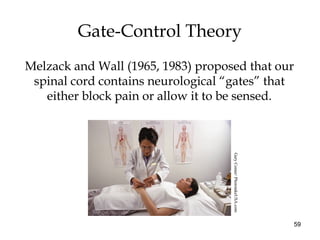
Gate-Control Theory
Melzack and Wall (1965, 1983) proposed that our
spinal cord contains neurological “gates” that
either block pain or allow it to be sensed.
GaryComer/PhototakeUSA.com
60
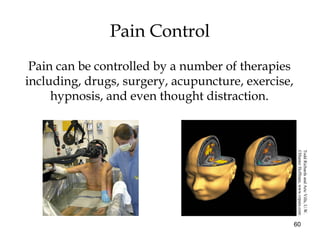
Pain Control
Pain can be controlled by a number of therapies
including, drugs, surgery, acupuncture, exercise,
hypnosis, and even thought distraction.
ToddRichardsandAricVills,U.W.
©HunterHoffman,www.vrpain.com
61
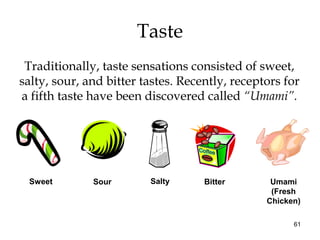
Taste
Traditionally, taste sensations consisted of sweet,
salty, sour, and bitter tastes. Recently, receptors for
a fifth taste have been discovered called “Umami”.
Sweet Sour Salty Bitter Umami
(Fresh
Chicken)
62
Sensory Interaction
When one sense affects another sense, sensory
interaction takes place. So, the taste of strawberry
interacts with its smell and its texture on the
tongue to produce flavor.
63
Smell
Like taste, smell is a chemical sense. Odorants
enter the nasal cavity to stimulate 5 million
receptors to sense smell. Unlike taste, there are
many different forms of smell.
64
Smell and Memories
The brain region for
smell (in red) is closely
connected with the
brain regions involved
with memory (limbic
system). That is why
strong memories are
made through the sense
of smell.
65
Body Position and Movement
The sense of our body parts’ position and
movement is called kinesthesis. The vestibular
sense monitors the head (and body’s) position.
http://www.heyokamagazine.com
Whirling Dervishes Wire Walk
BobDaemmrich/TheImageWorks
66
Perceptual Organization
How do we form meaningful perceptions
from sensory information?
We organize it. Gestalt psychologists
showed that a figure formed a “whole”
different than its surroundings.
67
Organization of the visual field into objects
(figures) that stand out from their surroundings
(ground).
Form Perception
TimeSavingsSuggestion,©2003RogerSheperd.
68
Grouping
After distinguishing the figure from the ground,
our perception needs to organize the figure into
a meaningful form using grouping rules.
69
Grouping & Reality
Although grouping principles usually help us construct
reality, they may occasionally lead us astray.
BothphotosbyWalterWick.ReprintedfromGAMES
Magazine..©1983PCSGamesLimitedPartnership
70
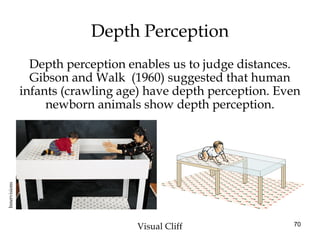
Depth Perception
Visual Cliff
Depth perception enables us to judge distances.
Gibson and Walk (1960) suggested that human
infants (crawling age) have depth perception. Even
newborn animals show depth perception.
Innervisions
71
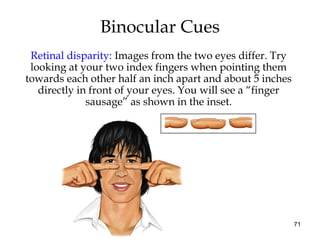
Binocular Cues
Retinal disparity: Images from the two eyes differ. Try
looking at your two index fingers when pointing them
towards each other half an inch apart and about 5 inches
directly in front of your eyes. You will see a “finger
sausage” as shown in the inset.
72
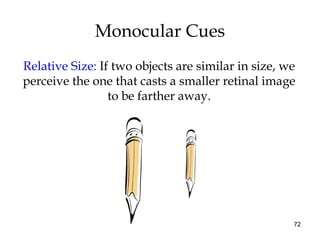
Monocular Cues
Relative Size: If two objects are similar in size, we
perceive the one that casts a smaller retinal image
to be farther away.
73
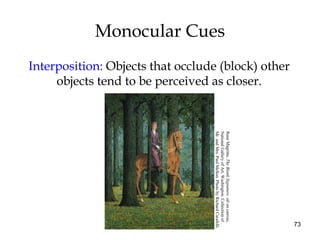
Monocular Cues
Interposition: Objects that occlude (block) other
objects tend to be perceived as closer.
ReneMagritte,TheBlankSignature,oiloncanvas,
NationalGalleryofArt,Washington.Collectionof
Mr.andMrs.PaulMellon.PhotobyRichardCarafelli.
74
Monocular Cues
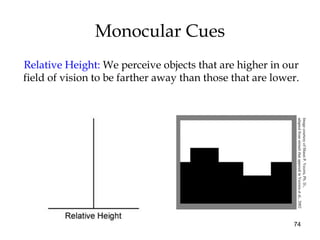
Relative Height: We perceive objects that are higher in our
field of vision to be farther away than those that are lower.
ImagecourtesyofShaunP.Vecera,Ph.D.,
adaptedfromstimulithatapperedinVecreraetal.,2002
75
Monocular Cues
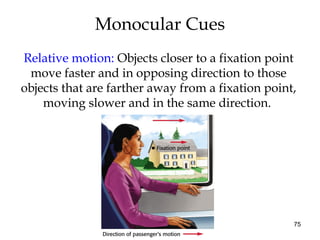
Relative motion: Objects closer to a fixation point
move faster and in opposing direction to those
objects that are farther away from a fixation point,
moving slower and in the same direction.
76
Monocular Cues
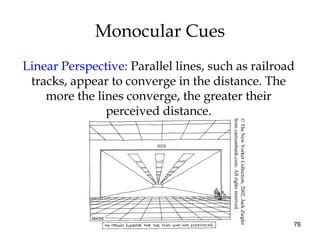
Linear Perspective: Parallel lines, such as railroad
tracks, appear to converge in the distance. The
more the lines converge, the greater their
perceived distance.
©TheNewYorkerCollection,2002,JackZiegler
fromcartoonbank.com.Allrightsreserved.
77
Monocular Cues
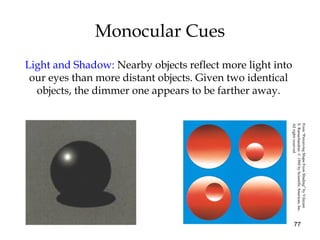
Light and Shadow: Nearby objects reflect more light into
our eyes than more distant objects. Given two identical
objects, the dimmer one appears to be farther away.
From“PerceivingShapeFromShading”byVilayaur
S.Ramachandran.©1988byScientificAmerican,Inc.
Allrightsreserved.
78
Perceptual Constancy
Perceiving objects as unchanging even as
illumination and retinal images change.
79
Perceiving familiar objects as having consistent
color even when changing illumination filters
the light reflected by the object.
Color Constancy
Color Constancy
80
Size-Distance Relationship
The distant monster (below, left) and the top red
bar (below, right) appear bigger because of
distance cues.
FromShepard,1990
AlanChoisnet/TheImageBank
81
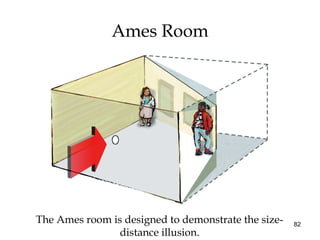
Size-Distance Relationship
Both girls in the room are of similar height.
However, we perceive them to be of different
heights as they stand in the two corners of the
room.
Both photos from S. Schwartzenberg/ The Exploratorium
82
Ames Room
The Ames room is designed to demonstrate the size-
distance illusion.
83
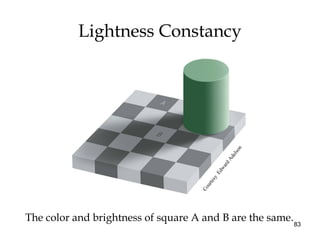
Lightness Constancy
The color and brightness of square A and B are the same.
Courtesy
EdwardAdelson
84
Perceptual Interpretation
Immanuel Kant (1724-1804) maintained that
knowledge comes from our inborn ways of
organizing sensory experiences.
John Locke (1632-1704) argued that we learn to
perceive the world through our experiences.
How important is experience in shaping our
perceptual interpretation?
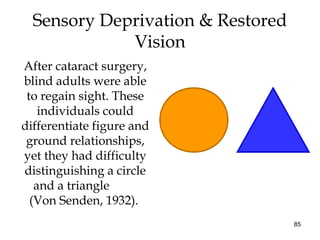
85
Sensory Deprivation & Restored
Vision
After cataract surgery,
blind adults were able
to regain sight. These
individuals could
differentiate figure and
ground relationships,
yet they had difficulty
distinguishing a circle
and a triangle
(Von Senden, 1932).
86
Facial Recognition
After blind adults
regained sight, they were
able to recognize distinct
features, but were unable
to recognize faces.
Normal observers also
show difficulty in facial
recognition when the
lower half of the pictures
are changed.
CourtesyofRichardLeGrand
87
Kittens raised
without exposure to
horizontal lines later
had difficulty
perceiving horizontal
bars.
Blakemore & Cooper (1970)
Sensory Deprivation
88
Perceptual Adaptation
Visual ability to adjust
to an artificially
displaced visual field,
e.g., prism glasses.
CourtesyofHubertDolezal
89
Perceptual Set
A mental predisposition to perceive one thing
and not another. What you see in the center
picture is influenced by flanking pictures.
FromShepard,1990.
90
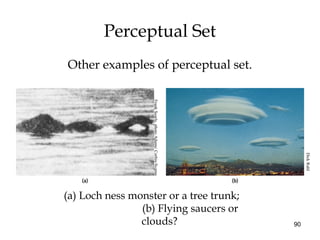
(a) Loch ness monster or a tree trunk;
(b) Flying saucers or
clouds?
Perceptual Set
Other examples of perceptual set.
FrankSearle,photoAdams/Corbis-Sygma
DickRuhl
91
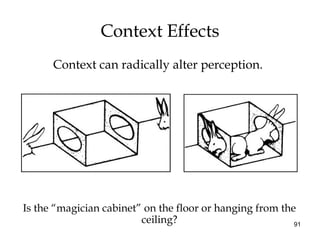
Is the “magician cabinet” on the floor or hanging from the
ceiling?
Context Effects
Context can radically alter perception.
92
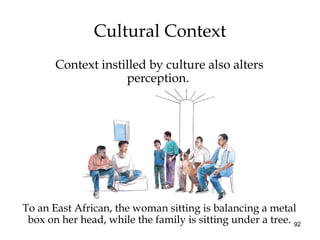
To an East African, the woman sitting is balancing a metal
box on her head, while the family is sitting under a tree.
Cultural Context
Context instilled by culture also alters
perception.
93
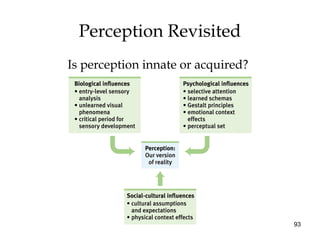
Perception Revisited
Is perception innate or acquired?
94
Is There Extrasensory Perception?
Perception without sensory input is called
extrasensory perception (ESP). A large percentage
of scientists do not believe in ESP.
95
Claims of ESP
1. Telepathy: Mind-to-mind communication. One
person sending thoughts and the other
receiving them.
2. Clairvoyance: Perception of remote events,
such as sensing a friend’s house on fire.
3. Precognition: Perceiving future events, such as
a political leader’s death.
Psychokinesis
The power of “mind over matter” such as
levitating a table/influencing a role of the die.

9e ch 06

  • 1.
    1 PSYCHOLOGY (9th Edition) David Myers PowerPointSlides Aneeq Ahmad Henderson State University Worth Publishers, © 2010
  • 2.
  • 3.
    3 Sensation Sensing the World: SomeBasic Principles  Thresholds  Sensory Adaptation Vision  The Stimulus Input: Light Energy  The Eye  Visual Information Processing  Color Vision
  • 4.
    4 Hearing  The StimulusInput: Sound Waves  The Ear  Hearing Loss and Deaf Culture Other Important Senses  Touch  Pain  Taste  Smell
  • 5.
    5 Perceptual Organization  FormPerception  Depth Perception  Motion Perception  Perceptual Constancy
  • 6.
    6 Perceptual Interpretation  SensoryDeprivation and Restored Vision  Perceptual Adaptation  Perceptual Set  Perception and the Human Factor
  • 7.
    7 Is There ExtrasensoryPerception?  Claims of ESP  Premonitions or Pretensions?  Putting ESP to Experimental Test
  • 8.
    8 Sensation & Perception Howdo we construct our representations of the external world? To represent the world, we must detect physical energy (a stimulus) from the environment and convert it into neural signals. This is a process called sensation. When we select, organize, and interpret our sensations, the process is called perception.
  • 9.
    9 Bottom-up Processing Analysis ofthe stimulus begins with the sense receptors and works up to the level of the brain and mind. Letter “A” is really a black blotch broken down into features by the brain that we perceive as an “A.”
  • 10.
    10 Top-Down Processing Information processingguided by higher-level mental processes as we construct perceptions, drawing on our experience and expectations. THE CHT
  • 11.
    11 Our sensory andperceptual processes work together to help us sort out complex images. Making Sense of Complexity “The Forest Has Eyes,” Bev Doolittle
  • 12.
    12 Sensing the World Sensesare nature’s gift that suit an organism’s needs. A frog feeds on flying insects; a male silkworm moth is sensitive to female sex-attractant odor; and we as human beings are sensitive to sound frequencies that represent the range of human voice.
  • 13.
    13 Exploring the Senses Whatstimuli cross our threshold for conscious awareness?
  • 14.
    14 Psychophysics A study ofthe relationship between physical characteristics of stimuli and our psychological experience with them. Physical World Psychological World Light Brightness Sound Volume Pressure Weight Sugar Sweet
  • 15.
    15 Thresholds Absolute Threshold: Minimumstimulation needed to detect a particular stimulus 50% of the time. Proportionof“Yes”Responses 0.000.501.00 0 5 10 15 20 25 Stimulus Intensity (lumens)
  • 16.
    16 Subliminal Threshold Subliminal Threshold: Whenstimuli are below one’s absolute threshold for conscious awareness. KurtScholz/Superstock
  • 17.
    17 Weber’s Law Two stimulimust differ by a constant minimum percentage (rather than a constant amount), to be perceived as different. Weber fraction: k = δI/I. Stimulus Constant (k) Light 8% Weight 2% Tone 3%
  • 18.
    18 Sensory Adaptation Diminished sensitivityas a consequence of constant stimulation. Put a band aid on your arm and after awhile you don’t sense it.
  • 19.
    19 Now you see,now you don’t
  • 20.
  • 21.
    21 Transduction In sensation, thetransformation of stimulus energy (sights, sounds, smells) into neural impulses.
  • 22.
    22 Visible Spectrum The Stimulus Input:Light EnergyBothPhotos:ThomasEisner
  • 23.
    23 Physical Characteristics ofLight 1. Wavelength (hue/color) 2. Intensity (brightness)
  • 24.
    24 Wavelength (Hue) Hue (color)is the dimension of color determined by the wavelength of the light. Wavelength is the distance from the peak of one wave to the peak of the next.
  • 25.
    25 Wavelength (Hue) Different wavelengthsof light result in different colors. 400 nm 700 nm Long wavelengthsShort wavelengths Violet Indigo Blue Green Yellow Orange Red
  • 26.
    26 Intensity (Brightness) Intensity: Amount of energyin a wave determined by the amplitude. It is related to perceived brightness.
  • 27.
    27 Intensity (Brightness) Blue colorwith varying levels of intensity. As intensity increases or decreases, blue color looks more “washed out” or “darkened.”
  • 28.
  • 29.
    29 Parts of theeye 1. Cornea: Transparent tissue where light enters the eye. 2. Iris: Muscle that expands and contracts to change the size of the opening (pupil) for light. 3. Lens: Focuses the light rays on the retina. 4. Retina: Contains sensory receptors that process visual information and sends it to the brain.
  • 30.
    30 The Lens Lens: Transparent structurebehind the pupil that changes shape to focus images on the retina. Accommodation: The process by which the eye’s lens changes shape to help focus near or far objects on the retina.
  • 31.
    31 Retina Retina: The light- sensitiveinner surface of the eye, containing receptor rods and cones in addition to layers of other neurons (bipolar, ganglion cells) that process visual information.
  • 32.
    32 Optic Nerve, BlindSpot & Fovea http://www.bergen.org Optic nerve: Carries neural impulses from the eye to the brain. Blind Spot: Point where the optic nerve leaves the eye because there are no receptor cells located there. Fovea: Central point in the retina around which the eye’s cones cluster.
  • 33.
    33 Test your BlindSpot Use your textbook. Close your left eye, and fixate your right eye on the black dot. Move the page towards your eye and away from your eye. At some point the car on the right will disappear due to a blind spot.
  • 34.
    34 Photoreceptors E.R. Lewis, Y.Y.Zeevi, F.S Werblin, 1969
  • 35.
    35 Bipolar & GanglionCells Bipolar cells receive messages from photoreceptors and transmit them to ganglion cells, which converge to form the optic nerve.
  • 36.
    36 Visual Information Processing Opticnerves connect to the thalamus in the middle of the brain, and the thalamus connects to the visual cortex.
  • 37.
    37 Feature Detection Nerve cellsin the visual cortex respond to specific features, such as edges, angles, and movement. RossKinnaird/Allsport/GettyImages
  • 38.
    38 Shape Detection Specific combinationsof temporal lobe activity occur as people look at shoes, faces, chairs and houses. Ishai,Ungerleider,MartinandHaxby/NIMH
  • 39.
    39 Visual Information Processing Processingof several aspects of the stimulus simultaneously is called parallel processing. The brain divides a visual scene into subdivisions such as color, depth, form, movement, etc.
  • 40.
  • 41.
    41 Color Vision Trichromatic theory:Young and von Helmholtz suggested that the eye must contain three receptors that are sensitive to red, blue and green colors. Blue Green Red Medium LowMax Standard stimulus Comparison stimulus
  • 42.
    42 Color Blindness Ishihara Test Geneticdisorder in which people are blind to green or red colors. This supports the Trichromatic theory.
  • 43.
    43 Opponent Colors Gaze atthe middle of the flag for about 30 Seconds. When it disappears, stare at the dot and report whether or not you see Britain's flag.
  • 44.
  • 45.
    45 Hearing The Stimulus Input:Sound Waves Sound waves are compressing and expanding air molecules.
  • 46.
    46 Sound Characteristics 1. Frequency(pitch) 2. Intensity (loudness)
  • 47.
  • 48.
    48 The Ear Outer Ear:Collects and sends sounds to the eardrum. Middle Ear: Chamber between eardrum and cochlea containing three tiny bones (hammer, anvil, stirrup) that concentrate the vibrations of the eardrum on the cochlea’s oval window. Inner Ear: Innermost part of the ear, containing the cochlea, semicircular canals, and vestibular sacs.
  • 49.
    49 Cochlea Cochlea: Coiled, bony,fluid-filled tube in the inner ear that transforms sound vibrations to auditory signals.
  • 50.
    50 Intensity (Loudness) Intensity (Loudness): Amount ofenergy in a wave, determined by the amplitude, relates to the perceived loudness.
  • 51.
  • 52.
    52 Frequency (Pitch) Frequency (pitch): Thedimension of frequency determined by the wavelength of sound. Wavelength: The distance from the peak of one wave to the peak of the next.
  • 53.
    53 Localization of Sounds Becausewe have two ears, sounds that reach one ear faster than the other ear cause us to localize the sound.
  • 54.
    54 Localization of Sound 1.Intensity differences 2. Time differences Time differences as small as 1/100,000 of a second can cause us to localize sound. The head acts as a “shadow” or partial sound barrier.
  • 55.
    55 Touch The sense oftouch is a mix of four distinct skin senses—pressure, warmth, cold, and pain. BruceAyers/Stone/GettyImages
  • 56.
    56 Skin Senses Only pressurehas identifiable receptors. All other skin sensations are variations of pressure, warmth, cold and pain. Burning hot Pressure Vibration Vibration Cold, warmth and pain
  • 57.
    57 Pain Pain tells thebody that something has gone wrong. Usually pain results from damage to the skin and other tissues. A rare disease exists in which the afflicted person feels no pain. Ashley Blocker (right) feels neither pain nor extreme hot or cold. APPhoto/StephenMorton
  • 58.
  • 59.
    59 Gate-Control Theory Melzack andWall (1965, 1983) proposed that our spinal cord contains neurological “gates” that either block pain or allow it to be sensed. GaryComer/PhototakeUSA.com
  • 60.
    60 Pain Control Pain canbe controlled by a number of therapies including, drugs, surgery, acupuncture, exercise, hypnosis, and even thought distraction. ToddRichardsandAricVills,U.W. ©HunterHoffman,www.vrpain.com
  • 61.
    61 Taste Traditionally, taste sensationsconsisted of sweet, salty, sour, and bitter tastes. Recently, receptors for a fifth taste have been discovered called “Umami”. Sweet Sour Salty Bitter Umami (Fresh Chicken)
  • 62.
    62 Sensory Interaction When onesense affects another sense, sensory interaction takes place. So, the taste of strawberry interacts with its smell and its texture on the tongue to produce flavor.
  • 63.
    63 Smell Like taste, smellis a chemical sense. Odorants enter the nasal cavity to stimulate 5 million receptors to sense smell. Unlike taste, there are many different forms of smell.
  • 64.
    64 Smell and Memories Thebrain region for smell (in red) is closely connected with the brain regions involved with memory (limbic system). That is why strong memories are made through the sense of smell.
  • 65.
    65 Body Position andMovement The sense of our body parts’ position and movement is called kinesthesis. The vestibular sense monitors the head (and body’s) position. http://www.heyokamagazine.com Whirling Dervishes Wire Walk BobDaemmrich/TheImageWorks
  • 66.
    66 Perceptual Organization How dowe form meaningful perceptions from sensory information? We organize it. Gestalt psychologists showed that a figure formed a “whole” different than its surroundings.
  • 67.
    67 Organization of thevisual field into objects (figures) that stand out from their surroundings (ground). Form Perception TimeSavingsSuggestion,©2003RogerSheperd.
  • 68.
    68 Grouping After distinguishing thefigure from the ground, our perception needs to organize the figure into a meaningful form using grouping rules.
  • 69.
    69 Grouping & Reality Althoughgrouping principles usually help us construct reality, they may occasionally lead us astray. BothphotosbyWalterWick.ReprintedfromGAMES Magazine..©1983PCSGamesLimitedPartnership
  • 70.
    70 Depth Perception Visual Cliff Depthperception enables us to judge distances. Gibson and Walk (1960) suggested that human infants (crawling age) have depth perception. Even newborn animals show depth perception. Innervisions
  • 71.
    71 Binocular Cues Retinal disparity:Images from the two eyes differ. Try looking at your two index fingers when pointing them towards each other half an inch apart and about 5 inches directly in front of your eyes. You will see a “finger sausage” as shown in the inset.
  • 72.
    72 Monocular Cues Relative Size:If two objects are similar in size, we perceive the one that casts a smaller retinal image to be farther away.
  • 73.
    73 Monocular Cues Interposition: Objectsthat occlude (block) other objects tend to be perceived as closer. ReneMagritte,TheBlankSignature,oiloncanvas, NationalGalleryofArt,Washington.Collectionof Mr.andMrs.PaulMellon.PhotobyRichardCarafelli.
  • 74.
    74 Monocular Cues Relative Height:We perceive objects that are higher in our field of vision to be farther away than those that are lower. ImagecourtesyofShaunP.Vecera,Ph.D., adaptedfromstimulithatapperedinVecreraetal.,2002
  • 75.
    75 Monocular Cues Relative motion:Objects closer to a fixation point move faster and in opposing direction to those objects that are farther away from a fixation point, moving slower and in the same direction.
  • 76.
    76 Monocular Cues Linear Perspective:Parallel lines, such as railroad tracks, appear to converge in the distance. The more the lines converge, the greater their perceived distance. ©TheNewYorkerCollection,2002,JackZiegler fromcartoonbank.com.Allrightsreserved.
  • 77.
    77 Monocular Cues Light andShadow: Nearby objects reflect more light into our eyes than more distant objects. Given two identical objects, the dimmer one appears to be farther away. From“PerceivingShapeFromShading”byVilayaur S.Ramachandran.©1988byScientificAmerican,Inc. Allrightsreserved.
  • 78.
    78 Perceptual Constancy Perceiving objectsas unchanging even as illumination and retinal images change.
  • 79.
    79 Perceiving familiar objectsas having consistent color even when changing illumination filters the light reflected by the object. Color Constancy Color Constancy
  • 80.
    80 Size-Distance Relationship The distantmonster (below, left) and the top red bar (below, right) appear bigger because of distance cues. FromShepard,1990 AlanChoisnet/TheImageBank
  • 81.
    81 Size-Distance Relationship Both girlsin the room are of similar height. However, we perceive them to be of different heights as they stand in the two corners of the room. Both photos from S. Schwartzenberg/ The Exploratorium
  • 82.
    82 Ames Room The Amesroom is designed to demonstrate the size- distance illusion.
  • 83.
    83 Lightness Constancy The colorand brightness of square A and B are the same. Courtesy EdwardAdelson
  • 84.
    84 Perceptual Interpretation Immanuel Kant(1724-1804) maintained that knowledge comes from our inborn ways of organizing sensory experiences. John Locke (1632-1704) argued that we learn to perceive the world through our experiences. How important is experience in shaping our perceptual interpretation?
  • 85.
    85 Sensory Deprivation &Restored Vision After cataract surgery, blind adults were able to regain sight. These individuals could differentiate figure and ground relationships, yet they had difficulty distinguishing a circle and a triangle (Von Senden, 1932).
  • 86.
    86 Facial Recognition After blindadults regained sight, they were able to recognize distinct features, but were unable to recognize faces. Normal observers also show difficulty in facial recognition when the lower half of the pictures are changed. CourtesyofRichardLeGrand
  • 87.
    87 Kittens raised without exposureto horizontal lines later had difficulty perceiving horizontal bars. Blakemore & Cooper (1970) Sensory Deprivation
  • 88.
    88 Perceptual Adaptation Visual abilityto adjust to an artificially displaced visual field, e.g., prism glasses. CourtesyofHubertDolezal
  • 89.
    89 Perceptual Set A mentalpredisposition to perceive one thing and not another. What you see in the center picture is influenced by flanking pictures. FromShepard,1990.
  • 90.
    90 (a) Loch nessmonster or a tree trunk; (b) Flying saucers or clouds? Perceptual Set Other examples of perceptual set. FrankSearle,photoAdams/Corbis-Sygma DickRuhl
  • 91.
    91 Is the “magiciancabinet” on the floor or hanging from the ceiling? Context Effects Context can radically alter perception.
  • 92.
    92 To an EastAfrican, the woman sitting is balancing a metal box on her head, while the family is sitting under a tree. Cultural Context Context instilled by culture also alters perception.
  • 93.
  • 94.
    94 Is There ExtrasensoryPerception? Perception without sensory input is called extrasensory perception (ESP). A large percentage of scientists do not believe in ESP.
  • 95.
    95 Claims of ESP 1.Telepathy: Mind-to-mind communication. One person sending thoughts and the other receiving them. 2. Clairvoyance: Perception of remote events, such as sensing a friend’s house on fire. 3. Precognition: Perceiving future events, such as a political leader’s death. Psychokinesis The power of “mind over matter” such as levitating a table/influencing a role of the die.
Editor's Notes

  • #9 Preview Question 1: What are sensation and perception? What do we mean by bottom-up processing and top-down processing?
  • #16 Preview Question 2: What is are the absolute and difference thresholds, and do stimuli below the absolute threshold have any influence?
  • #19 Preview Question 3: What is the function of sensory adaptation?
  • #23 Preview Question 4: What are the energy that we see as visible light?
  • #29 Preview Question 5: How does the eye transform light energy into neural messages?
  • #37 Preview Question 6: How does the brain process visual information?
  • #42 Preview Question 7: What theories help us understand color vision?
  • #46 Preview Question 8: What are the characteristics of air pressure waves that we hear as sound?
  • #48 Preview Question 9: How does the ear transform sound energy into neural messages?
  • #53 Preview Question 10: What theories help us understand pitch perception?
  • #54 Preview Question 11: How do we locate sounds?
  • #55 Preview Question 12: What are the common causes of hearing loss, and why does controversy surround cochlear implants?
  • #56 Preview Question 13: How do we sense touch and sense our body’s position and movement? How do we experience pain?
  • #62 Preview Question 14: How do we experience taste?
  • #64 Preview Question 15: How do we experience smell?
  • #67 Preview Question 16: How did the Gestalt psychologists understand perceptual organization?
  • #68 Preview Question 17: How do figure-ground and grouping principles contribute to our perceptions?
  • #71 Preview Question 18: How do we see the world in three dimensions?
  • #76 Preview Question 19: How do we perceive motion?
  • #79 Preview Question 20: How do perceptual constancies help us to organize our sensations into meaningful perceptions?
  • #86 Preview Question 21: What does research on sensory restriction and restored vision reveal about the effects of experience?
  • #89 Preview Question 22: How adaptable is our ability to perceive?
  • #90 Preview Question 23: How do our expectations, contexts, and emotions influence our perceptions?
  • #94 Preview Question 24: How do human factors psychologists work to create user-friendly machines and work settings?
  • #95 Preview Question 25: What are the claims of ESP, and what have most research psychologists concluded after putting these claims to the test?