Sensation!
Perception!
!
&
Sensation & Perception
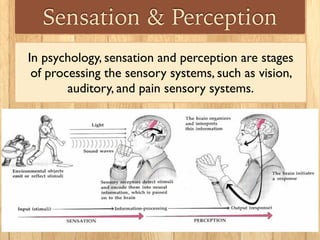
In psychology, sensation and perception are stages 	

of processing the sensory systems, such as vision,
auditory, and pain sensory systems.
Sensation & Perception
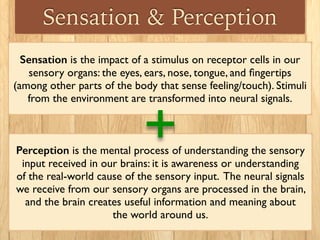
Sensation is the impact of a stimulus on receptor cells in our
sensory organs: the eyes, ears, nose, tongue, and fingertips
(among other parts of the body that sense feeling/touch). Stimuli
from the environment are transformed into neural signals.
Perception is the mental process of understanding the sensory
input received in our brains: it is awareness or understanding 	

of the real-world cause of the sensory input. The neural signals
we receive from our sensory organs are processed in the brain,
and the brain creates useful information and meaning about 	

the world around us.
+
Sensation & Perception
+
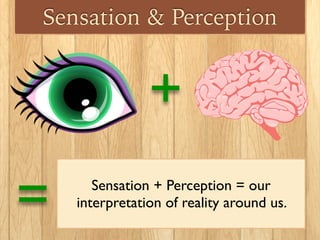
= Sensation + Perception = our
interpretation of reality around us.
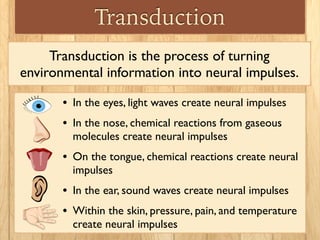
Transduction
Transduction is the process of turning
environmental information into neural impulses.
• In the eyes, light waves create neural impulses	

• In the nose, chemical reactions from gaseous
molecules create neural impulses	

• On the tongue, chemical reactions create neural
impulses	

• In the ear, sound waves create neural impulses	

• Within the skin, pressure, pain, and temperature
create neural impulses
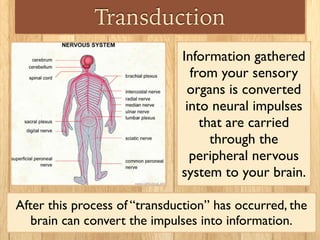
Transduction
Information gathered
from your sensory
organs is converted
into neural impulses
that are carried
through the
peripheral nervous
system to your brain.
After this process of “transduction” has occurred, the
brain can convert the impulses into information.
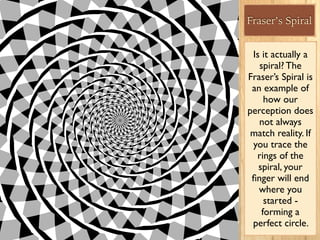
Fraser’s Spiral
Is it actually a
spiral? The
Fraser’s Spiral is
an example of
how our
perception does
not always
match reality. If
you trace the
rings of the
spiral, your
finger will end
where you
started -
forming a
perfect circle.
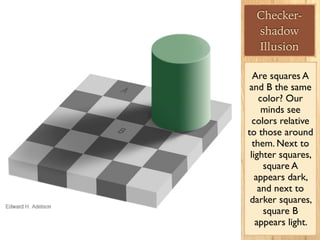
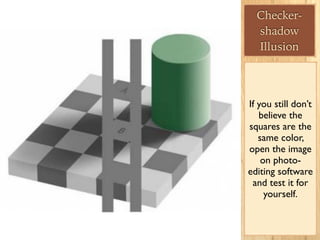
Checker-
shadow
Illusion
Are squares A
and B the same
color? Our
minds see
colors relative
to those around
them. Next to
lighter squares,
square A
appears dark,
and next to
darker squares,
square B
appears light.
Video1
Checker-
shadow
Illusion
If you still don’t
believe the
squares are the
same color,
open the image
on photo-
editing software
and test it for
yourself.
Video 2
Video 3
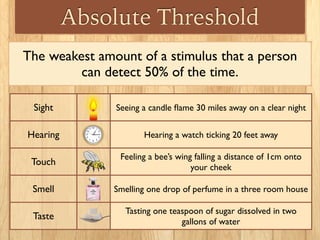
Absolute Threshold
The weakest amount of a stimulus that a person 	

can detect 50% of the time.
Sight Seeing a candle flame 30 miles away on a clear night
Hearing Hearing a watch ticking 20 feet away
Touch
Feeling a bee’s wing falling a distance of 1cm onto
your cheek
Smell Smelling one drop of perfume in a three room house
Taste
Tasting one teaspoon of sugar dissolved in two
gallons of water
Video 4
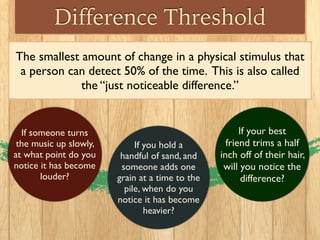
Difference Threshold
The smallest amount of change in a physical stimulus that 	

a person can detect 50% of the time. This is also called
the “just noticeable difference.”
If someone turns
the music up slowly,
at what point do you
notice it has become
louder?
If you hold a
handful of sand, and
someone adds one
grain at a time to the
pile, when do you
notice it has become 	

heavier?
If your best 	

friend trims a half
inch off of their hair,
will you notice the 	

difference?
Video 5
Signal Detection Theory
It is impossible to process every simultaneous
stimulus equally in our brains. Instead, we focus our
attention on certain things while at the same time
attempting to ignore the flood of information
entering our senses.  When we do this, we are
making a determination as to what is important to
sense and what should be in the background.  This
concept is referred to as signal detection because we
detect what we want to focus on, and ignore or
minimize everything else.
Signal Detection Theory
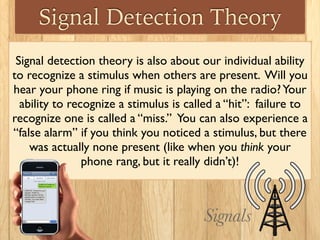
Signal detection theory is also about our individual ability
to recognize a stimulus when others are present. Will you
hear your phone ring if music is playing on the radio?Your
ability to recognize a stimulus is called a “hit”: failure to
recognize one is called a “miss.” You can also experience a
“false alarm” if you think you noticed a stimulus, but there
was actually none present (like when you think your 	

phone rang, but it really didn’t)!
Signals
Sensory Adaptation
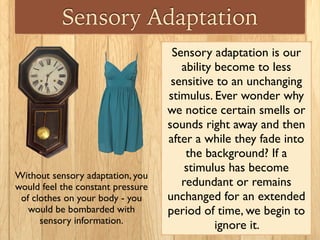
Sensory adaptation is our
ability become to less
sensitive to an unchanging
stimulus. Ever wonder why
we notice certain smells or
sounds right away and then
after a while they fade into
the background? If a
stimulus has become
redundant or remains
unchanged for an extended
period of time, we begin to
ignore it.
Without sensory adaptation, you
would feel the constant pressure
of clothes on your body - you
would be bombarded with
sensory information.
Sensory Adaptation
Clock ticking in the room? Funny
smell in the room? Eventually you
will stop noticing them. Eating spicy
food? Eventually it will taste less
spicy. Step into a hot bath? At first
it might feel too hot, but eventually
it feels cooler. Walk into a dark
room? At first it will be too dark to
see, but then it becomes lighter.
These are examples of sensory
adaptation.

Sensation & Perception 1

  • 1.
  • 2.
    Sensation & Perception Inpsychology, sensation and perception are stages of processing the sensory systems, such as vision, auditory, and pain sensory systems.
  • 3.
    Sensation & Perception Sensationis the impact of a stimulus on receptor cells in our sensory organs: the eyes, ears, nose, tongue, and fingertips (among other parts of the body that sense feeling/touch). Stimuli from the environment are transformed into neural signals. Perception is the mental process of understanding the sensory input received in our brains: it is awareness or understanding of the real-world cause of the sensory input. The neural signals we receive from our sensory organs are processed in the brain, and the brain creates useful information and meaning about the world around us. +
  • 4.
    Sensation & Perception + =Sensation + Perception = our interpretation of reality around us.
  • 5.
    Transduction Transduction is theprocess of turning environmental information into neural impulses. • In the eyes, light waves create neural impulses • In the nose, chemical reactions from gaseous molecules create neural impulses • On the tongue, chemical reactions create neural impulses • In the ear, sound waves create neural impulses • Within the skin, pressure, pain, and temperature create neural impulses
  • 6.
    Transduction Information gathered from yoursensory organs is converted into neural impulses that are carried through the peripheral nervous system to your brain. After this process of “transduction” has occurred, the brain can convert the impulses into information.
  • 7.
    Fraser’s Spiral Is itactually a spiral? The Fraser’s Spiral is an example of how our perception does not always match reality. If you trace the rings of the spiral, your finger will end where you started - forming a perfect circle.
  • 8.
    Checker- shadow Illusion Are squares A andB the same color? Our minds see colors relative to those around them. Next to lighter squares, square A appears dark, and next to darker squares, square B appears light.
  • 9.
  • 10.
    Checker- shadow Illusion If you stilldon’t believe the squares are the same color, open the image on photo- editing software and test it for yourself.
  • 11.
  • 12.
  • 13.
    Absolute Threshold The weakestamount of a stimulus that a person can detect 50% of the time. Sight Seeing a candle flame 30 miles away on a clear night Hearing Hearing a watch ticking 20 feet away Touch Feeling a bee’s wing falling a distance of 1cm onto your cheek Smell Smelling one drop of perfume in a three room house Taste Tasting one teaspoon of sugar dissolved in two gallons of water
  • 14.
  • 15.
    Difference Threshold The smallestamount of change in a physical stimulus that a person can detect 50% of the time. This is also called the “just noticeable difference.” If someone turns the music up slowly, at what point do you notice it has become louder? If you hold a handful of sand, and someone adds one grain at a time to the pile, when do you notice it has become heavier? If your best friend trims a half inch off of their hair, will you notice the difference?
  • 16.
  • 17.
    Signal Detection Theory Itis impossible to process every simultaneous stimulus equally in our brains. Instead, we focus our attention on certain things while at the same time attempting to ignore the flood of information entering our senses.  When we do this, we are making a determination as to what is important to sense and what should be in the background.  This concept is referred to as signal detection because we detect what we want to focus on, and ignore or minimize everything else.
  • 18.
    Signal Detection Theory Signaldetection theory is also about our individual ability to recognize a stimulus when others are present. Will you hear your phone ring if music is playing on the radio?Your ability to recognize a stimulus is called a “hit”: failure to recognize one is called a “miss.” You can also experience a “false alarm” if you think you noticed a stimulus, but there was actually none present (like when you think your phone rang, but it really didn’t)! Signals
  • 19.
    Sensory Adaptation Sensory adaptationis our ability become to less sensitive to an unchanging stimulus. Ever wonder why we notice certain smells or sounds right away and then after a while they fade into the background? If a stimulus has become redundant or remains unchanged for an extended period of time, we begin to ignore it. Without sensory adaptation, you would feel the constant pressure of clothes on your body - you would be bombarded with sensory information.
  • 20.
    Sensory Adaptation Clock tickingin the room? Funny smell in the room? Eventually you will stop noticing them. Eating spicy food? Eventually it will taste less spicy. Step into a hot bath? At first it might feel too hot, but eventually it feels cooler. Walk into a dark room? At first it will be too dark to see, but then it becomes lighter. These are examples of sensory adaptation.