Download to read offline


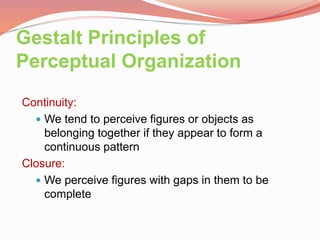
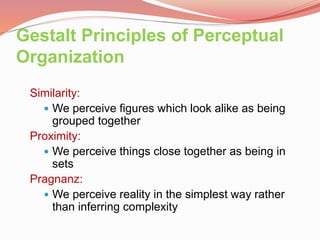



This document discusses motion perception and time perception. It describes that motion perception involves integrating retinal cell responses over time to detect movement. There are two types of movement: real movement when an object's position changes, and apparent movement which is due to higher-level brain processes, like the phi phenomenon. Time perception is measured by an individual's sense of duration and is affected by mental and physical state as well as environmental cues. Form perception is organized according to Gestalt principles like continuity, closure, similarity and proximity.


