Sensation & Perception AP Psychology Mrs. VanCoughnett
Do you hear what I hear? Write the first thing you think of when you hear the following.
What’s the Difference? Sensation:   detecting and encoding physical energy as neural signals aka: what you hear/see/touch/smell/taste Perception:   selection, organization, and interpretation of our sensations; aka:  what it all MEANS We transform  sensations   into   perceptions
Creating Meaning Bottom-Up Processing:  analysis of information incoming from sense receptors “ Bottom” = Stimulus Top-Down Processing:  Drawing meaning from experience and expectations “ Top” = mental set in the brain
How sensitive art thou? Absolute threshold:  minimum stimulation needed to detect a stimulus 50% of the time Difference threshold:   minimum difference detected between 2 stimuli 50% of the time Aka: Just Noticeable Difference (JND)
 
Laws Governing Detection Weber’s Law:  to be perceived differently, stimulus must differ by a constant minimum percentage Fechner’s Law:   actual magnitude vs. perceived magnitude Steven’s Power Law:  estimation of magnitude
Change is GOOD All senses require CHANGE to FUNCTION Sensory Adaptation:  diminished sensitivity resulting from constant stimulation Heightens sensitivity to important information “ We perceive the world not exactly as it is, but as it is useful for us to perceive it.”
VISION:  Light Energy Eyes see pulses of electromagnetic energy
VISION:  Light Energy Wavelength:  distance between wave peaks Hue:  experienced color (red, green, etc.) Intensity:  energy of light waves; influences brightness
VISION:  The Retina Photoreceptors:  light-sensitive cells that convert light energy to neural impulses Rods:  detect black, white, gray; peripheral & twilight vision Cones:  detect fine detail and color sensations; daylight & well-lit conditions  Optic Nerve:  bundle of ganglion cell axons which carry information to the brain Blind Spot:   where the optic nerve leaves the eye
VISION:  Blind Spot Blind spot
Vision Centers in the Brain Visual Cortex (in the Occipital Lobe) Turns 2D into 3D Transforms neural impulses into visual sensations (color, images, patterns etc.)
Color? Color is a sensation that is created by our brains Wavelengths of visible light are transduced by photoreceptors in our retinas We can create over 5 million different hues
Theories of Color Trichromatic Color Theory  (Young & Von Helmholtz) Cones in retina sense red, green, and blue Opponent Process Theory  (Hering) Process colors in complementary pairs Seeing red means that the green photoreceptors are turned off Negative Afterimages
Color Blindness “ Color Weakness” Lacking a chemical produced by the cones Red/Green is most common More common in males The world through color blind eyes
Hearing:  Audition Best hear frequencies in the range of human voice Why?? Detect important faint sounds (ex: child’s whimper) Signal Detection Theory** Our threshold for hearing depends on a variety of factors (ex:  fatique, emotional distress, attention)
How do we hear? Frequency:  the # of wavelengths that pass a point at a given time; determines pitch Pitch:   highness/lowness of tone Depends on frequency Sound waves     neural impulses in the brain Waves vary by strength (amplitude) and length (frequency/pitch)
Physical Properties of Waves Short wavelength=high frequency (bluish colors, high-pitched sounds) Long wavelength=low frequency (reddish colors, low-pitched sounds) Great amplitude (bright colors, loud sounds) Small amplitude (dull colors, soft sounds)
How is sound measured? Decibels:   unit of measure for sound energy
How safe is your iPod? 5 minutes 95% level 90 minutes per day 80% level 4.6 hours per day 70% level Safe listening time iPod sound level
 
Hearing Loss Conduction Hearing Loss Punctured ear drum, inner ear bones don’t vibrate Sensorineural Hearing Loss More common Damage to cochlea or nerve fibers Age, heredity, exposed to loud noise
Touch:  Kinesthetic Sense Essential to development Attachment, Harlow’s monkeys Mixture of 4 elements Pressure, warmth, cold, pain Why can’t you tickle yourself?? Rubber Hand Illusion Kinesthesis :  sense of position and movement of your body parts Vestibular Sense : position and movement of your head  (balance)
Pain Why do we feel pain? Melzack & Wall –  Gate Control Theory theory that the spinal cord contains a neurological “gate” that blocks pain signals or allows them to pass on to the brain Can we control the pain? Distraction, phantom limb  endorphins
Smell Olfaction : sense of smell Chemical sense Odors can evoke memory & emotion Anosmia : Inability to smell Smelling ability peaks in adulthood Good or bad smells based on experience
Figure 12.5  The sense of smell Myers: Exploring Psychology, Sixth Edition in Modules Copyright © 2005 by Worth Publishers
The Other Senses: Taste 200 + tastebuds Receptors for: sweet, sour, salty, bitter, & umami Taste receptors reproduce every 1-2 weeks Decrease in taste sensitivity as age increases Smoking and alcohol speed up process Sensory interaction : one sense influences another Smell+Texture+Taste=Flavor
Subliminal Messaging How does it work? Unconscious perception of stimuli Suggestive powers Priming Good vs. bad scenes and faces Much of our information processing occurs automatically and outside of our conscious awareness.
 
Perception Gestalt Psychology:  study of human tendency to organize pieces of information into meaningful wholes
Form   Perception Figure-Ground:   perceive an object (figure) as distinct from its surroundings (ground)
Grouping
Closure
 
Depth   Perception:  A 3-D World
How does 2-D become 3-D? Binocular Cues Retinal Disparity:  the greater difference between objects viewed, the closer it is
How does 2-D become 3-D? Monocular Cues Relative Size Interposition: object blocking the view of another perceived as closer Relative Height Relative Motion (motion parallax) Linear Perspective Light & Shadow


Motion Perception Rapid series of varying images Phi phenomenon :  illusion of movement created when two lights blink on and off in quick succession
Perceptual Constancy Perceiving objects as unchanging, even though our sensations of them have changed Shape Size Distance Lightness


The Nature/Nurture of Perception Does experience influence our perception of the world around us? The blind have problems perceiving objects once their vision is restored due to lack of experience and neural connections Critical Period : optimal time for sensory and perceptual development
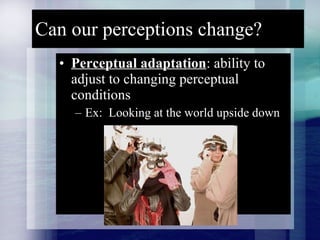
Can our perceptions change? Perceptual adaptation : ability to adjust to changing perceptual conditions Ex:  Looking at the world upside down
Do Assumptions Effect Perception? Perceptual set : mental predisposition influencing what we perceive Mary had a a little lamb Paris in the the Springtime
Looking in Context Perception different between individuals due to differing schemas and context “ Dye” vs. “die”; “attacks” vs. “a tax”
The Human Factor Human Factor Psychologists :  design technology & environments to fit our perceptions User-test products

Sensation & Perception

  • 1.
    Sensation & PerceptionAP Psychology Mrs. VanCoughnett
  • 2.
    Do you hearwhat I hear? Write the first thing you think of when you hear the following.
  • 3.
    What’s the Difference?Sensation: detecting and encoding physical energy as neural signals aka: what you hear/see/touch/smell/taste Perception: selection, organization, and interpretation of our sensations; aka: what it all MEANS We transform sensations into perceptions
  • 4.
    Creating Meaning Bottom-UpProcessing: analysis of information incoming from sense receptors “ Bottom” = Stimulus Top-Down Processing: Drawing meaning from experience and expectations “ Top” = mental set in the brain
  • 5.
    How sensitive artthou? Absolute threshold: minimum stimulation needed to detect a stimulus 50% of the time Difference threshold: minimum difference detected between 2 stimuli 50% of the time Aka: Just Noticeable Difference (JND)
  • 6.
  • 7.
    Laws Governing DetectionWeber’s Law: to be perceived differently, stimulus must differ by a constant minimum percentage Fechner’s Law: actual magnitude vs. perceived magnitude Steven’s Power Law: estimation of magnitude
  • 8.
    Change is GOODAll senses require CHANGE to FUNCTION Sensory Adaptation: diminished sensitivity resulting from constant stimulation Heightens sensitivity to important information “ We perceive the world not exactly as it is, but as it is useful for us to perceive it.”
  • 9.
    VISION: LightEnergy Eyes see pulses of electromagnetic energy
  • 10.
    VISION: LightEnergy Wavelength: distance between wave peaks Hue: experienced color (red, green, etc.) Intensity: energy of light waves; influences brightness
  • 11.
    VISION: TheRetina Photoreceptors: light-sensitive cells that convert light energy to neural impulses Rods: detect black, white, gray; peripheral & twilight vision Cones: detect fine detail and color sensations; daylight & well-lit conditions Optic Nerve: bundle of ganglion cell axons which carry information to the brain Blind Spot: where the optic nerve leaves the eye
  • 12.
    VISION: BlindSpot Blind spot
  • 13.
    Vision Centers inthe Brain Visual Cortex (in the Occipital Lobe) Turns 2D into 3D Transforms neural impulses into visual sensations (color, images, patterns etc.)
  • 14.
    Color? Color isa sensation that is created by our brains Wavelengths of visible light are transduced by photoreceptors in our retinas We can create over 5 million different hues
  • 15.
    Theories of ColorTrichromatic Color Theory (Young & Von Helmholtz) Cones in retina sense red, green, and blue Opponent Process Theory (Hering) Process colors in complementary pairs Seeing red means that the green photoreceptors are turned off Negative Afterimages
  • 16.
    Color Blindness “Color Weakness” Lacking a chemical produced by the cones Red/Green is most common More common in males The world through color blind eyes
  • 17.
    Hearing: AuditionBest hear frequencies in the range of human voice Why?? Detect important faint sounds (ex: child’s whimper) Signal Detection Theory** Our threshold for hearing depends on a variety of factors (ex: fatique, emotional distress, attention)
  • 18.
    How do wehear? Frequency: the # of wavelengths that pass a point at a given time; determines pitch Pitch: highness/lowness of tone Depends on frequency Sound waves  neural impulses in the brain Waves vary by strength (amplitude) and length (frequency/pitch)
  • 19.
    Physical Properties ofWaves Short wavelength=high frequency (bluish colors, high-pitched sounds) Long wavelength=low frequency (reddish colors, low-pitched sounds) Great amplitude (bright colors, loud sounds) Small amplitude (dull colors, soft sounds)
  • 20.
    How is soundmeasured? Decibels: unit of measure for sound energy
  • 21.
    How safe isyour iPod? 5 minutes 95% level 90 minutes per day 80% level 4.6 hours per day 70% level Safe listening time iPod sound level
  • 22.
  • 23.
    Hearing Loss ConductionHearing Loss Punctured ear drum, inner ear bones don’t vibrate Sensorineural Hearing Loss More common Damage to cochlea or nerve fibers Age, heredity, exposed to loud noise
  • 24.
    Touch: KinestheticSense Essential to development Attachment, Harlow’s monkeys Mixture of 4 elements Pressure, warmth, cold, pain Why can’t you tickle yourself?? Rubber Hand Illusion Kinesthesis : sense of position and movement of your body parts Vestibular Sense : position and movement of your head (balance)
  • 25.
    Pain Why dowe feel pain? Melzack & Wall – Gate Control Theory theory that the spinal cord contains a neurological “gate” that blocks pain signals or allows them to pass on to the brain Can we control the pain? Distraction, phantom limb endorphins
  • 26.
    Smell Olfaction :sense of smell Chemical sense Odors can evoke memory & emotion Anosmia : Inability to smell Smelling ability peaks in adulthood Good or bad smells based on experience
  • 27.
    Figure 12.5 The sense of smell Myers: Exploring Psychology, Sixth Edition in Modules Copyright © 2005 by Worth Publishers
  • 28.
    The Other Senses:Taste 200 + tastebuds Receptors for: sweet, sour, salty, bitter, & umami Taste receptors reproduce every 1-2 weeks Decrease in taste sensitivity as age increases Smoking and alcohol speed up process Sensory interaction : one sense influences another Smell+Texture+Taste=Flavor
  • 29.
    Subliminal Messaging Howdoes it work? Unconscious perception of stimuli Suggestive powers Priming Good vs. bad scenes and faces Much of our information processing occurs automatically and outside of our conscious awareness.
  • 30.
  • 31.
    Perception Gestalt Psychology: study of human tendency to organize pieces of information into meaningful wholes
  • 32.
    Form Perception Figure-Ground: perceive an object (figure) as distinct from its surroundings (ground)
  • 33.
  • 34.
  • 35.
  • 36.
    Depth Perception: A 3-D World
  • 37.
    How does 2-Dbecome 3-D? Binocular Cues Retinal Disparity: the greater difference between objects viewed, the closer it is
  • 38.
    How does 2-Dbecome 3-D? Monocular Cues Relative Size Interposition: object blocking the view of another perceived as closer Relative Height Relative Motion (motion parallax) Linear Perspective Light & Shadow
  • 39.
  • 40.
  • 41.
  • 42.
  • 43.
  • 44.
    Motion Perception Rapidseries of varying images Phi phenomenon : illusion of movement created when two lights blink on and off in quick succession
  • 45.
    Perceptual Constancy Perceivingobjects as unchanging, even though our sensations of them have changed Shape Size Distance Lightness
  • 46.
  • 47.
  • 48.
  • 49.
  • 50.
    The Nature/Nurture ofPerception Does experience influence our perception of the world around us? The blind have problems perceiving objects once their vision is restored due to lack of experience and neural connections Critical Period : optimal time for sensory and perceptual development
  • 51.
    Can our perceptionschange? Perceptual adaptation : ability to adjust to changing perceptual conditions Ex: Looking at the world upside down
  • 52.
    Do Assumptions EffectPerception? Perceptual set : mental predisposition influencing what we perceive Mary had a a little lamb Paris in the the Springtime
  • 53.
    Looking in ContextPerception different between individuals due to differing schemas and context “ Dye” vs. “die”; “attacks” vs. “a tax”
  • 54.
    The Human FactorHuman Factor Psychologists : design technology & environments to fit our perceptions User-test products