ALKA V.
III B.SC. PSΨCHOLOGY
KURIAKOSE ELIAS COLLEGE
RORSCHACH’S INKBLOT TEST
Hermann Rorschach
 Swiss psychiatrist and psychoanalyst.
 His education in arts helped in the invention of the inkblots.
 He continued developing his inkblot tests until his premature death
at the age of 37.
 He is the author of the book Psychodiagnostik.
Rorschach Inkblot Test
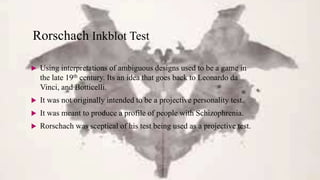
 Using interpretations of ambiguous designs used to be a game in
the late 19th century. Its an idea that goes back to Leonardo da
Vinci, and Botticelli.
 It was not originally intended to be a projective personality test.
 It was meant to produce a profile of people with Schizophrenia.
 Rorschach was sceptical of his test being used as a projective test.
Rorschach Inkblot Test
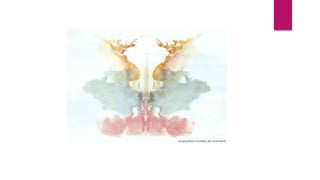
 Is a psychological test in which subject’s perception of inkblots are recorded and
interpreted.
 It is used to determine the personality of subjects.
 Uses inkblots on paper as test material.
Rorschach Inkblot Test
 It is a widely used projective test.
 Projective tests are personality tests designed to let people respond to ambiguous
stimuli, which reveals inner emotion and turmoil.
 It is used to determine thought disorders. Especially when the subjects are
reluctant to share their thinking processes.
Rorschach Inkblot Test- Cards
 Consists of 10 bilaterally symmetrical (mirrored images) inkblots
 5 achromatic inkblots
 2 black, red, and white cards
 The remaining 3 – multi-coloured.
 Reliability: internal reliability of .85 or higher.
 Validity: has been found to be moderate to low (.30).
Rorschach Inkblot Test- Cards
 The cards are thick and rectangular cardboards of the size 6 5/8 inches by 9 1/5
inches.
 The cards are generally kept secret to the public so that there is a spontaneous
reaction from the test participant.
 The psychologist sits in an informal setting, giving the participant one card after
another.
 Notes are taken on anything the psychologist thinks would help in decoding the
results.
Administration
 Free association phase
 The cards are shown to the subject
 The subject is asked to tell what is on each of the cards
 Inquiry phase
 The examiners tries to determine which aspect of the inkblot played a role in
the perception of the image by the subject
 What made it look like a (percept)? Is it the mainly the shape? How important was the
colour?
Administration
 Testing the limits
 Asks specific questions, identify confusions and misunderstandings
 Determining whether the subject can refocus percept when given a new
frame of reference.
Scoring
 Includes 15 special scores for responses such as unusual verbalizations and
aggressive movement.
 Features
 Location: part of the inkblot that was utilized in forming the percept
 Determinants: the qualities of the inkblot that determines what the individual
perceives. (shape, colour, texture)
Scoring
 Content: content category of the response. (whole human, human detail,
animal, food)
 Popularity: frequency of response.
 Form: how accurately the individual’s perception matches the corresponding
part of the inkblot.
Location
 Where?
 Entire blot
 Common detail
 Unusual detail
 Use of white space
Determinants
 Why?
 Ex. Shape, colour, texture
 Form
 Colour
 Human movement
 Animal movement
 Texture response …
Content
 What?
 Human
 Animal
 Human anatomy
 Animal anatomy
 Object
 Blood
 Fire
 Plant
Limitations
 Lack of an objective system.
 Lack of satisfactory internal consistency.
 Failure to provide evidence for clinical validity.
 Individual differences between groups of normal subjects.
 Failure to find any significant relationships between Rorschach scores and
intelligence, or creativity.
References
 Groth, G., Marnat. (2003). Handbook of psychological Assessment. (4th edition). Canada:
Wiley.
 NCERT. Textbook for class 12. New Delhi: Ncert.
Rorschach's Inkblot Test

Rorschach's Inkblot Test

  • 1.
    ALKA V. III B.SC.PSΨCHOLOGY KURIAKOSE ELIAS COLLEGE RORSCHACH’S INKBLOT TEST
  • 2.
    Hermann Rorschach  Swisspsychiatrist and psychoanalyst.  His education in arts helped in the invention of the inkblots.  He continued developing his inkblot tests until his premature death at the age of 37.  He is the author of the book Psychodiagnostik.
  • 3.
    Rorschach Inkblot Test Using interpretations of ambiguous designs used to be a game in the late 19th century. Its an idea that goes back to Leonardo da Vinci, and Botticelli.  It was not originally intended to be a projective personality test.  It was meant to produce a profile of people with Schizophrenia.  Rorschach was sceptical of his test being used as a projective test.
  • 4.
    Rorschach Inkblot Test Is a psychological test in which subject’s perception of inkblots are recorded and interpreted.  It is used to determine the personality of subjects.  Uses inkblots on paper as test material.
  • 5.
    Rorschach Inkblot Test It is a widely used projective test.  Projective tests are personality tests designed to let people respond to ambiguous stimuli, which reveals inner emotion and turmoil.  It is used to determine thought disorders. Especially when the subjects are reluctant to share their thinking processes.
  • 6.
    Rorschach Inkblot Test-Cards  Consists of 10 bilaterally symmetrical (mirrored images) inkblots  5 achromatic inkblots  2 black, red, and white cards  The remaining 3 – multi-coloured.  Reliability: internal reliability of .85 or higher.  Validity: has been found to be moderate to low (.30).
  • 7.
    Rorschach Inkblot Test-Cards  The cards are thick and rectangular cardboards of the size 6 5/8 inches by 9 1/5 inches.  The cards are generally kept secret to the public so that there is a spontaneous reaction from the test participant.  The psychologist sits in an informal setting, giving the participant one card after another.  Notes are taken on anything the psychologist thinks would help in decoding the results.
  • 8.
    Administration  Free associationphase  The cards are shown to the subject  The subject is asked to tell what is on each of the cards  Inquiry phase  The examiners tries to determine which aspect of the inkblot played a role in the perception of the image by the subject  What made it look like a (percept)? Is it the mainly the shape? How important was the colour?
  • 9.
    Administration  Testing thelimits  Asks specific questions, identify confusions and misunderstandings  Determining whether the subject can refocus percept when given a new frame of reference.
  • 10.
    Scoring  Includes 15special scores for responses such as unusual verbalizations and aggressive movement.  Features  Location: part of the inkblot that was utilized in forming the percept  Determinants: the qualities of the inkblot that determines what the individual perceives. (shape, colour, texture)
  • 11.
    Scoring  Content: contentcategory of the response. (whole human, human detail, animal, food)  Popularity: frequency of response.  Form: how accurately the individual’s perception matches the corresponding part of the inkblot.
  • 12.
    Location  Where?  Entireblot  Common detail  Unusual detail  Use of white space
  • 13.
    Determinants  Why?  Ex.Shape, colour, texture  Form  Colour  Human movement  Animal movement  Texture response …
  • 14.
    Content  What?  Human Animal  Human anatomy  Animal anatomy  Object  Blood  Fire  Plant
  • 26.
    Limitations  Lack ofan objective system.  Lack of satisfactory internal consistency.  Failure to provide evidence for clinical validity.  Individual differences between groups of normal subjects.  Failure to find any significant relationships between Rorschach scores and intelligence, or creativity.
  • 27.
    References  Groth, G.,Marnat. (2003). Handbook of psychological Assessment. (4th edition). Canada: Wiley.  NCERT. Textbook for class 12. New Delhi: Ncert.