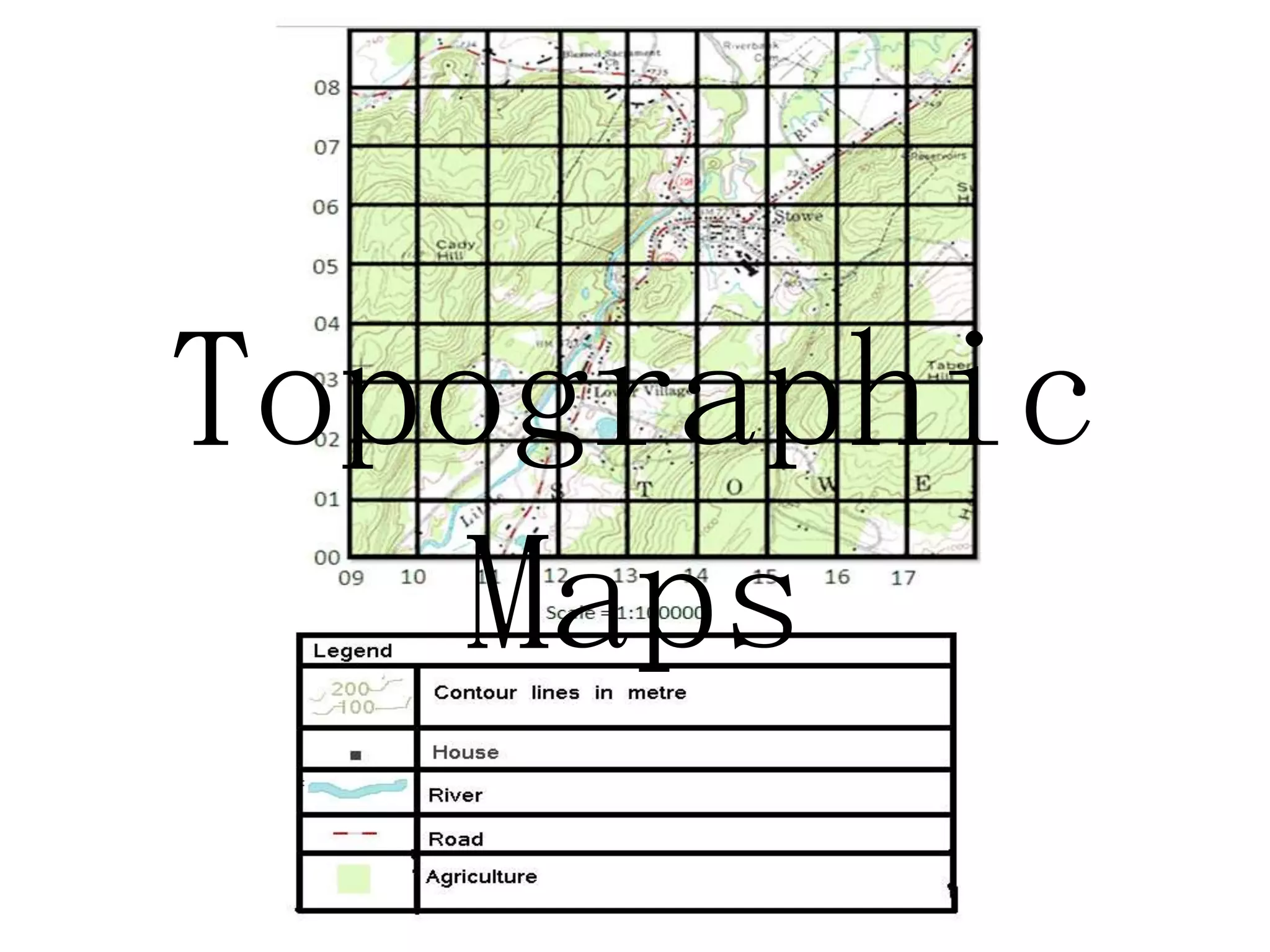
Topographic
    Maps
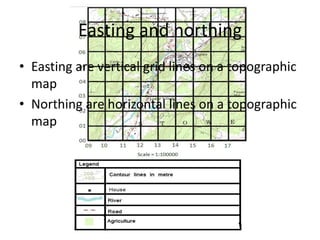
Easting and northing
• Easting are vertical grid lines on a topographic
  map
• Northing are horizontal lines on a topographic
  map
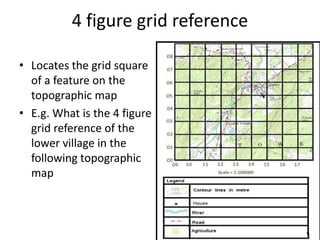
4 figure grid reference

• Locates the grid square
  of a feature on the
  topographic map
• E.g. What is the 4 figure
  grid reference of the
  lower village in the
  following topographic
  map
Identify the grid
square of the
feature(Lower
village)
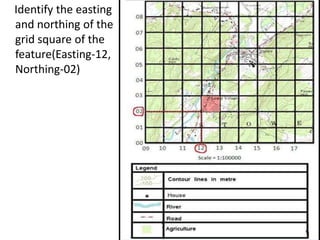
Identify the easting
and northing of the
grid square of the
feature(Easting-12,
Northing-02)
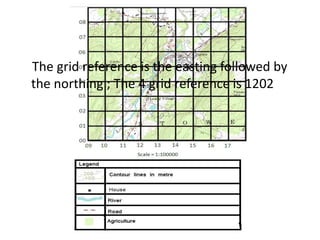
The grid reference is the easting followed by
the northing ; The 4 grid reference is 1202
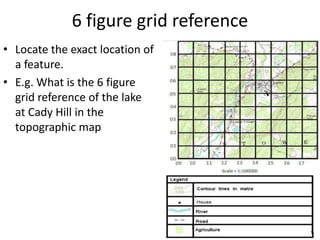
6 figure grid reference
• Locate the exact location of
  a feature.
• E.g. What is the 6 figure
  grid reference of the lake
  at Cady Hill in the
  topographic map
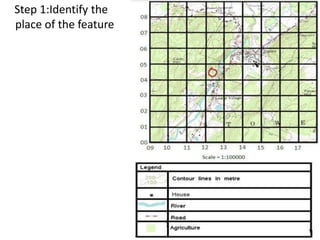
Step 1:Identify the
place of the feature
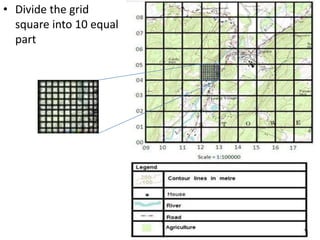
• Divide the grid
  square into 10 equal
  part
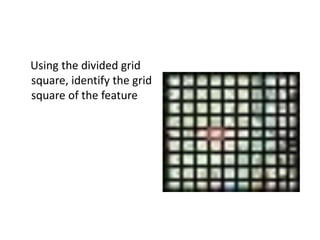
Using the divided grid
square, identify the grid
square of the feature
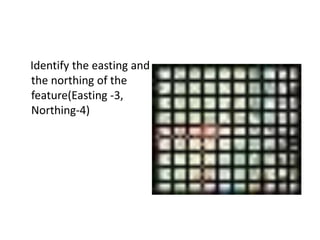
Identify the easting and
the northing of the
feature(Easting -3,
Northing-4)
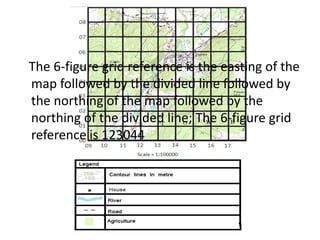
The 6-figure grid reference is the easting of the
map followed by the divided line followed by
the northing of the map followed by the
northing of the divided line; The 6-figure grid
reference is 123044
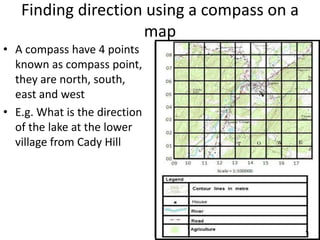
Finding direction using a compass on a
                    map
• A compass have 4 points
  known as compass point,
  they are north, south,
  east and west
• E.g. What is the direction
  of the lake at the lower
  village from Cady Hill
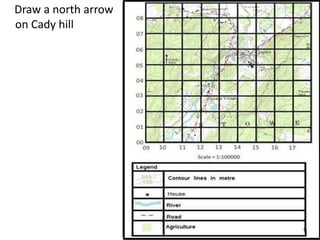
Draw a north arrow
on Cady hill
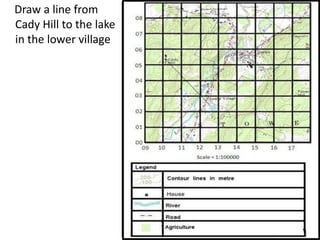
Draw a line from
Cady Hill to the lake
in the lower village
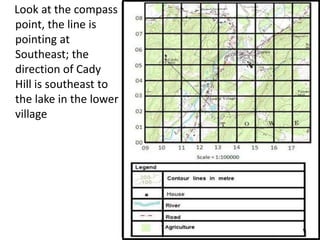
Look at the compass
point, the line is
pointing at
Southeast; the
direction of Cady
Hill is southeast to
the lake in the lower
village
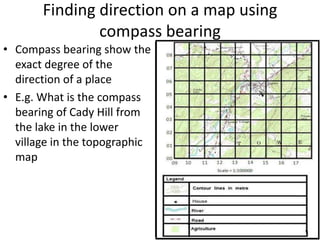
Finding direction on a map using
               compass bearing
• Compass bearing show the
  exact degree of the
  direction of a place
• E.g. What is the compass
  bearing of Cady Hill from
  the lake in the lower
  village in the topographic
  map
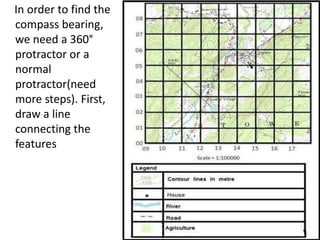
In order to find the
compass bearing,
we need a 360°
protractor or a
normal
protractor(need
more steps). First,
draw a line
connecting the
features
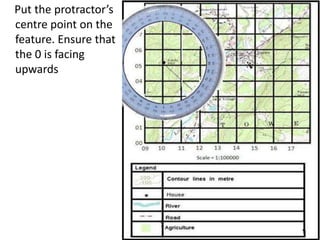
Put the protractor’s
centre point on the
feature. Ensure that
the 0 is facing
upwards
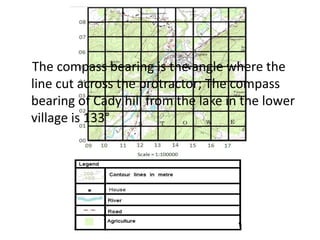
The compass bearing is the angle where the
line cut across the protractor; The compass
bearing of Cady hill from the lake in the lower
village is 133°
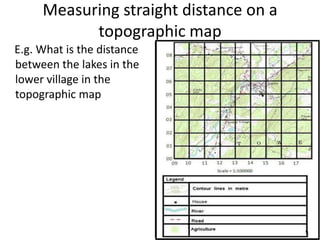
Measuring straight distance on a
           topographic map
E.g. What is the distance
between the lakes in the
lower village in the
topographic map
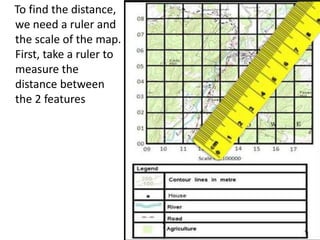
To find the distance,
we need a ruler and
the scale of the map.
First, take a ruler to
measure the
distance between
the 2 features
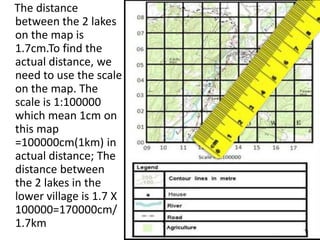
The distance
between the 2 lakes
on the map is
1.7cm.To find the
actual distance, we
need to use the scale
on the map. The
scale is 1:100000
which mean 1cm on
this map
=100000cm(1km) in
actual distance; The
distance between
the 2 lakes in the
lower village is 1.7 X
100000=170000cm/
1.7km
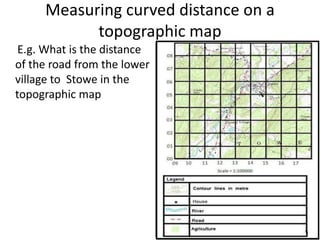
Measuring curved distance on a
           topographic map
 E.g. What is the distance
of the road from the lower
village to Stowe in the
topographic map
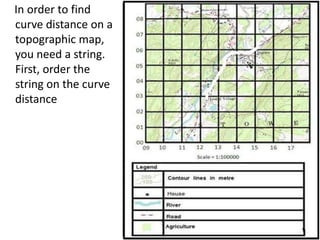
In order to find
curve distance on a
topographic map,
you need a string.
First, order the
string on the curve
distance
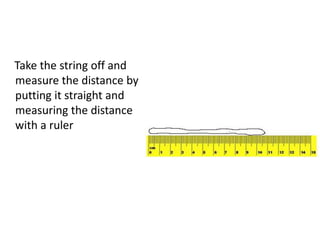
Take the string off and
measure the distance by
putting it straight and
measuring the distance
with a ruler
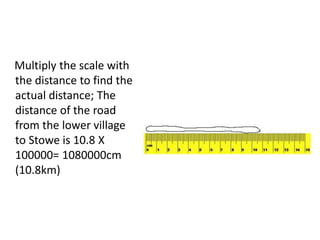
Multiply the scale with
the distance to find the
actual distance; The
distance of the road
from the lower village
to Stowe is 10.8 X
100000= 1080000cm
(10.8km)
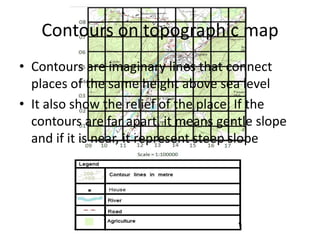
Contours on topographic map
• Contours are imaginary lines that connect
  places of the same height above sea level
• It also show the relief of the place; If the
  contours are far apart, it means gentle slope
  and if it is near, it represent steep slope
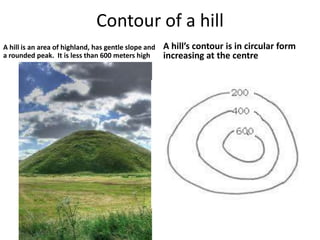
Contour of a hill
A hill is an area of highland, has gentle slope and   A hill’s contour is in circular form
a rounded peak. It is less than 600 meters high       increasing at the centre
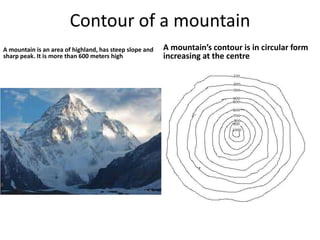
Contour of a mountain
A mountain is an area of highland, has steep slope and   A mountain’s contour is in circular form
sharp peak. It is more than 600 meters high              increasing at the centre
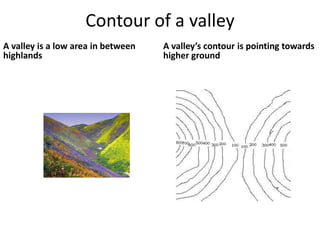
Contour of a valley
A valley is a low area in between   A valley’s contour is pointing towards
highlands                           higher ground
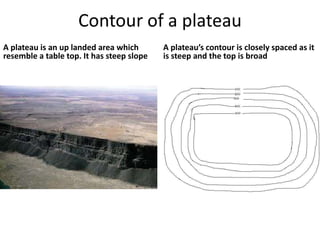
Contour of a plateau
A plateau is an up landed area which       A plateau’s contour is closely spaced as it
resemble a table top. It has steep slope   is steep and the top is broad
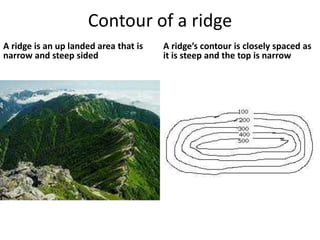
Contour of a ridge
A ridge is an up landed area that is   A ridge’s contour is closely spaced as
narrow and steep sided                 it is steep and the top is narrow
Summary
 Easting and northing are vertical and horizontal grid lines on a topographic map
respectively.4 and 6 figure grid reference show the grid square of a place and the exact
location of a feature respectively. Identify the grid square of the feature first. Next, identify
the easting and northing of the grid square of the feature. The 4 grid reference is the easting
followed by the northing. Divide the grid square into 10 equal part. Using the divided grid
square, identify the divided grid square of the feature from 1 to 10. The 6-figure grid
reference is the eastings followed by the northings. A compass have 4 compass point. Draw a
north arrow on the feature then look at the line pointing which is the direction. Compass
bearing show the exact degree of the direction of a place. Connect the features with a line.
Put the protractor’s centre point on the feature with 0° facing upwards. The compass bearing
is the angle where the line cut across the protractor. A ruler and a string (for curved distance)
is needed for finding distance. Order the string of the curve distance(For curved distance),
next, measure the distance using a ruler, next, multiply the scale by the distance of the thing
you are measuring on the map. Contours are imaginary lines connecting places of the same
height above sea level and also show the relief of the place; Contours far away means gentle
slope and contours near to each other means steep slope. A hill and a mountain is an area of
highland. A hill less than 600 meters high, has a rounded peak and gentle slope while a hill is
more than 600 meters high, has sharp peak and steep slope. A hill and mountain have
contours in circles increasing at the centre. A valley is a low area in between highlands and
has contours pointing towards higher ground. A plateau and a ridge is an up landed area with
steep slope. A plateau has flat top while a ridge is narrow

Secondary 1 Geography-Topographic Map

  • 1.
  • 2.
    Easting and northing •Easting are vertical grid lines on a topographic map • Northing are horizontal lines on a topographic map
  • 3.
    4 figure gridreference • Locates the grid square of a feature on the topographic map • E.g. What is the 4 figure grid reference of the lower village in the following topographic map
  • 4.
    Identify the grid squareof the feature(Lower village)
  • 5.
    Identify the easting andnorthing of the grid square of the feature(Easting-12, Northing-02)
  • 6.
    The grid referenceis the easting followed by the northing ; The 4 grid reference is 1202
  • 7.
    6 figure gridreference • Locate the exact location of a feature. • E.g. What is the 6 figure grid reference of the lake at Cady Hill in the topographic map
  • 8.
  • 9.
    • Divide thegrid square into 10 equal part
  • 10.
    Using the dividedgrid square, identify the grid square of the feature
  • 11.
    Identify the eastingand the northing of the feature(Easting -3, Northing-4)
  • 12.
    The 6-figure gridreference is the easting of the map followed by the divided line followed by the northing of the map followed by the northing of the divided line; The 6-figure grid reference is 123044
  • 13.
    Finding direction usinga compass on a map • A compass have 4 points known as compass point, they are north, south, east and west • E.g. What is the direction of the lake at the lower village from Cady Hill
  • 14.
    Draw a northarrow on Cady hill
  • 15.
    Draw a linefrom Cady Hill to the lake in the lower village
  • 16.
    Look at thecompass point, the line is pointing at Southeast; the direction of Cady Hill is southeast to the lake in the lower village
  • 17.
    Finding direction ona map using compass bearing • Compass bearing show the exact degree of the direction of a place • E.g. What is the compass bearing of Cady Hill from the lake in the lower village in the topographic map
  • 18.
    In order tofind the compass bearing, we need a 360° protractor or a normal protractor(need more steps). First, draw a line connecting the features
  • 19.
    Put the protractor’s centrepoint on the feature. Ensure that the 0 is facing upwards
  • 20.
    The compass bearingis the angle where the line cut across the protractor; The compass bearing of Cady hill from the lake in the lower village is 133°
  • 21.
    Measuring straight distanceon a topographic map E.g. What is the distance between the lakes in the lower village in the topographic map
  • 22.
    To find thedistance, we need a ruler and the scale of the map. First, take a ruler to measure the distance between the 2 features
  • 23.
    The distance between the2 lakes on the map is 1.7cm.To find the actual distance, we need to use the scale on the map. The scale is 1:100000 which mean 1cm on this map =100000cm(1km) in actual distance; The distance between the 2 lakes in the lower village is 1.7 X 100000=170000cm/ 1.7km
  • 24.
    Measuring curved distanceon a topographic map E.g. What is the distance of the road from the lower village to Stowe in the topographic map
  • 25.
    In order tofind curve distance on a topographic map, you need a string. First, order the string on the curve distance
  • 26.
    Take the stringoff and measure the distance by putting it straight and measuring the distance with a ruler
  • 27.
    Multiply the scalewith the distance to find the actual distance; The distance of the road from the lower village to Stowe is 10.8 X 100000= 1080000cm (10.8km)
  • 28.
    Contours on topographicmap • Contours are imaginary lines that connect places of the same height above sea level • It also show the relief of the place; If the contours are far apart, it means gentle slope and if it is near, it represent steep slope
  • 29.
    Contour of ahill A hill is an area of highland, has gentle slope and A hill’s contour is in circular form a rounded peak. It is less than 600 meters high increasing at the centre
  • 30.
    Contour of amountain A mountain is an area of highland, has steep slope and A mountain’s contour is in circular form sharp peak. It is more than 600 meters high increasing at the centre
  • 31.
    Contour of avalley A valley is a low area in between A valley’s contour is pointing towards highlands higher ground
  • 32.
    Contour of aplateau A plateau is an up landed area which A plateau’s contour is closely spaced as it resemble a table top. It has steep slope is steep and the top is broad
  • 33.
    Contour of aridge A ridge is an up landed area that is A ridge’s contour is closely spaced as narrow and steep sided it is steep and the top is narrow
  • 34.
    Summary Easting andnorthing are vertical and horizontal grid lines on a topographic map respectively.4 and 6 figure grid reference show the grid square of a place and the exact location of a feature respectively. Identify the grid square of the feature first. Next, identify the easting and northing of the grid square of the feature. The 4 grid reference is the easting followed by the northing. Divide the grid square into 10 equal part. Using the divided grid square, identify the divided grid square of the feature from 1 to 10. The 6-figure grid reference is the eastings followed by the northings. A compass have 4 compass point. Draw a north arrow on the feature then look at the line pointing which is the direction. Compass bearing show the exact degree of the direction of a place. Connect the features with a line. Put the protractor’s centre point on the feature with 0° facing upwards. The compass bearing is the angle where the line cut across the protractor. A ruler and a string (for curved distance) is needed for finding distance. Order the string of the curve distance(For curved distance), next, measure the distance using a ruler, next, multiply the scale by the distance of the thing you are measuring on the map. Contours are imaginary lines connecting places of the same height above sea level and also show the relief of the place; Contours far away means gentle slope and contours near to each other means steep slope. A hill and a mountain is an area of highland. A hill less than 600 meters high, has a rounded peak and gentle slope while a hill is more than 600 meters high, has sharp peak and steep slope. A hill and mountain have contours in circles increasing at the centre. A valley is a low area in between highlands and has contours pointing towards higher ground. A plateau and a ridge is an up landed area with steep slope. A plateau has flat top while a ridge is narrow