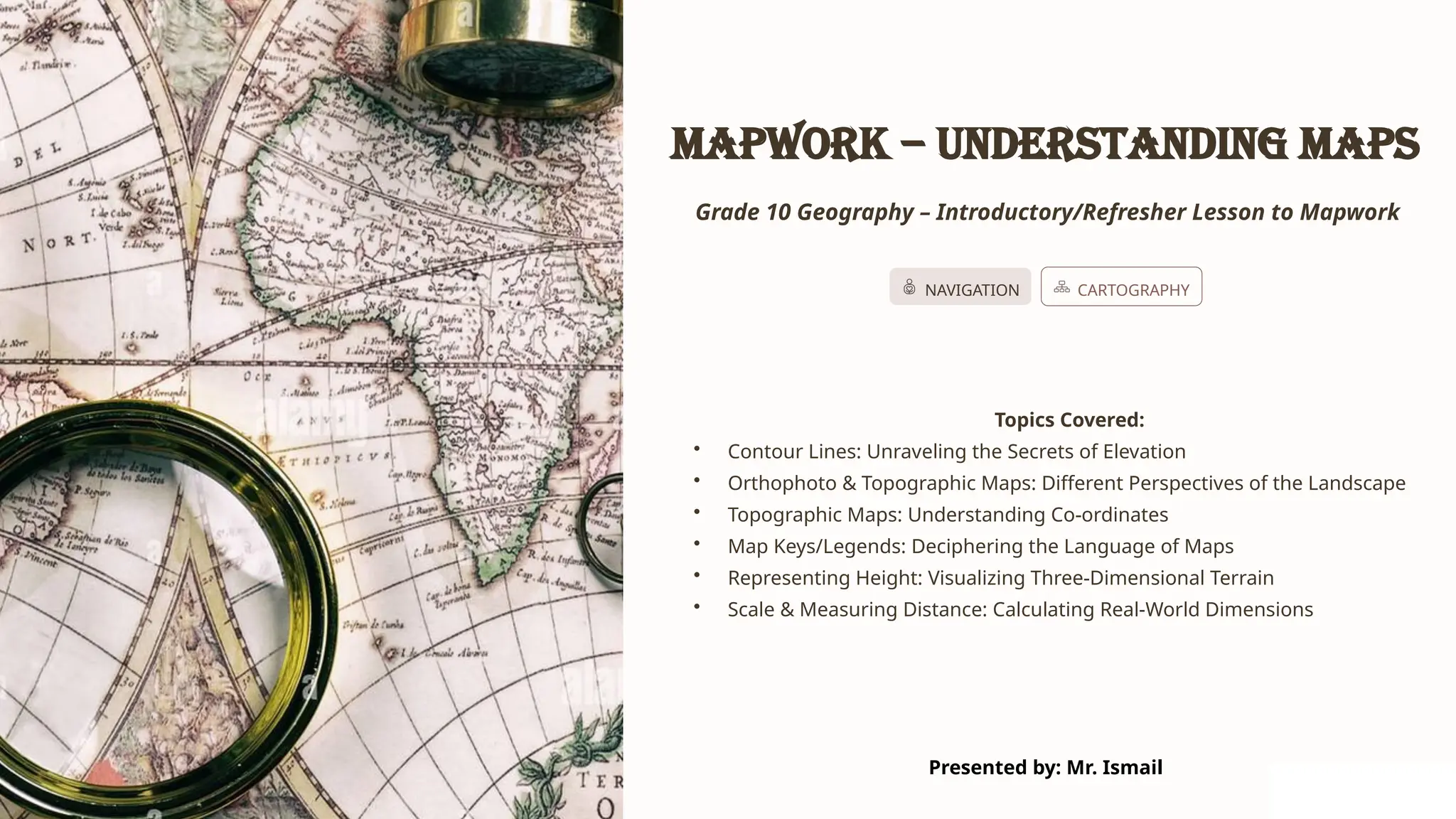
Mapwork – Understanding Maps
Grade 10 Geography – Introductory/Refresher Lesson to Mapwork
NAVIGATION CARTOGRAPHY
Topics Covered:
• Contour Lines: Unraveling the Secrets of Elevation
• Orthophoto & Topographic Maps: Different Perspectives of the Landscape
• Topographic Maps: Understanding Co-ordinates
• Map Keys/Legends: Deciphering the Language of Maps
• Representing Height: Visualizing Three-Dimensional Terrain
• Scale & Measuring Distance: Calculating Real-World Dimensions
Presented by: Mr. Ismail
Lesson Objectives:
Navigating Our Learning Journey
By the end of this lesson, you should be able to:
Identify and describe four slope types
You will be able to distinguish between and articulate the
characteristics of gradual, steep, concave, and convex slopes
as depicted by contour lines.
Compare and contrast orthophoto maps
(1:10 000) and topographic maps (1:50 000)
You will analyze the differences in detail, purpose, and
representation between these two critical map types,
understanding their respective applications in geographical
analysis.
Calculate real-world distances in kilometers
for at least three straight and curved
features
You will master the use of both line scale and ratio scale
methods to accurately determine actual distances on the
ground from map measurements, a fundamental skill in
geographical mapping.
Interpret height information on a topographic map
You will achieve this by identifying contour intervals, spot
heights, trigonometric beacons, and benchmarks, and
understanding their significance in representing vertical relief.
This will enable you to visualize the 3D landscape from a 2D
map.
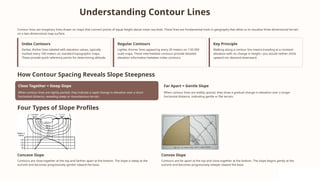
Understanding Contour Lines
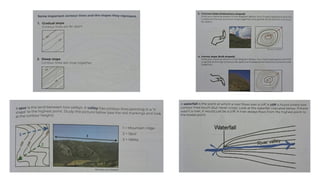
Contour lines are imaginary lines drawn on maps that connect points of equal height above mean sea level. These lines are fundamental tools in geography that allow us to visualize three-dimensional terrain
on a two-dimensional map surface.
Index Contours
Darker, thicker lines labeled with elevation values, typically
marked every 100 meters on standard topographic maps.
These provide quick reference points for determining altitude.
Regular Contours
Lighter, thinner lines appearing every 20 meters on 1:50 000
scale maps. These intermediate contours provide detailed
elevation information between index contours.
Key Principle
Walking along a contour line means traveling at a constant
elevation with no change in height—you would neither climb
upward nor descend downward.
How Contour Spacing Reveals Slope Steepness
Close Together = Steep Slope
When contour lines are tightly packed, they indicate a rapid change in elevation over a short
horizontal distance, revealing steep or mountainous terrain.
Far Apart = Gentle Slope
When contour lines are widely spaced, they show a gradual change in elevation over a longer
horizontal distance, indicating gentle or flat terrain.
Four Types of Slope Profiles
Concave Slope
Contours are close together at the top and farther apart at the bottom. The slope is steep at the
summit and becomes progressively gentler toward the base.
Convex Slope
Contours are far apart at the top and close together at the bottom. The slope begins gently at the
summit and becomes progressively steeper toward the base.
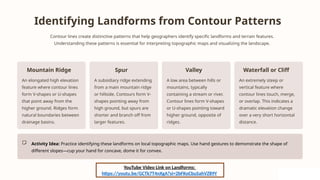
Identifying Landforms from Contour Patterns
Contour lines create distinctive patterns that help geographers identify specific landforms and terrain features.
Understanding these patterns is essential for interpreting topographic maps and visualizing the landscape.
Mountain Ridge
An elongated high elevation
feature where contour lines
form V-shapes or U-shapes
that point away from the
higher ground. Ridges form
natural boundaries between
drainage basins.
Spur
A subsidiary ridge extending
from a main mountain ridge
or hillside. Contours form V-
shapes pointing away from
high ground, but spurs are
shorter and branch off from
larger features.
Valley
A low area between hills or
mountains, typically
containing a stream or river.
Contour lines form V-shapes
or U-shapes pointing toward
higher ground, opposite of
ridges.
Waterfall or Cliff
An extremely steep or
vertical feature where
contour lines touch, merge,
or overlap. This indicates a
dramatic elevation change
over a very short horizontal
distance.
Activity Idea: Practice identifying these landforms on local topographic maps. Use hand gestures to demonstrate the shape of
different slopes—cup your hand for concave, dome it for convex.
YouTube Video Link on Landforms:
https://youtu.be/GCTk7T4nXgA?si=2bFKoCbuSahVZ89Y
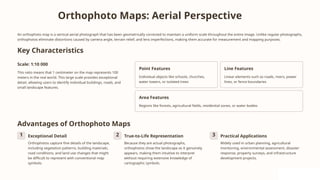
Orthophoto Maps: Aerial Perspective
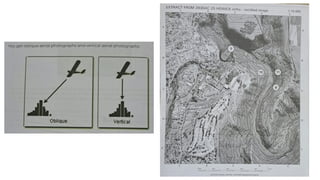
An orthophoto map is a vertical aerial photograph that has been geometrically corrected to maintain a uniform scale throughout the entire image. Unlike regular photographs,
orthophotos eliminate distortions caused by camera angle, terrain relief, and lens imperfections, making them accurate for measurement and mapping purposes.
Key Characteristics
Scale: 1:10 000
This ratio means that 1 centimeter on the map represents 100
meters in the real world. This large scale provides exceptional
detail, allowing users to identify individual buildings, roads, and
small landscape features.
Point Features
Individual objects like schools, churches,
water towers, or isolated trees
Line Features
Linear elements such as roads, rivers, power
lines, or fence boundaries
Area Features
Regions like forests, agricultural fields, residential zones, or water bodies
Advantages of Orthophoto Maps
1 Exceptional Detail
Orthophotos capture fine details of the landscape,
including vegetation patterns, building materials,
road conditions, and land use changes that might
be difficult to represent with conventional map
symbols.
2 True-to-Life Representation
Because they are actual photographs,
orthophotos show the landscape as it genuinely
appears, making them intuitive to interpret
without requiring extensive knowledge of
cartographic symbols.
3 Practical Applications
Widely used in urban planning, agricultural
monitoring, environmental assessment, disaster
response, property surveys, and infrastructure
development projects.
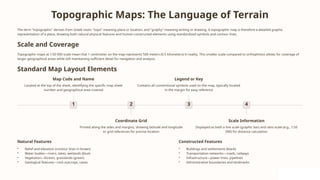
Topographic Maps: The Language of Terrain
The term "topographic" derives from Greek roots: "topo" meaning place or location, and "graphy" meaning writing or drawing. A topographic map is therefore a detailed graphic
representation of a place, showing both natural physical features and human-constructed elements using standardized symbols and contour lines.
Scale and Coverage
Topographic maps at 1:50 000 scale mean that 1 centimeter on the map represents 500 meters (0.5 kilometers) in reality. This smaller scale compared to orthophotos allows for coverage of
larger geographical areas while still maintaining sufficient detail for navigation and analysis.
Standard Map Layout Elements
1
Map Code and Name
Located at the top of the sheet, identifying the specific map sheet
number and geographical area covered
2
Coordinate Grid
Printed along the sides and margins, showing latitude and longitude
or grid references for precise location
3
Legend or Key
Contains all conventional symbols used on the map, typically located
in the margin for easy reference
4
Scale Information
Displayed as both a line scale (graphic bar) and ratio scale (e.g., 1:50
000) for distance calculation
Natural Features
• Relief and elevation (contour lines in brown)
• Water bodies—rivers, lakes, wetlands (blue)
• Vegetation—forests, grasslands (green)
• Geological features—rock outcrops, caves
Constructed Features
• Buildings and settlements (black)
• Transportation networks—roads, railways
• Infrastructure—power lines, pipelines
• Administrative boundaries and landmarks
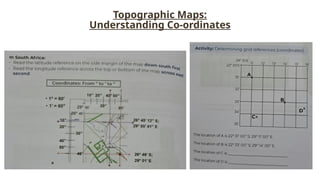
Topographic Maps:
Understanding Co-ordinates
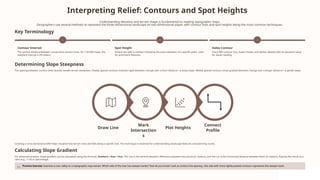
Interpreting Relief: Contours and Spot Heights
Understanding elevation and terrain shape is fundamental to reading topographic maps.
Geographers use several methods to represent the three-dimensional landscape on two-dimensional paper, with contour lines and spot heights being the most common techniques.
Key Terminology
Contour Interval
The vertical distance between consecutive contour lines. On 1:50 000 maps, the
standard interval is 20 meters.
Spot Height
A black dot with a number indicating the exact elevation of a specific point, used
for prominent features.
Index Contour
Every fifth contour line, drawn thicker and darker, labeled with its elevation value
for easier reading.
Determining Slope Steepness
The spacing between contour lines directly reveals terrain steepness. Closely spaced contours indicate rapid elevation change over a short distance—a steep slope. Widely spaced contours show gradual elevation change over a longer distance—a gentle slope.
Connect
Profile
Plot Heights
Mark
Intersection
s
Draw Line
Creating a cross-sectional profile helps visualize how terrain rises and falls along a specific line. This technique is essential for understanding landscape features and planning routes.
Calculating Slope Gradient
For advanced analysis, slope gradient can be calculated using the formula: Gradient = Rise ÷ Run. The rise is the vertical elevation difference between two points (in meters), and the run is the horizontal distance between them (in meters). Express the result as a
ratio (e.g., 1:10) or percentage.
Practice Exercise: Examine a river valley on a topographic map extract. Which side of the river has steeper banks? How do you know? Look at contour line spacing—the side with more tightly packed contours represents the steeper bank.
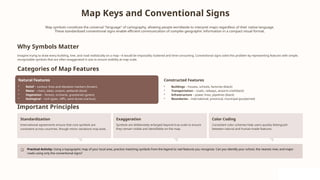
Map Keys and Conventional Signs
Map symbols constitute the universal "language" of cartography, allowing people worldwide to interpret maps regardless of their native language.
These standardized conventional signs enable efficient communication of complex geographic information in a compact visual format.
Why Symbols Matter
Imagine trying to draw every building, tree, and road realistically on a map—it would be impossibly cluttered and time-consuming. Conventional signs solve this problem by representing features with simple,
recognizable symbols that are often exaggerated in size to ensure visibility at map scale.
Categories of Map Features
Natural Features
• Relief – contour lines and elevation markers (brown)
• Water – rivers, lakes, oceans, wetlands (blue)
• Vegetation – forests, orchards, grasslands (green)
• Geological – rock types, cliffs, sand dunes (various)
Constructed Features
• Buildings – houses, schools, factories (black)
• Transportation – roads, railways, airports (red/black)
• Infrastructure – power lines, pipelines (black)
• Boundaries – international, provincial, municipal (purple/red)
Important Principles
Standardization
International agreements ensure that core symbols are
consistent across countries, though minor variations may exist.
Exaggeration
Symbols are deliberately enlarged beyond true scale to ensure
they remain visible and identifiable on the map.
Color Coding
Consistent color schemes help users quickly distinguish
between natural and human-made features.
Practical Activity: Using a topographic map of your local area, practice matching symbols from the legend to real features you recognize. Can you identify your school, the nearest river, and major
roads using only the conventional signs?
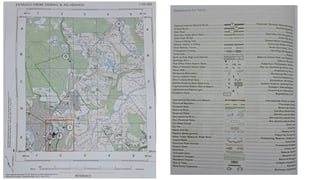
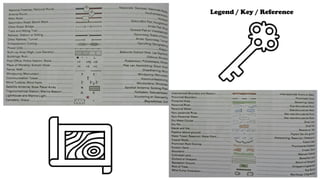
Legend / Key / Reference
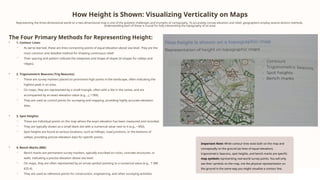
How Height is Shown: Visualizing Verticality on Maps
Representing the three-dimensional world on a two-dimensional map is one of the greatest challenges and triumphs of cartography. To accurately convey elevation and relief, geographers employ several distinct methods.
Understanding each of these is crucial for fully interpreting the topography of an area.
The Four Primary Methods for Representing Height:
• 1. Contour Lines:
◦ As we've learned, these are lines connecting points of equal elevation above sea level. They are the
most common and detailed method for showing continuous relief.
◦ Their spacing and pattern indicate the steepness and shape of slopes (V-shapes for valleys and
ridges).
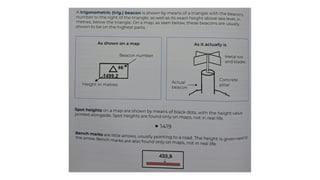
• 2. Trigonometric Beacons (Trig Beacons):
◦ These are survey markers placed on prominent high points in the landscape, often indicating the
highest peak in an area.
◦ On maps, they are represented by a small triangle, often with a dot in the center, and are
accompanied by an exact elevation value (e.g., 1789).
△
◦ They are used as control points for surveying and mapping, providing highly accurate elevation
data.
• 3. Spot Heights:
◦ These are individual points on the map where the exact elevation has been measured and recorded.
◦ They are typically shown as a small black dot with a numerical value next to it (e.g., • 850).
◦ Spot heights are found at various locations, such as hilltops, road junctions, or the bottoms of
valleys, providing precise elevation data for specific points.
• 4. Bench Marks (BM):
◦ Bench marks are permanent survey markers, typically inscribed on rocks, concrete structures, or
walls, indicating a precise elevation above sea level.
◦ On maps, they are often represented by an arrow symbol pointing to a numerical value (e.g., BM
↑
625.4).
◦ They are used as reference points for construction, engineering, and other surveying activities.
Important Note: While contour lines exist both on the map and
conceptually on the ground (as lines of equal elevation),
trigonometric beacons, spot heights, and bench marks are specific
map symbols representing real-world survey points. You will only
see their symbols on the map, not the physical representation on
the ground in the same way you might visualize a contour line.
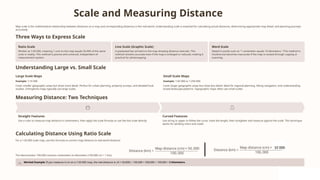
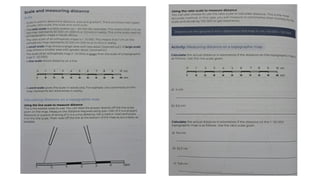
Scale and Measuring Distance
Map scale is the mathematical relationship between distances on a map and corresponding distances in the real world. Understanding scale is essential for calculating actual distances, determining appropriate map detail, and planning journeys
accurately.
Three Ways to Express Scale
Ratio Scale
Written as 1:50 000, meaning 1 unit on the map equals 50,000 of the same
units in reality. This method is precise and universal, independent of
measurement system.
Line Scale (Graphic Scale)
A graduated bar printed on the map showing distance intervals. This
method remains accurate even if the map is enlarged or reduced, making it
practical for photocopying.
Word Scale
Stated in words such as "1 centimeter equals 10 kilometers." This method is
intuitive but becomes inaccurate if the map is resized through copying or
scanning.
Understanding Large vs. Small Scale
Large Scale Maps
Example: 1:10 000
Cover smaller geographic areas but show more detail. Perfect for urban planning, property surveys, and detailed local
studies. Orthophoto maps typically use large scales.
Small Scale Maps
Example: 1:50 000 or 1:250 000
Cover larger geographic areas but show less detail. Ideal for regional planning, hiking navigation, and understanding
broad landscape patterns. Topographic maps often use small scales.
Measuring Distance: Two Techniques
Straight Features
Use a ruler to measure map distance in centimeters, then apply the scale formula or use the line scale directly.
Curved Features
Use string or paper to follow the curve, mark the length, then straighten and measure against the scale. This technique
works for winding rivers and roads.
Calculating Distance Using Ratio Scale
For a 1:50 000 scale map, use this formula to convert map distance to real-world distance:
The denominator 100,000 converts centimeters to kilometers (100,000 cm = 1 km).
Worked Example: If you measure 4 cm on a 1:50 000 map, the real distance is: (4 × 50,000) ÷ 100,000 = 200,000 ÷ 100,000 = 2 kilometers.
10 000
Summary:
Key Takeaways in Mapwork
Contour Lines Unveiled
Contour lines are fundamental to visualizing three-dimensional landscapes on a flat map. You now understand how their spacing reveals the steepness of a slope (close
for steep, far for gentle) and how their V-shapes indicate valleys (pointing upstream) or ridges (pointing downhill). We also explored concave and convex slope types.
Orthophoto vs. Topographic
We compared orthophoto maps (1:10,000), which are geometrically corrected aerial photographs offering high detail and true-to-life representation, with topographic
maps (1:50,000), which depict both natural and human-made features using symbols and contours. Each serves distinct purposes in geographical analysis.
The Power of Map Keys
You've learned that map keys, or legends, are the universal language of maps. They explain the conventional signs used to represent natural features (like relief, water,
vegetation) and constructed features (like buildings, roads, power lines). Understanding these symbols is critical for accurate map interpretation.
Height Representation
We covered the four primary methods for showing height on maps: contour lines for continuous relief, trigonometric beacons ( ) for major high points, spot heights (•)
△
for exact point elevations, and benchmarks ( ) for precise survey reference points. Each contributes to a comprehensive understanding of vertical terrain.
↑
Mastering Scale & Distance
Finally, you've grasped the importance of map scale (ratio, line, and word scales) and how to measure real-world distances. You can now apply formulas to calculate
distances for both straight and curved features, effectively bridging the gap between the map and the physical world.

Grade 10 Mapwork - Understanding Maps - Ismail M.pptx

  • 1.
    Mapwork – UnderstandingMaps Grade 10 Geography – Introductory/Refresher Lesson to Mapwork NAVIGATION CARTOGRAPHY Topics Covered: • Contour Lines: Unraveling the Secrets of Elevation • Orthophoto & Topographic Maps: Different Perspectives of the Landscape • Topographic Maps: Understanding Co-ordinates • Map Keys/Legends: Deciphering the Language of Maps • Representing Height: Visualizing Three-Dimensional Terrain • Scale & Measuring Distance: Calculating Real-World Dimensions Presented by: Mr. Ismail
  • 2.
    Lesson Objectives: Navigating OurLearning Journey By the end of this lesson, you should be able to: Identify and describe four slope types You will be able to distinguish between and articulate the characteristics of gradual, steep, concave, and convex slopes as depicted by contour lines. Compare and contrast orthophoto maps (1:10 000) and topographic maps (1:50 000) You will analyze the differences in detail, purpose, and representation between these two critical map types, understanding their respective applications in geographical analysis. Calculate real-world distances in kilometers for at least three straight and curved features You will master the use of both line scale and ratio scale methods to accurately determine actual distances on the ground from map measurements, a fundamental skill in geographical mapping. Interpret height information on a topographic map You will achieve this by identifying contour intervals, spot heights, trigonometric beacons, and benchmarks, and understanding their significance in representing vertical relief. This will enable you to visualize the 3D landscape from a 2D map.
  • 3.
    Understanding Contour Lines Contourlines are imaginary lines drawn on maps that connect points of equal height above mean sea level. These lines are fundamental tools in geography that allow us to visualize three-dimensional terrain on a two-dimensional map surface. Index Contours Darker, thicker lines labeled with elevation values, typically marked every 100 meters on standard topographic maps. These provide quick reference points for determining altitude. Regular Contours Lighter, thinner lines appearing every 20 meters on 1:50 000 scale maps. These intermediate contours provide detailed elevation information between index contours. Key Principle Walking along a contour line means traveling at a constant elevation with no change in height—you would neither climb upward nor descend downward. How Contour Spacing Reveals Slope Steepness Close Together = Steep Slope When contour lines are tightly packed, they indicate a rapid change in elevation over a short horizontal distance, revealing steep or mountainous terrain. Far Apart = Gentle Slope When contour lines are widely spaced, they show a gradual change in elevation over a longer horizontal distance, indicating gentle or flat terrain. Four Types of Slope Profiles Concave Slope Contours are close together at the top and farther apart at the bottom. The slope is steep at the summit and becomes progressively gentler toward the base. Convex Slope Contours are far apart at the top and close together at the bottom. The slope begins gently at the summit and becomes progressively steeper toward the base.
  • 4.
    Identifying Landforms fromContour Patterns Contour lines create distinctive patterns that help geographers identify specific landforms and terrain features. Understanding these patterns is essential for interpreting topographic maps and visualizing the landscape. Mountain Ridge An elongated high elevation feature where contour lines form V-shapes or U-shapes that point away from the higher ground. Ridges form natural boundaries between drainage basins. Spur A subsidiary ridge extending from a main mountain ridge or hillside. Contours form V- shapes pointing away from high ground, but spurs are shorter and branch off from larger features. Valley A low area between hills or mountains, typically containing a stream or river. Contour lines form V-shapes or U-shapes pointing toward higher ground, opposite of ridges. Waterfall or Cliff An extremely steep or vertical feature where contour lines touch, merge, or overlap. This indicates a dramatic elevation change over a very short horizontal distance. Activity Idea: Practice identifying these landforms on local topographic maps. Use hand gestures to demonstrate the shape of different slopes—cup your hand for concave, dome it for convex. YouTube Video Link on Landforms: https://youtu.be/GCTk7T4nXgA?si=2bFKoCbuSahVZ89Y
  • 6.
    Orthophoto Maps: AerialPerspective An orthophoto map is a vertical aerial photograph that has been geometrically corrected to maintain a uniform scale throughout the entire image. Unlike regular photographs, orthophotos eliminate distortions caused by camera angle, terrain relief, and lens imperfections, making them accurate for measurement and mapping purposes. Key Characteristics Scale: 1:10 000 This ratio means that 1 centimeter on the map represents 100 meters in the real world. This large scale provides exceptional detail, allowing users to identify individual buildings, roads, and small landscape features. Point Features Individual objects like schools, churches, water towers, or isolated trees Line Features Linear elements such as roads, rivers, power lines, or fence boundaries Area Features Regions like forests, agricultural fields, residential zones, or water bodies Advantages of Orthophoto Maps 1 Exceptional Detail Orthophotos capture fine details of the landscape, including vegetation patterns, building materials, road conditions, and land use changes that might be difficult to represent with conventional map symbols. 2 True-to-Life Representation Because they are actual photographs, orthophotos show the landscape as it genuinely appears, making them intuitive to interpret without requiring extensive knowledge of cartographic symbols. 3 Practical Applications Widely used in urban planning, agricultural monitoring, environmental assessment, disaster response, property surveys, and infrastructure development projects.
  • 8.
    Topographic Maps: TheLanguage of Terrain The term "topographic" derives from Greek roots: "topo" meaning place or location, and "graphy" meaning writing or drawing. A topographic map is therefore a detailed graphic representation of a place, showing both natural physical features and human-constructed elements using standardized symbols and contour lines. Scale and Coverage Topographic maps at 1:50 000 scale mean that 1 centimeter on the map represents 500 meters (0.5 kilometers) in reality. This smaller scale compared to orthophotos allows for coverage of larger geographical areas while still maintaining sufficient detail for navigation and analysis. Standard Map Layout Elements 1 Map Code and Name Located at the top of the sheet, identifying the specific map sheet number and geographical area covered 2 Coordinate Grid Printed along the sides and margins, showing latitude and longitude or grid references for precise location 3 Legend or Key Contains all conventional symbols used on the map, typically located in the margin for easy reference 4 Scale Information Displayed as both a line scale (graphic bar) and ratio scale (e.g., 1:50 000) for distance calculation Natural Features • Relief and elevation (contour lines in brown) • Water bodies—rivers, lakes, wetlands (blue) • Vegetation—forests, grasslands (green) • Geological features—rock outcrops, caves Constructed Features • Buildings and settlements (black) • Transportation networks—roads, railways • Infrastructure—power lines, pipelines • Administrative boundaries and landmarks
  • 10.
  • 11.
    Interpreting Relief: Contoursand Spot Heights Understanding elevation and terrain shape is fundamental to reading topographic maps. Geographers use several methods to represent the three-dimensional landscape on two-dimensional paper, with contour lines and spot heights being the most common techniques. Key Terminology Contour Interval The vertical distance between consecutive contour lines. On 1:50 000 maps, the standard interval is 20 meters. Spot Height A black dot with a number indicating the exact elevation of a specific point, used for prominent features. Index Contour Every fifth contour line, drawn thicker and darker, labeled with its elevation value for easier reading. Determining Slope Steepness The spacing between contour lines directly reveals terrain steepness. Closely spaced contours indicate rapid elevation change over a short distance—a steep slope. Widely spaced contours show gradual elevation change over a longer distance—a gentle slope. Connect Profile Plot Heights Mark Intersection s Draw Line Creating a cross-sectional profile helps visualize how terrain rises and falls along a specific line. This technique is essential for understanding landscape features and planning routes. Calculating Slope Gradient For advanced analysis, slope gradient can be calculated using the formula: Gradient = Rise ÷ Run. The rise is the vertical elevation difference between two points (in meters), and the run is the horizontal distance between them (in meters). Express the result as a ratio (e.g., 1:10) or percentage. Practice Exercise: Examine a river valley on a topographic map extract. Which side of the river has steeper banks? How do you know? Look at contour line spacing—the side with more tightly packed contours represents the steeper bank.
  • 12.
    Map Keys andConventional Signs Map symbols constitute the universal "language" of cartography, allowing people worldwide to interpret maps regardless of their native language. These standardized conventional signs enable efficient communication of complex geographic information in a compact visual format. Why Symbols Matter Imagine trying to draw every building, tree, and road realistically on a map—it would be impossibly cluttered and time-consuming. Conventional signs solve this problem by representing features with simple, recognizable symbols that are often exaggerated in size to ensure visibility at map scale. Categories of Map Features Natural Features • Relief – contour lines and elevation markers (brown) • Water – rivers, lakes, oceans, wetlands (blue) • Vegetation – forests, orchards, grasslands (green) • Geological – rock types, cliffs, sand dunes (various) Constructed Features • Buildings – houses, schools, factories (black) • Transportation – roads, railways, airports (red/black) • Infrastructure – power lines, pipelines (black) • Boundaries – international, provincial, municipal (purple/red) Important Principles Standardization International agreements ensure that core symbols are consistent across countries, though minor variations may exist. Exaggeration Symbols are deliberately enlarged beyond true scale to ensure they remain visible and identifiable on the map. Color Coding Consistent color schemes help users quickly distinguish between natural and human-made features. Practical Activity: Using a topographic map of your local area, practice matching symbols from the legend to real features you recognize. Can you identify your school, the nearest river, and major roads using only the conventional signs?
  • 13.
    Legend / Key/ Reference
  • 14.
    How Height isShown: Visualizing Verticality on Maps Representing the three-dimensional world on a two-dimensional map is one of the greatest challenges and triumphs of cartography. To accurately convey elevation and relief, geographers employ several distinct methods. Understanding each of these is crucial for fully interpreting the topography of an area. The Four Primary Methods for Representing Height: • 1. Contour Lines: ◦ As we've learned, these are lines connecting points of equal elevation above sea level. They are the most common and detailed method for showing continuous relief. ◦ Their spacing and pattern indicate the steepness and shape of slopes (V-shapes for valleys and ridges). • 2. Trigonometric Beacons (Trig Beacons): ◦ These are survey markers placed on prominent high points in the landscape, often indicating the highest peak in an area. ◦ On maps, they are represented by a small triangle, often with a dot in the center, and are accompanied by an exact elevation value (e.g., 1789). △ ◦ They are used as control points for surveying and mapping, providing highly accurate elevation data. • 3. Spot Heights: ◦ These are individual points on the map where the exact elevation has been measured and recorded. ◦ They are typically shown as a small black dot with a numerical value next to it (e.g., • 850). ◦ Spot heights are found at various locations, such as hilltops, road junctions, or the bottoms of valleys, providing precise elevation data for specific points. • 4. Bench Marks (BM): ◦ Bench marks are permanent survey markers, typically inscribed on rocks, concrete structures, or walls, indicating a precise elevation above sea level. ◦ On maps, they are often represented by an arrow symbol pointing to a numerical value (e.g., BM ↑ 625.4). ◦ They are used as reference points for construction, engineering, and other surveying activities. Important Note: While contour lines exist both on the map and conceptually on the ground (as lines of equal elevation), trigonometric beacons, spot heights, and bench marks are specific map symbols representing real-world survey points. You will only see their symbols on the map, not the physical representation on the ground in the same way you might visualize a contour line.
  • 16.
    Scale and MeasuringDistance Map scale is the mathematical relationship between distances on a map and corresponding distances in the real world. Understanding scale is essential for calculating actual distances, determining appropriate map detail, and planning journeys accurately. Three Ways to Express Scale Ratio Scale Written as 1:50 000, meaning 1 unit on the map equals 50,000 of the same units in reality. This method is precise and universal, independent of measurement system. Line Scale (Graphic Scale) A graduated bar printed on the map showing distance intervals. This method remains accurate even if the map is enlarged or reduced, making it practical for photocopying. Word Scale Stated in words such as "1 centimeter equals 10 kilometers." This method is intuitive but becomes inaccurate if the map is resized through copying or scanning. Understanding Large vs. Small Scale Large Scale Maps Example: 1:10 000 Cover smaller geographic areas but show more detail. Perfect for urban planning, property surveys, and detailed local studies. Orthophoto maps typically use large scales. Small Scale Maps Example: 1:50 000 or 1:250 000 Cover larger geographic areas but show less detail. Ideal for regional planning, hiking navigation, and understanding broad landscape patterns. Topographic maps often use small scales. Measuring Distance: Two Techniques Straight Features Use a ruler to measure map distance in centimeters, then apply the scale formula or use the line scale directly. Curved Features Use string or paper to follow the curve, mark the length, then straighten and measure against the scale. This technique works for winding rivers and roads. Calculating Distance Using Ratio Scale For a 1:50 000 scale map, use this formula to convert map distance to real-world distance: The denominator 100,000 converts centimeters to kilometers (100,000 cm = 1 km). Worked Example: If you measure 4 cm on a 1:50 000 map, the real distance is: (4 × 50,000) ÷ 100,000 = 200,000 ÷ 100,000 = 2 kilometers. 10 000
  • 18.
    Summary: Key Takeaways inMapwork Contour Lines Unveiled Contour lines are fundamental to visualizing three-dimensional landscapes on a flat map. You now understand how their spacing reveals the steepness of a slope (close for steep, far for gentle) and how their V-shapes indicate valleys (pointing upstream) or ridges (pointing downhill). We also explored concave and convex slope types. Orthophoto vs. Topographic We compared orthophoto maps (1:10,000), which are geometrically corrected aerial photographs offering high detail and true-to-life representation, with topographic maps (1:50,000), which depict both natural and human-made features using symbols and contours. Each serves distinct purposes in geographical analysis. The Power of Map Keys You've learned that map keys, or legends, are the universal language of maps. They explain the conventional signs used to represent natural features (like relief, water, vegetation) and constructed features (like buildings, roads, power lines). Understanding these symbols is critical for accurate map interpretation. Height Representation We covered the four primary methods for showing height on maps: contour lines for continuous relief, trigonometric beacons ( ) for major high points, spot heights (•) △ for exact point elevations, and benchmarks ( ) for precise survey reference points. Each contributes to a comprehensive understanding of vertical terrain. ↑ Mastering Scale & Distance Finally, you've grasped the importance of map scale (ratio, line, and word scales) and how to measure real-world distances. You can now apply formulas to calculate distances for both straight and curved features, effectively bridging the gap between the map and the physical world.