Map Projections
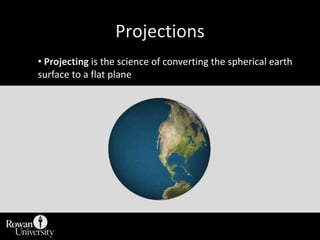
ProjectionsProjecting is the science of converting the spherical earth surface to a flat planeProjectionsNo system can do this perfectly. Some distortion will always exist.Properties that are distorted are angles, areas, directions, shapes and distances.Each projection distorts one or more of these while maintaining others.Selecting a projection is based on selecting which needs to be preserved.
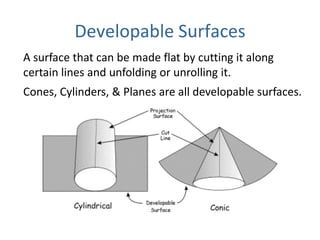
Developable SurfacesA surface that can be made flat by cutting it along certain lines and unfolding or unrolling it.Cones, Cylinders, & Planes are all developable surfaces.
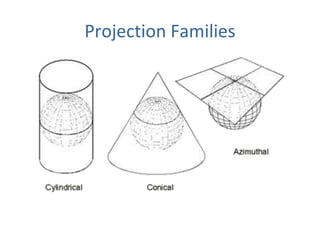
Developable SurfacesProjection families are based on the developable surface that is used to create themCones = conical projections
Cylinders = cylindrical projections
Planes = azimuthal or planar projectionsProjection Families
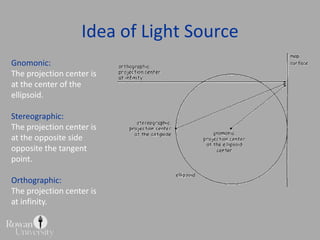
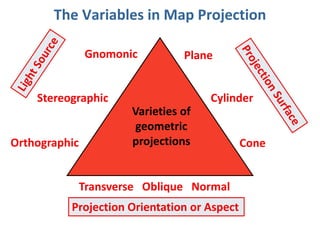
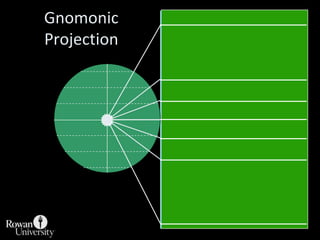
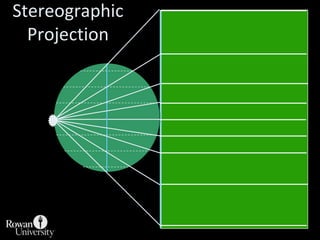
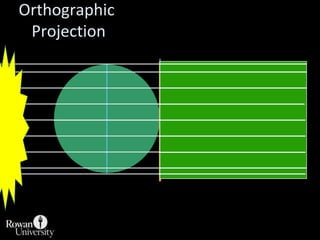
Idea of Light SourceGnomonic:The projection center is at the center of the ellipsoid.Stereographic: The projection center is at the opposite sideopposite the tangent point.Orthographic:The projection center is at infinity.
Types of ProjectionsDistortion is unavoidableConformal—where angles are preserved
Equal Area (equivalent)—where areas are preserved.
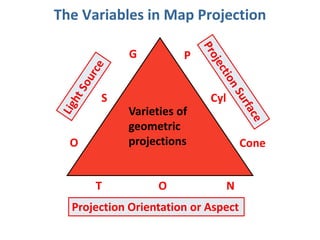
Equidistance—where distance is preserved between two points.The Variables in Map ProjectionGnomonicPlaneLight SourceProjection SurfaceStereographicCylinderVarieties ofgeometric projectionsOrthographicConeTransverse   ObliqueNormalProjection Orientation or Aspect
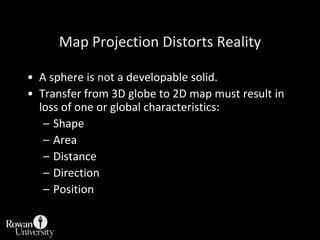
Map Projection Distorts RealityA sphere is not a developable solid.Transfer from 3D globe to 2D map must result in loss of one or global characteristics:ShapeAreaDistanceDirectionPosition
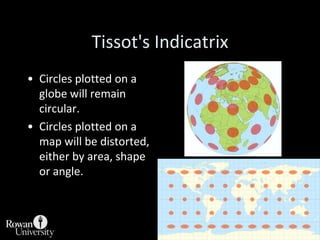
Tissot'sIndicatrixCircles plotted on a globe will remain circular.Circles plotted on a map will be distorted, either by area, shape or angle.
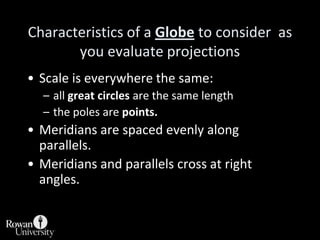
Characteristics of a Globe to consider  as you evaluate projectionsScale is everywhere the same:all great circles are the same lengththe poles are points.Meridians are spaced evenly along parallels.Meridians and parallels cross at right angles.
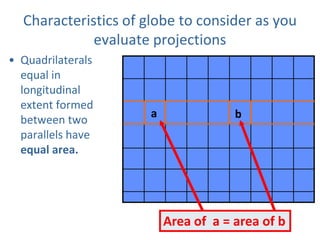
Characteristics of globe to consider as you evaluate projectionsabQuadrilaterals equal in longitudinal extent formed between two parallels have equal area.Area of  a = area of b
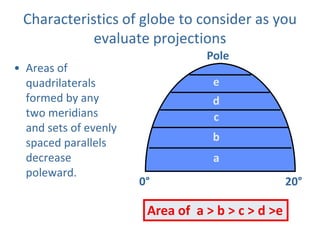
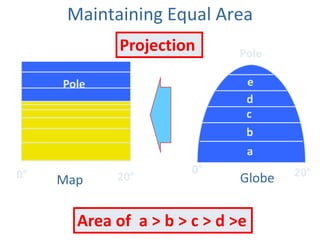
Poleedcba0°20°Characteristics of globe to consider as you evaluate projectionsAreas of quadrilaterals formed by any two meridians and sets of evenly spaced parallels decrease poleward.Area of  a > b > c > d >e
Classification of ProjectionsProjections are classed by the global characteristic preserved.Geometric approach to construction.projection surface“light” sourceOrientation.Interface of projection surface to Earth.
Global Characteristic PreservedConformal (Shape)Equivalent (Area)Equidistant (Distance)Azimuthal (Direction)
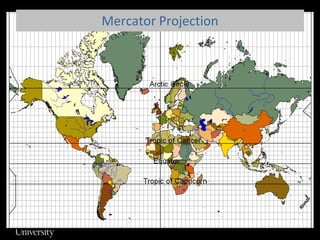
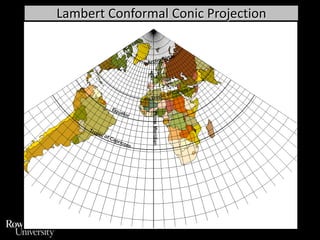
Conformal ProjectionsRetain correct angular relations in transfer from globe to map.Angles correct for small areas.Scale same in any direction around a point, but scale changes from point to point.Parallels and meridians cross at right angles.Large areas tend to look more like they do on the globe than is true for other projections.Examples: Mercator and Lambert Conformal Conic
Mercator Projection
Lambert Conformal Conic Projection
Equivalent or Equal Area ProjectionsA map areaof a given size, a circle three inches in diameter for instance, represents same amount of Earth space no matter where on the globe the map area is located. Maintaining equal area requires:Scale changes in one direction to be offset by scale changes in the other direction.Right angle crossing of meridians and parallels often lost, resulting in shape distortion.
PoleProjectionePoledcba0°20°0°20°Area of  a > b > c > d >eMaintaining Equal AreaGlobeMap
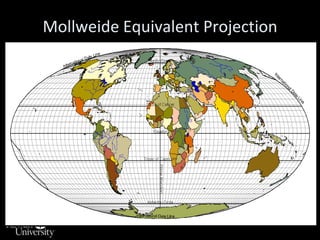
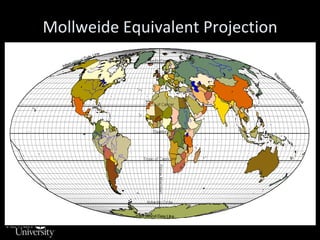
Mollweide Equivalent Projection
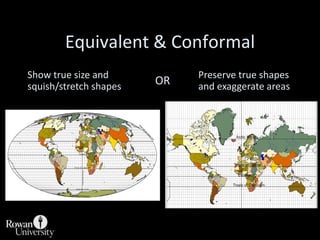
Equivalent & ConformalPreserve true shapes and exaggerate areasShow true size and squish/stretch shapesOR
Equidistant ProjectionsLength of  a straight line between two points represents correct great circle distance.Lines to measure distance can originate at only one or two points.
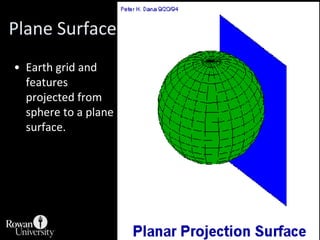
Plane SurfaceEarth grid and features projected from sphere to a plane surface.
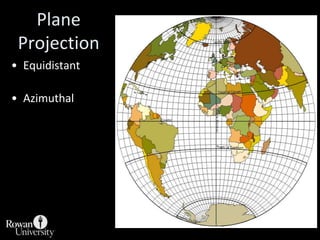
Plane ProjectionEquidistantAzimuthal
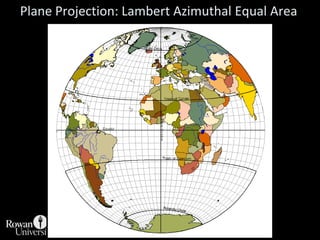
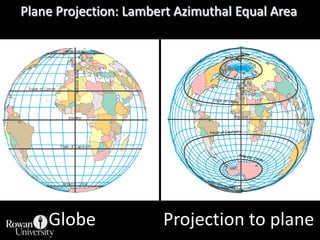
Plane Projection: Lambert Azimuthal Equal Area
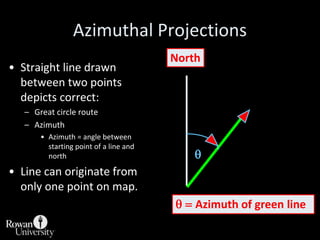
Azimuthal ProjectionsNorthStraight line drawn between two points depicts correct:Great circle routeAzimuthAzimuth = angle between starting point of a line and northLine can originate from only one point on map.Azimuth of green line
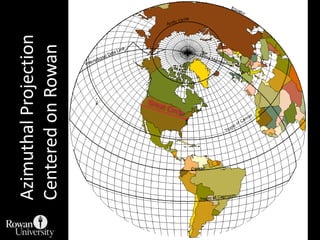
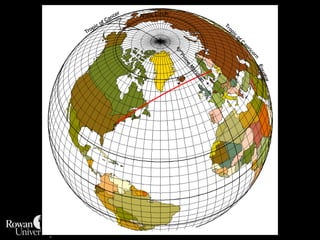
Azimuthal Projection Centered on RowanGreat Circle
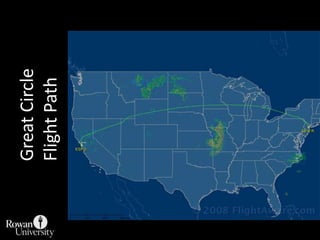
Great CircleFlight Path
Plane Projection: Lambert Azimuthal Equal AreaGlobeProjection to plane
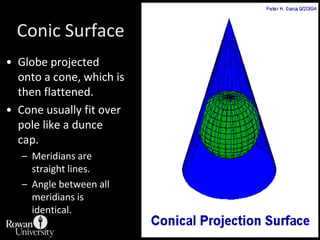
Conic SurfaceGlobe projected onto a cone, which is then flattened.Cone usually fit over pole like a dunce cap.Meridians are straight lines.Angle between all meridians is identical.
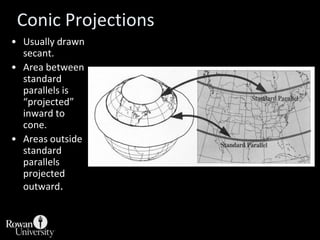
Conic ProjectionsUsually drawn secant.Area between standard parallels is “projected” inward to cone.Areas outside standard parallels projected outward.
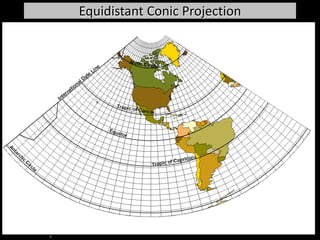
Equidistant Conic Projection
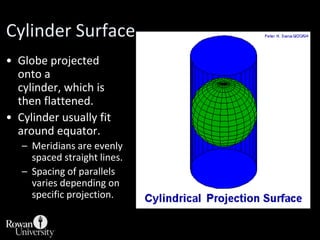
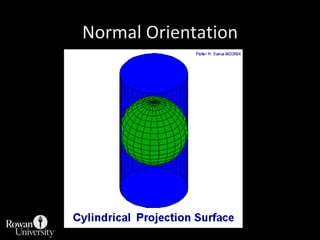
Cylinder SurfaceGlobe projected onto a cylinder, which is then flattened.Cylinder usually fit around equator.Meridians are evenly spaced straight lines.Spacing of parallels varies depending on specific projection.
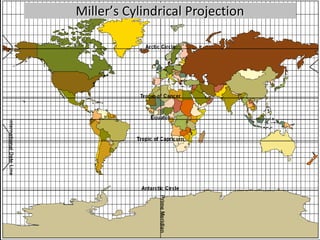
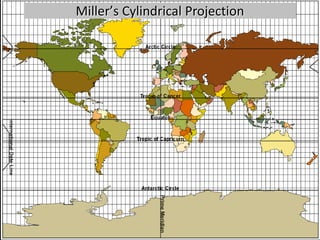
Miller’s Cylindrical Projection
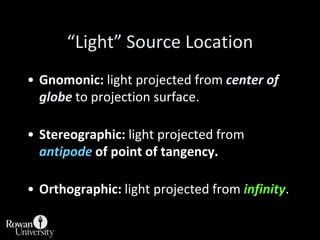
“Light” Source LocationGnomonic: light projected from center of globe to projection surface.Stereographic: light projected from antipodeof point of tangency.Orthographic: light projected from infinity.
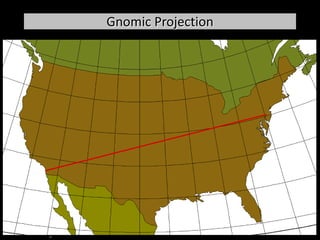
Gnomonic Projection
Gnomic Projection
Gnomic ProjectionMercator Projection
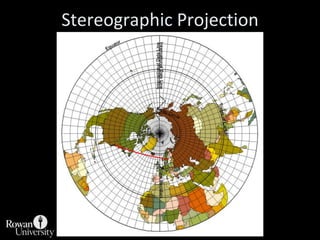
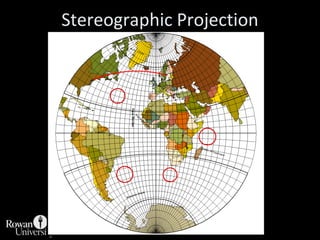
Stereographic Projection
Orthographic Projection
Normal Orientation
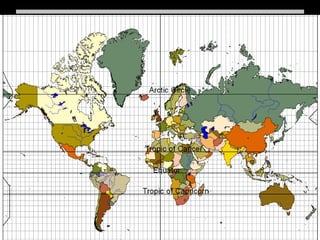
Mercator Projection
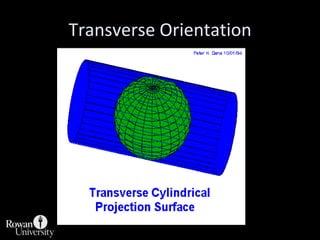
Transverse Orientation
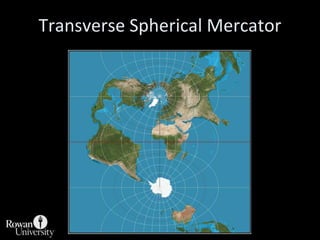
Transverse Spherical Mercator
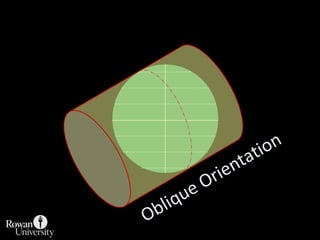
Oblique Orientation
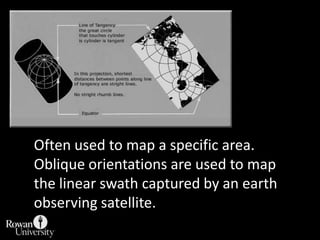
Often used to map a specific area. Oblique orientations are used to map the linear swath captured by an earth observing satellite.
The Variables in Map ProjectionGPProjection SurfaceLight SourceSCylVarieties ofgeometric projectionsOConeTO  NProjection Orientation or Aspect
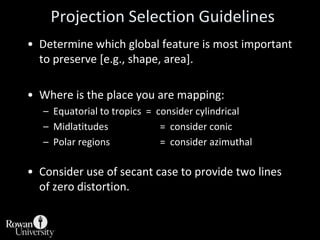
Projection Selection GuidelinesDetermine which global feature is most important to preserve [e.g., shape, area].Where is the place you are mapping:Equatorial to tropics  =  consider cylindricalMidlatitudes  		  =  consider conicPolar regions		  =  consider azimuthalConsider use of secant case to provide two lines of zero distortion.
Example Projections & Their UseCylindricalConicAzimuthalNongeometric or mathematical
Cylindrical Projections
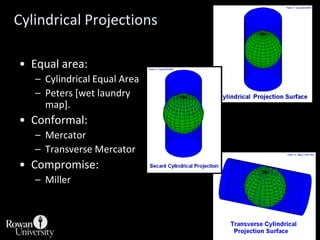
Cylindrical ProjectionsEqual area:Cylindrical Equal AreaPeters [wet laundry map].Conformal:MercatorTransverse MercatorCompromise:Miller
Cylindrical ProjectionsCylinder wrapped around globe:Scale factor = 1 at equator [normal aspect]Meridians are evenly spaced.  As one moves poleward, equal longitudinal distance on the map represents less and less distance on the globe.Parallel spacing varies depending on the projection.  For instance different light sources result in different spacing.
Peters ProjectionCylindrical – Equal Area
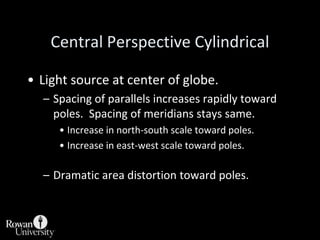
Central Perspective CylindricalLight source at center of globe.Spacing of parallels increases rapidly toward poles.  Spacing of meridians stays same.Increase in north-south scale toward poles.Increase in east-west scale toward poles.Dramatic area distortion toward poles.
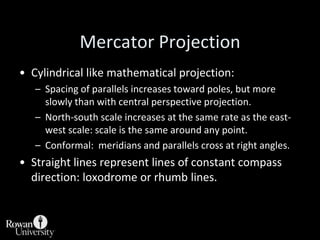
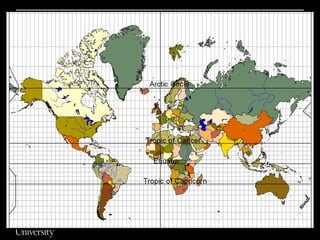
Mercator ProjectionCylindrical like mathematical projection:Spacing of parallels increases toward poles, but more slowly than with central perspective projection.North-south scale increases at the same rate as the east-west scale: scale is the same around any point.Conformal:  meridians and parallels cross at right angles. Straight lines represent lines of constant compass direction: loxodrome or rhumb lines.
Mercator Projection
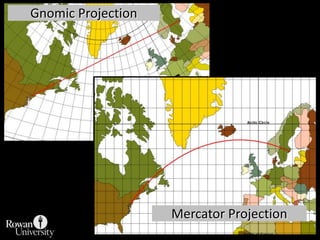
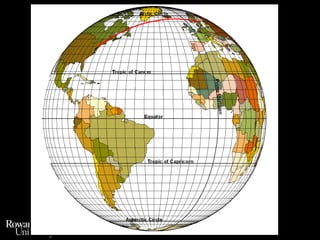
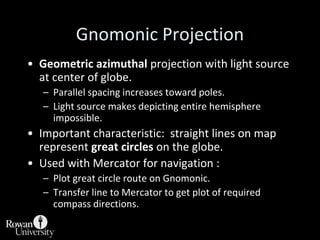
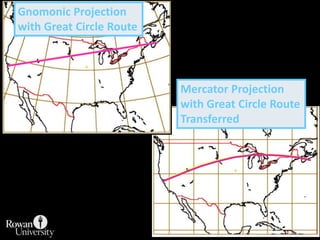
Gnomonic ProjectionGeometric azimuthal projection with light source at center of globe.Parallel spacing increases toward poles.Light source makes depicting entire hemisphere impossible.Important characteristic:  straight lines on map represent great circles on the globe.Used with Mercator for navigation :Plot great circle route on Gnomonic.Transfer line to Mercator to get plot of required compass directions.
Gnomonic Projection with Great Circle RouteMercator Projectionwith Great Circle RouteTransferred
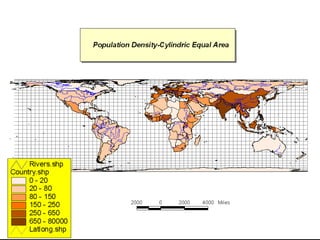
Cylindrical Equal AreaLight source: orthographic.Parallel spacing decreases toward poles.Decrease in N-S spacing of parallels is exactly offset by increase E-W scale of meridians.   Result is equivalent projection.Used for world maps.
Miller’s CylindricalCompromise projection near conformalSimilar to Mercator, but less distortion of area toward poles.Used for world maps.
Miller’s Cylindrical Projection
Conic Projections
ConicsGlobe projected onto a cone, which is then opened and flattened.Chief differences among conics result from:Choice of standard parallel.Variation in spacing of parallels.Transverse or oblique aspect is possible, but rare.All polar conics have straight meridians.Angle between meridians is identical for a given standard parallel.
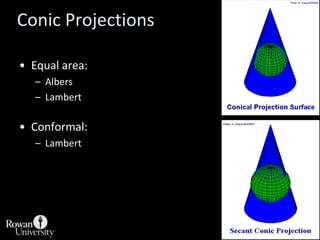
Conic ProjectionsEqual area:AlbersLambertConformal:Lambert
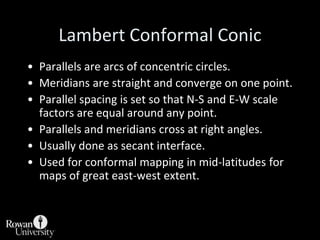
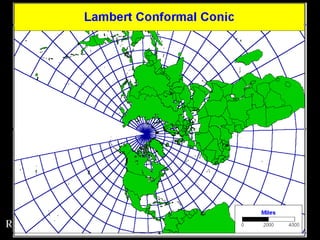
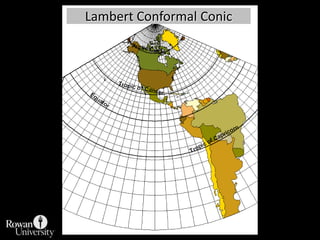
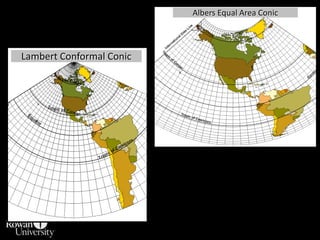
Lambert Conformal ConicParallels are arcs of concentric circles.Meridians are straight and converge on one point.Parallel spacing is set so that N-S and E-W scale factors are equal around any point.Parallels and meridians cross at right angles.Usually done as secant interface.Used for conformal mapping in mid-latitudes for maps of great east-west extent.
Lambert Conformal Conic
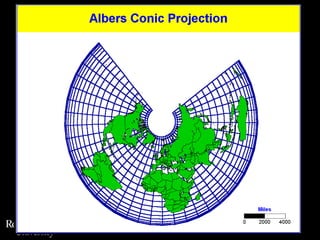
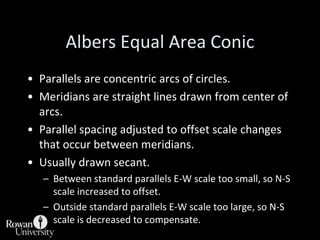
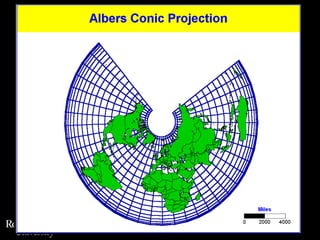
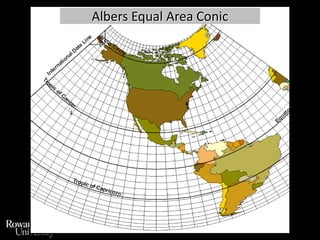
Albers Equal Area ConicParallels are concentric arcs of circles.Meridians are straight lines drawn from center of arcs.Parallel spacing adjusted to offset scale changes that occur between meridians.Usually drawn secant.Between standard parallels E-W scale too small, so N-S scale increased to offset.Outside standard parallels E-W scale too large, so N-S scale is decreased to compensate.
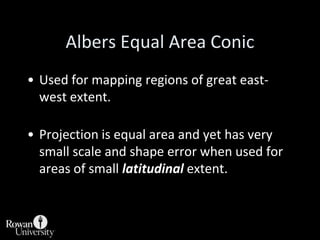
Albers Equal Area ConicUsed for mapping regions of great east-west extent.Projection is equal area and yet has very small scale and shape error when used for areas of small latitudinal extent.
Albers Equal Area Conic
Albers Equal Area ConicLambert Conformal Conic
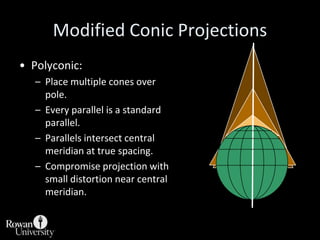
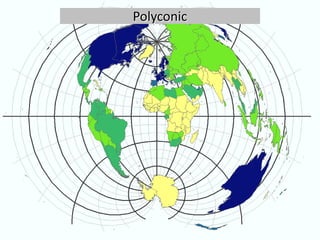
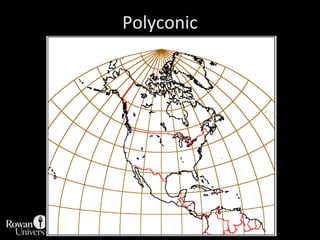
Modified Conic ProjectionsPolyconic:Place multiple cones over pole.Every parallel is a standard parallel.Parallels intersect central meridian at true spacing.Compromise projection with small distortion near central meridian.
7Polyconic
Polyconic
Azimuthal Projections
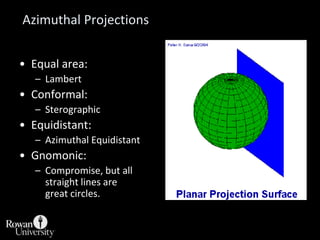
Azimuthal ProjectionsEqual area:LambertConformal:SterographicEquidistant:Azimuthal EquidistantGnomonic:Compromise, but all straight lines are great circles.
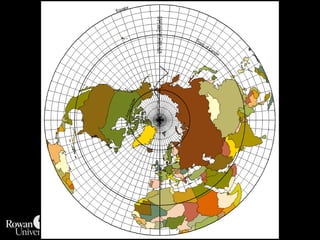
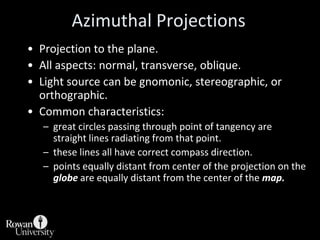
Azimuthal ProjectionsProjection to the plane.All aspects: normal, transverse, oblique.Light source can be gnomonic, stereographic, or orthographic.Common characteristics:great circles passing through point of tangency are straight lines radiating from that point.these lines all have correct compass direction. points equally distant from center of the projection on the globe are equally distant from the center of the map.
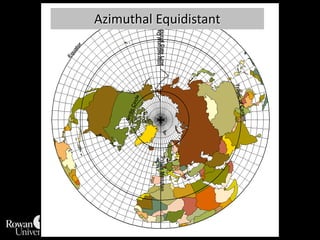
Azimuthal Equidistant
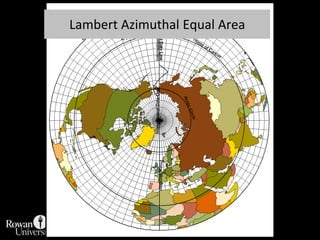
Lambert Azimuthal Equal Area
Other Projections
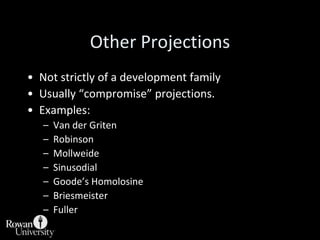
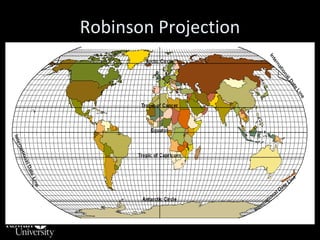
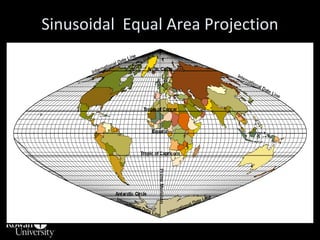
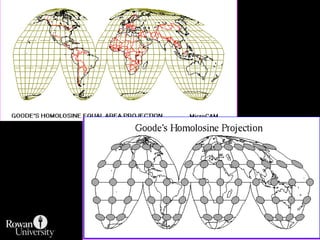
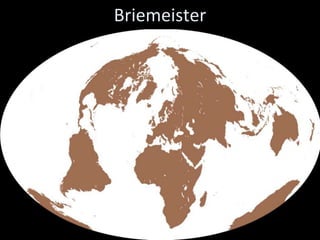
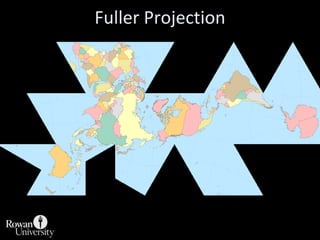
Other ProjectionsNot strictly of a development familyUsually “compromise” projections.Examples:Van der GritenRobinsonMollweideSinusodialGoode’s HomolosineBriesmeisterFuller
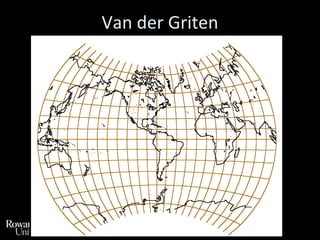
Van der Griten
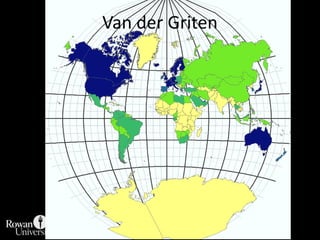
Van der Griten
Robinson Projection
Mollweide Equivalent Projection
Sinusoidal  Equal Area Projection
Briemeister

Map Projections