GEOGRAPHY
SKILLS:

SCALE


            Created by tbonnar.
Map Scale
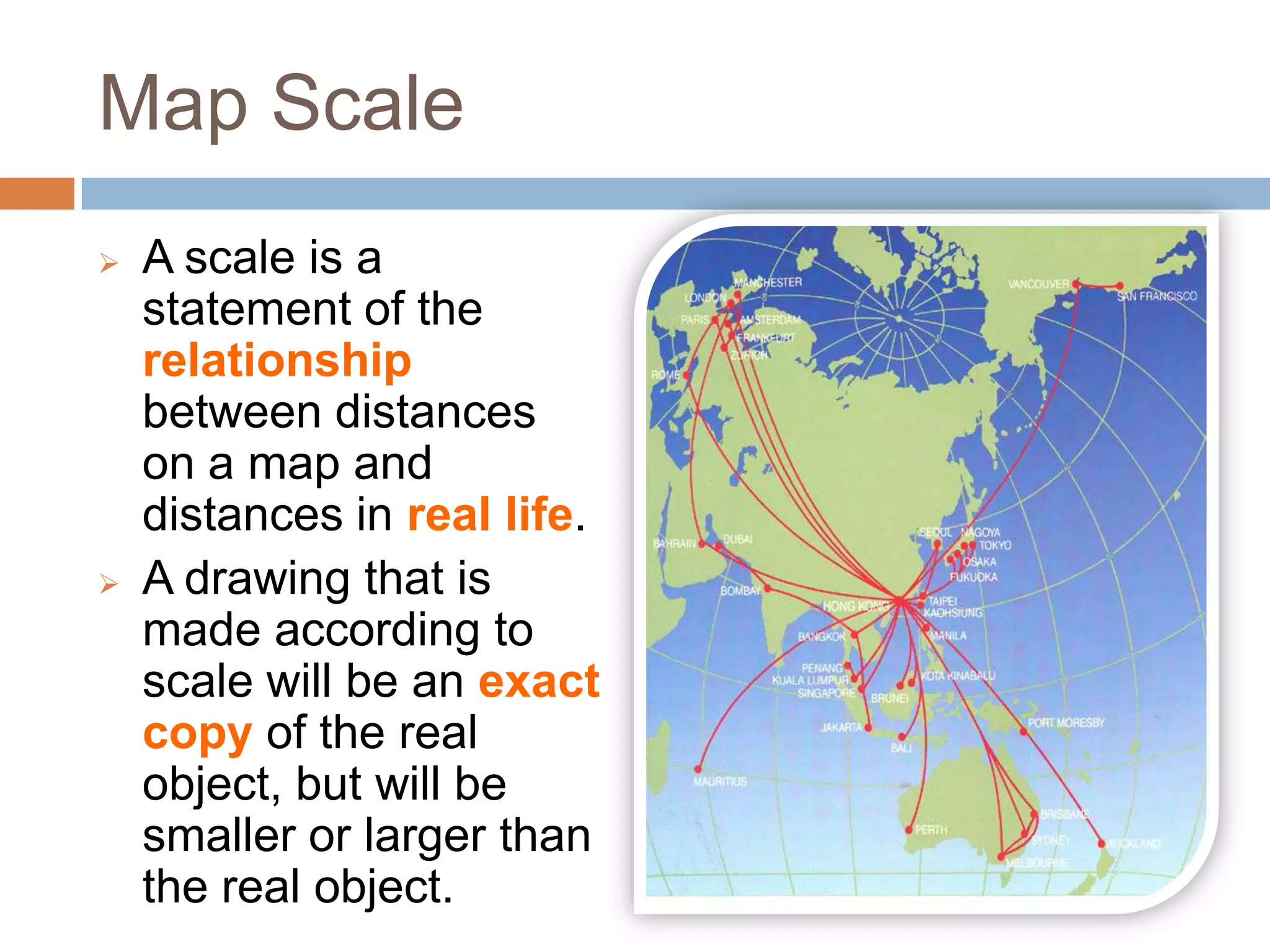
   A scale is a
    statement of the
    relationship
    between distances
    on a map and
    distances in real life.
   A drawing that is
    made according to
    scale will be an exact
    copy of the real
    object, but will be
    smaller or larger than
    the real object.
Map Scale
   Scale drawings are often used in real life
    because they are very accurate, including in
    maps, blueprints, and architectural models.
Section A:
Three Types of Scale

   There are three different ways to write
    scale.
           Stated • 1 cm = 250 km
           Scale
            Linear
            Scale
            Ratio     • 1:25 000 000
            Scale
Map Scales
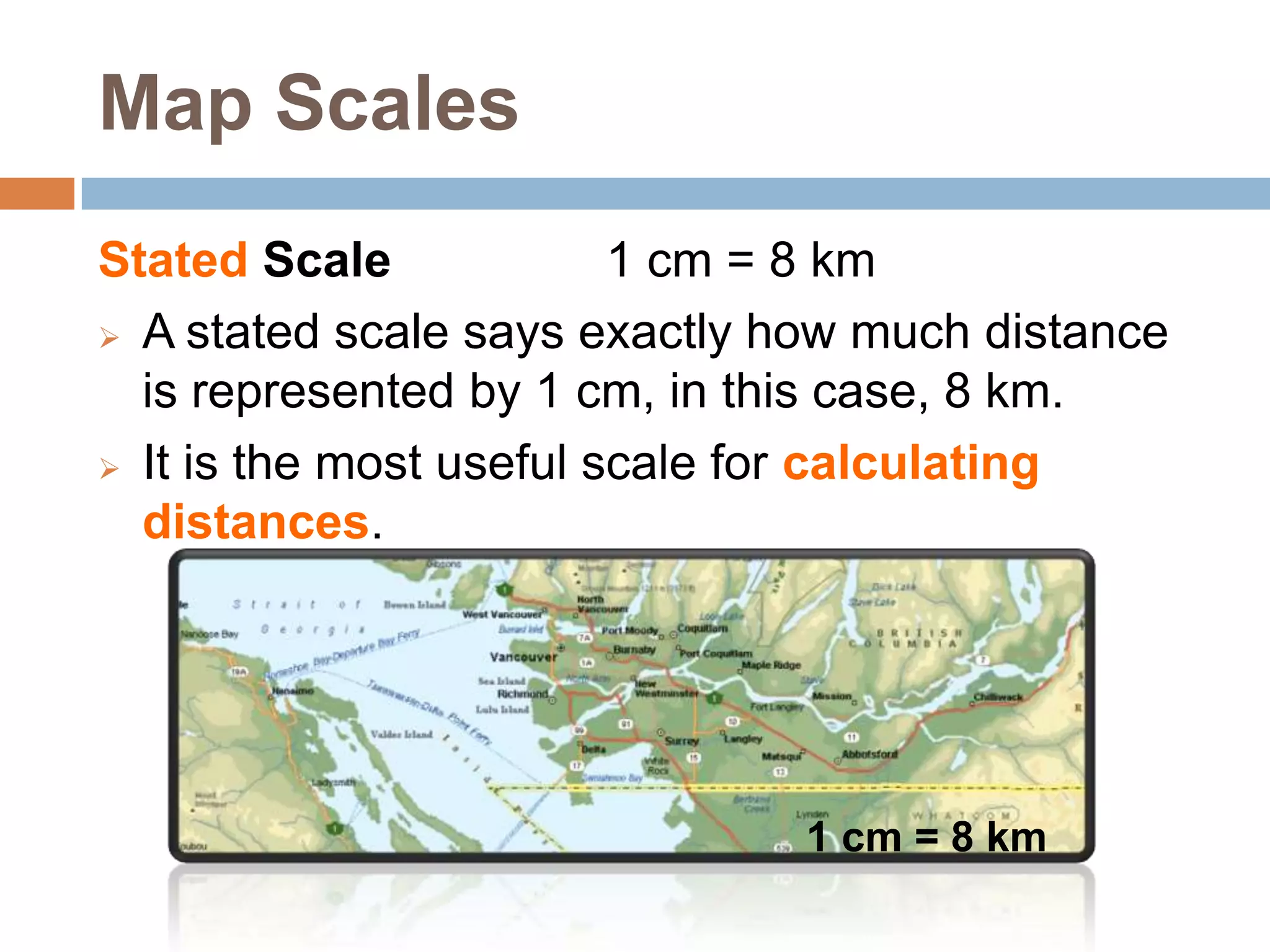
Stated Scale             1 cm = 8 km
 A stated scale says exactly how much distance

  is represented by 1 cm, in this case, 8 km.
 It is the most useful scale for calculating

  distances.


                               1 cm = 8 km
Map Scales
Linear Scale:
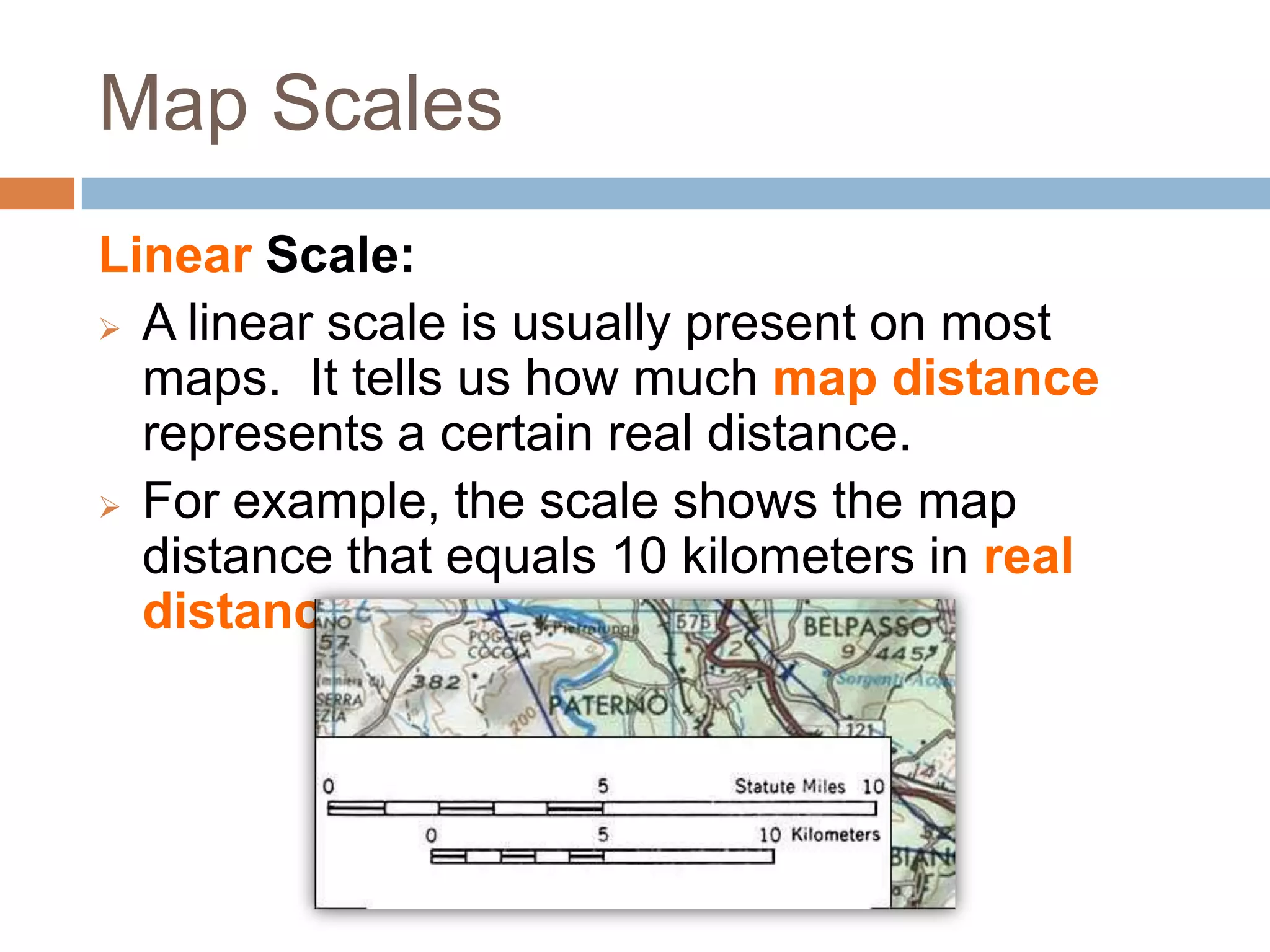
 A linear scale is usually present on most
  maps. It tells us how much map distance
  represents a certain real distance.
 For example, the scale shows the map
  distance that equals 10 kilometers in real
  distance.
Map Scales

Ratio Scale
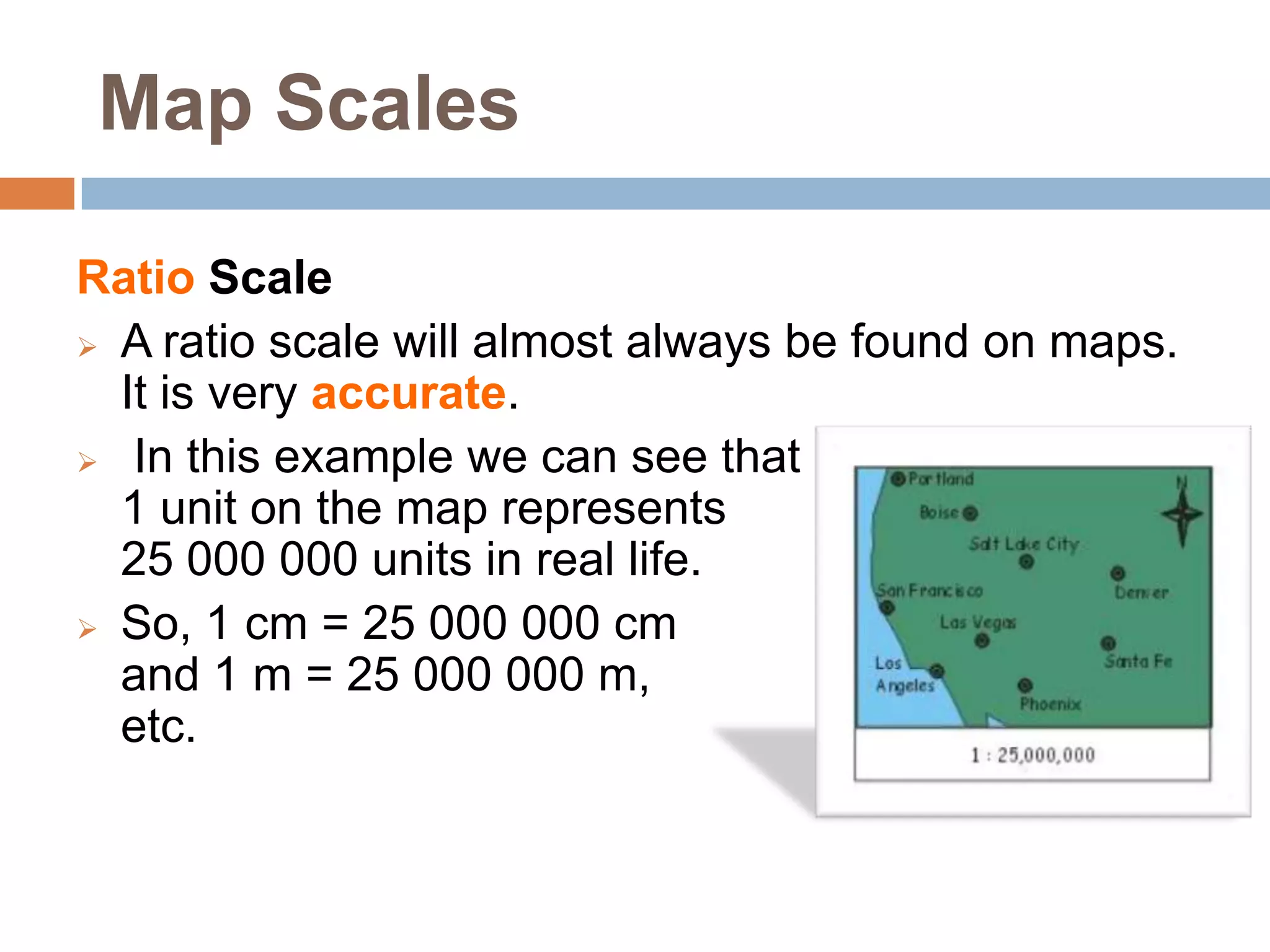
 A ratio scale will almost always be found on maps.
  It is very accurate.
 In this example we can see that
  1 unit on the map represents
  25 000 000 units in real life.
 So, 1 cm = 25 000 000 cm
  and 1 m = 25 000 000 m,
  etc.
Map Scales: Changing
Scales
   Distances such as 25 000 000 cm are very
    difficult to imagine. So, we usually change a
    ratio scale into a stated scale.
   In this example, we would use the metric
    system to help us change the ratio scale of
    1:25 000 000 into a stated scale of 1 cm = 250
    km.
Section B:
Metric System Review

   Recall that the metric system is based
    on multiplying and dividing by 10. To
    change from one unit to another you
    just need to multiply or divide by 10
    the correct number of times.
Metric System Review
   Another way to say this is that you just
    need to move the decimal place the
    correct number of spaces to the left
    (dividing) or right (multiplying). For scale
    calculations, you need to learn a quick
    method of changing units.
Metric System Review
Quick Method of Changing Units

a) To change cm into km, move your decimal
  five places to the left.
  ex. 550 000 cm = 5.5 km

b) To change km into cm, move your decimal
  five places to the right.
  ex. 72 km = 7 200 000 cm
Metric System Review
Practice 1. Make the following conversions using
  the shortcut method.

a) 47 000 cm =       km    d) 89 km =      cm
b) 321 400 cm =      km    e) 6.5 km =
      cm
c) 4 000 000 cm =    km    f) .54 km =     cm
Metric System Review
Practice 1. Make the following conversions using
  the shortcut method.

a) 47 000 cm =   0.47 km   d) 89 km = 8 900 000 cm
b) 321 400 cm = 3.214 km   e) 6.5 km = 650 000 cm
c) 4 000 000 cm = 40 km    f) .54 km = 54 000 cm
Section C:
Changing from
Ratio Scale to Stated Scale
Changing from Ratio Scale to Stated
Scale
   It is easiest to calculate distance using a Stated
    Scale, but most maps don’t include Stated Scales.
   So, to change Ratio Scale into Stated Scale, do the
    following.
                                         Stated Scale
• 1:25 000 000

                              • 1 cm = 250 km
          Ratio Scale
Changing Scales
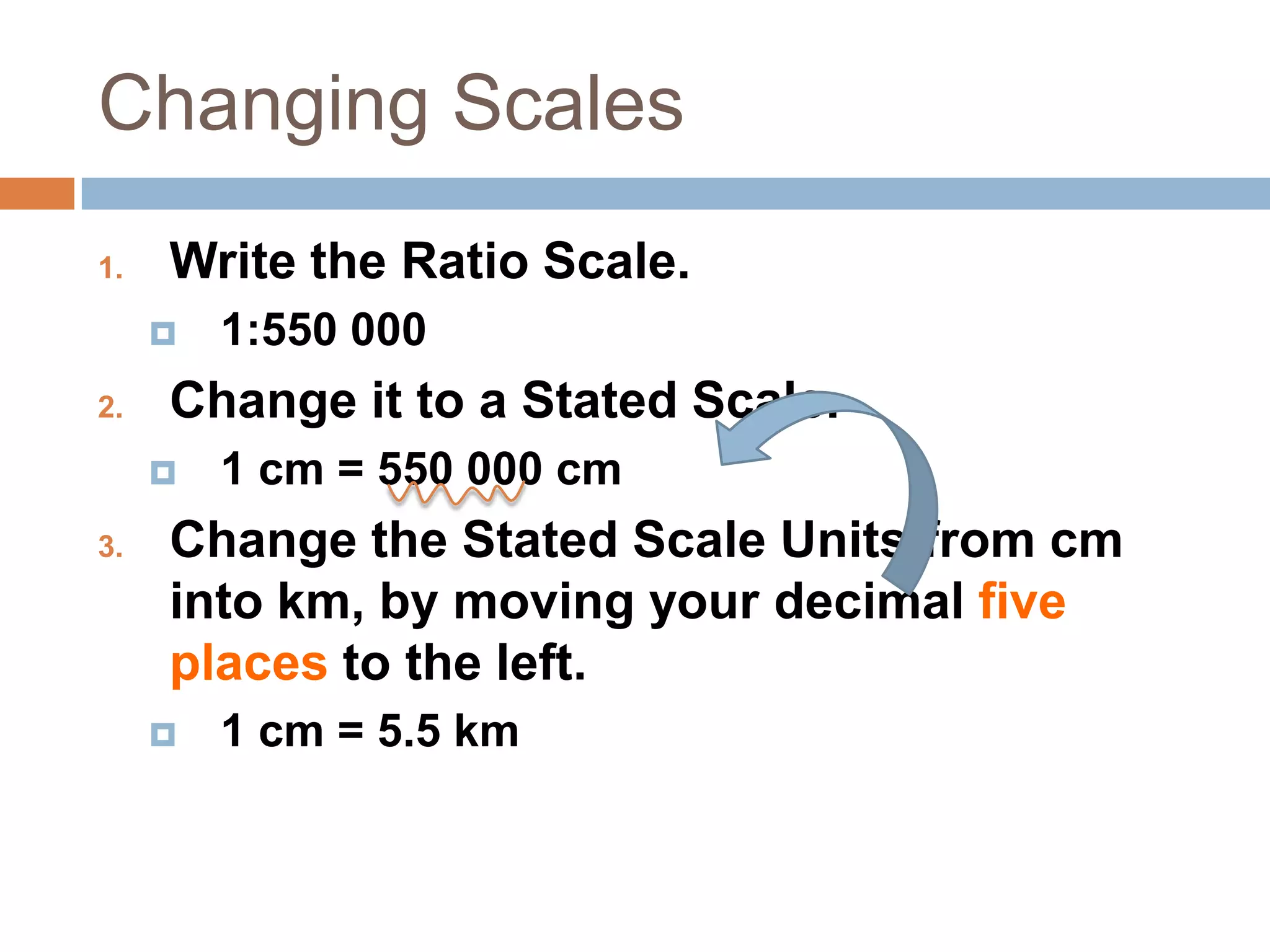
1.   Write the Ratio Scale.
        1:550 000
2.   Change it to a Stated Scale.
        1 cm = 550 000 cm
3.   Change the Stated Scale Units from cm
     into km, by moving your decimal five
     places to the left.
        1 cm = 5.5 km
Changing Scales
Practice 2. Find the ratio scale of the main map
  and change it to a stated scale.
ex. p132
1 : 44 000 000
1 cm = 44 000 000 cm
1 cm = 440 km

a) p65     b) p116         c) p136    d) p71
Changing Scales
Practice 2.
a) p65              b) p116
1: 7 000 000        1 : 13 000 000
1cm = 7 000 000cm   1cm = 13 000 000cm
1cm = 70km                 1cm = 130km

c) p136             d) p71
1:25 000 000        1:50 000
1cm=25 000 000cm    1cm = 50 000cm
1cm = 250km         1cm=0.5km
Section D: Solving scale questions
using cross-multiplication
   Now that you know how to change a ratio
    scale into a stated scale, you can calculate the
    real distance between two places shown on a
    map. To do so though, you need to know how
    to cross-multiply.
Solving scale questions
using cross-multiplication
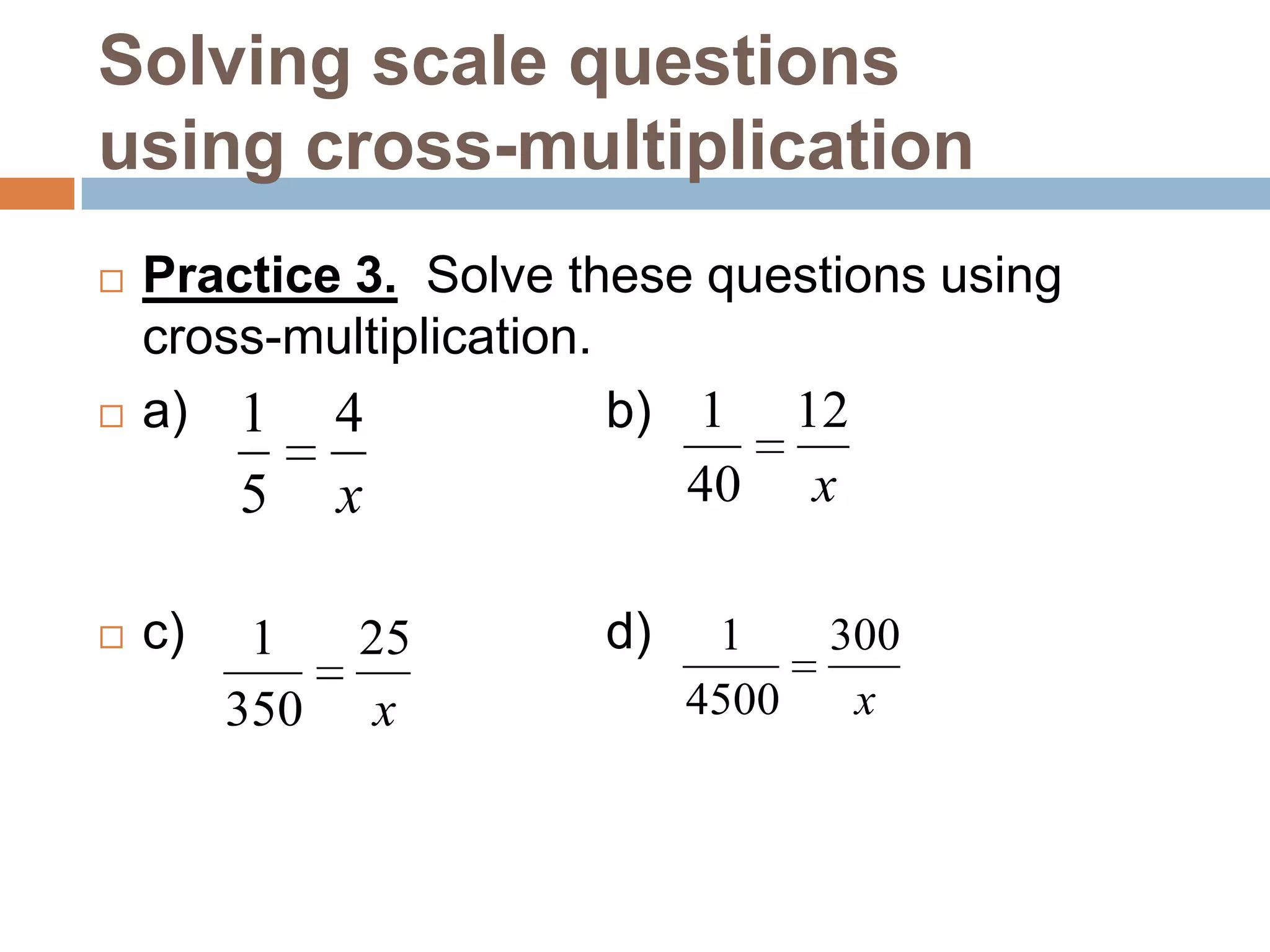
   Practice 3. Solve these questions using
    cross-multiplication.
   a) 1 4                b) 1 12
        5 x                  40 x

   c)    1    25      d)    1     300
         350    x           4500    x
Solving scale questions
using cross-multiplication
   Practice 3. Solve these questions using
    cross-multiplication.
   a) 1 4                b) 1 12
        5 x                  40 x

   c)    1    25      d)    1     300
         350    x           4500    x
Section E: Five Steps
to Calculate Real Distance
Now, you are ready to calculate the real distances
  between
places shown on a map by following these five simple
  steps.

   Step A. Find the ratio scale.
   Step B. Change the ratio scale into a stated scale.
   Step C. Measure the map distance in cm.
   Step D. Use cross-multiplication to solve this
    equation:
    scale (cm) = map distance (cm)
    scale (km) real distance (km)
   Step E. Write a conclusion (a therefore statement).
    Include the country names.
Section E: Five Steps
   to Calculate Real Distance
   Example: Madrid to Moscow
Step A 1:25 000 000
Step B 1 cm = 250 km
Step C m.d. = 13.2 cm
Step D scale (cm) = map distance (cm)
       scale (km) real distance (km)

          1 cm    = 13.2 cm
         250 km         x
               1x = 13.2(250)
                x = 3300 km
Step E    Madrid, Spain is 3300km from Moscow, Russia.
Section E: Five Steps
  to Calculate Real Distance
  Example: Casablanca to Cairo
Step A   1:37 000 000
Step B   1 cm = 370 km
Step C   m.d. = 10.2 cm
Step D   scale (cm) = map distance (cm)
         scale (km) real distance (km)

           1 cm     =   10.2 cm
          370 km          x

                   x = 3374 km
Step E     Casablanca, Morocco is 3774 km from Cairo, Egypt.
Map Scales:
Large Scale vs. Small Scale
Larg
e
Scal
e vs.
Smal
l
Scal
Map Scales:
    Large Scale vs. Small Scale
   A map showing the
    whole world is on a
    very small scale
    (1:360 000 000 000)
    which allows for an
    overall view, but not
    much detail.
   Small scale maps are
    ideal for travelling by
    car because they cover
    large areas of land.
                              1:250 000
Map Scales:
Large Scale vs. Small Scale
   A town plan is on a
    much larger scale so
    that features such as
    roads can be shown
    clearly (1cm:500m)
   Large scale maps are
    better for showing
    individual buildings in
    detail because they
    only cover a small
    area of land.

Geography Skills: Scale

  • 1.
    GEOGRAPHY SKILLS: SCALE Created by tbonnar.
  • 2.
    Map Scale  A scale is a statement of the relationship between distances on a map and distances in real life.  A drawing that is made according to scale will be an exact copy of the real object, but will be smaller or larger than the real object.
  • 3.
    Map Scale  Scale drawings are often used in real life because they are very accurate, including in maps, blueprints, and architectural models.
  • 4.
  • 5.
    Three Types ofScale  There are three different ways to write scale. Stated • 1 cm = 250 km Scale Linear Scale Ratio • 1:25 000 000 Scale
  • 6.
    Map Scales Stated Scale 1 cm = 8 km  A stated scale says exactly how much distance is represented by 1 cm, in this case, 8 km.  It is the most useful scale for calculating distances. 1 cm = 8 km
  • 7.
    Map Scales Linear Scale: A linear scale is usually present on most maps. It tells us how much map distance represents a certain real distance.  For example, the scale shows the map distance that equals 10 kilometers in real distance.
  • 8.
    Map Scales Ratio Scale A ratio scale will almost always be found on maps. It is very accurate.  In this example we can see that 1 unit on the map represents 25 000 000 units in real life.  So, 1 cm = 25 000 000 cm and 1 m = 25 000 000 m, etc.
  • 9.
    Map Scales: Changing Scales  Distances such as 25 000 000 cm are very difficult to imagine. So, we usually change a ratio scale into a stated scale.  In this example, we would use the metric system to help us change the ratio scale of 1:25 000 000 into a stated scale of 1 cm = 250 km.
  • 10.
  • 11.
    Metric System Review  Recall that the metric system is based on multiplying and dividing by 10. To change from one unit to another you just need to multiply or divide by 10 the correct number of times.
  • 12.
  • 13.
    Metric System Review  Another way to say this is that you just need to move the decimal place the correct number of spaces to the left (dividing) or right (multiplying). For scale calculations, you need to learn a quick method of changing units.
  • 14.
    Metric System Review QuickMethod of Changing Units a) To change cm into km, move your decimal five places to the left. ex. 550 000 cm = 5.5 km b) To change km into cm, move your decimal five places to the right. ex. 72 km = 7 200 000 cm
  • 15.
    Metric System Review Practice1. Make the following conversions using the shortcut method. a) 47 000 cm = km d) 89 km = cm b) 321 400 cm = km e) 6.5 km = cm c) 4 000 000 cm = km f) .54 km = cm
  • 16.
    Metric System Review Practice1. Make the following conversions using the shortcut method. a) 47 000 cm = 0.47 km d) 89 km = 8 900 000 cm b) 321 400 cm = 3.214 km e) 6.5 km = 650 000 cm c) 4 000 000 cm = 40 km f) .54 km = 54 000 cm
  • 17.
    Section C: Changing from RatioScale to Stated Scale
  • 18.
    Changing from RatioScale to Stated Scale  It is easiest to calculate distance using a Stated Scale, but most maps don’t include Stated Scales.  So, to change Ratio Scale into Stated Scale, do the following. Stated Scale • 1:25 000 000 • 1 cm = 250 km Ratio Scale
  • 19.
    Changing Scales 1. Write the Ratio Scale.  1:550 000 2. Change it to a Stated Scale.  1 cm = 550 000 cm 3. Change the Stated Scale Units from cm into km, by moving your decimal five places to the left.  1 cm = 5.5 km
  • 20.
    Changing Scales Practice 2.Find the ratio scale of the main map and change it to a stated scale. ex. p132 1 : 44 000 000 1 cm = 44 000 000 cm 1 cm = 440 km a) p65 b) p116 c) p136 d) p71
  • 21.
    Changing Scales Practice 2. a)p65 b) p116 1: 7 000 000 1 : 13 000 000 1cm = 7 000 000cm 1cm = 13 000 000cm 1cm = 70km 1cm = 130km c) p136 d) p71 1:25 000 000 1:50 000 1cm=25 000 000cm 1cm = 50 000cm 1cm = 250km 1cm=0.5km
  • 22.
    Section D: Solvingscale questions using cross-multiplication  Now that you know how to change a ratio scale into a stated scale, you can calculate the real distance between two places shown on a map. To do so though, you need to know how to cross-multiply.
  • 23.
    Solving scale questions usingcross-multiplication  Practice 3. Solve these questions using cross-multiplication.  a) 1 4 b) 1 12 5 x 40 x  c) 1 25 d) 1 300 350 x 4500 x
  • 24.
    Solving scale questions usingcross-multiplication  Practice 3. Solve these questions using cross-multiplication.  a) 1 4 b) 1 12 5 x 40 x  c) 1 25 d) 1 300 350 x 4500 x
  • 25.
    Section E: FiveSteps to Calculate Real Distance Now, you are ready to calculate the real distances between places shown on a map by following these five simple steps.  Step A. Find the ratio scale.  Step B. Change the ratio scale into a stated scale.  Step C. Measure the map distance in cm.  Step D. Use cross-multiplication to solve this equation: scale (cm) = map distance (cm) scale (km) real distance (km)  Step E. Write a conclusion (a therefore statement). Include the country names.
  • 26.
    Section E: FiveSteps to Calculate Real Distance Example: Madrid to Moscow Step A 1:25 000 000 Step B 1 cm = 250 km Step C m.d. = 13.2 cm Step D scale (cm) = map distance (cm) scale (km) real distance (km) 1 cm = 13.2 cm 250 km x 1x = 13.2(250) x = 3300 km Step E Madrid, Spain is 3300km from Moscow, Russia.
  • 27.
    Section E: FiveSteps to Calculate Real Distance Example: Casablanca to Cairo Step A 1:37 000 000 Step B 1 cm = 370 km Step C m.d. = 10.2 cm Step D scale (cm) = map distance (cm) scale (km) real distance (km) 1 cm = 10.2 cm 370 km x x = 3374 km Step E Casablanca, Morocco is 3774 km from Cairo, Egypt.
  • 28.
    Map Scales: Large Scalevs. Small Scale
  • 29.
  • 30.
    Map Scales: Large Scale vs. Small Scale  A map showing the whole world is on a very small scale (1:360 000 000 000) which allows for an overall view, but not much detail.  Small scale maps are ideal for travelling by car because they cover large areas of land. 1:250 000
  • 31.
    Map Scales: Large Scalevs. Small Scale  A town plan is on a much larger scale so that features such as roads can be shown clearly (1cm:500m)  Large scale maps are better for showing individual buildings in detail because they only cover a small area of land.