ANUSHKA SINGH
CARTOGRAPHY
CONTENT
• * INTRODUCTION
• * CARTOGRAPHIC PROCESSES
• * USES & FUNCTIONS OF MAPS
• * TYPES OF MAP & MAP SYMBOLS
• * MAP PROJECTIONS
• * TECHNOLOGICAL CHANGES
• * ADVANTAGES OF MAPS & LIMITATIONS
• * CONCLUSION
• * BIBLIOGRAPHY
INTRODUCTION
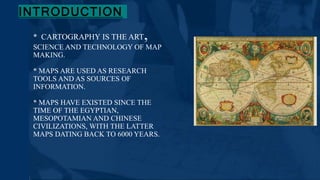
* CARTOGRAPHY IS THE ART,
SCIENCE AND TECHNOLOGY OF MAP
MAKING.
* MAPS ARE USED AS RESEARCH
TOOLS AND AS SOURCES OF
INFORMATION.
* MAPS HAVE EXISTED SINCE THE
TIME OF THE EGYPTIAN,
MESOPOTAMIAN AND CHINESE
CIVILIZATIONS, WITH THE LATTER
MAPS DATING BACK TO 6000 YEARS.
CARTOGRAPHIC PROCESS
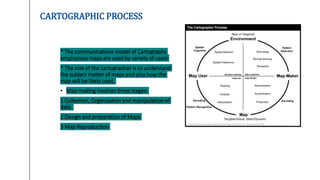
* The communications model of Cartography
emphasizes maps are used by variety of users
* The role of the cartographer is to understand
the subject matter of maps and also how the
map will be likely used.
• Map making involves three stages:
1 Collection, Organization and manipulation of
data.
2 Design and preparation of Maps
3 Map Reproduction
1. COLLECTION, ORGANIZATION AND MANIPULATION OF DATA
* Data collection from existing maps, aerial photographs or digital imagery,
documents e.g. legal descriptions of property boundaries, historical documents,
etc., field work or questionnaire surveys.
• Data organized to understand the phenomena being represented.
• * Data manipulation - in a form suitable for map making i.e. aggregating data to
some specified set of spatial units, percentages, densities or other
summary measures.
2. DESIGN AND PREPARATION OF MAP
• Many decisions go into the design of an effective map.
• * These include geographic features and thematic attributes.
• * The choices depend upon purpose of the map, the intended audience and the cartographer's
understanding of the phenomena being represented.
• * Maps of large areas it is a must to choose an appropriate map projection.
• * Small scale maps are less detailed but covers a larger area.
3. MAP REPRODUCTION
• Many decisions go into the design of an effective map.
• * These include geographic features and thematic attributes.
• * The choices depend upon purpose of the map, the intended audience and the cartographer's
understanding of the phenomena being represented.
• * Maps of large areas it is a must to choose an appropriate map projection.
• * Small scale maps are less detailed but covers a larger area.
USES OF MAPS
• It is a learned process requiring a variety of skills.
• * Using a Map involves, three processes:
• + Map reading
• + Analysis
• + Interpretation
TYPES OF MAPS
• Hundreds of Maps Prepared for Various
Purposes
• × General vs. thematic cartography
• × Topographic vs. topological
MAP SYMBOLS
× In cartography symbols are everything.
• Cartographic symbology has been developed in an effort to portray
the world accurately and effectively convey information to the map
reader.
• * A legend explains the pictorial language of the map, known
as its symbology.
MAP PROJECTION
• Any system for transferring parallels and meridians from a globe onto a flat map
is called a projection.
• Mapmakers create projections according to mathematical formulas, often with
the aid of computers.
• × It is impossible to project a sphere, such as the earth's surface, onto a flat
surface with complete accuracy.
• * Every flat map has inaccuracies in scale that result from shrinking the globe in
some places and stretching it in others to flatten it.
.
• Projections by surface
• + Cylindrical+ Pseudocylindrical
• + Hybrid
• + Conic
• + Pseudoconic
• + Azimuthal (projections onto a plane)
• Projections by preservation of a metric property
• + Conformal
• + Equal-area+ Equidistant+ Gnomonic
• + Retroazimuthal
• + Compromise projections
+ A map projection may be classified according to which properties of the
globe it distorts least.
+ Equal-area projections represent the sizes of regions in correct relation to
one another but distort shapes.
+ Conformal projections show angles and directions at any point accurately but
distort size relationships.
+ A map cannot be both equal-area and conformal, but many maps are neither.
There is no name for this third category of projections classified by distortion.
• A second way of classifying projections is according to the geometrical shape of the surface onto which the
projection is drawn.
• Many maps are--in theory--projections onto a cylinder, a cone, or a plane.
• Cylindrical projections are projections of the globe onto a cylinder.
Although constructed by mathematical formulas, such projections can be visualized by imagining a paper
cylinder wrapped around an illuminated globe.
• Lines from the globe would be projected onto the cylinder, which would then be slit and unrolled. The
resulting map has one or two lines that are free from distortion.
• The most famous cylindrical projection is the Mercator projection.
• This conformal projection is useful to navigators because a straight
line drawn between any two points on the mapprovides a route that
can be followed without changing compass direction.
• Conic projections are projections of a globe onto a cone.
• To visualize a conic projection, imagine a paper cone with its open end
resting over part of an illuminated globe.
• Lines from the globe would be projected onto the cone, which would
then be slit and unrolled.
• If the point of the cone lies directly above one of the poles, the
meridians are projected as straight lines radiating from the pole.
• The parallels appear as portions of a circle.
• Azimuthal projections are used most commonly to map compact areas of the earth's surface, such as the
polar regions.
• One type of azimuthal projection, called a gnomonic projection, shows the shortest distance between any
two points on the earth as a straight line.& This distance is known as a great-circle route.
• Gnomonic projections are especially useful for planning intercontinental flights.
• Other projections:
• * Several useful projections are not based on the cylinder, cone, or plane. For example, projections that are oval in shape
fall into a different category.
• * Equal-area oval projections have little distortion along the equator and along the meridian that runs through their
center.
• * Mapmakers can achieve even less distortion by splitting the oval into several arching shapes.
ADVANTAGES OF MAPS
• Maps are more objective and more efficient than verbal descriptions.
• A map makes it simpler to visualize and understand the spatial patterns.
• Maps can be useful sources of data and can give an historical perspective.
• Maps can be used to solve complex problems.
LIMITATION OF MAPS
• No map is ever completely accurate or complete.
• No one map can show all features present on the surface of the actual area.
• Good maps show the features that are relevant and focuses less on other features.
CONCLUSION
Cartography is the theory and practice
of map making and map use.
• Map is a form of communication
between the map maker and the
map user.
• As maps are synoptic they should be
carefully designed to ensure the
information is effectively conveyed.
• Earliest known maps were hand
drawn whereas the modern day
maps are digitized using high end
softwares and instruments.
THANK YOU

cartography PPT...pptx

  • 1.
  • 2.
    CONTENT • * INTRODUCTION •* CARTOGRAPHIC PROCESSES • * USES & FUNCTIONS OF MAPS • * TYPES OF MAP & MAP SYMBOLS • * MAP PROJECTIONS • * TECHNOLOGICAL CHANGES • * ADVANTAGES OF MAPS & LIMITATIONS • * CONCLUSION • * BIBLIOGRAPHY
  • 3.
    INTRODUCTION * CARTOGRAPHY ISTHE ART, SCIENCE AND TECHNOLOGY OF MAP MAKING. * MAPS ARE USED AS RESEARCH TOOLS AND AS SOURCES OF INFORMATION. * MAPS HAVE EXISTED SINCE THE TIME OF THE EGYPTIAN, MESOPOTAMIAN AND CHINESE CIVILIZATIONS, WITH THE LATTER MAPS DATING BACK TO 6000 YEARS.
  • 4.
    CARTOGRAPHIC PROCESS * Thecommunications model of Cartography emphasizes maps are used by variety of users * The role of the cartographer is to understand the subject matter of maps and also how the map will be likely used. • Map making involves three stages: 1 Collection, Organization and manipulation of data. 2 Design and preparation of Maps 3 Map Reproduction
  • 5.
    1. COLLECTION, ORGANIZATIONAND MANIPULATION OF DATA * Data collection from existing maps, aerial photographs or digital imagery, documents e.g. legal descriptions of property boundaries, historical documents, etc., field work or questionnaire surveys. • Data organized to understand the phenomena being represented. • * Data manipulation - in a form suitable for map making i.e. aggregating data to some specified set of spatial units, percentages, densities or other summary measures.
  • 6.
    2. DESIGN ANDPREPARATION OF MAP • Many decisions go into the design of an effective map. • * These include geographic features and thematic attributes. • * The choices depend upon purpose of the map, the intended audience and the cartographer's understanding of the phenomena being represented. • * Maps of large areas it is a must to choose an appropriate map projection. • * Small scale maps are less detailed but covers a larger area.
  • 7.
    3. MAP REPRODUCTION •Many decisions go into the design of an effective map. • * These include geographic features and thematic attributes. • * The choices depend upon purpose of the map, the intended audience and the cartographer's understanding of the phenomena being represented. • * Maps of large areas it is a must to choose an appropriate map projection. • * Small scale maps are less detailed but covers a larger area.
  • 8.
    USES OF MAPS •It is a learned process requiring a variety of skills. • * Using a Map involves, three processes: • + Map reading • + Analysis • + Interpretation
  • 9.
    TYPES OF MAPS •Hundreds of Maps Prepared for Various Purposes • × General vs. thematic cartography • × Topographic vs. topological
  • 10.
    MAP SYMBOLS × Incartography symbols are everything. • Cartographic symbology has been developed in an effort to portray the world accurately and effectively convey information to the map reader. • * A legend explains the pictorial language of the map, known as its symbology.
  • 13.
    MAP PROJECTION • Anysystem for transferring parallels and meridians from a globe onto a flat map is called a projection. • Mapmakers create projections according to mathematical formulas, often with the aid of computers. • × It is impossible to project a sphere, such as the earth's surface, onto a flat surface with complete accuracy. • * Every flat map has inaccuracies in scale that result from shrinking the globe in some places and stretching it in others to flatten it.
  • 14.
    . • Projections bysurface • + Cylindrical+ Pseudocylindrical • + Hybrid • + Conic • + Pseudoconic • + Azimuthal (projections onto a plane) • Projections by preservation of a metric property • + Conformal • + Equal-area+ Equidistant+ Gnomonic • + Retroazimuthal • + Compromise projections
  • 15.
    + A mapprojection may be classified according to which properties of the globe it distorts least. + Equal-area projections represent the sizes of regions in correct relation to one another but distort shapes. + Conformal projections show angles and directions at any point accurately but distort size relationships. + A map cannot be both equal-area and conformal, but many maps are neither. There is no name for this third category of projections classified by distortion.
  • 16.
    • A secondway of classifying projections is according to the geometrical shape of the surface onto which the projection is drawn. • Many maps are--in theory--projections onto a cylinder, a cone, or a plane. • Cylindrical projections are projections of the globe onto a cylinder. Although constructed by mathematical formulas, such projections can be visualized by imagining a paper cylinder wrapped around an illuminated globe. • Lines from the globe would be projected onto the cylinder, which would then be slit and unrolled. The resulting map has one or two lines that are free from distortion.
  • 17.
    • The mostfamous cylindrical projection is the Mercator projection. • This conformal projection is useful to navigators because a straight line drawn between any two points on the mapprovides a route that can be followed without changing compass direction. • Conic projections are projections of a globe onto a cone. • To visualize a conic projection, imagine a paper cone with its open end resting over part of an illuminated globe. • Lines from the globe would be projected onto the cone, which would then be slit and unrolled. • If the point of the cone lies directly above one of the poles, the meridians are projected as straight lines radiating from the pole. • The parallels appear as portions of a circle.
  • 18.
    • Azimuthal projectionsare used most commonly to map compact areas of the earth's surface, such as the polar regions. • One type of azimuthal projection, called a gnomonic projection, shows the shortest distance between any two points on the earth as a straight line.& This distance is known as a great-circle route. • Gnomonic projections are especially useful for planning intercontinental flights. • Other projections: • * Several useful projections are not based on the cylinder, cone, or plane. For example, projections that are oval in shape fall into a different category. • * Equal-area oval projections have little distortion along the equator and along the meridian that runs through their center. • * Mapmakers can achieve even less distortion by splitting the oval into several arching shapes.
  • 19.
    ADVANTAGES OF MAPS •Maps are more objective and more efficient than verbal descriptions. • A map makes it simpler to visualize and understand the spatial patterns. • Maps can be useful sources of data and can give an historical perspective. • Maps can be used to solve complex problems. LIMITATION OF MAPS • No map is ever completely accurate or complete. • No one map can show all features present on the surface of the actual area. • Good maps show the features that are relevant and focuses less on other features.
  • 20.
    CONCLUSION Cartography is thetheory and practice of map making and map use. • Map is a form of communication between the map maker and the map user. • As maps are synoptic they should be carefully designed to ensure the information is effectively conveyed. • Earliest known maps were hand drawn whereas the modern day maps are digitized using high end softwares and instruments.
  • 21.