Scanning Transmission
Electron Microscope
Outline
• History
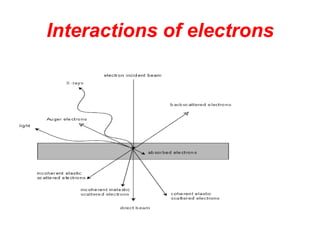
• Interactions of Electrons
• Background
• STEM
• Components
• Specimen Preparation
• Mode
• Image formation
• Comparison
Cont…
• The first STEM was built in 1938 by Baron
Manfred von Ardenne.(distroyed in air raid)
• Not developed further until the 1970.
• Then Albert Crewe at the University of
Chicago developed the field emission gun.
• Then built a STEM able to visualize single
heavy atoms on thin carbon substrates
Interactions of electrons
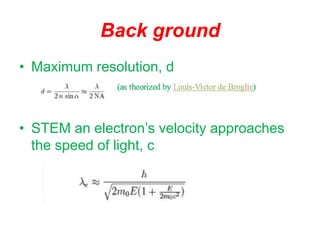
Back ground
• Maximum resolution, d
• STEM an electron’s velocity approaches
the speed of light, c
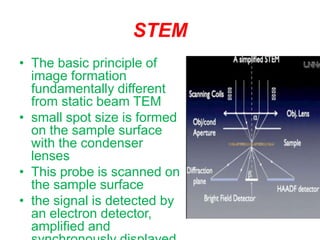
STEM
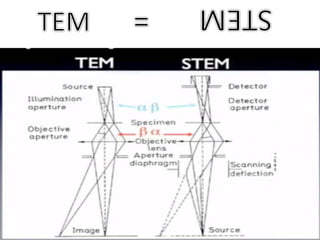
• The basic principle of
image formation
fundamentally different
from static beam TEM
• small spot size is formed
on the sample surface
with the condenser
lenses
• This probe is scanned on
the sample surface
• the signal is detected by
an electron detector,
amplified and
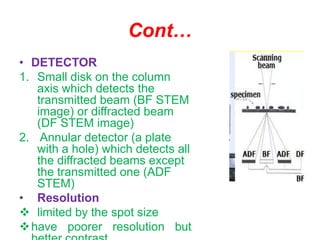
Cont…
• DETECTOR
1. Small disk on the column
axis which detects the
transmitted beam (BF STEM
image) or diffracted beam
(DF STEM image)
2. Annular detector (a plate
with a hole) which detects all
the diffracted beams except
the transmitted one (ADF
STEM)
• Resolution
 limited by the spot size
have poorer resolution but
Scattered beam electrons
• In STEM signal is detected by
I. back scattered electrons(BSE)
II. Transmitted beam electrons scattered at
some angles
• In both cases, BSE and TBE, the signal
intensity is a function of the average
atomic number of the sample volume and
also phase contrast that interacted with
the beam
• Thus providing atomic number and phase
Cont…
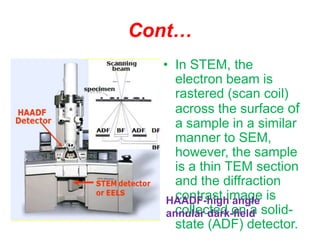
• In STEM, the
electron beam is
rastered (scan coil)
across the surface of
a sample in a similar
manner to SEM,
however, the sample
is a thin TEM section
and the diffraction
contrast image is
collected on a solid-
state (ADF) detector.
HAADF-high angle
annular dark-field
Components
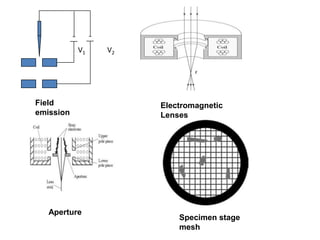
• Source formation
- Field emission
• Electromagnetic Lenses
- Condenser lens
• Aperture
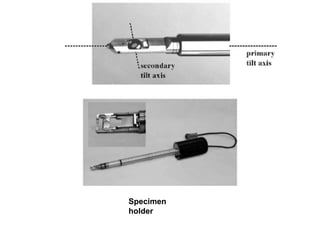
• Specimen stage
-1. Single-tilt 2. Double-tilt
• Vacuum system
• Scanning coils
• Detectors
-1. BF 2.ADF3.HAADF
Source formation
• The STEM consists of an emission source
tungsten filament, or a lanthanum
hexaboride
• High voltage source (typically 100-300kV)
• Electrons emit by field emission.
Vacuum system
• STEM is evacuated to low pressure 10^ -4
Pa
• It consists of multiple pumping systems
and air locks.
• Low or roughing vacuum is achieved with
either rotary vacuum pump or diaphram
pumps
• For low vacuum turbomolecular pumps are
connected to the chamber
• Gate valve: for different vacuum levels in
V1 V2
Field
emission
Electromagnetic
Lenses
Aperture
Specimen stage
mesh
Specimen
holder
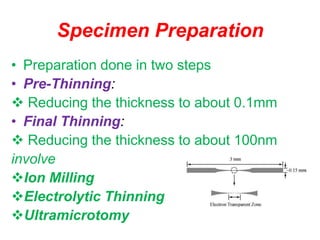
Specimen Preparation
• Preparation done in two steps
• Pre-Thinning:
 Reducing the thickness to about 0.1mm
• Final Thinning:
 Reducing the thickness to about 100nm
involve
Ion Milling
Electrolytic Thinning
Ultramicrotomy
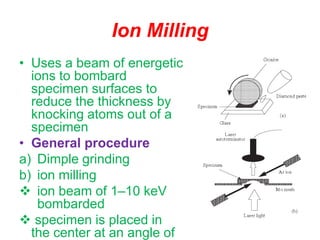
Ion Milling
• Uses a beam of energetic
ions to bombard
specimen surfaces to
reduce the thickness by
knocking atoms out of a
specimen
• General procedure
a) Dimple grinding
b) ion milling
 ion beam of 1–10 keV
bombarded
 specimen is placed in
the center at an angle of
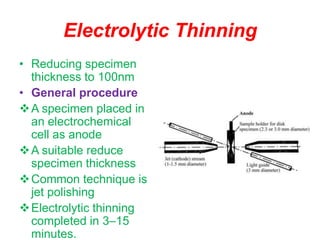
Electrolytic Thinning
• Reducing specimen
thickness to 100nm
• General procedure
A specimen placed in
an electrochemical
cell as anode
A suitable reduce
specimen thickness
Common technique is
jet polishing
Electrolytic thinning
completed in 3–15
minutes.
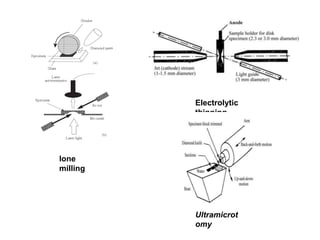
Ione
milling
Electrolytic
thinning
Ultramicrot
omy
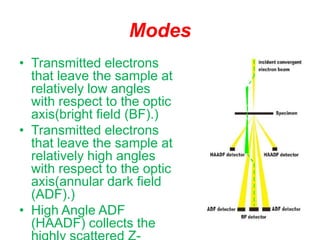
Modes
• Transmitted electrons
that leave the sample at
relatively low angles
with respect to the optic
axis(bright field (BF).)
• Transmitted electrons
that leave the sample at
relatively high angles
with respect to the optic
axis(annular dark field
(ADF).)
• High Angle ADF
(HAADF) collects the
Image formation
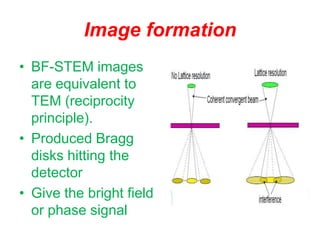
• BF-STEM images
are equivalent to
TEM (reciprocity
principle).
• Produced Bragg
disks hitting the
detector
• Give the bright field
or phase signal
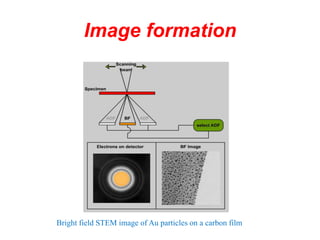
Image formation
Bright field STEM image of Au particles on a carbon film
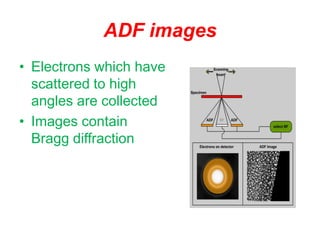
ADF images
• Electrons which have
scattered to high
angles are collected
• Images contain
Bragg diffraction
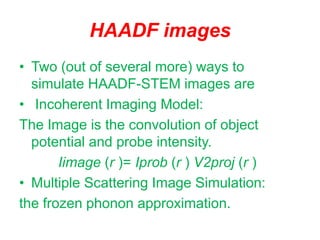
HAADF images
• Two (out of several more) ways to
simulate HAADF-STEM images are
• Incoherent Imaging Model:
The Image is the convolution of object
potential and probe intensity.
Iimage (r )= Iprob (r ) V2proj (r )
• Multiple Scattering Image Simulation:
the frozen phonon approximation.
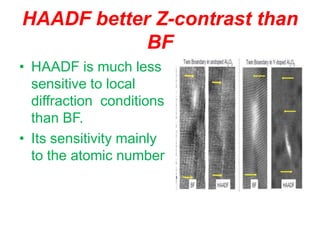
HAADF better Z-contrast than
BF
• HAADF is much less
sensitive to local
diffraction conditions
than BF.
• Its sensitivity mainly
to the atomic number
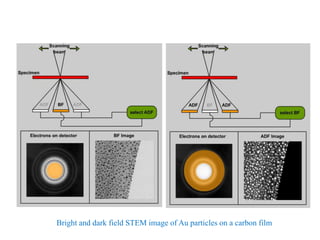
Bright and dark field STEM image of Au particles on a carbon film
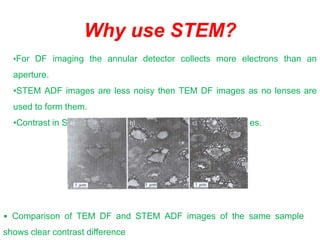
Why use STEM?
•For DF imaging the annular detector collects more electrons than an
aperture.
•STEM ADF images are less noisy then TEM DF images as no lenses are
used to form them.
•Contrast in STEM images is greater than standard DF images.a) b) c)
• Comparison of TEM DF and STEM ADF images of the same sample
shows clear contrast difference
Scanning transmission electron microscope

Scanning transmission electron microscope

  • 1.
  • 2.
    Outline • History • Interactionsof Electrons • Background • STEM • Components • Specimen Preparation • Mode • Image formation • Comparison
  • 4.
    Cont… • The firstSTEM was built in 1938 by Baron Manfred von Ardenne.(distroyed in air raid) • Not developed further until the 1970. • Then Albert Crewe at the University of Chicago developed the field emission gun. • Then built a STEM able to visualize single heavy atoms on thin carbon substrates
  • 5.
  • 7.
    Back ground • Maximumresolution, d • STEM an electron’s velocity approaches the speed of light, c
  • 8.
    STEM • The basicprinciple of image formation fundamentally different from static beam TEM • small spot size is formed on the sample surface with the condenser lenses • This probe is scanned on the sample surface • the signal is detected by an electron detector, amplified and
  • 9.
    Cont… • DETECTOR 1. Smalldisk on the column axis which detects the transmitted beam (BF STEM image) or diffracted beam (DF STEM image) 2. Annular detector (a plate with a hole) which detects all the diffracted beams except the transmitted one (ADF STEM) • Resolution  limited by the spot size have poorer resolution but
  • 11.
    Scattered beam electrons •In STEM signal is detected by I. back scattered electrons(BSE) II. Transmitted beam electrons scattered at some angles • In both cases, BSE and TBE, the signal intensity is a function of the average atomic number of the sample volume and also phase contrast that interacted with the beam • Thus providing atomic number and phase
  • 12.
    Cont… • In STEM,the electron beam is rastered (scan coil) across the surface of a sample in a similar manner to SEM, however, the sample is a thin TEM section and the diffraction contrast image is collected on a solid- state (ADF) detector. HAADF-high angle annular dark-field
  • 15.
    Components • Source formation -Field emission • Electromagnetic Lenses - Condenser lens • Aperture • Specimen stage -1. Single-tilt 2. Double-tilt • Vacuum system • Scanning coils • Detectors -1. BF 2.ADF3.HAADF
  • 16.
    Source formation • TheSTEM consists of an emission source tungsten filament, or a lanthanum hexaboride • High voltage source (typically 100-300kV) • Electrons emit by field emission.
  • 17.
    Vacuum system • STEMis evacuated to low pressure 10^ -4 Pa • It consists of multiple pumping systems and air locks. • Low or roughing vacuum is achieved with either rotary vacuum pump or diaphram pumps • For low vacuum turbomolecular pumps are connected to the chamber • Gate valve: for different vacuum levels in
  • 18.
  • 19.
  • 21.
    Specimen Preparation • Preparationdone in two steps • Pre-Thinning:  Reducing the thickness to about 0.1mm • Final Thinning:  Reducing the thickness to about 100nm involve Ion Milling Electrolytic Thinning Ultramicrotomy
  • 22.
    Ion Milling • Usesa beam of energetic ions to bombard specimen surfaces to reduce the thickness by knocking atoms out of a specimen • General procedure a) Dimple grinding b) ion milling  ion beam of 1–10 keV bombarded  specimen is placed in the center at an angle of
  • 23.
    Electrolytic Thinning • Reducingspecimen thickness to 100nm • General procedure A specimen placed in an electrochemical cell as anode A suitable reduce specimen thickness Common technique is jet polishing Electrolytic thinning completed in 3–15 minutes.
  • 24.
  • 26.
    Modes • Transmitted electrons thatleave the sample at relatively low angles with respect to the optic axis(bright field (BF).) • Transmitted electrons that leave the sample at relatively high angles with respect to the optic axis(annular dark field (ADF).) • High Angle ADF (HAADF) collects the
  • 27.
    Image formation • BF-STEMimages are equivalent to TEM (reciprocity principle). • Produced Bragg disks hitting the detector • Give the bright field or phase signal
  • 28.
    Image formation Bright fieldSTEM image of Au particles on a carbon film
  • 29.
    ADF images • Electronswhich have scattered to high angles are collected • Images contain Bragg diffraction
  • 30.
    HAADF images • Two(out of several more) ways to simulate HAADF-STEM images are • Incoherent Imaging Model: The Image is the convolution of object potential and probe intensity. Iimage (r )= Iprob (r ) V2proj (r ) • Multiple Scattering Image Simulation: the frozen phonon approximation.
  • 31.
    HAADF better Z-contrastthan BF • HAADF is much less sensitive to local diffraction conditions than BF. • Its sensitivity mainly to the atomic number
  • 32.
    Bright and darkfield STEM image of Au particles on a carbon film
  • 33.
    Why use STEM? •ForDF imaging the annular detector collects more electrons than an aperture. •STEM ADF images are less noisy then TEM DF images as no lenses are used to form them. •Contrast in STEM images is greater than standard DF images.a) b) c) • Comparison of TEM DF and STEM ADF images of the same sample shows clear contrast difference