A
PRESENTATION
ON
“SCANNING ELECTRON MICROSCOPY”
Presented by :
Himanshu
16EUCNT600
CENTER OF NANOTECHNOLOGY, RTU KOTA
CONTENTS
 THE SCANNING ELECTRON MICROSCOPE
 PRINCIPLE
 CONSTRUCTION
 SEM Vs TEM
 ADVANTAGES
 DISADVANTAGES
 APPLICATIONS
THE SCANNING ELECTRON MICROSCOPE
PRINCIPLE
 The basic principle is that a beam of electrons is generated by a suitable source,
typically a tungsten filament or a field emission gun.
 The electron beam is accelerated through a high voltage (e.g.: 20 kV) and pass
through a system of apertures and electromagnetic lenses to produce a thin beam of
electrons.
 Then the beam scans the surface of the specimen. Electrons are emitted from the
specimen by the action of the scanning beam and collected by a suitably-positioned
detector.
CONSTRUCTION
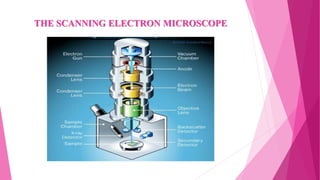
Basic components are as following :
 Electron gun (Filament)
 Condenser lenses
 Objective Aperture
 Scan coils
 Chamber
 Detectors
 Computer hardware and software
THE SCANNING ELECTRON MICROSCOPE
HOW THE SEM WORKS
 The SEM uses electrons instead of light to form an image.
 A beam of electrons is produced at the top of the microscope by heating of a metallic
filament.
 The electron beam follows a vertical path through the column of the microscope. It makes
its way through electromagnetic lenses which focus and direct the beam down towards the
sample.
 Once it hits the sample, other electrons ( backscattered or secondary ) are ejected from the
sample.
Detectors collect the secondary or backscattered electrons, and convert them to a signal
that is sent to a viewing screen similar to the one in an ordinary television, producing an
image.
CHARACTERISTIC INFORMATION: SEM
 Topography:
The surface features of an object or "how it looks", its texture; direct relation between these
features and materials properties
 Morphology:
The shape and size of the particles making up the object; direct relation between these
structures and materials properties
 Composition:
The elements and compounds that the object is composed of and the relative amounts of
them; direct relationship between composition and materials properties
 Crystallographic Information:
How the atoms are arranged in the object; direct relation between these arrangements and
material properties.
HOW DOES IT LOOKS LIKE
AFM Cantilever Tip Ant Head Blood Cells
Diamond Thin Film Microstructure of a plain carbon
steel
Calcium Phosphate Crystal
ELECTRON GUNS
 Electron guns are typically one of TWO types.
1) THERMIONIC GUNS
2) FIELD EMISSION GUNS
THERMIONIC GUNS:
 Which are the most common type, apply thermal energy to a filament to coax
electrons away from the gun and toward the specimen under examination.
 Usually made of tungsten, which has a high melting point
ELECTRON GUNS
FIELD EMISSION GUNS:
 Create a strong electrical field to pull electrons away from the atoms they are
associated with.
 Electron guns are located either at the very top or at the very bottom of an
SEM and fire a beam of electrons at the object under examination.
 These electrons don't naturally go where they need to, however, which gets us
to the next component of SEMs.
CONDENSER LENSES
 Just like optical microscopes, SEMs use Condenser lenses to produce clear and
detailed images.
 The Condenser lenses in these devices, however, work differently.
 For one thing, they aren't made of glass.
 Instead, the Condenser lenses are made of magnets capable of bending the path
of electrons.
 By doing so, the Condenser lenses focus and control the electron beam, ensuring
that the electrons end up precisely where they need to go.
OBJECTIVE APERTURE
 The objective aperture arm fits above the objective lens in the SEM.
 It is a metal rod that holds a thin plate of metal containing four holes.
 By moving the arm in and out different sized holes can be put into the beam path.
 An aperture holder: This arm holds a thin metal strip with different sized holes
that line up with the larger holes.
 The metal strip is called an Aperture strip.
OBJECTIVE APERTURE
CHAMBER
 The sample chamber of an SEM is where researchers place the specimen that they
are examining.
 Because the specimen must be kept extremely still for the microscope to produce
clear images, the sample chamber must be very sturdy and insulated from
vibration.
 In fact, SEMs are so sensitive to vibrations that they are often installed on the
ground floor of a building.
 They also manipulate the specimen, placing it at different angles and moving it so
that researchers don't have to constantly remount the object to take different
images.
SIGNALS FROM THE SAMPLE
Incoming electrons
Secondary electrons
Backscattered
electrons
Auger electrons
X-rays
Cathodo-
luminescence (light)
Sample
SECONDARY ELECTRONS (SE)
 Generated from the collision between the incoming electrons and the
loosely bonded outer electrons
 Low energy electrons (~10-50 eV)
 Only SE generated close to surface escape (topographic information
is obtained)
BACKSCATTERED ELECTRONS (BSE)
 A fraction of the incident electrons is retarded by the electro-
magnetic field of the nucleus and if the scattering angle is
greater than 180° the electron can escape from the surface
 High energy electrons
 Fewer BSE than SE
DETECTORS
 Various types of detectors are there in SEM.
 These devices detect the various ways that the electron beam interacts with the
sample object.
 For instance, Everhart-Thornley detectors register secondary electrons, which are
electrons dislodged from the outer surface of a specimen. These detectors are
capable of producing the most detailed images of an object's surface.
 Other detectors, such as backscattered electron detectors and X-ray detectors, can
tell researchers about the composition of a substance.
Secondary electron detector:
(Everhart-Thornley)
Backscattered electron detector:
(Solid-State Detector)
 Secondary electrons: Everhart-Thornley Detector
 Backscattered electrons: Solid State Detector
 X-rays: Energy dispersive spectrometer (EDS)
VACUUM CHAMBER
 SEMs require a vacuum to operate.
 Without a vacuum, the electron beam generated by the electron gun would
encounter constant interference from air particles in the atmosphere.
 Not only would these particles block the path of the electron beam, they would
also be knocked out of the air and onto the specimen, which would distort the
surface of the specimen.
SEM ANIMATION
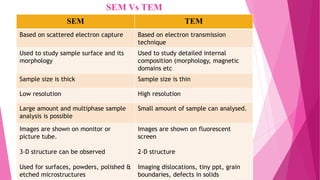
SEM Vs TEM
SEM TEM
Based on scattered electron capture Based on electron transmission
technique
Used to study sample surface and its
morphology
Used to study detailed internal
composition (morphology, magnetic
domains etc
Sample size is thick Sample size is thin
Low resolution High resolution
Large amount and multiphase sample
analysis is possible
Small amount of sample can analysed.
Images are shown on monitor or
picture tube.
3-D structure can be observed
Used for surfaces, powders, polished &
etched microstructures
Images are shown on fluorescent
screen
2-D structure
Imaging dislocations, tiny ppt, grain
boundaries, defects in solids
ADVANTAGES
 Advantages of a Scanning Electron Microscope include its wide-array of
applications, the detailed three-dimensional and topographical imaging and the
versatile information garnered from different detectors.
 SEMs are also easy to operate with the proper training and advances in computer
technology and associated software make operation user-friendly.
 Although all samples must be prepared before placed in the vacuum chamber,
most SEM samples require minimal preparation actions.
DISADVANTAGES
 The disadvantages of a Scanning Electron Microscope start with the size and
cost.
 SEMs are expensive, large and must be housed in an area free of any possible
electric, magnetic or vibration interference.
 Maintenance involves keeping a steady voltage, currents to electromagnetic
coils and circulation of cool water.
 SEMs are limited to solid, inorganic samples small enough to fit inside the
vacuum chamber that can handle moderate vacuum pressure.
APPLICATIONS
 SEMs have a variety of applications in a number of scientific and industry-related
fields, especially where characterizations of solid materials is beneficial.
 In addition to topographical, morphological and compositional information, a
Scanning Electron Microscope can detect and analyze surface fractures, provide
information in microstructures, examine surface contaminations, reveal spatial
variations in chemical compositions, provide qualitative chemical analyses and
identify crystalline structures.
 In addition, SEMs have practical industrial and technological applications such as
semiconductor inspection, production line of miniscule products and assembly of
microchips for computers.
 SEMs can be as essential research tool in fields such as life science, biology,
gemology, medical and forensic science, metallurgy.
THANK YOU

scanning electron microscope (SEM)

  • 1.
    A PRESENTATION ON “SCANNING ELECTRON MICROSCOPY” Presentedby : Himanshu 16EUCNT600 CENTER OF NANOTECHNOLOGY, RTU KOTA
  • 2.
    CONTENTS  THE SCANNINGELECTRON MICROSCOPE  PRINCIPLE  CONSTRUCTION  SEM Vs TEM  ADVANTAGES  DISADVANTAGES  APPLICATIONS
  • 3.
    THE SCANNING ELECTRONMICROSCOPE PRINCIPLE  The basic principle is that a beam of electrons is generated by a suitable source, typically a tungsten filament or a field emission gun.  The electron beam is accelerated through a high voltage (e.g.: 20 kV) and pass through a system of apertures and electromagnetic lenses to produce a thin beam of electrons.  Then the beam scans the surface of the specimen. Electrons are emitted from the specimen by the action of the scanning beam and collected by a suitably-positioned detector.
  • 4.
    CONSTRUCTION Basic components areas following :  Electron gun (Filament)  Condenser lenses  Objective Aperture  Scan coils  Chamber  Detectors  Computer hardware and software
  • 5.
  • 6.
    HOW THE SEMWORKS  The SEM uses electrons instead of light to form an image.  A beam of electrons is produced at the top of the microscope by heating of a metallic filament.  The electron beam follows a vertical path through the column of the microscope. It makes its way through electromagnetic lenses which focus and direct the beam down towards the sample.  Once it hits the sample, other electrons ( backscattered or secondary ) are ejected from the sample. Detectors collect the secondary or backscattered electrons, and convert them to a signal that is sent to a viewing screen similar to the one in an ordinary television, producing an image.
  • 7.
    CHARACTERISTIC INFORMATION: SEM Topography: The surface features of an object or "how it looks", its texture; direct relation between these features and materials properties  Morphology: The shape and size of the particles making up the object; direct relation between these structures and materials properties  Composition: The elements and compounds that the object is composed of and the relative amounts of them; direct relationship between composition and materials properties  Crystallographic Information: How the atoms are arranged in the object; direct relation between these arrangements and material properties.
  • 8.
    HOW DOES ITLOOKS LIKE AFM Cantilever Tip Ant Head Blood Cells Diamond Thin Film Microstructure of a plain carbon steel Calcium Phosphate Crystal
  • 9.
    ELECTRON GUNS  Electronguns are typically one of TWO types. 1) THERMIONIC GUNS 2) FIELD EMISSION GUNS THERMIONIC GUNS:  Which are the most common type, apply thermal energy to a filament to coax electrons away from the gun and toward the specimen under examination.  Usually made of tungsten, which has a high melting point
  • 10.
    ELECTRON GUNS FIELD EMISSIONGUNS:  Create a strong electrical field to pull electrons away from the atoms they are associated with.  Electron guns are located either at the very top or at the very bottom of an SEM and fire a beam of electrons at the object under examination.  These electrons don't naturally go where they need to, however, which gets us to the next component of SEMs.
  • 11.
    CONDENSER LENSES  Justlike optical microscopes, SEMs use Condenser lenses to produce clear and detailed images.  The Condenser lenses in these devices, however, work differently.  For one thing, they aren't made of glass.  Instead, the Condenser lenses are made of magnets capable of bending the path of electrons.  By doing so, the Condenser lenses focus and control the electron beam, ensuring that the electrons end up precisely where they need to go.
  • 12.
    OBJECTIVE APERTURE  Theobjective aperture arm fits above the objective lens in the SEM.  It is a metal rod that holds a thin plate of metal containing four holes.  By moving the arm in and out different sized holes can be put into the beam path.  An aperture holder: This arm holds a thin metal strip with different sized holes that line up with the larger holes.  The metal strip is called an Aperture strip.
  • 13.
  • 14.
    CHAMBER  The samplechamber of an SEM is where researchers place the specimen that they are examining.  Because the specimen must be kept extremely still for the microscope to produce clear images, the sample chamber must be very sturdy and insulated from vibration.  In fact, SEMs are so sensitive to vibrations that they are often installed on the ground floor of a building.  They also manipulate the specimen, placing it at different angles and moving it so that researchers don't have to constantly remount the object to take different images.
  • 15.
    SIGNALS FROM THESAMPLE Incoming electrons Secondary electrons Backscattered electrons Auger electrons X-rays Cathodo- luminescence (light) Sample
  • 16.
    SECONDARY ELECTRONS (SE) Generated from the collision between the incoming electrons and the loosely bonded outer electrons  Low energy electrons (~10-50 eV)  Only SE generated close to surface escape (topographic information is obtained)
  • 17.
    BACKSCATTERED ELECTRONS (BSE) A fraction of the incident electrons is retarded by the electro- magnetic field of the nucleus and if the scattering angle is greater than 180° the electron can escape from the surface  High energy electrons  Fewer BSE than SE
  • 18.
    DETECTORS  Various typesof detectors are there in SEM.  These devices detect the various ways that the electron beam interacts with the sample object.  For instance, Everhart-Thornley detectors register secondary electrons, which are electrons dislodged from the outer surface of a specimen. These detectors are capable of producing the most detailed images of an object's surface.  Other detectors, such as backscattered electron detectors and X-ray detectors, can tell researchers about the composition of a substance.
  • 19.
    Secondary electron detector: (Everhart-Thornley) Backscatteredelectron detector: (Solid-State Detector)  Secondary electrons: Everhart-Thornley Detector  Backscattered electrons: Solid State Detector  X-rays: Energy dispersive spectrometer (EDS)
  • 20.
    VACUUM CHAMBER  SEMsrequire a vacuum to operate.  Without a vacuum, the electron beam generated by the electron gun would encounter constant interference from air particles in the atmosphere.  Not only would these particles block the path of the electron beam, they would also be knocked out of the air and onto the specimen, which would distort the surface of the specimen.
  • 21.
  • 22.
    SEM Vs TEM SEMTEM Based on scattered electron capture Based on electron transmission technique Used to study sample surface and its morphology Used to study detailed internal composition (morphology, magnetic domains etc Sample size is thick Sample size is thin Low resolution High resolution Large amount and multiphase sample analysis is possible Small amount of sample can analysed. Images are shown on monitor or picture tube. 3-D structure can be observed Used for surfaces, powders, polished & etched microstructures Images are shown on fluorescent screen 2-D structure Imaging dislocations, tiny ppt, grain boundaries, defects in solids
  • 23.
    ADVANTAGES  Advantages ofa Scanning Electron Microscope include its wide-array of applications, the detailed three-dimensional and topographical imaging and the versatile information garnered from different detectors.  SEMs are also easy to operate with the proper training and advances in computer technology and associated software make operation user-friendly.  Although all samples must be prepared before placed in the vacuum chamber, most SEM samples require minimal preparation actions.
  • 24.
    DISADVANTAGES  The disadvantagesof a Scanning Electron Microscope start with the size and cost.  SEMs are expensive, large and must be housed in an area free of any possible electric, magnetic or vibration interference.  Maintenance involves keeping a steady voltage, currents to electromagnetic coils and circulation of cool water.  SEMs are limited to solid, inorganic samples small enough to fit inside the vacuum chamber that can handle moderate vacuum pressure.
  • 25.
    APPLICATIONS  SEMs havea variety of applications in a number of scientific and industry-related fields, especially where characterizations of solid materials is beneficial.  In addition to topographical, morphological and compositional information, a Scanning Electron Microscope can detect and analyze surface fractures, provide information in microstructures, examine surface contaminations, reveal spatial variations in chemical compositions, provide qualitative chemical analyses and identify crystalline structures.  In addition, SEMs have practical industrial and technological applications such as semiconductor inspection, production line of miniscule products and assembly of microchips for computers.  SEMs can be as essential research tool in fields such as life science, biology, gemology, medical and forensic science, metallurgy.
  • 26.