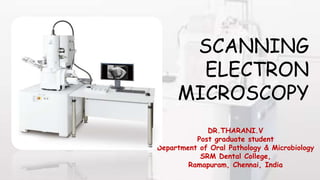
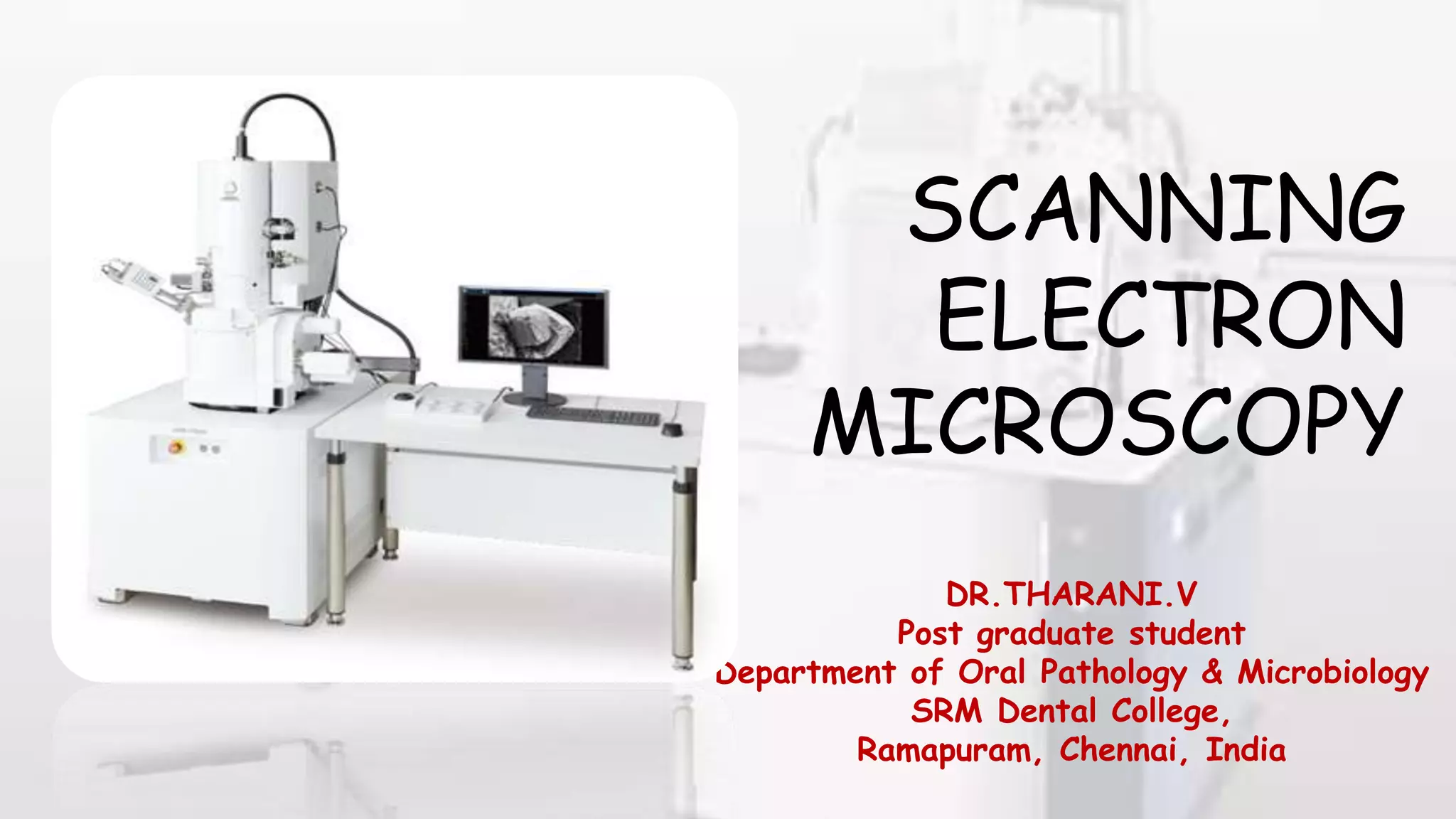



SCANNING
ELECTRON
MICROSCOPY
DR.THARANI.V
Post graduate student
Department of Oral Pathology & Microbiology
SRM Dental College,
Ramapuram, Chennai, India
CONTENTS
● INTRODUCTION
● HISTORY OF SEM
● TYPES OF ELECTRON
MICROSCOPE
● COMPONENTS OF
ELECTRON MICROSCOPE
● MAGNIFICATION OF
SEM
● DEPTH OF FOCUS OF
SEM
● HOW THE IMAGES ARE
VISIBLE?
● CHARGING AND
INFLUENCE
● ADVANTAGE AND
DISADVANTAGE OF SEM
● APPLICATIONS OF SEM
● SPECIMEN PREPARATION
FOR SEM
INTRODUCTION
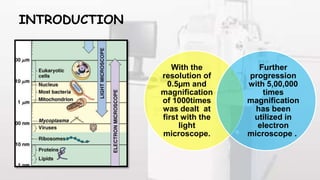
With the
resolution of
0.5µm and
magnification
of 1000times
was dealt at
first with the
light
microscope.
Further
progression
with 5,00,000
times
magnification
has been
utilized in
electron
microscope .
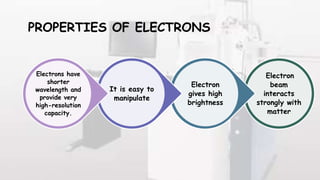
PROPERTIES OF ELECTRONS
Electron
beam
interacts
strongly with
matter
Electron
gives high
brightness
It is easy to
manipulate
Electrons have
shorter
wavelength and
provide very
high-resolution
capacity.
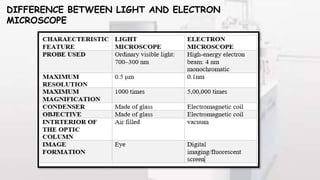
DIFFERENCE BETWEEN LIGHT AND ELECTRON
MICROSCOPE
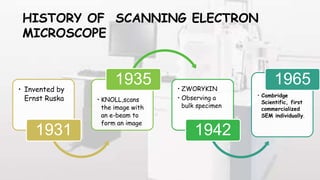
HISTORY OF SCANNING ELECTRON
MICROSCOPE
• Invented by
Ernst Ruska
1931
• KNOLL,scans
the image with
an e-beam to
form an image
1935 • ZWORYKIN
• Observing a
bulk specimen
1942
• Cambridge
Scientific, first
commercialized
SEM individually.
1965
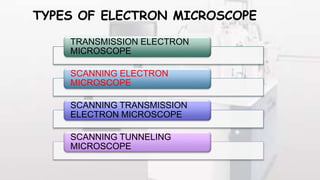
TYPES OF ELECTRON MICROSCOPE
TRANSMISSION ELECTRON
MICROSCOPE
SCANNING ELECTRON
MICROSCOPE
SCANNING TRANSMISSION
ELECTRON MICROSCOPE
SCANNING TUNNELING
MICROSCOPE
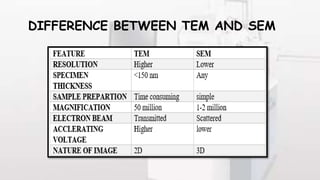
DIFFERENCE BETWEEN TEM AND SEM
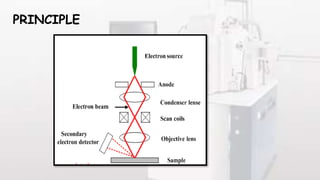
PRINCIPLE
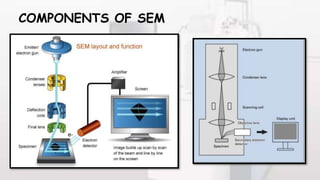
COMPONENTS OF SEM
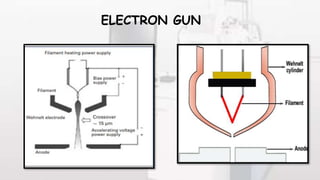
ELECTRON GUN
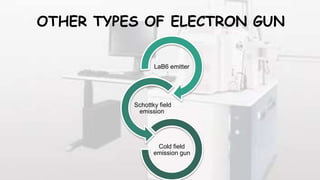
OTHER TYPES OF ELECTRON GUN
LaB6 emitter
Schottky field
emission
Cold field
emission gun
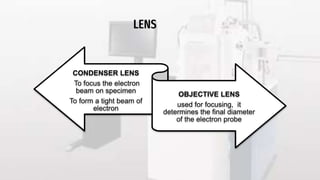
LENS
CONDENSER LENS
To focus the electron
beam on specimen
To form a tight beam of
electron
OBJECTIVE LENS
used for focusing, it
determines the final diameter
of the electron probe
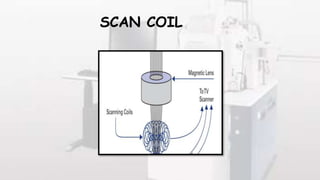
SCAN COIL
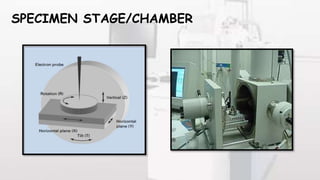
SPECIMEN STAGE/CHAMBER
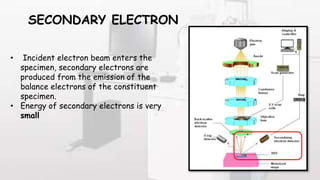
SECONDARY ELECTRON
• Incident electron beam enters the
specimen, secondary electrons are
produced from the emission of the
balance electrons of the constituent
specimen.
• Energy of secondary electrons is very
small
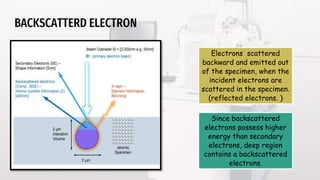
BACKSCATTERD ELECTRON
Electrons scattered
backward and emitted out
of the specimen, when the
incident electrons are
scattered in the specimen.
(reflected electrons. )
Since backscattered
electrons possess higher
energy than secondary
electrons, deep region
contains a backscattered
electrons.
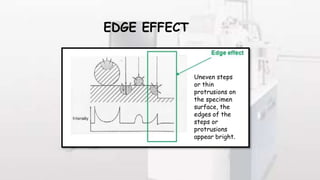
EDGE EFFECT
Uneven steps
or thin
protrusions on
the specimen
surface, the
edges of the
steps or
protrusions
appear bright.
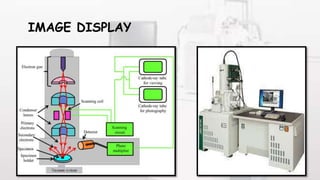
IMAGE DISPLAY
RECORDING
 Earlier - CRT was photographed with a
camera
 Recently- digital format (electronic file) is
used(it is easier to process image and
convenient to send or receive image)
VACCUM SYSTEM
● Inside the electron optical system and
the specimen chamber must be kept at a
high vacuum of 10-3 to 10-4 Pa.
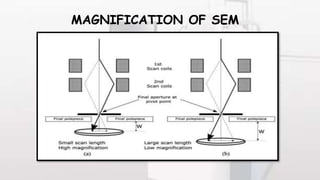
MAGNIFICATION OF SEM
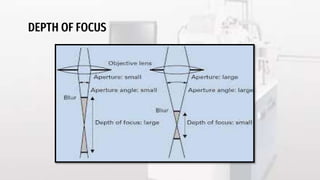
DEPTH OF FOCUS
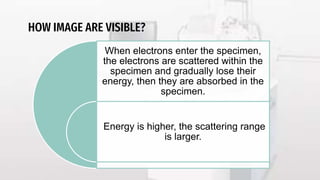
HOW IMAGE ARE VISIBLE?
When electrons enter the specimen,
the electrons are scattered within the
specimen and gradually lose their
energy, then they are absorbed in the
specimen.
Energy is higher, the scattering range
is larger.
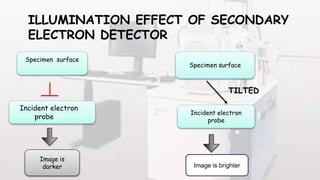
ILLUMINATION EFFECT OF SECONDARY
ELECTRON DETECTOR
Incident electron
probe
Image is
darker
Specimen surface
Specimen surface
Incident electron
probe
Image is brighter
TILTED
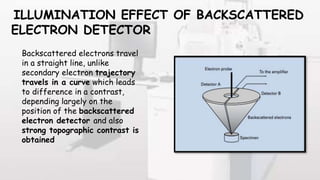
ILLUMINATION EFFECT OF BACKSCATTERED
ELECTRON DETECTOR
Backscattered electrons travel
in a straight line, unlike
secondary electron trajectory
travels in a curve which leads
to difference in a contrast,
depending largely on the
position of the backscattered
electron detector and also
strong topographic contrast is
obtained
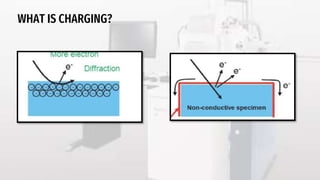
WHAT IS CHARGING?
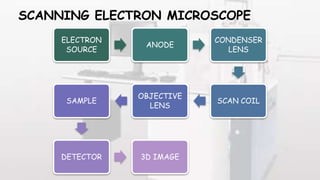
SCANNING ELECTRON MICROSCOPE
ELECTRON
SOURCE
ANODE
CONDENSER
LENS
SCAN COIL
OBJECTIVE
LENS
SAMPLE
DETECTOR 3D IMAGE
APPLICATIONS
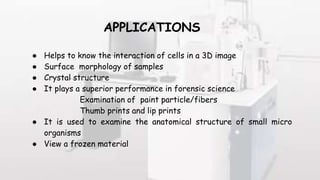
● Helps to know the interaction of cells in a 3D image
● Surface morphology of samples
● Crystal structure
● It plays a superior performance in forensic science
Examination of paint particle/fibers
Thumb prints and lip prints
● It is used to examine the anatomical structure of small micro
organisms
● View a frozen material
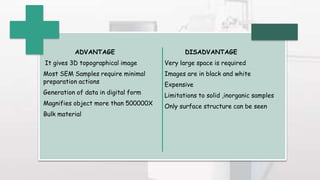
ADVANTAGE
It gives 3D topographical image
Most SEM Samples require minimal
preparation actions
Generation of data in digital form
Magnifies object more than 500000X
Bulk material
DISADVANTAGE
Very large space is required
Images are in black and white
Expensive
Limitations to solid ,inorganic samples
Only surface structure can be seen
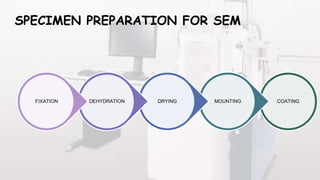
SPECIMEN PREPARATION FOR SEM
COATING
MOUNTING
DRYING
DEHYDRATION
FIXATION
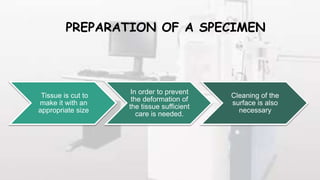
PREPARATION OF A SPECIMEN
Tissue is cut to
make it with an
appropriate size
In order to prevent
the deformation of
the tissue sufficient
care is needed.
Cleaning of the
surface is also
necessary
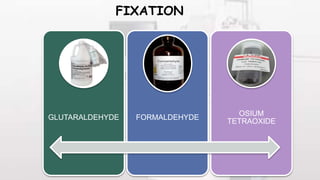
FIXATION
GLUTARALDEHYDE FORMALDEHYDE
OSIUM
TETRAOXIDE
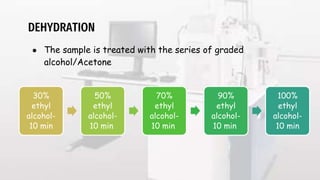
DEHYDRATION
● The sample is treated with the series of graded
alcohol/Acetone
30%
ethyl
alcohol-
10 min
50%
ethyl
alcohol-
10 min
70%
ethyl
alcohol-
10 min
90%
ethyl
alcohol-
10 min
100%
ethyl
alcohol-
10 min
CRITICAL POINT DRYING
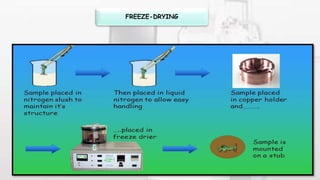
FREEZE-DRYING
MOUNTING
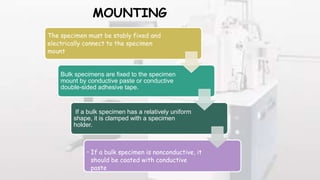
The specimen must be stably fixed and
electrically connect to the specimen
mount
Bulk specimens are fixed to the specimen
mount by conductive paste or conductive
double-sided adhesive tape.
If a bulk specimen has a relatively uniform
shape, it is clamped with a specimen
holder.
• If a bulk specimen is nonconductive, it
should be coated with conductive
paste
COATING
If a specimen is nonconductive, its surface needs to be
coated with a thin metal film so that the surface has
conductivity.
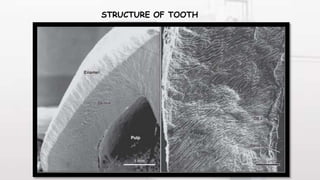
STRUCTURE OF TOOTH
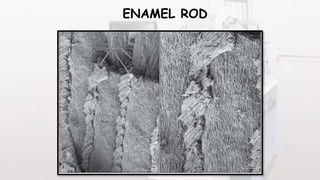
ENAMEL ROD
PRE SECRETARY STAGE OF AMELOBLAST
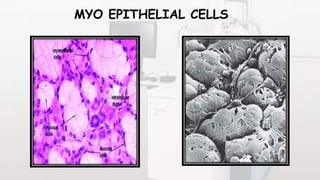
MYO EPITHELIAL CELLS
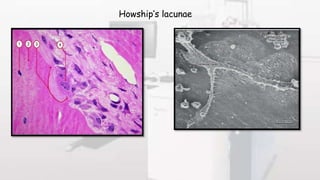
Howship‘s lacunae
REFERENCES:
 Ul-Hamid A. A Beginners' guide to scanning electron microscopy.
Springer International Publishing; 2018 Oct 26.
 Dey P. Basic and advanced laboratory techniques in histopathology
and cytology. Springer Singapore; 2018 Jun 8.
 Nanci A. Ten Cate's oral histology-e-book: development, structure,
and function. Elsevier Health Sciences; 2017 Aug 15.
Scanning electron microscope

Scanning electron microscope

  • 1.
    SCANNING ELECTRON MICROSCOPY DR.THARANI.V Post graduate student Departmentof Oral Pathology & Microbiology SRM Dental College, Ramapuram, Chennai, India
  • 2.
    CONTENTS ● INTRODUCTION ● HISTORYOF SEM ● TYPES OF ELECTRON MICROSCOPE ● COMPONENTS OF ELECTRON MICROSCOPE ● MAGNIFICATION OF SEM ● DEPTH OF FOCUS OF SEM ● HOW THE IMAGES ARE VISIBLE? ● CHARGING AND INFLUENCE ● ADVANTAGE AND DISADVANTAGE OF SEM ● APPLICATIONS OF SEM ● SPECIMEN PREPARATION FOR SEM
  • 3.
    INTRODUCTION With the resolution of 0.5µmand magnification of 1000times was dealt at first with the light microscope. Further progression with 5,00,000 times magnification has been utilized in electron microscope .
  • 4.
    PROPERTIES OF ELECTRONS Electron beam interacts stronglywith matter Electron gives high brightness It is easy to manipulate Electrons have shorter wavelength and provide very high-resolution capacity.
  • 5.
    DIFFERENCE BETWEEN LIGHTAND ELECTRON MICROSCOPE
  • 6.
    HISTORY OF SCANNINGELECTRON MICROSCOPE • Invented by Ernst Ruska 1931 • KNOLL,scans the image with an e-beam to form an image 1935 • ZWORYKIN • Observing a bulk specimen 1942 • Cambridge Scientific, first commercialized SEM individually. 1965
  • 7.
    TYPES OF ELECTRONMICROSCOPE TRANSMISSION ELECTRON MICROSCOPE SCANNING ELECTRON MICROSCOPE SCANNING TRANSMISSION ELECTRON MICROSCOPE SCANNING TUNNELING MICROSCOPE
  • 8.
  • 9.
  • 10.
  • 11.
  • 12.
    OTHER TYPES OFELECTRON GUN LaB6 emitter Schottky field emission Cold field emission gun
  • 13.
    LENS CONDENSER LENS To focusthe electron beam on specimen To form a tight beam of electron OBJECTIVE LENS used for focusing, it determines the final diameter of the electron probe
  • 14.
  • 15.
  • 16.
    SECONDARY ELECTRON • Incidentelectron beam enters the specimen, secondary electrons are produced from the emission of the balance electrons of the constituent specimen. • Energy of secondary electrons is very small
  • 17.
    BACKSCATTERD ELECTRON Electrons scattered backwardand emitted out of the specimen, when the incident electrons are scattered in the specimen. (reflected electrons. ) Since backscattered electrons possess higher energy than secondary electrons, deep region contains a backscattered electrons.
  • 18.
    EDGE EFFECT Uneven steps orthin protrusions on the specimen surface, the edges of the steps or protrusions appear bright.
  • 19.
  • 20.
    RECORDING  Earlier -CRT was photographed with a camera  Recently- digital format (electronic file) is used(it is easier to process image and convenient to send or receive image)
  • 21.
    VACCUM SYSTEM ● Insidethe electron optical system and the specimen chamber must be kept at a high vacuum of 10-3 to 10-4 Pa.
  • 22.
  • 23.
  • 24.
    HOW IMAGE AREVISIBLE? When electrons enter the specimen, the electrons are scattered within the specimen and gradually lose their energy, then they are absorbed in the specimen. Energy is higher, the scattering range is larger.
  • 25.
    ILLUMINATION EFFECT OFSECONDARY ELECTRON DETECTOR Incident electron probe Image is darker Specimen surface Specimen surface Incident electron probe Image is brighter TILTED
  • 26.
    ILLUMINATION EFFECT OFBACKSCATTERED ELECTRON DETECTOR Backscattered electrons travel in a straight line, unlike secondary electron trajectory travels in a curve which leads to difference in a contrast, depending largely on the position of the backscattered electron detector and also strong topographic contrast is obtained
  • 27.
  • 28.
  • 29.
    APPLICATIONS ● Helps toknow the interaction of cells in a 3D image ● Surface morphology of samples ● Crystal structure ● It plays a superior performance in forensic science Examination of paint particle/fibers Thumb prints and lip prints ● It is used to examine the anatomical structure of small micro organisms ● View a frozen material
  • 30.
    ADVANTAGE It gives 3Dtopographical image Most SEM Samples require minimal preparation actions Generation of data in digital form Magnifies object more than 500000X Bulk material DISADVANTAGE Very large space is required Images are in black and white Expensive Limitations to solid ,inorganic samples Only surface structure can be seen
  • 31.
    SPECIMEN PREPARATION FORSEM COATING MOUNTING DRYING DEHYDRATION FIXATION
  • 32.
    PREPARATION OF ASPECIMEN Tissue is cut to make it with an appropriate size In order to prevent the deformation of the tissue sufficient care is needed. Cleaning of the surface is also necessary
  • 33.
  • 34.
    DEHYDRATION ● The sampleis treated with the series of graded alcohol/Acetone 30% ethyl alcohol- 10 min 50% ethyl alcohol- 10 min 70% ethyl alcohol- 10 min 90% ethyl alcohol- 10 min 100% ethyl alcohol- 10 min
  • 35.
  • 36.
  • 37.
    MOUNTING The specimen mustbe stably fixed and electrically connect to the specimen mount Bulk specimens are fixed to the specimen mount by conductive paste or conductive double-sided adhesive tape. If a bulk specimen has a relatively uniform shape, it is clamped with a specimen holder. • If a bulk specimen is nonconductive, it should be coated with conductive paste
  • 38.
    COATING If a specimenis nonconductive, its surface needs to be coated with a thin metal film so that the surface has conductivity.
  • 39.
  • 40.
  • 41.
    PRE SECRETARY STAGEOF AMELOBLAST
  • 42.
  • 43.
  • 44.
    REFERENCES:  Ul-Hamid A.A Beginners' guide to scanning electron microscopy. Springer International Publishing; 2018 Oct 26.  Dey P. Basic and advanced laboratory techniques in histopathology and cytology. Springer Singapore; 2018 Jun 8.  Nanci A. Ten Cate's oral histology-e-book: development, structure, and function. Elsevier Health Sciences; 2017 Aug 15.

Editor's Notes

  • #4 The word microscope is derived from Greek micros (small) and skopeo (look at) Microscope magnifies the image of the object so that we can visualize the smallest particles. The resolution power of the light microscope is limited. The improvement of the resolution capacity of the microscope can only be improved by reducing the wavelength of the light.
  • #10 Thermoelectrons ,electron beam is finely focused by a wehnelt electrode
  • #11 VACCUM CHAMBER
  • #13 LANTHANUM HEXABORIDE
  • #16 The X and Y movements the selection of a field of view. While the Z movement the change of image resolution and the depth of focus
  • #18 The backscattered electrons are sensitive to the composition of the specimen.
  • #19 The uneven steps or thin protrusions on the specimen surface, the edges of the steps or protrusions appear bright. This phenomenon is called the edge effect.
  • #20 The output signals from the secondary electron detector are amplified and then transferred to the display unit. Since the scanning on the display unit is synchronized with the electron-probe scan, brightness variation, which depends on the number of the secondary electrons, appears on the monitor screen on the display unit, thus forming a SEM image
  • #23 At this time, if the scan width of the electron probe is changed, the magnification of the displayed SEM image is also changed.
  • #24 Observation of a specimen with a substantial depth, if the focus is adjusted to the top side, the bottom side may be out of focus. In such a case, the range between upper and lower image blur is large, it is said that “the depth of focus is large.” Whereas if the range between upper and lower image blur is small, it is said that “the depth of focus is small.”
  • #28  The electrons that entered the specimen lose their energy and they are absorbed in the specimen. If a specimen is conductive, the electrons flow through the specimen stage; if a specimen is nonconductive, the electrons stop in the specimen. If the charging, the electron potential deflect the electron probe, which leads to image distortion, if discharging occurs, the probe will return to its original position for a moment so that the image will appear as broken away
  • #34 Since a removed tissue starts to change its structure after its death, in order to prevent this change, it is chemically fixed by chemicals such as glutaraldehyde, formaldehyde, and osmium tetroxide
  • #42 odontoblast process (Odp) and matrix vesicles (mv) in the region of forming mantle predentin where the first enamel protein