Presented to: 
Antresh sir 
Assistant professor 
Dept. of Biotechnology 
Presented by: 
Mithilesh Choudhary 
Mphil-Phd Bioinformatics 
CBS Bioinformatics 
Enroll No. CUB 1403175001
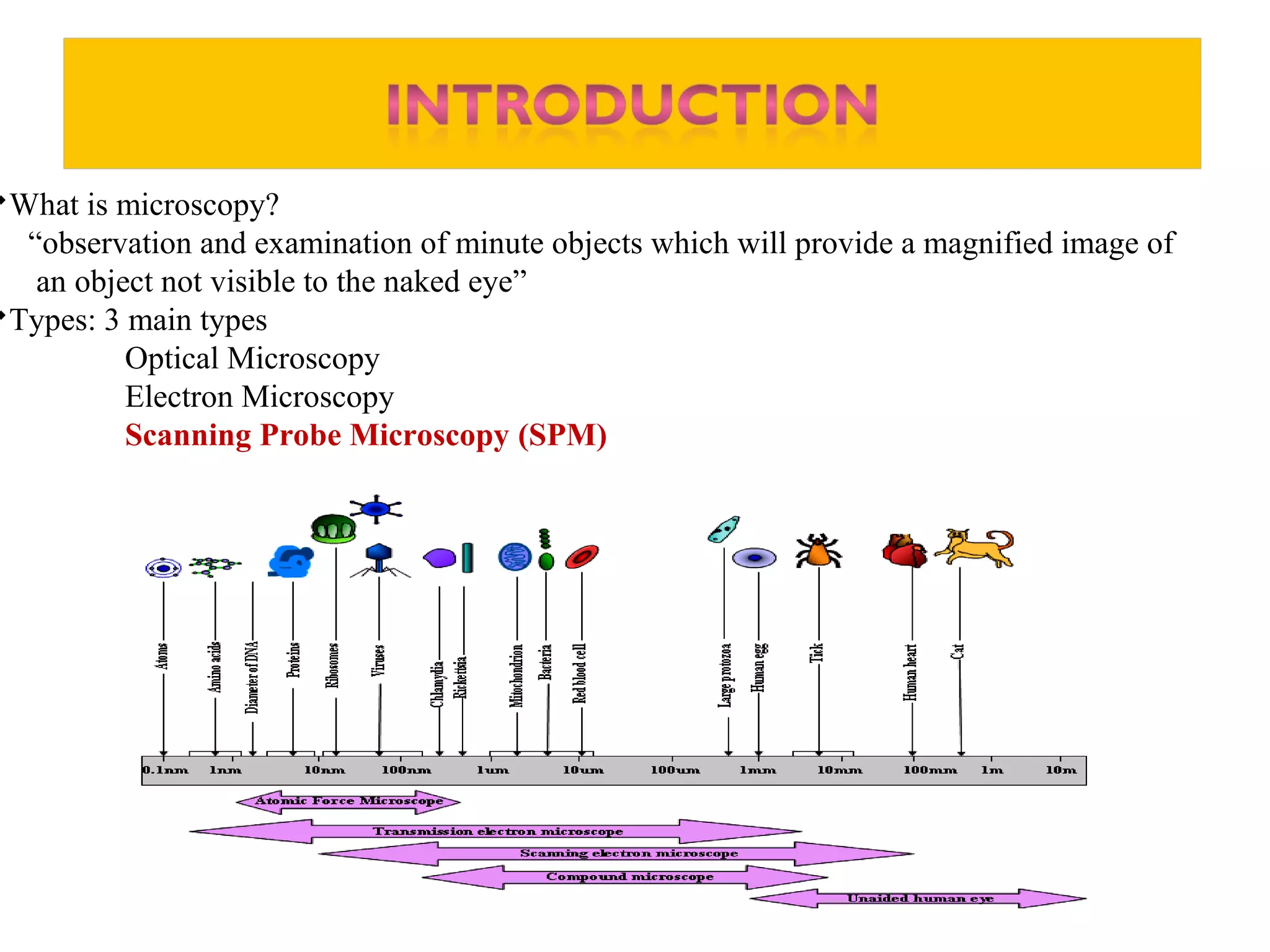
What is microscopy? 
“observation and examination of minute objects which will provide a magnified image of 
an object not visible to the naked eye” 
Types: 3 main types 
Optical Microscopy 
Electron Microscopy 
Scanning Probe Microscopy (SPM)
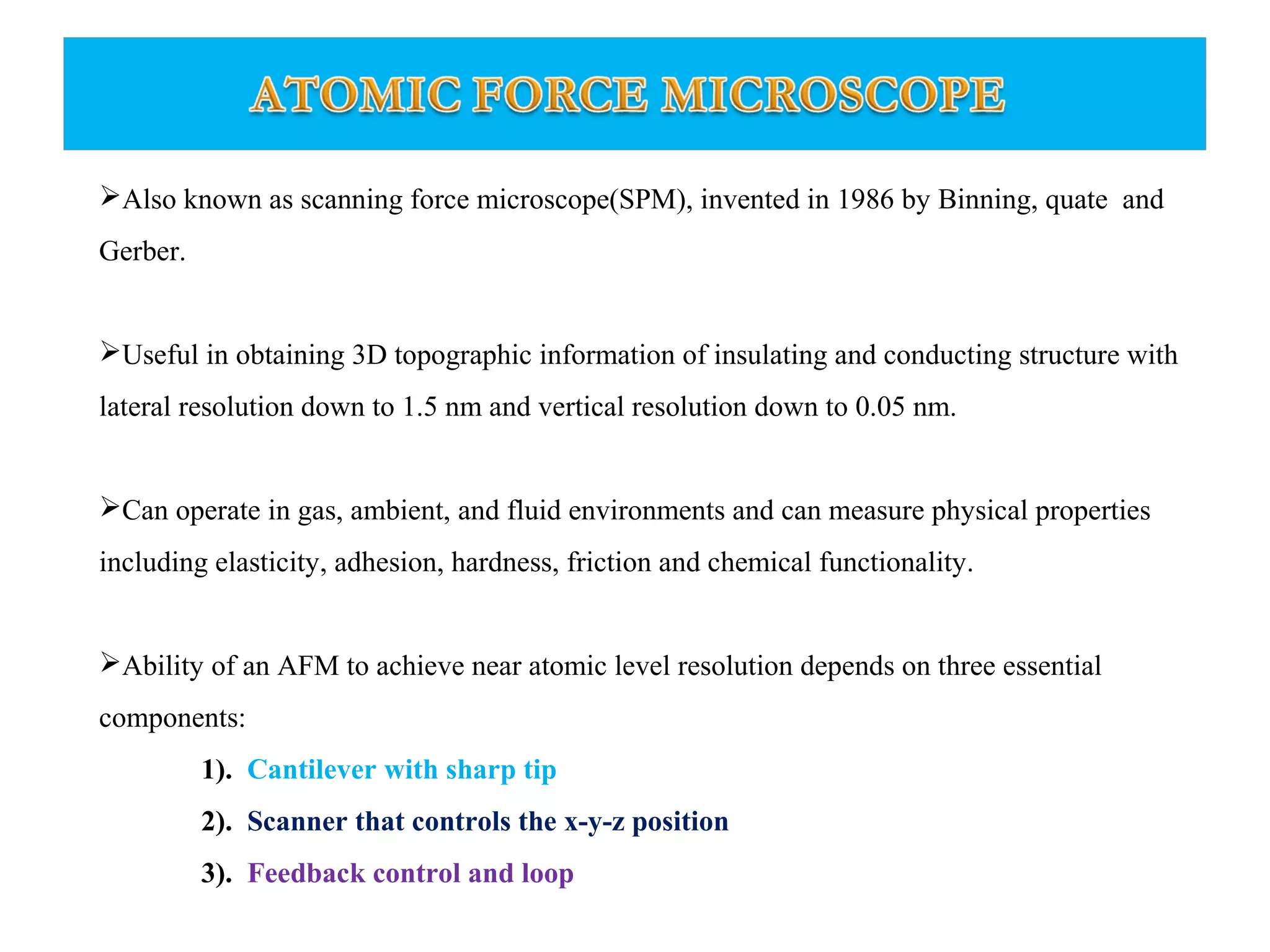
Also known as scanning force microscope(SPM), invented in 1986 by Binning, quate and 
Gerber. 
Useful in obtaining 3D topographic information of insulating and conducting structure with 
lateral resolution down to 1.5 nm and vertical resolution down to 0.05 nm. 
Can operate in gas, ambient, and fluid environments and can measure physical properties 
including elasticity, adhesion, hardness, friction and chemical functionality. 
Ability of an AFM to achieve near atomic level resolution depends on three essential 
components: 
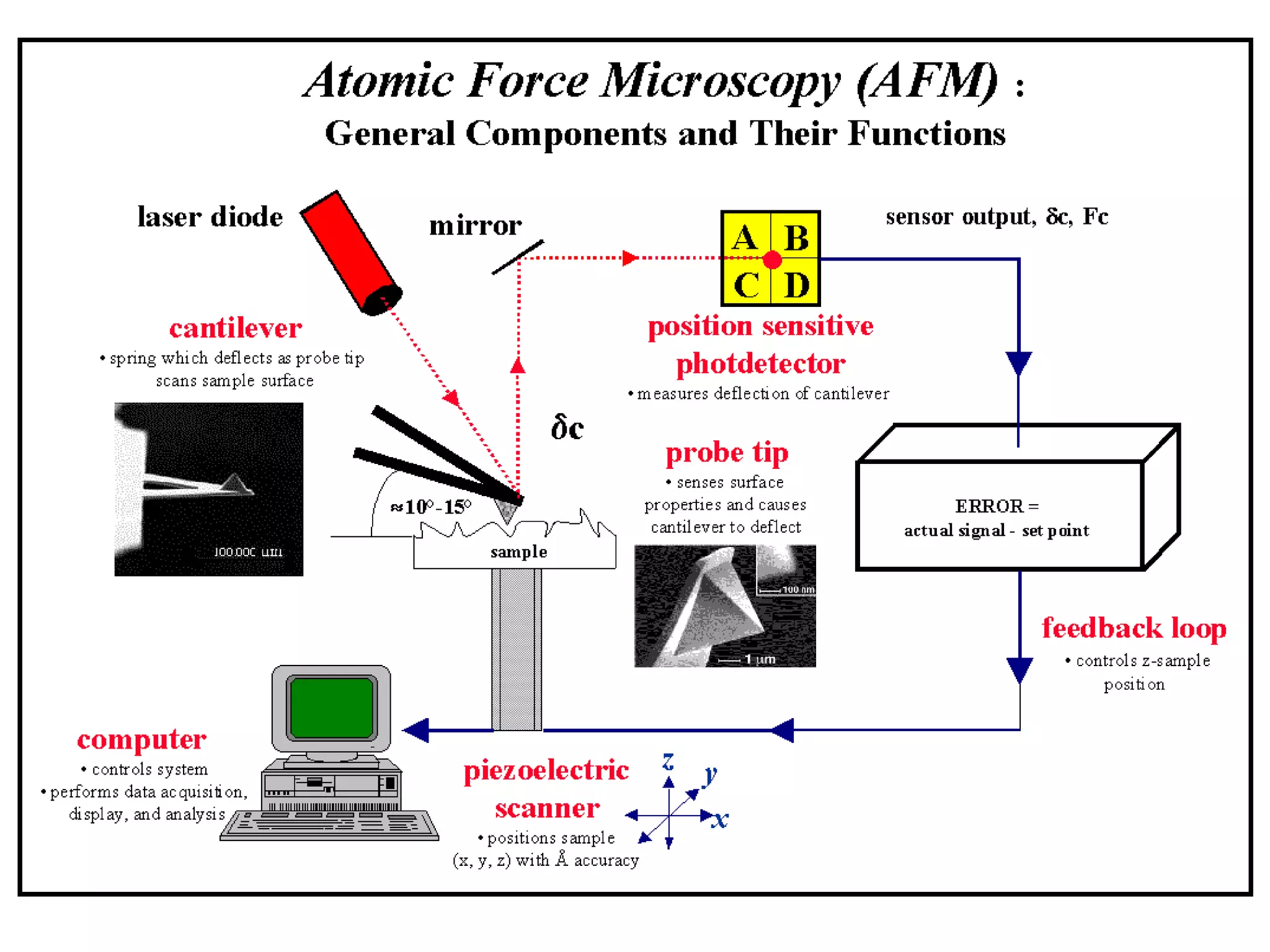
1). Cantilever with sharp tip 
2). Scanner that controls the x-y-z position 
3). Feedback control and loop
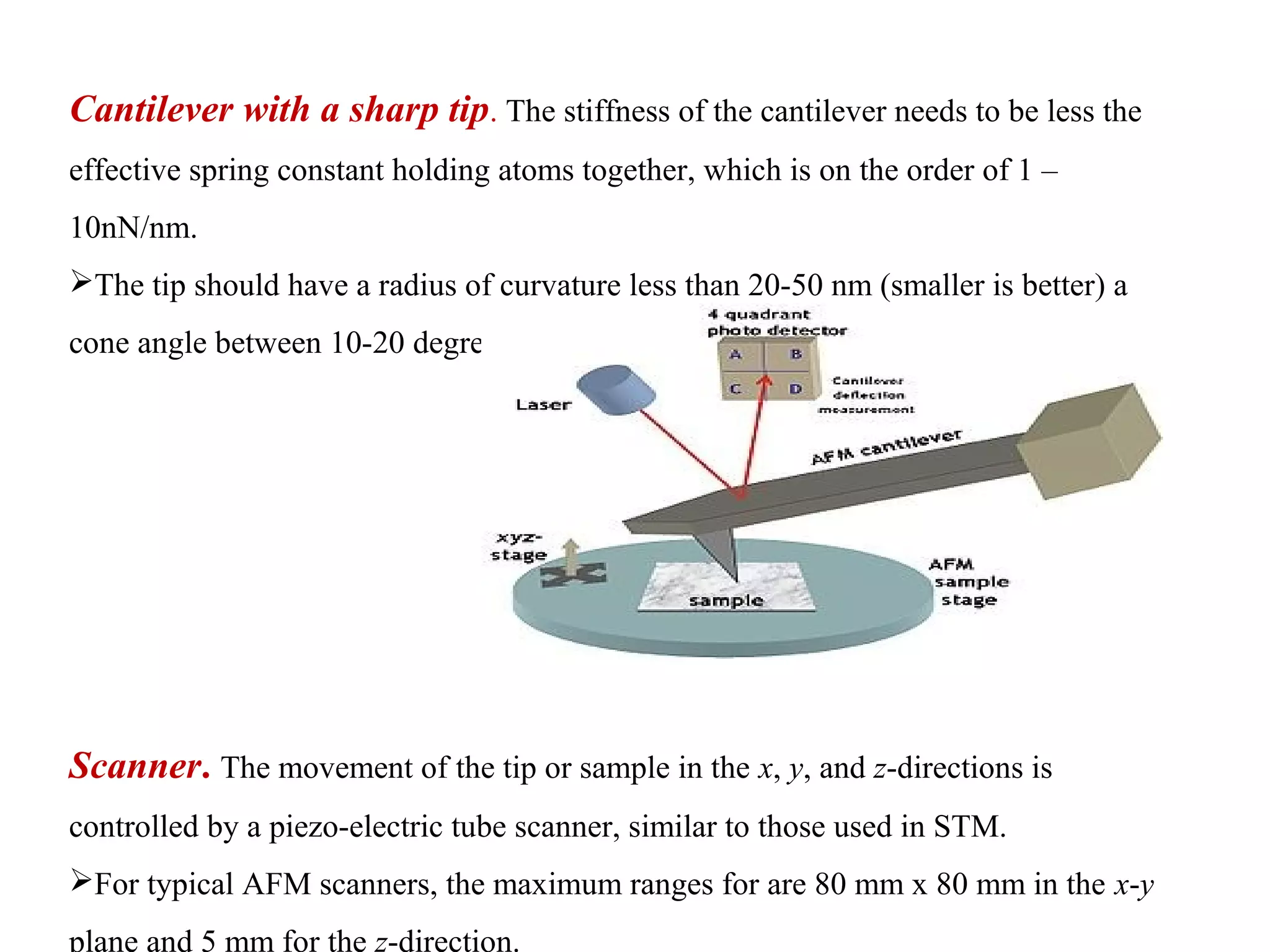
Cantilever with a sharp tip. The stiffness of the cantilever needs to be less the 
effective spring constant holding atoms together, which is on the order of 1 – 
10nN/nm. 
The tip should have a radius of curvature less than 20-50 nm (smaller is better) a 
cone angle between 10-20 degrees. 
Scanner. The movement of the tip or sample in the x, y, and z-directions is 
controlled by a piezo-electric tube scanner, similar to those used in STM. 
For typical AFM scanners, the maximum ranges for are 80 mm x 80 mm in the x-y 
plane and 5 mm for the z-direction.
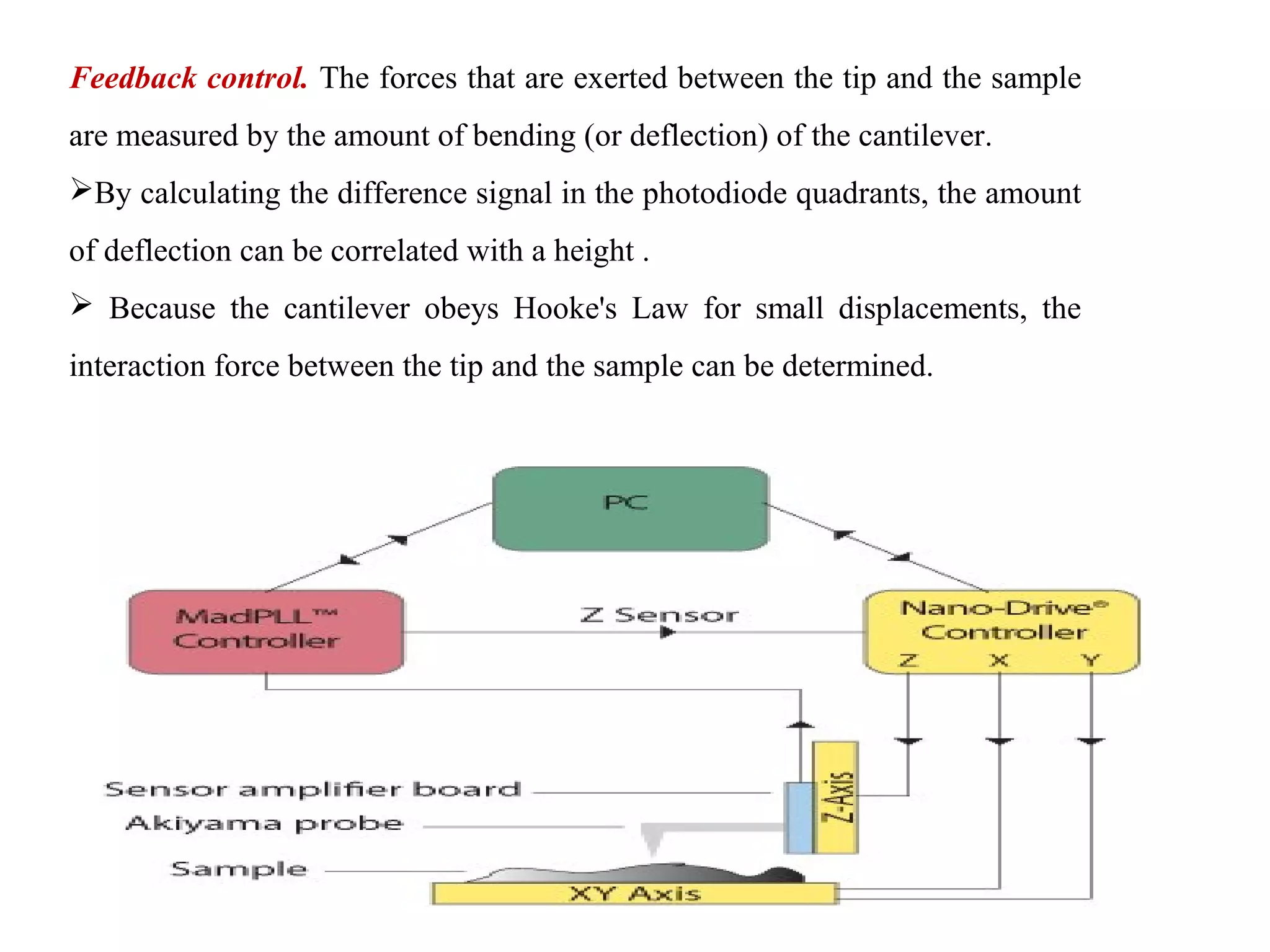
Feedback control. The forces that are exerted between the tip and the sample 
are measured by the amount of bending (or deflection) of the cantilever. 
By calculating the difference signal in the photodiode quadrants, the amount 
of deflection can be correlated with a height . 
 Because the cantilever obeys Hooke's Law for small displacements, the 
interaction force between the tip and the sample can be determined.
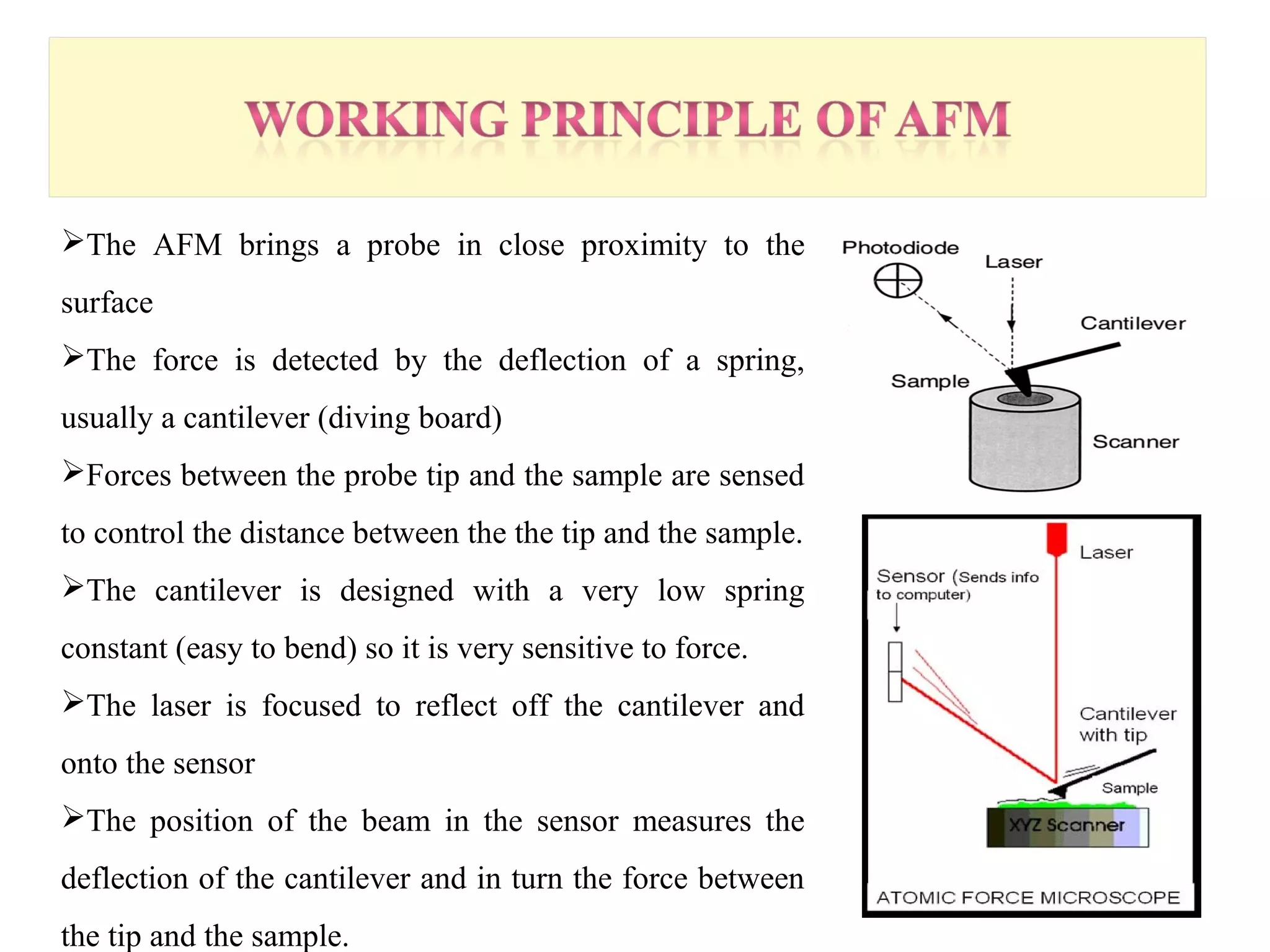
The AFM brings a probe in close proximity to the 
surface 
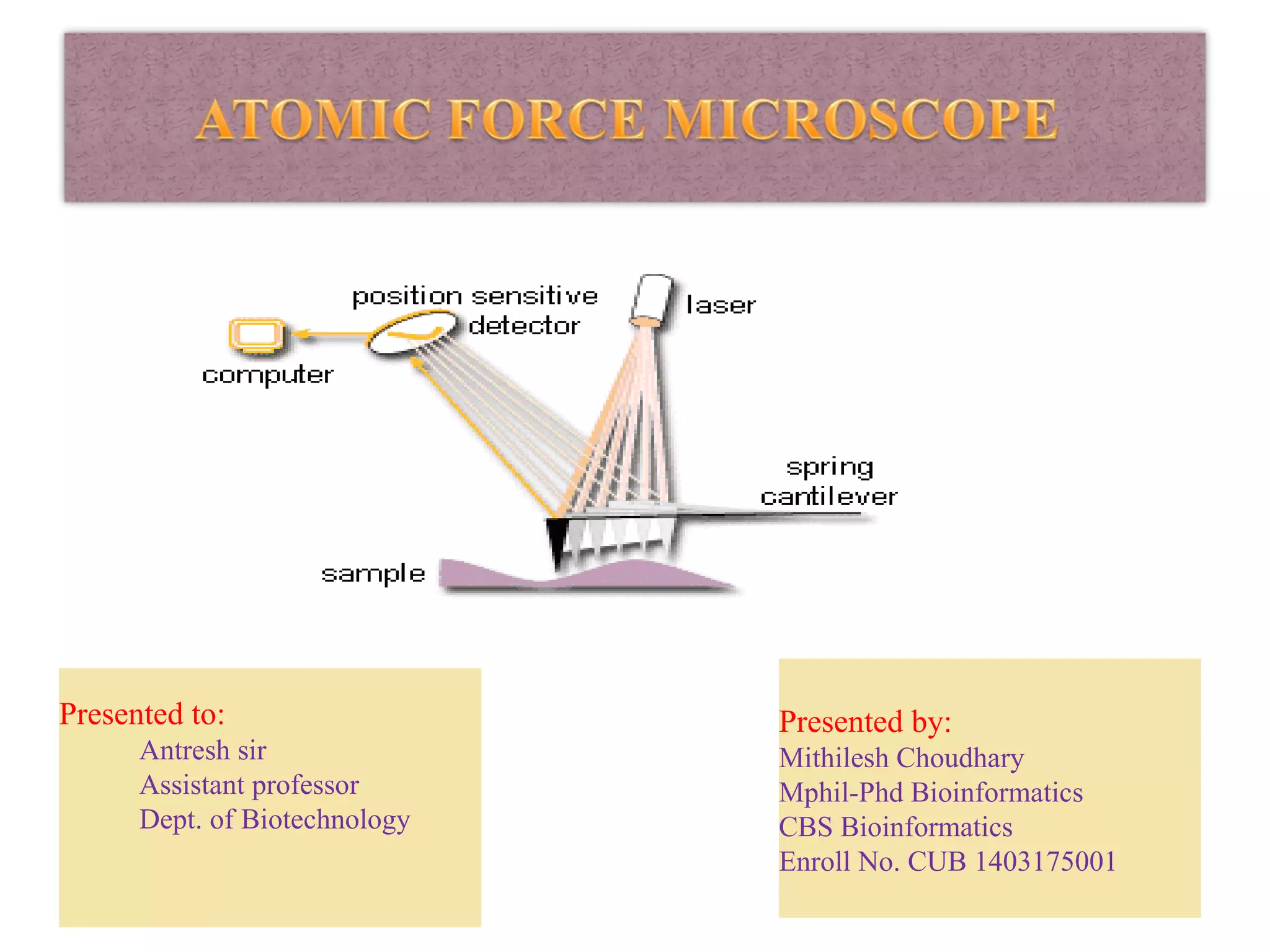
The force is detected by the deflection of a spring, 
usually a cantilever (diving board) 
Forces between the probe tip and the sample are sensed 
to control the distance between the the tip and the sample. 
The cantilever is designed with a very low spring 
constant (easy to bend) so it is very sensitive to force. 
The laser is focused to reflect off the cantilever and 
onto the sensor 
The position of the beam in the sensor measures the 
deflection of the cantilever and in turn the force between 
the tip and the sample.
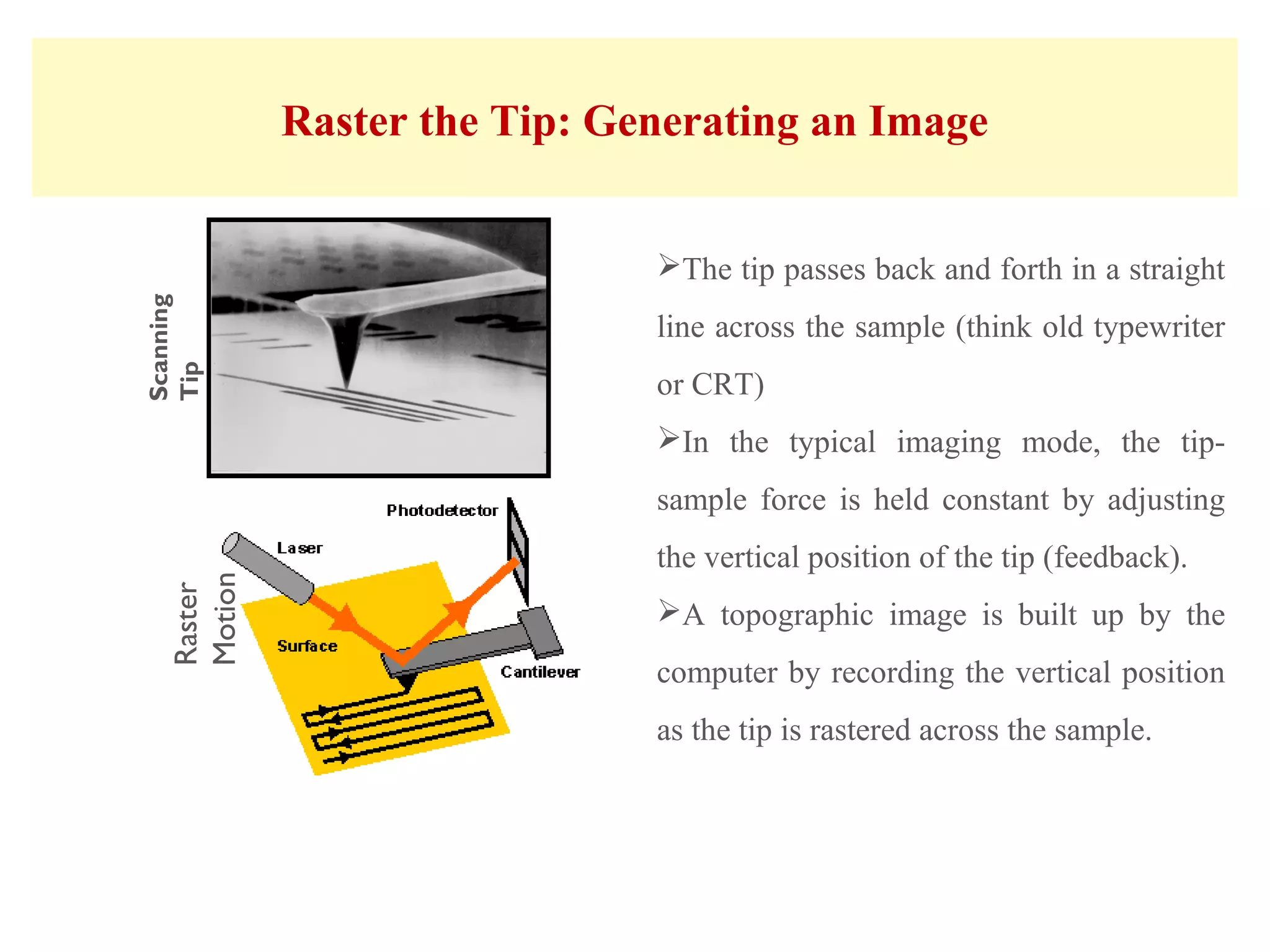
Raster the Tip: Generating an Image 
The tip passes back and forth in a straight 
line across the sample (think old typewriter 
or CRT) 
In the typical imaging mode, the tip-sample 
force is held constant by adjusting 
the vertical position of the tip (feedback). 
A topographic image is built up by the 
computer by recording the vertical position 
as the tip is rastered across the sample. 
Scanning 
Raster Tip 
Motion
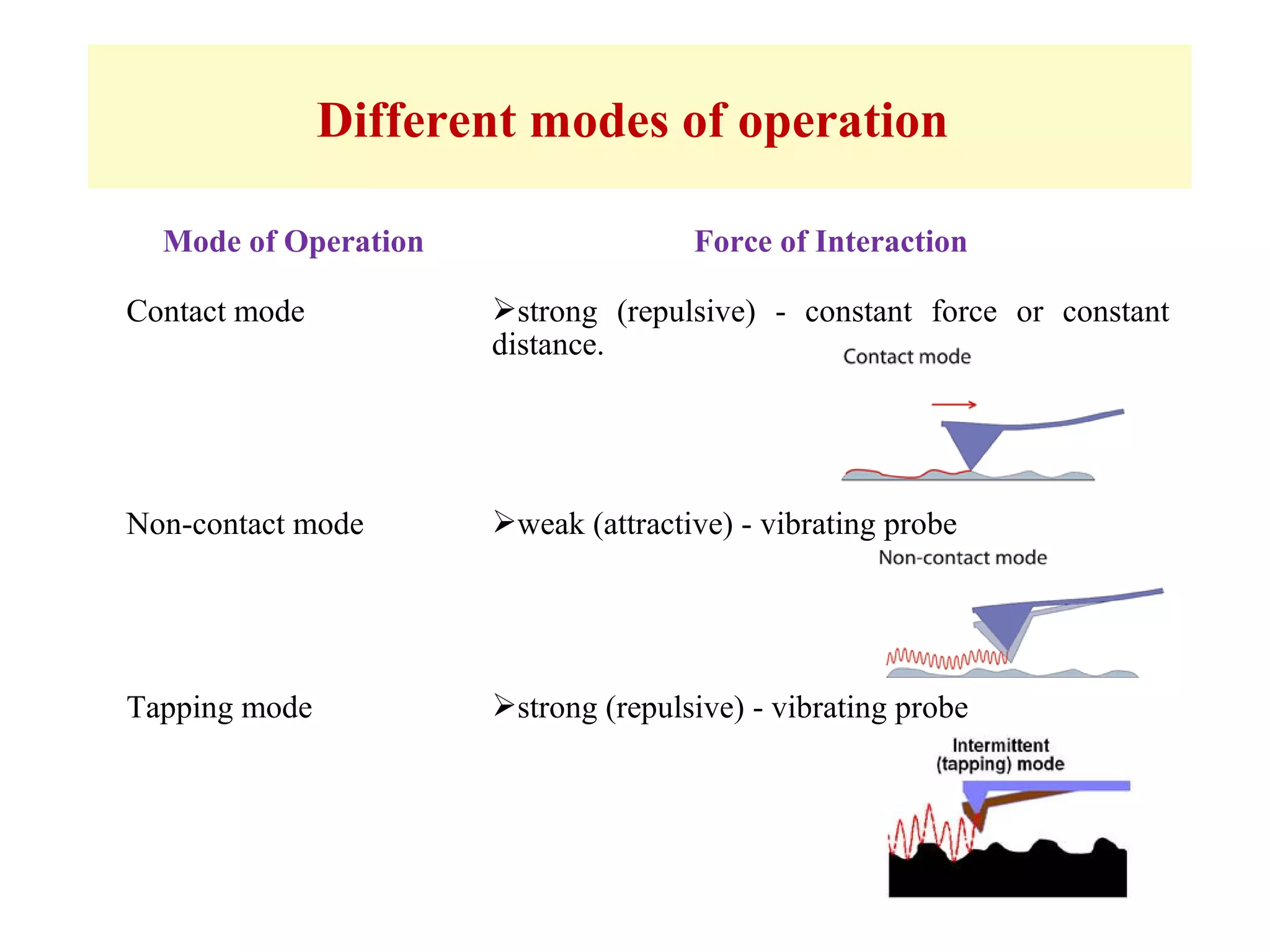
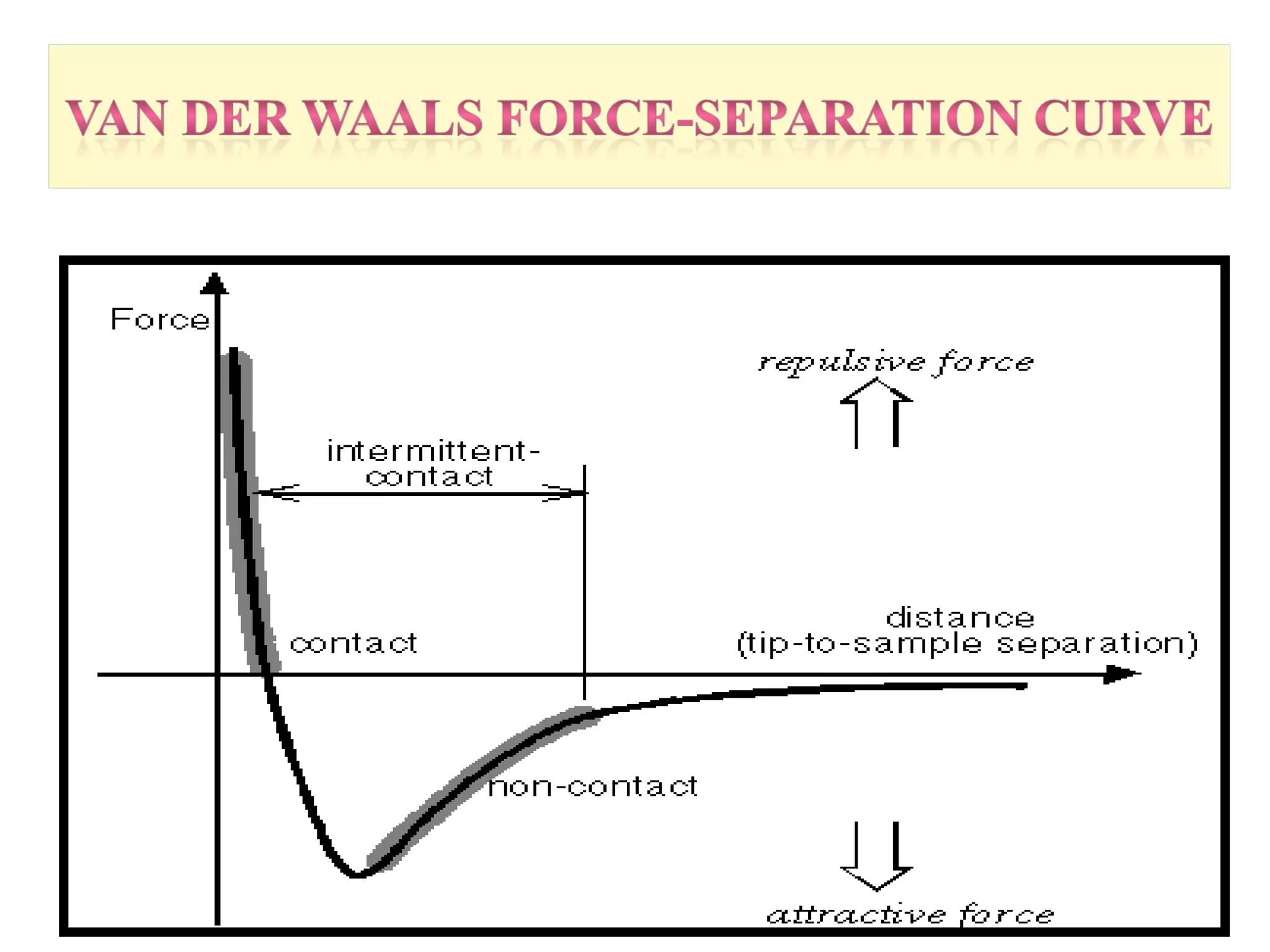
Different modes of operation 
Mode of Operation Force of Interaction 
Contact mode strong (repulsive) - constant force or constant 
distance. 
Non-contact mode weak (attractive) - vibrating probe 
Tapping mode strong (repulsive) - vibrating probe
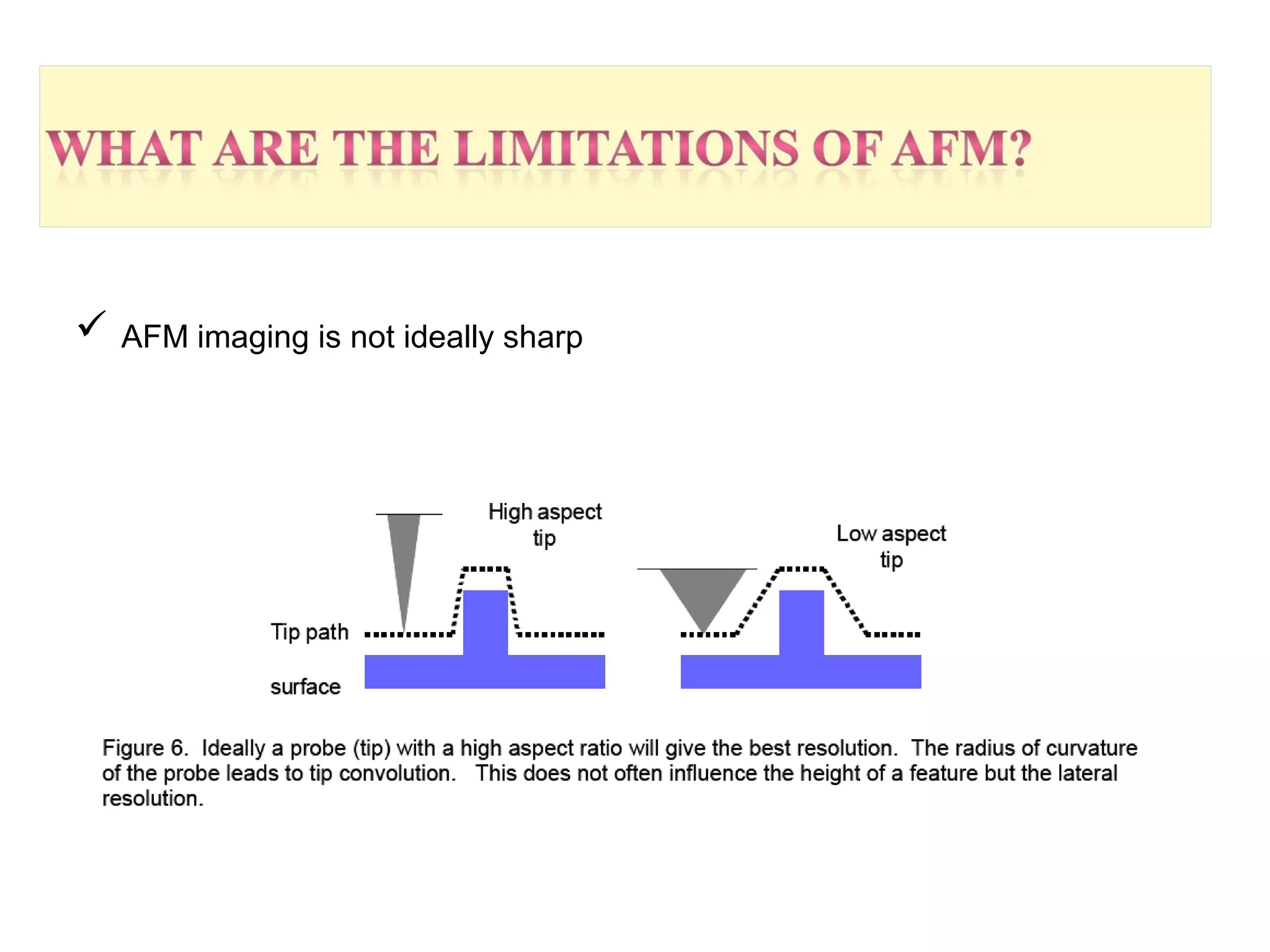
 AFM imaging is not ideally sharp
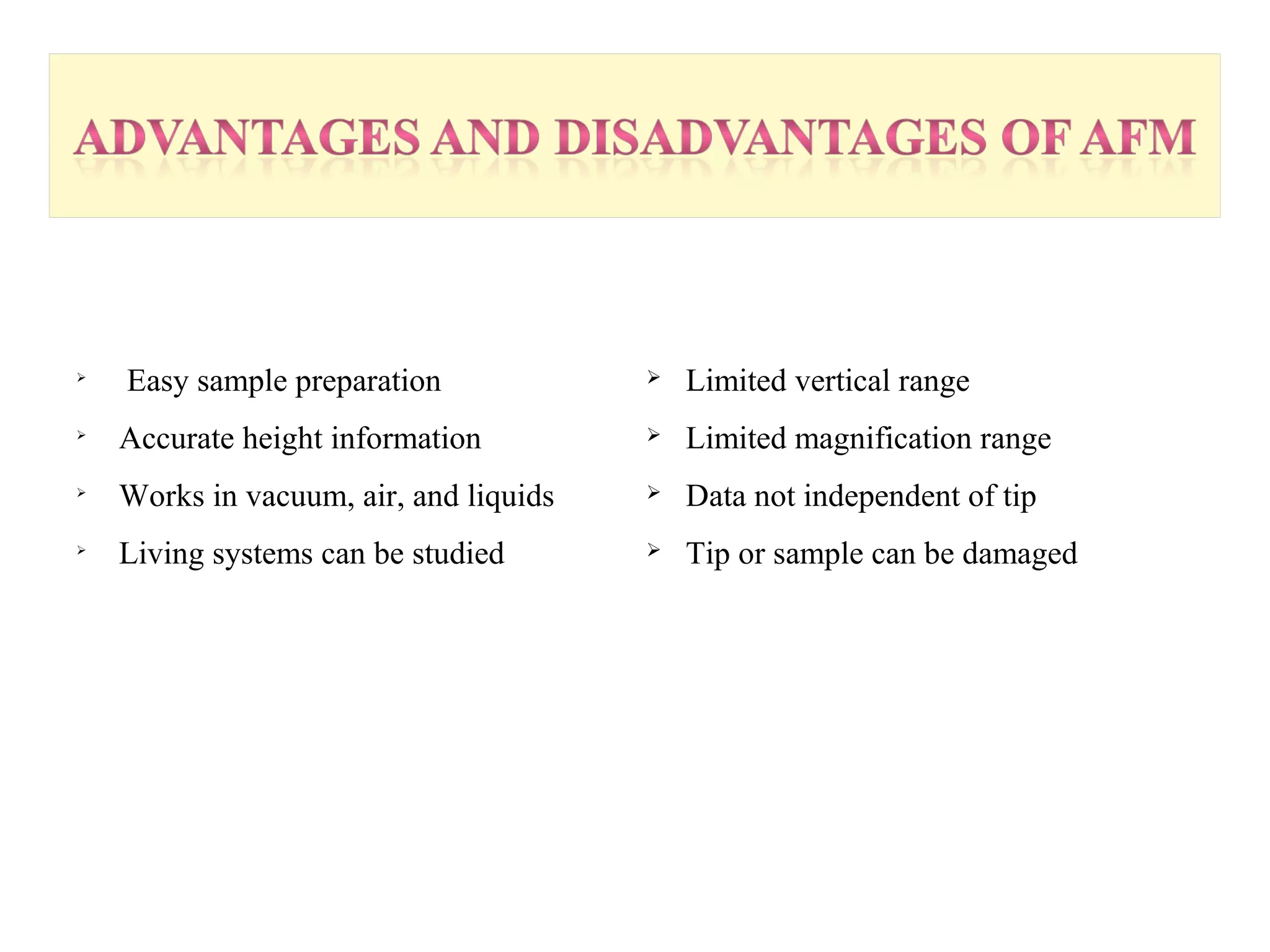
 Easy sample preparation 
 Accurate height information 
 Works in vacuum, air, and liquids 
 Living systems can be studied 
 Limited vertical range 
 Limited magnification range 
 Data not independent of tip 
 Tip or sample can be damaged
Materials Investigated: Thin and thick film coatings, ceramics, composites, 
glasses, synthetic and biological membranes, metals, polymers, and 
semiconductors. 
Used to study phenomena of: Abrasion, adhesion, cleaning, corrosion, 
etching, friction, lubricating, plating, and polishing. 
AFM can image surface of material in atomic resolution and also measure 
force at the nano-Newton scale.
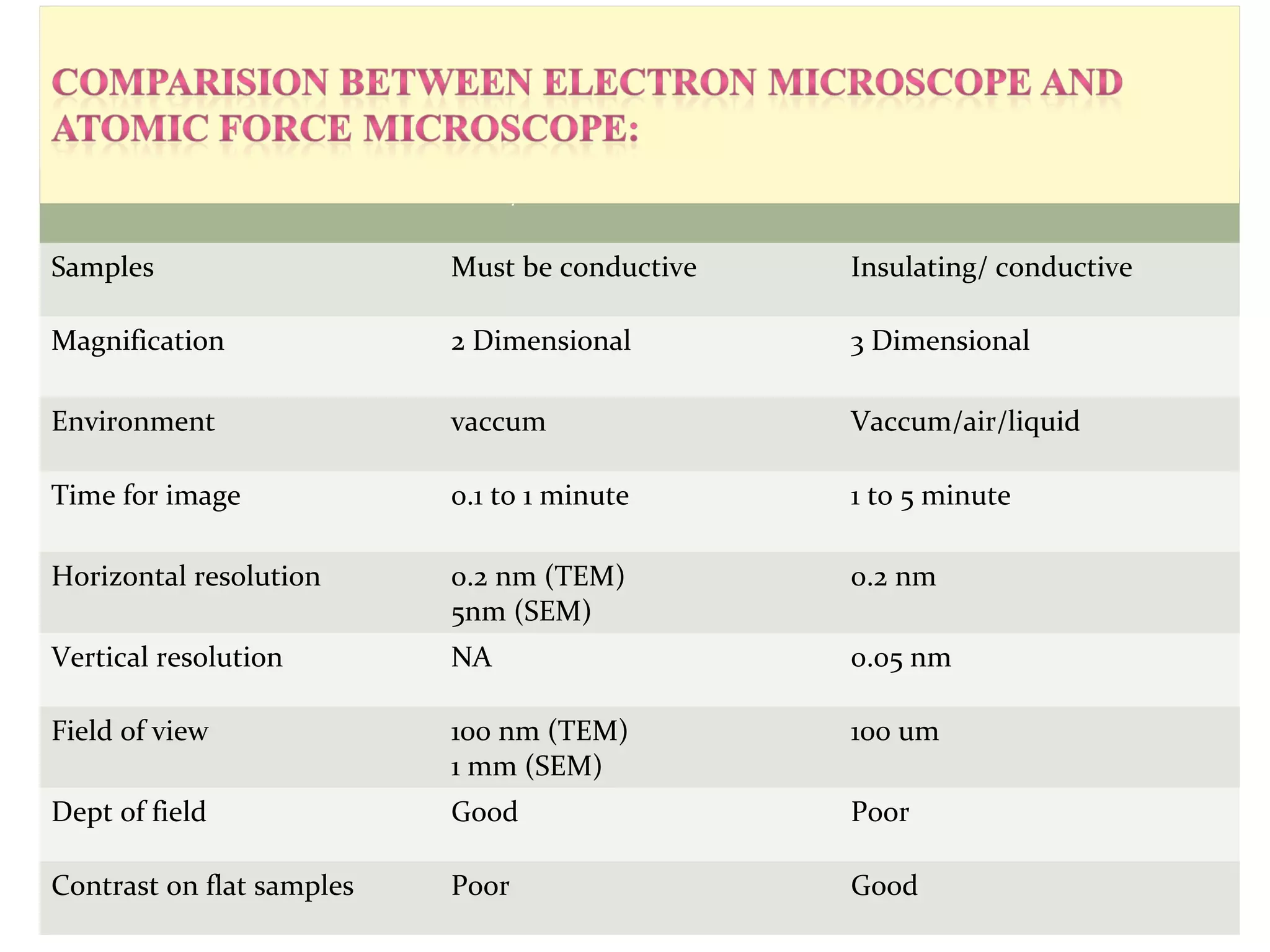
SEM/TEM AFM 
Samples Must be conductive Insulating/ conductive 
Magnification 2 Dimensional 3 Dimensional 
Environment vaccum Vaccum/air/liquid 
Time for image 0.1 to 1 minute 1 to 5 minute 
Horizontal resolution 0.2 nm (TEM) 
5nm (SEM) 
0.2 nm 
Vertical resolution NA 0.05 nm 
Field of view 100 nm (TEM) 
1 mm (SEM) 
100 um 
Dept of field Good Poor 
Contrast on flat samples Poor Good
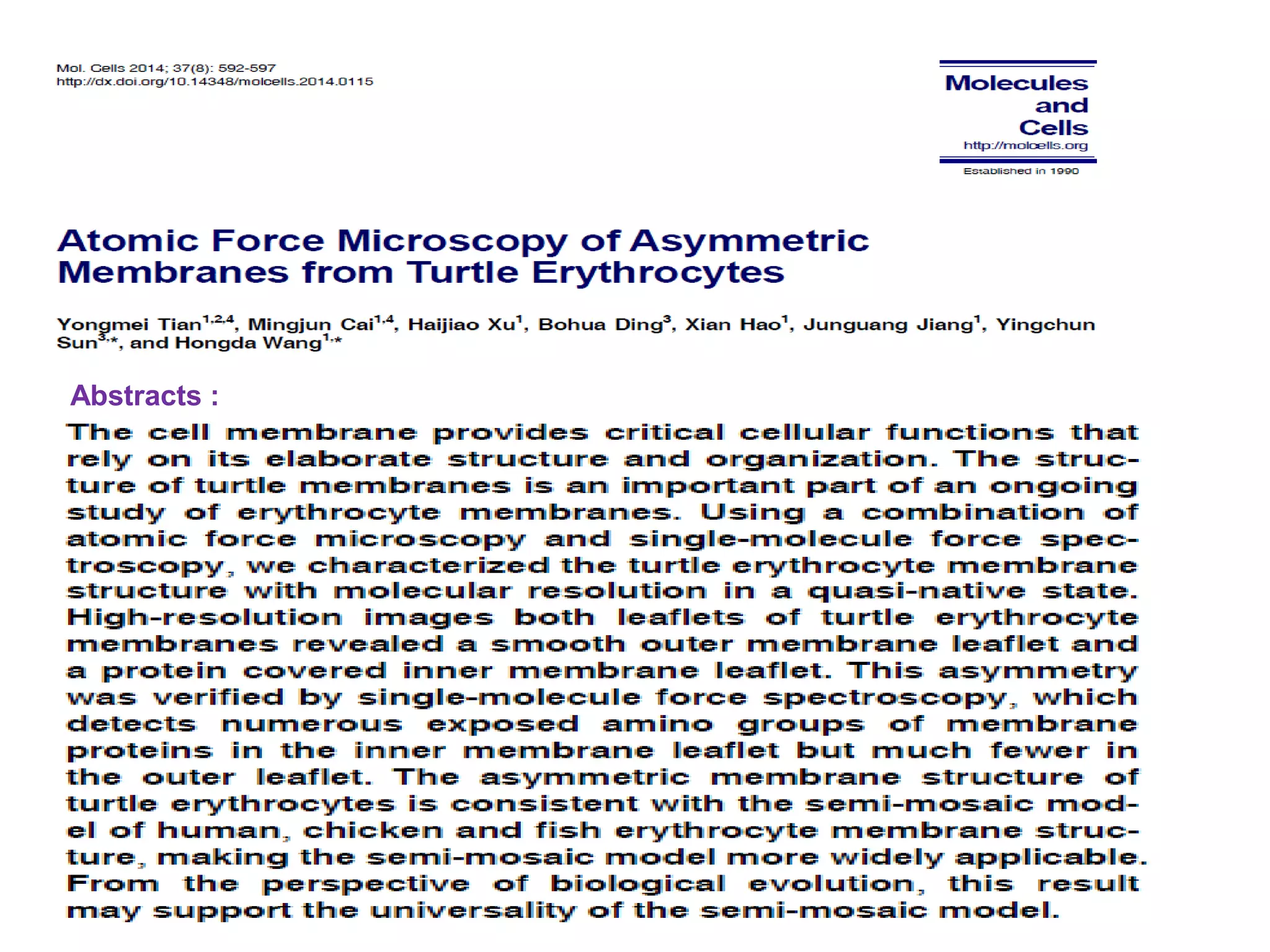
Abstracts :
OBJECTIVE OF THE STUDY: 
To characterize turtle erythrocyte membrane structure with molecular resolution in a 
quasi native state. 
METHODS: 
[1]. Isolation of Turtle erythrocytes 
[2]. Preparation of the outer and inner leaflets of erythrocyte 
Membranes 
[3]. Digestion of the inner leaflet of erythrocyte membranes with 
proteinase K 
[4]. AFM imaging and force spectroscopy
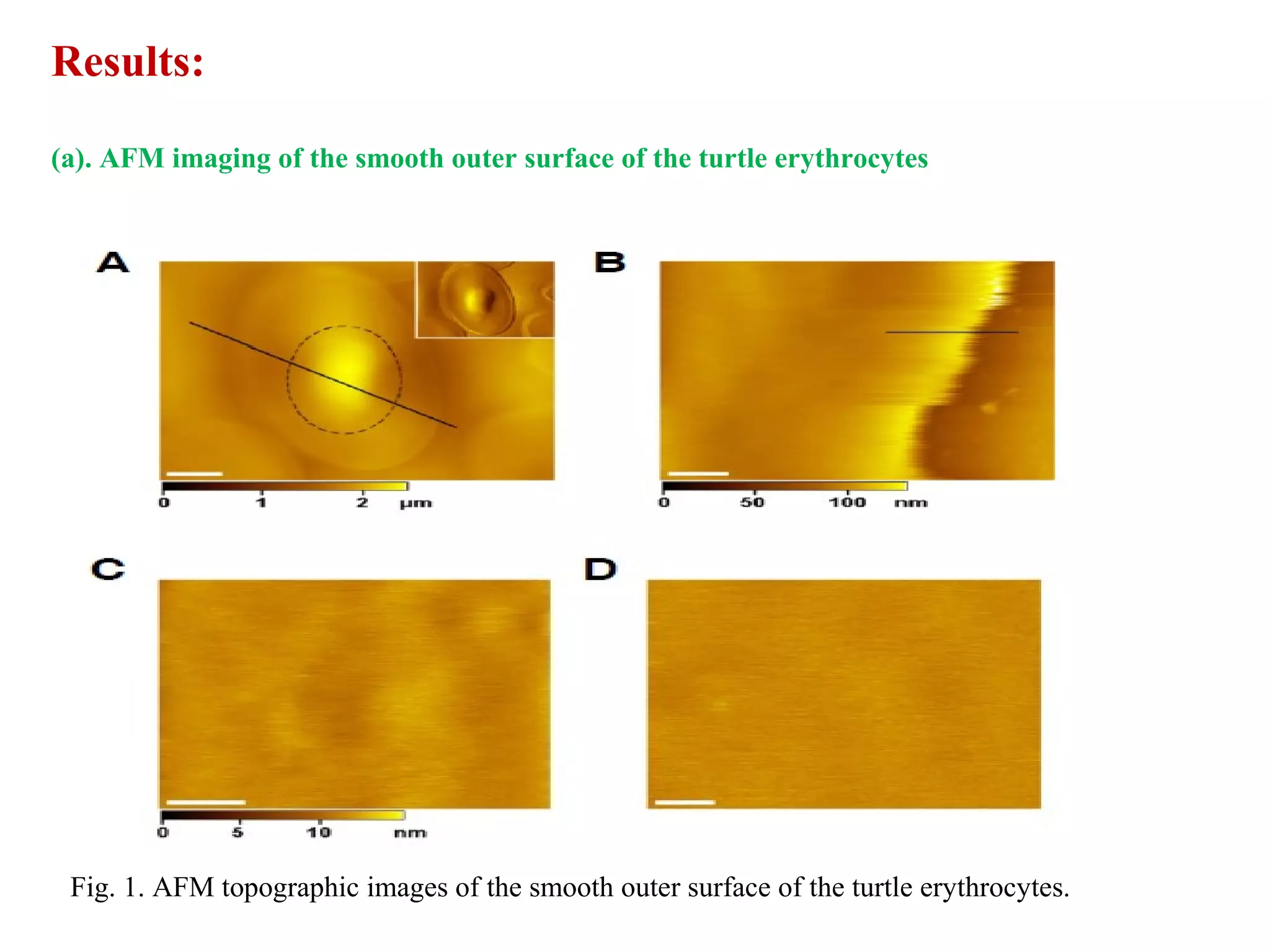
Results: 
(a). AFM imaging of the smooth outer surface of the turtle erythrocytes 
Fig. 1. AFM topographic images of the smooth outer surface of the turtle erythrocytes.
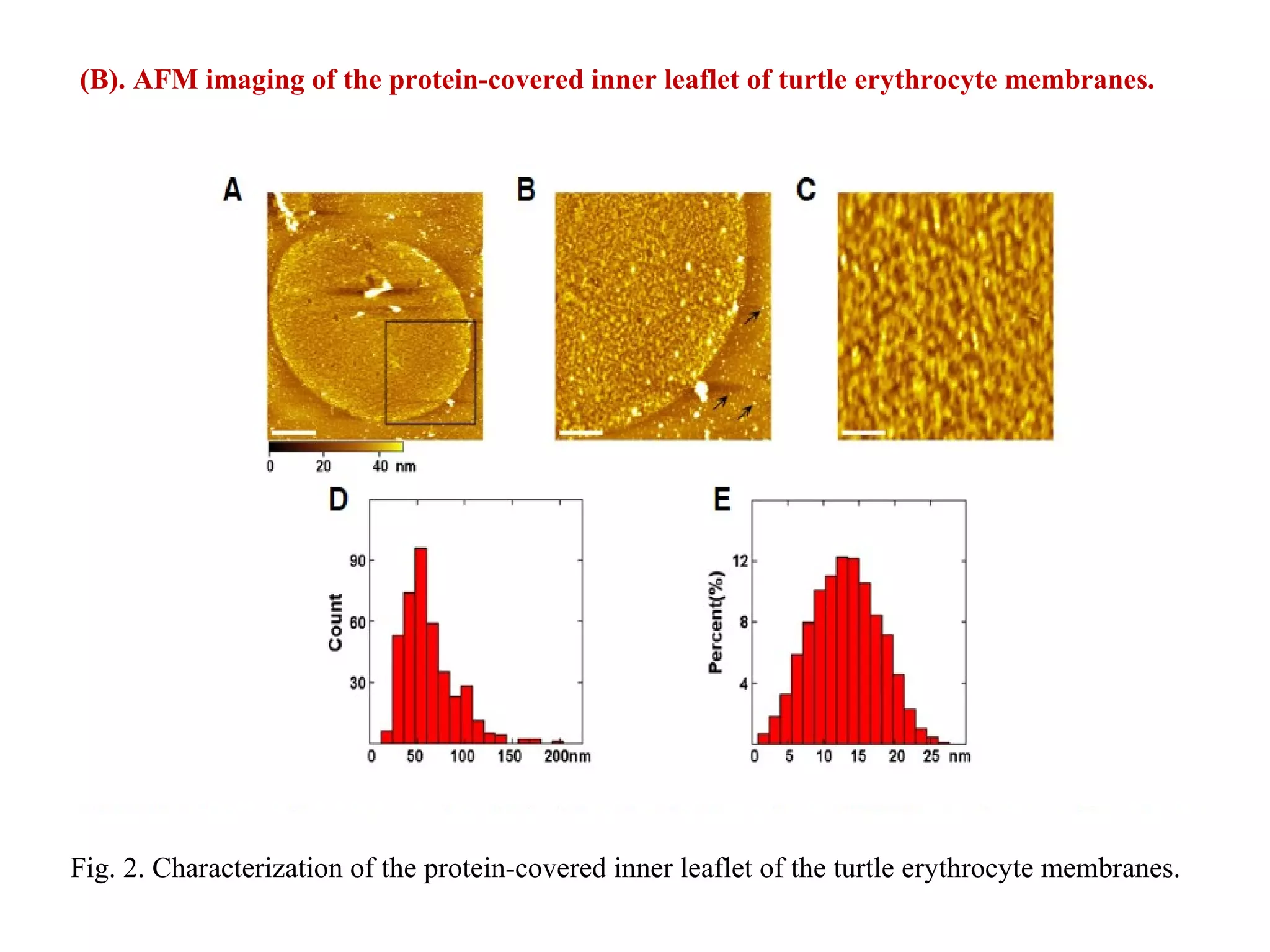
(B). AFM imaging of the protein-covered inner leaflet of turtle erythrocyte membranes. 
Fig. 2. Characterization of the protein-covered inner leaflet of the turtle erythrocyte membranes.
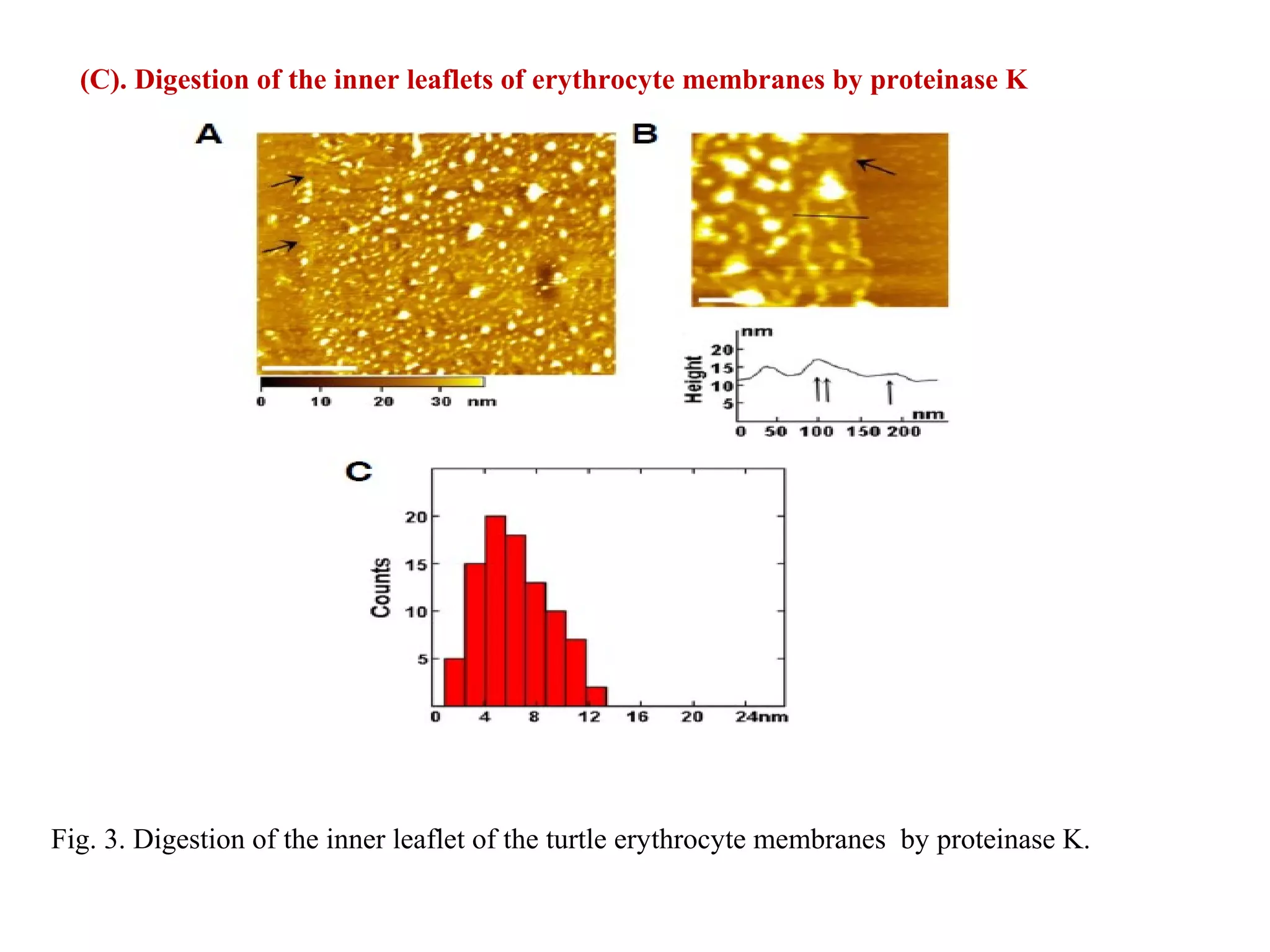
(C). Digestion of the inner leaflets of erythrocyte membranes by proteinase K 
Fig. 3. Digestion of the inner leaflet of the turtle erythrocyte membranes by proteinase K.
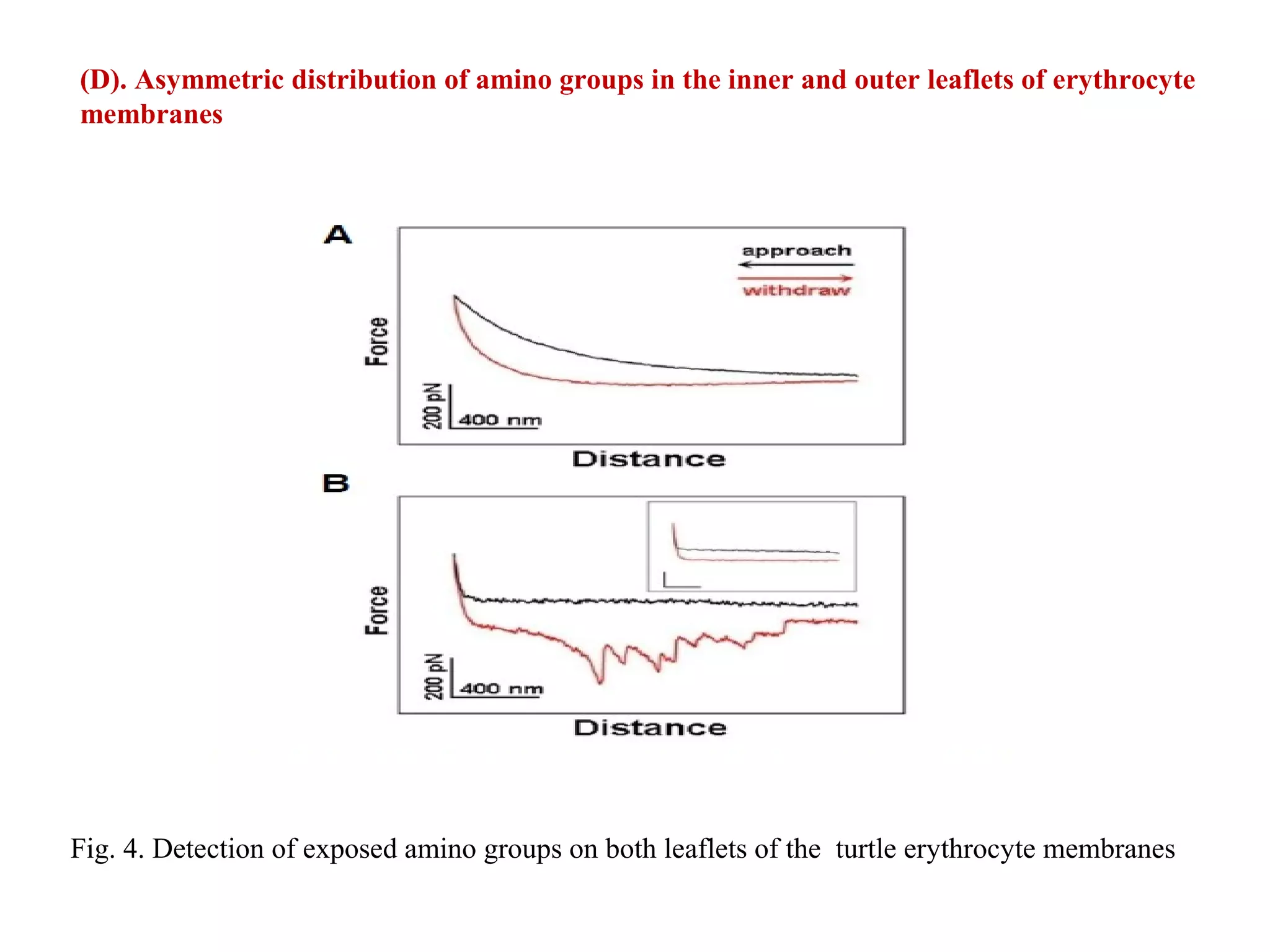
(D). Asymmetric distribution of amino groups in the inner and outer leaflets of erythrocyte 
membranes 
Fig. 4. Detection of exposed amino groups on both leaflets of the turtle erythrocyte membranes
Conclusion: 
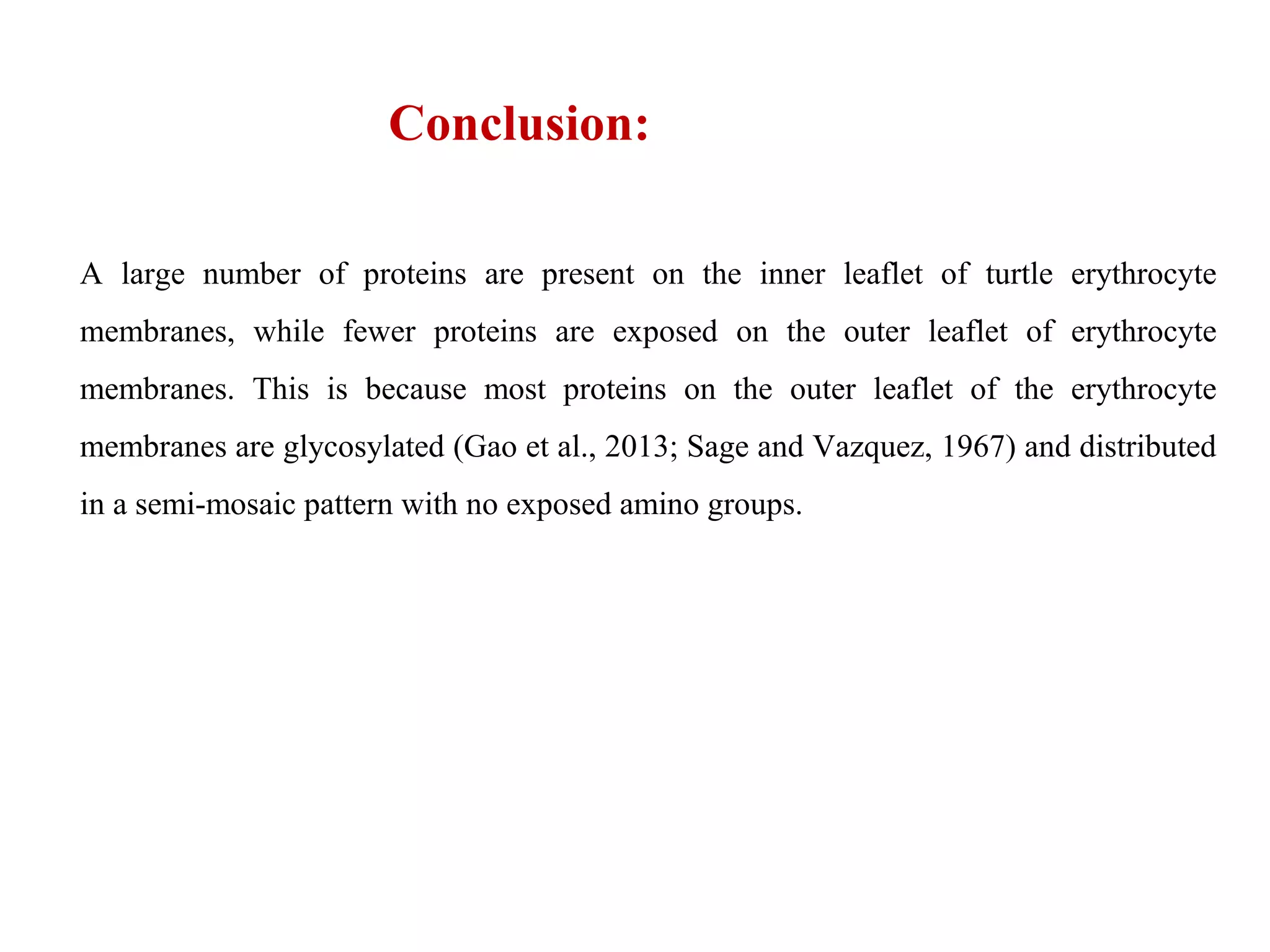
A large number of proteins are present on the inner leaflet of turtle erythrocyte 
membranes, while fewer proteins are exposed on the outer leaflet of erythrocyte 
membranes. This is because most proteins on the outer leaflet of the erythrocyte 
membranes are glycosylated (Gao et al., 2013; Sage and Vazquez, 1967) and distributed 
in a semi-mosaic pattern with no exposed amino groups.
THANK U

ATOMIC FORCE MICROSCOPE MITHILESH CHOUDHARY

  • 1.
    Presented to: Antreshsir Assistant professor Dept. of Biotechnology Presented by: Mithilesh Choudhary Mphil-Phd Bioinformatics CBS Bioinformatics Enroll No. CUB 1403175001
  • 2.
    What is microscopy? “observation and examination of minute objects which will provide a magnified image of an object not visible to the naked eye” Types: 3 main types Optical Microscopy Electron Microscopy Scanning Probe Microscopy (SPM)
  • 3.
    Also known asscanning force microscope(SPM), invented in 1986 by Binning, quate and Gerber. Useful in obtaining 3D topographic information of insulating and conducting structure with lateral resolution down to 1.5 nm and vertical resolution down to 0.05 nm. Can operate in gas, ambient, and fluid environments and can measure physical properties including elasticity, adhesion, hardness, friction and chemical functionality. Ability of an AFM to achieve near atomic level resolution depends on three essential components: 1). Cantilever with sharp tip 2). Scanner that controls the x-y-z position 3). Feedback control and loop
  • 4.
    Cantilever with asharp tip. The stiffness of the cantilever needs to be less the effective spring constant holding atoms together, which is on the order of 1 – 10nN/nm. The tip should have a radius of curvature less than 20-50 nm (smaller is better) a cone angle between 10-20 degrees. Scanner. The movement of the tip or sample in the x, y, and z-directions is controlled by a piezo-electric tube scanner, similar to those used in STM. For typical AFM scanners, the maximum ranges for are 80 mm x 80 mm in the x-y plane and 5 mm for the z-direction.
  • 5.
    Feedback control. Theforces that are exerted between the tip and the sample are measured by the amount of bending (or deflection) of the cantilever. By calculating the difference signal in the photodiode quadrants, the amount of deflection can be correlated with a height .  Because the cantilever obeys Hooke's Law for small displacements, the interaction force between the tip and the sample can be determined.
  • 7.
    The AFM bringsa probe in close proximity to the surface The force is detected by the deflection of a spring, usually a cantilever (diving board) Forces between the probe tip and the sample are sensed to control the distance between the the tip and the sample. The cantilever is designed with a very low spring constant (easy to bend) so it is very sensitive to force. The laser is focused to reflect off the cantilever and onto the sensor The position of the beam in the sensor measures the deflection of the cantilever and in turn the force between the tip and the sample.
  • 8.
    Raster the Tip:Generating an Image The tip passes back and forth in a straight line across the sample (think old typewriter or CRT) In the typical imaging mode, the tip-sample force is held constant by adjusting the vertical position of the tip (feedback). A topographic image is built up by the computer by recording the vertical position as the tip is rastered across the sample. Scanning Raster Tip Motion
  • 9.
    Different modes ofoperation Mode of Operation Force of Interaction Contact mode strong (repulsive) - constant force or constant distance. Non-contact mode weak (attractive) - vibrating probe Tapping mode strong (repulsive) - vibrating probe
  • 11.
     AFM imagingis not ideally sharp
  • 12.
     Easy samplepreparation  Accurate height information  Works in vacuum, air, and liquids  Living systems can be studied  Limited vertical range  Limited magnification range  Data not independent of tip  Tip or sample can be damaged
  • 13.
    Materials Investigated: Thinand thick film coatings, ceramics, composites, glasses, synthetic and biological membranes, metals, polymers, and semiconductors. Used to study phenomena of: Abrasion, adhesion, cleaning, corrosion, etching, friction, lubricating, plating, and polishing. AFM can image surface of material in atomic resolution and also measure force at the nano-Newton scale.
  • 14.
    SEM/TEM AFM SamplesMust be conductive Insulating/ conductive Magnification 2 Dimensional 3 Dimensional Environment vaccum Vaccum/air/liquid Time for image 0.1 to 1 minute 1 to 5 minute Horizontal resolution 0.2 nm (TEM) 5nm (SEM) 0.2 nm Vertical resolution NA 0.05 nm Field of view 100 nm (TEM) 1 mm (SEM) 100 um Dept of field Good Poor Contrast on flat samples Poor Good
  • 15.
  • 16.
    OBJECTIVE OF THESTUDY: To characterize turtle erythrocyte membrane structure with molecular resolution in a quasi native state. METHODS: [1]. Isolation of Turtle erythrocytes [2]. Preparation of the outer and inner leaflets of erythrocyte Membranes [3]. Digestion of the inner leaflet of erythrocyte membranes with proteinase K [4]. AFM imaging and force spectroscopy
  • 17.
    Results: (a). AFMimaging of the smooth outer surface of the turtle erythrocytes Fig. 1. AFM topographic images of the smooth outer surface of the turtle erythrocytes.
  • 18.
    (B). AFM imagingof the protein-covered inner leaflet of turtle erythrocyte membranes. Fig. 2. Characterization of the protein-covered inner leaflet of the turtle erythrocyte membranes.
  • 19.
    (C). Digestion ofthe inner leaflets of erythrocyte membranes by proteinase K Fig. 3. Digestion of the inner leaflet of the turtle erythrocyte membranes by proteinase K.
  • 20.
    (D). Asymmetric distributionof amino groups in the inner and outer leaflets of erythrocyte membranes Fig. 4. Detection of exposed amino groups on both leaflets of the turtle erythrocyte membranes
  • 21.
    Conclusion: A largenumber of proteins are present on the inner leaflet of turtle erythrocyte membranes, while fewer proteins are exposed on the outer leaflet of erythrocyte membranes. This is because most proteins on the outer leaflet of the erythrocyte membranes are glycosylated (Gao et al., 2013; Sage and Vazquez, 1967) and distributed in a semi-mosaic pattern with no exposed amino groups.
  • 22.