Scanning Electron Microscope
and Transmitting Electron
Microscope
Why We Need Electron
Microscope?
 Light Microscopes are limited by the physics of light to
500x or 1000x magnification and a resolution of 0.2
micrometers.
 In the early 1930's there was a scientific desire to see the
fine details of the interior structures of organic cells
(nucleus, mitochondria...etc.).
 This required 10,000x plus magnification which was just
not possible using Light Microscopes.
HISTORY OF ELECTRON
MICROSCOPE
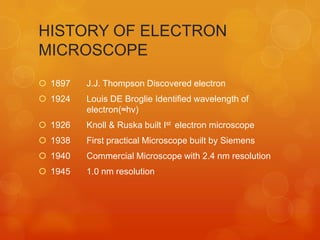
 1897

J.J. Thompson Discovered electron

 1924

Louis DE Broglie Identified wavelength of
electron(≈hν)

 1926

Knoll & Ruska built Ist electron microscope

 1938

First practical Microscope built by Siemens

 1940

Commercial Microscope with 2.4 nm resolution

 1945

1.0 nm resolution
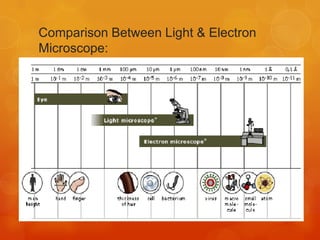
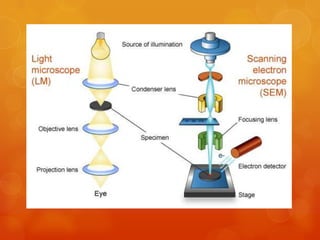
Comparison Between Light & Electron
Microscope:
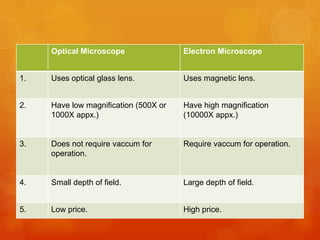
Optical Microscope

Electron Microscope

1.

Uses optical glass lens.

Uses magnetic lens.

2.

Have low magnification (500X or
1000X appx.)

Have high magnification
(10000X appx.)

3.

Does not require vaccum for
operation.

Require vaccum for operation.

4.

Small depth of field.

Large depth of field.

5.

Low price.

High price.
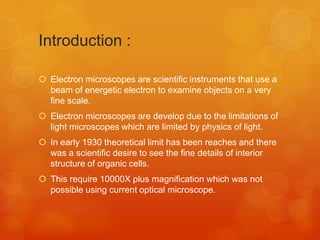
Introduction :
 Electron microscopes are scientific instruments that use a
beam of energetic electron to examine objects on a very
fine scale.
 Electron microscopes are develop due to the limitations of
light microscopes which are limited by physics of light.
 In early 1930 theoretical limit has been reaches and there
was a scientific desire to see the fine details of interior
structure of organic cells.
 This require 10000X plus magnification which was not
possible using current optical microscope.
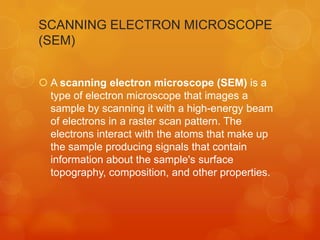
SCANNING ELECTRON MICROSCOPE
(SEM)
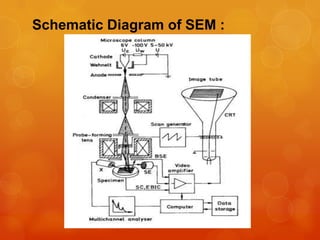
 A scanning electron microscope (SEM) is a
type of electron microscope that images a
sample by scanning it with a high-energy beam
of electrons in a raster scan pattern. The
electrons interact with the atoms that make up
the sample producing signals that contain
information about the sample's surface
topography, composition, and other properties.
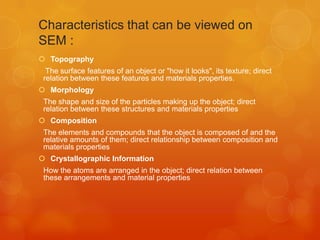
Characteristics that can be viewed on
SEM :
 Topography
The surface features of an object or "how it looks", its texture; direct
relation between these features and materials properties.
 Morphology
The shape and size of the particles making up the object; direct
relation between these structures and materials properties
 Composition
The elements and compounds that the object is composed of and the
relative amounts of them; direct relationship between composition and
materials properties
 Crystallographic Information
How the atoms are arranged in the object; direct relation between
these arrangements and material properties
Schematic Diagram of SEM :
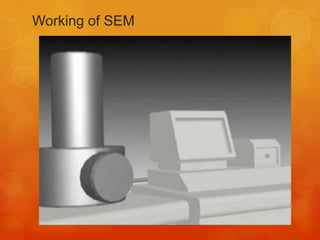
Working of SEM
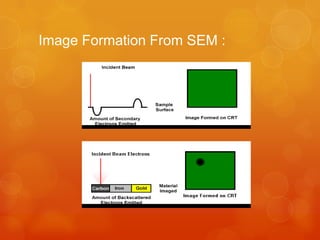
Image Formation From SEM :
Transmission Electron Microscope :
 The transmission electron microscope was the
first type of electron microscope to be developed
and is patterned exactly on the light transmission
microscope except that a focused beam of
electrons is used instead of light to "see through"
the specimen. It was developed by Max Knoll
and Ernst Ruska in Germany in 1931.
 TEMs find application in cancer
research, virology, material science as well as
pollution, nanotechnology and semiconductor
research.
Transmission Electron Microscopy
 In a conventional transmission electron microscope, a thin
specimen is irradiated with an electron beam of uniform
current density.
 Electrons are emitted from the electron gun and illuminate
the specimen through a two or three stage condenser lens
system.
 Objective lens provides the formation of either image or
diffraction pattern of the specimen.
 The electron intensity distribution behind the specimen is
magnified with a three or four stage lens system and viewed
on a fluorescent screen. The image can be recorded by
direct exposure of a photographic emulsion or an image
plate or digitally by a CCD camera.
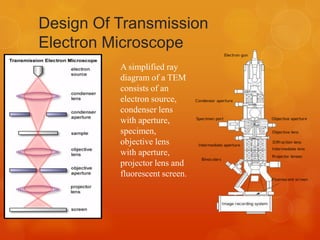
Design Of Transmission
Electron Microscope
A simplified ray
diagram of a TEM
consists of an
electron source,
condenser lens
with aperture,
specimen,
objective lens
with aperture,
projector lens and
fluorescent screen.
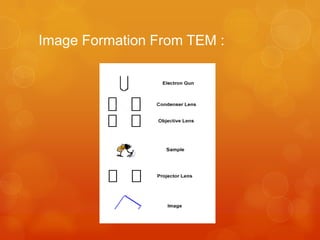
Image Formation From TEM :
EXAMPLE OF DIFFRACTION PATTERN

In this case incident beam direction B [100] in an Aluminum (f,c.c),
single crystal specimen. Transmitted beam is marked as T and the
arrangement of the diffracted beams D around the transmitted beam
is the characteristic of the four fold symmetry of the [100] cube axis
of Aluminum.
Single Crystal Diffraction Pattern

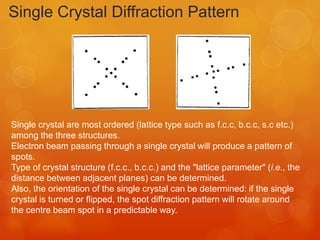
Single crystal are most ordered (lattice type such as f.c.c, b.c.c, s.c etc.)
among the three structures.
Electron beam passing through a single crystal will produce a pattern of
spots.
Type of crystal structure (f.c.c., b.c.c.) and the "lattice parameter" (i.e., the
distance between adjacent planes) can be determined.
Also, the orientation of the single crystal can be determined: if the single
crystal is turned or flipped, the spot diffraction pattern will rotate around
the centre beam spot in a predictable way.
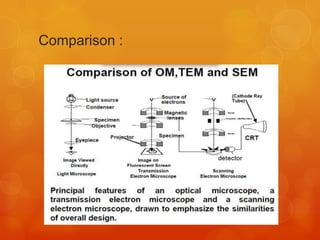
Comparison :
Difference Between SEM & TEM :
 SEM is based on scattered electrons while TEM is based on
transmitted electrons.

 The sample in TEM has to be cut thinner whereas there is no
such need with SEM sample.
 SEM allows for large amount of sample to be analysed at a time
whereas with TEM only small amount of sample can be analysed
at a time.

 SEM is used for surfaces, powders, polished & etched
microstructures, IC chips, chemical segregation whereas TEM is
used for imaging of dislocations, tiny precipitates, grain
boundaries and other defect structures in solids
 TEM has much higher resolution than SEM.

Sem and tem

  • 1.
    Scanning Electron Microscope andTransmitting Electron Microscope
  • 2.
    Why We NeedElectron Microscope?  Light Microscopes are limited by the physics of light to 500x or 1000x magnification and a resolution of 0.2 micrometers.  In the early 1930's there was a scientific desire to see the fine details of the interior structures of organic cells (nucleus, mitochondria...etc.).  This required 10,000x plus magnification which was just not possible using Light Microscopes.
  • 3.
    HISTORY OF ELECTRON MICROSCOPE 1897 J.J. Thompson Discovered electron  1924 Louis DE Broglie Identified wavelength of electron(≈hν)  1926 Knoll & Ruska built Ist electron microscope  1938 First practical Microscope built by Siemens  1940 Commercial Microscope with 2.4 nm resolution  1945 1.0 nm resolution
  • 4.
    Comparison Between Light& Electron Microscope:
  • 5.
    Optical Microscope Electron Microscope 1. Usesoptical glass lens. Uses magnetic lens. 2. Have low magnification (500X or 1000X appx.) Have high magnification (10000X appx.) 3. Does not require vaccum for operation. Require vaccum for operation. 4. Small depth of field. Large depth of field. 5. Low price. High price.
  • 6.
    Introduction :  Electronmicroscopes are scientific instruments that use a beam of energetic electron to examine objects on a very fine scale.  Electron microscopes are develop due to the limitations of light microscopes which are limited by physics of light.  In early 1930 theoretical limit has been reaches and there was a scientific desire to see the fine details of interior structure of organic cells.  This require 10000X plus magnification which was not possible using current optical microscope.
  • 7.
    SCANNING ELECTRON MICROSCOPE (SEM) A scanning electron microscope (SEM) is a type of electron microscope that images a sample by scanning it with a high-energy beam of electrons in a raster scan pattern. The electrons interact with the atoms that make up the sample producing signals that contain information about the sample's surface topography, composition, and other properties.
  • 8.
    Characteristics that canbe viewed on SEM :  Topography The surface features of an object or "how it looks", its texture; direct relation between these features and materials properties.  Morphology The shape and size of the particles making up the object; direct relation between these structures and materials properties  Composition The elements and compounds that the object is composed of and the relative amounts of them; direct relationship between composition and materials properties  Crystallographic Information How the atoms are arranged in the object; direct relation between these arrangements and material properties
  • 9.
  • 11.
  • 12.
  • 13.
    Transmission Electron Microscope:  The transmission electron microscope was the first type of electron microscope to be developed and is patterned exactly on the light transmission microscope except that a focused beam of electrons is used instead of light to "see through" the specimen. It was developed by Max Knoll and Ernst Ruska in Germany in 1931.  TEMs find application in cancer research, virology, material science as well as pollution, nanotechnology and semiconductor research.
  • 14.
    Transmission Electron Microscopy In a conventional transmission electron microscope, a thin specimen is irradiated with an electron beam of uniform current density.  Electrons are emitted from the electron gun and illuminate the specimen through a two or three stage condenser lens system.  Objective lens provides the formation of either image or diffraction pattern of the specimen.  The electron intensity distribution behind the specimen is magnified with a three or four stage lens system and viewed on a fluorescent screen. The image can be recorded by direct exposure of a photographic emulsion or an image plate or digitally by a CCD camera.
  • 15.
    Design Of Transmission ElectronMicroscope A simplified ray diagram of a TEM consists of an electron source, condenser lens with aperture, specimen, objective lens with aperture, projector lens and fluorescent screen.
  • 16.
  • 17.
    EXAMPLE OF DIFFRACTIONPATTERN In this case incident beam direction B [100] in an Aluminum (f,c.c), single crystal specimen. Transmitted beam is marked as T and the arrangement of the diffracted beams D around the transmitted beam is the characteristic of the four fold symmetry of the [100] cube axis of Aluminum.
  • 18.
    Single Crystal DiffractionPattern Single crystal are most ordered (lattice type such as f.c.c, b.c.c, s.c etc.) among the three structures. Electron beam passing through a single crystal will produce a pattern of spots. Type of crystal structure (f.c.c., b.c.c.) and the "lattice parameter" (i.e., the distance between adjacent planes) can be determined. Also, the orientation of the single crystal can be determined: if the single crystal is turned or flipped, the spot diffraction pattern will rotate around the centre beam spot in a predictable way.
  • 19.
  • 20.
    Difference Between SEM& TEM :  SEM is based on scattered electrons while TEM is based on transmitted electrons.  The sample in TEM has to be cut thinner whereas there is no such need with SEM sample.  SEM allows for large amount of sample to be analysed at a time whereas with TEM only small amount of sample can be analysed at a time.  SEM is used for surfaces, powders, polished & etched microstructures, IC chips, chemical segregation whereas TEM is used for imaging of dislocations, tiny precipitates, grain boundaries and other defect structures in solids  TEM has much higher resolution than SEM.