Electron Microscopy
Sagar Sen
Junior research fellow(JRF)
School of Instrumentation
Devi Ahilya University Indore(M.P.)
Content
 Introduction.
 Types of electron microscopy.
 Scanning electron microscopy(SEM).
 Main Part of SEM
* Electron Gun
* Electron Lenses
* Detector
 Summary
Introduction
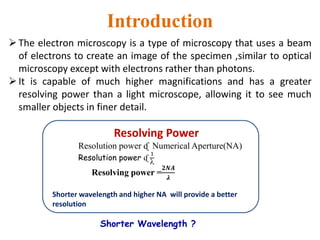
The electron microscopy is a type of microscopy that uses a beam
of electrons to create an image of the specimen ,similar to optical
microscopy except with electrons rather than photons.
It is capable of much higher magnifications and has a greater
resolving power than a light microscope, allowing it to see much
smaller objects in finer detail.
Resolving Power
Resolution power ᶑ Numerical Aperture(NA)
Resolution power ᶑ
1

Resolving power =
𝟐𝑵𝑨
𝝀
Shorter wavelength and higher NA will provide a better
resolution
Shorter Wavelength ?
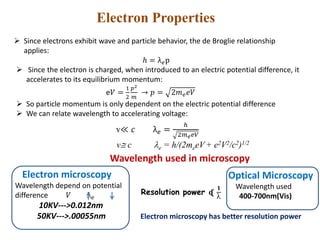
v≪ 𝑐 λ 𝑒 =
ℎ
2𝑚 𝑒 𝑒𝑉
v c e = h/(2meeV+ e2V2/c2)1/2
 Since electrons exhibit wave and particle behavior, the de Broglie relationship
applies:
ℎ = λ 𝑒p
 Since the electron is charged, when introduced to an electric potential difference, it
accelerates to its equilibrium momentum:
e𝑉 =
1
2
𝑝2
𝑚
→ 𝑝 = 2𝑚 𝑒 𝑒𝑉
 So particle momentum is only dependent on the electric potential difference
 We can relate wavelength to accelerating voltage:
Electron Properties
Wavelength used in microscopy
Electron microscopy
Wavelength depend on potential
difference 𝑉 λ 𝑒
10KV--->0.012nm
50KV--->.00055nm
Optical Microscopy
Wavelength used
400-700nm(Vis)Resolution power ᶑ
𝟏

Electron microscopy has better resolution power
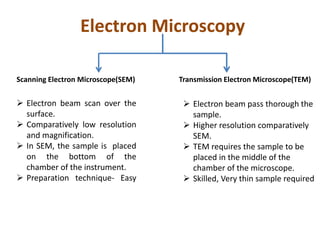
Electron Microscopy
Scanning Electron Microscope(SEM) Transmission Electron Microscope(TEM)
 Electron beam scan over the
surface.
 Comparatively low resolution
and magnification.
 In SEM, the sample is placed
on the bottom of the
chamber of the instrument.
 Preparation technique- Easy
 Electron beam pass thorough the
sample.
 Higher resolution comparatively
SEM.
 TEM requires the sample to be
placed in the middle of the
chamber of the microscope.
 Skilled, Very thin sample required
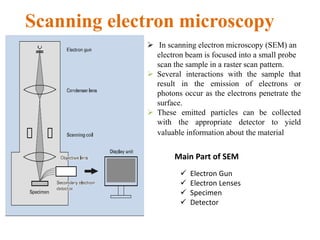
Scanning electron microscopy
 In scanning electron microscopy (SEM) an
electron beam is focused into a small probe
scan the sample in a raster scan pattern.
 Several interactions with the sample that
result in the emission of electrons or
photons occur as the electrons penetrate the
surface.
 These emitted particles can be collected
with the appropriate detector to yield
valuable information about the material
Main Part of SEM
 Electron Gun
 Electron Lenses
 Specimen
 Detector
How an Electron Beam is Produced?
• Electron guns are used to produce a fine, controlled beam of
electrons which are then focused at the specimen surface.
• The electron guns may either be
(1) Thermionic gun or
(2) field-emission gun.
Cathode current density (emission current density)
For Thermionic emission
Richardson Law:
Jc = AcT2exp(-Ew/kT) in A/cm2
For Tungsten: T = 2700K Work function Ew = 4.5ev
Jc = 3.4 A/cm2
Improve current density?
Use cathode material of lower Ew
For LaB6 single crystal T=1700K
Work function Ew=2.7ev
Jc = 25 A/cm2
Brightness
[Β = 4ip / (π dp αp)2]
W filament
LaB6 Single
Crystal αp Probe convergence
angle.
dp Probe diameter or
spot size.
ip Probe current
The resolution is determined by beam
diameter.
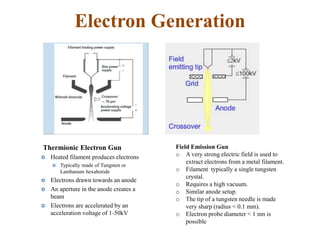
Electron Generation
Thermionic Electron Gun
 Heated filament produces electrons
 Typically made of Tungsten or
Lanthanum hexaboride
 Electrons drawn towards an anode
 An aperture in the anode creates a
beam
 Electrons are accelerated by an
acceleration voltage of 1-50kV
Field Emission Gun
o A very strong electric field is used to
extract electrons from a metal filament.
o Filament typically a single tungsten
crystal.
o Requires a high vacuum.
o Similar anode setup.
o The tip of a tungsten needle is made
very sharp (radius < 0.1 mm).
o Electron probe diameter < 1 nm is
possible
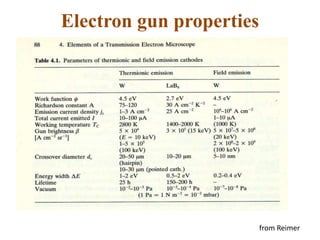
Electron gun properties
from Reimer
Role of Lenses
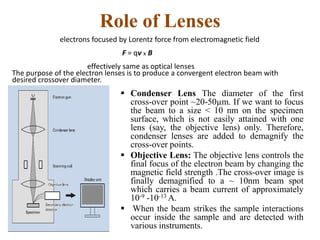
 Condenser Lens The diameter of the first
cross-over point ~20-50µm. If we want to focus
the beam to a size < 10 nm on the specimen
surface, which is not easily attained with one
lens (say, the objective lens) only. Therefore,
condenser lenses are added to demagnify the
cross-over points.
 Objective Lens: The objective lens controls the
final focus of the electron beam by changing the
magnetic field strength .The cross-over image is
finally demagnified to a ~ 10nm beam spot
which carries a beam current of approximately
10-9 -10-13 A.
 When the beam strikes the sample interactions
occur inside the sample and are detected with
various instruments.
electrons focused by Lorentz force from electromagnetic field
F = qv x B
effectively same as optical lenses
The purpose of the electron lenses is to produce a convergent electron beam with
desired crossover diameter.
Electron Matter Interaction
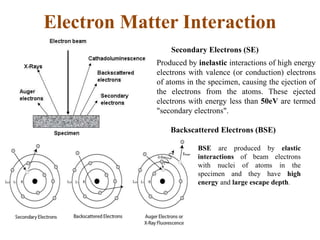
Secondary Electrons (SE)
Produced by inelastic interactions of high energy
electrons with valence (or conduction) electrons
of atoms in the specimen, causing the ejection of
the electrons from the atoms. These ejected
electrons with energy less than 50eV are termed
"secondary electrons".
Backscattered Electrons (BSE)
BSE are produced by elastic
interactions of beam electrons
with nuclei of atoms in the
specimen and they have high
energy and large escape depth.
Detectors: secondary electrons
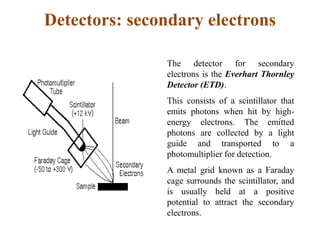
The detector for secondary
electrons is the Everhart Thornley
Detector (ETD).
This consists of a scintillator that
emits photons when hit by high-
energy electrons. The emitted
photons are collected by a light
guide and transported to a
photomultiplier for detection.
A metal grid known as a Faraday
cage surrounds the scintillator, and
is usually held at a positive
potential to attract the secondary
electrons.
Summary
• SEM is an analytical technique that can provide a
“quick look” of a material.
• Resolution between less than 1 nm and 20 nm can be
achieved.
• Magnification from about 10 to 500,000 times.
• Versatile platform that supports many other tools.
• Useful for the determination of the composition.
Research Publication
• “Tailoring optical properties of TiO2-Cr co-sputtered films
using swift heavy ions” Ratnesh Gupta, Sagar Sen,
D.M.Phase, D.K. Avasthi, Ajay Gupta, Appl. Surf. Sci. 2017.
• “Evolution of magnetic anisotropy by O ion implantation in
Fe/Co/Fe trilaye” Sagar Sen , B.K. Panigrahi , R.J. Choudhary
,Ajay Gupta Communicated Metall. Trans. A, 2017. E-
SYMP-17-1875-A.
• “Influence of preparation methods on the optical and
electronic properties of Cr-doped TiO2 thin films“Sagar Sen,
Ajay Gupta, D. M. Phase, and Ratnesh Gupta, AIP
Conference Proceedings 1832, 080074 (2017).
• “Influence of substrate temperature on the electronic and
optical properties of Cr doped TiO2” Sagar Sen, M. Gupta,
and Ratnesh Gupta AIP Conference Proceedings 1731,
080086 (2016).
Achievements and awards
• Received Madhya Pradesh Young Scientist award organized by
Madhya Pradesh Council Science & Technology(MPCST) Bhopal
2017.
• Received Rajiv Gandhi national fellowship (RGNF-OBC) 2015.
• Received best oral presentation in Research Scholar
workshop(RSW) at UGC IUC DAE CSR ,Indore 2014.
• Oral presentation in an International Conference on Nano
Structuring by Ion Beam (ICNIB-2017) at Devi Ahilya University
Indore 2017.
• Oral presentation in an Madam Curie international school on
Domain wall and spintronics at Spetses, Greece 2016.
• Performed experiments at India’s leading research centre IUAC
New Delhi, RRCAT Indore and UGC DAE CSR Indore.
Thank You

Scanning Electron microscopy

  • 1.
    Electron Microscopy Sagar Sen Juniorresearch fellow(JRF) School of Instrumentation Devi Ahilya University Indore(M.P.)
  • 2.
    Content  Introduction.  Typesof electron microscopy.  Scanning electron microscopy(SEM).  Main Part of SEM * Electron Gun * Electron Lenses * Detector  Summary
  • 3.
    Introduction The electron microscopyis a type of microscopy that uses a beam of electrons to create an image of the specimen ,similar to optical microscopy except with electrons rather than photons. It is capable of much higher magnifications and has a greater resolving power than a light microscope, allowing it to see much smaller objects in finer detail. Resolving Power Resolution power ᶑ Numerical Aperture(NA) Resolution power ᶑ 1  Resolving power = 𝟐𝑵𝑨 𝝀 Shorter wavelength and higher NA will provide a better resolution Shorter Wavelength ?
  • 4.
    v≪ 𝑐 λ𝑒 = ℎ 2𝑚 𝑒 𝑒𝑉 v c e = h/(2meeV+ e2V2/c2)1/2  Since electrons exhibit wave and particle behavior, the de Broglie relationship applies: ℎ = λ 𝑒p  Since the electron is charged, when introduced to an electric potential difference, it accelerates to its equilibrium momentum: e𝑉 = 1 2 𝑝2 𝑚 → 𝑝 = 2𝑚 𝑒 𝑒𝑉  So particle momentum is only dependent on the electric potential difference  We can relate wavelength to accelerating voltage: Electron Properties Wavelength used in microscopy Electron microscopy Wavelength depend on potential difference 𝑉 λ 𝑒 10KV--->0.012nm 50KV--->.00055nm Optical Microscopy Wavelength used 400-700nm(Vis)Resolution power ᶑ 𝟏  Electron microscopy has better resolution power
  • 5.
    Electron Microscopy Scanning ElectronMicroscope(SEM) Transmission Electron Microscope(TEM)  Electron beam scan over the surface.  Comparatively low resolution and magnification.  In SEM, the sample is placed on the bottom of the chamber of the instrument.  Preparation technique- Easy  Electron beam pass thorough the sample.  Higher resolution comparatively SEM.  TEM requires the sample to be placed in the middle of the chamber of the microscope.  Skilled, Very thin sample required
  • 6.
    Scanning electron microscopy In scanning electron microscopy (SEM) an electron beam is focused into a small probe scan the sample in a raster scan pattern.  Several interactions with the sample that result in the emission of electrons or photons occur as the electrons penetrate the surface.  These emitted particles can be collected with the appropriate detector to yield valuable information about the material Main Part of SEM  Electron Gun  Electron Lenses  Specimen  Detector
  • 7.
    How an ElectronBeam is Produced? • Electron guns are used to produce a fine, controlled beam of electrons which are then focused at the specimen surface. • The electron guns may either be (1) Thermionic gun or (2) field-emission gun. Cathode current density (emission current density) For Thermionic emission Richardson Law: Jc = AcT2exp(-Ew/kT) in A/cm2 For Tungsten: T = 2700K Work function Ew = 4.5ev Jc = 3.4 A/cm2 Improve current density? Use cathode material of lower Ew For LaB6 single crystal T=1700K Work function Ew=2.7ev Jc = 25 A/cm2 Brightness [Β = 4ip / (π dp αp)2] W filament LaB6 Single Crystal αp Probe convergence angle. dp Probe diameter or spot size. ip Probe current The resolution is determined by beam diameter.
  • 8.
    Electron Generation Thermionic ElectronGun  Heated filament produces electrons  Typically made of Tungsten or Lanthanum hexaboride  Electrons drawn towards an anode  An aperture in the anode creates a beam  Electrons are accelerated by an acceleration voltage of 1-50kV Field Emission Gun o A very strong electric field is used to extract electrons from a metal filament. o Filament typically a single tungsten crystal. o Requires a high vacuum. o Similar anode setup. o The tip of a tungsten needle is made very sharp (radius < 0.1 mm). o Electron probe diameter < 1 nm is possible
  • 9.
  • 10.
    Role of Lenses Condenser Lens The diameter of the first cross-over point ~20-50µm. If we want to focus the beam to a size < 10 nm on the specimen surface, which is not easily attained with one lens (say, the objective lens) only. Therefore, condenser lenses are added to demagnify the cross-over points.  Objective Lens: The objective lens controls the final focus of the electron beam by changing the magnetic field strength .The cross-over image is finally demagnified to a ~ 10nm beam spot which carries a beam current of approximately 10-9 -10-13 A.  When the beam strikes the sample interactions occur inside the sample and are detected with various instruments. electrons focused by Lorentz force from electromagnetic field F = qv x B effectively same as optical lenses The purpose of the electron lenses is to produce a convergent electron beam with desired crossover diameter.
  • 11.
    Electron Matter Interaction SecondaryElectrons (SE) Produced by inelastic interactions of high energy electrons with valence (or conduction) electrons of atoms in the specimen, causing the ejection of the electrons from the atoms. These ejected electrons with energy less than 50eV are termed "secondary electrons". Backscattered Electrons (BSE) BSE are produced by elastic interactions of beam electrons with nuclei of atoms in the specimen and they have high energy and large escape depth.
  • 12.
    Detectors: secondary electrons Thedetector for secondary electrons is the Everhart Thornley Detector (ETD). This consists of a scintillator that emits photons when hit by high- energy electrons. The emitted photons are collected by a light guide and transported to a photomultiplier for detection. A metal grid known as a Faraday cage surrounds the scintillator, and is usually held at a positive potential to attract the secondary electrons.
  • 13.
    Summary • SEM isan analytical technique that can provide a “quick look” of a material. • Resolution between less than 1 nm and 20 nm can be achieved. • Magnification from about 10 to 500,000 times. • Versatile platform that supports many other tools. • Useful for the determination of the composition.
  • 14.
    Research Publication • “Tailoringoptical properties of TiO2-Cr co-sputtered films using swift heavy ions” Ratnesh Gupta, Sagar Sen, D.M.Phase, D.K. Avasthi, Ajay Gupta, Appl. Surf. Sci. 2017. • “Evolution of magnetic anisotropy by O ion implantation in Fe/Co/Fe trilaye” Sagar Sen , B.K. Panigrahi , R.J. Choudhary ,Ajay Gupta Communicated Metall. Trans. A, 2017. E- SYMP-17-1875-A. • “Influence of preparation methods on the optical and electronic properties of Cr-doped TiO2 thin films“Sagar Sen, Ajay Gupta, D. M. Phase, and Ratnesh Gupta, AIP Conference Proceedings 1832, 080074 (2017). • “Influence of substrate temperature on the electronic and optical properties of Cr doped TiO2” Sagar Sen, M. Gupta, and Ratnesh Gupta AIP Conference Proceedings 1731, 080086 (2016).
  • 15.
    Achievements and awards •Received Madhya Pradesh Young Scientist award organized by Madhya Pradesh Council Science & Technology(MPCST) Bhopal 2017. • Received Rajiv Gandhi national fellowship (RGNF-OBC) 2015. • Received best oral presentation in Research Scholar workshop(RSW) at UGC IUC DAE CSR ,Indore 2014. • Oral presentation in an International Conference on Nano Structuring by Ion Beam (ICNIB-2017) at Devi Ahilya University Indore 2017. • Oral presentation in an Madam Curie international school on Domain wall and spintronics at Spetses, Greece 2016. • Performed experiments at India’s leading research centre IUAC New Delhi, RRCAT Indore and UGC DAE CSR Indore.
  • 16.

Editor's Notes

  • #7 The purpose of the electron lenses is to produce a convergent electron beam with desired crossover diameter.