Open Reading Frame In A Clone Gene
Definition:
 In molecular genetics, an open reading frame (ORF) is the part of a reading frame that
contains no stop codons. The transcription termination pause site is located after the
ORF, beyond the translation stop codon, because if transcription were to cease before the
stop codon, an incomplete protein would be made during translation.
 Normally, inserts which interrupt the reading frame of a subsequent region after the start
codon cause frame shift mutation of the sequence and dislocate the sequences for stop
codons.

Significance:


One common use of open reading frames is as one piece of evidence to assist in gene
prediction. Long ORFs are often used, along with other evidence, to initially identify
candidate protein coding regions in a DNA sequence.

 The presence of an ORF does not necessarily mean that the region is ever translated.
 For example in a randomly generated DNA sequence with an equal percentage of
each nucleotide, a stop-codon would be expected once every 21 codons.
 A simple gene prediction algorithm for prokaryotes might look for a start codon followed
by an open reading frame that is long enough to encode a typical protein, where
the codon usage of that region matches the frequency characteristic for the given
organism's coding regions.
 By itself even a long open reading frame is not conclusive evidence for the presence of
a gene.
Example:
If a portion of a genome has been sequenced (e.g. 5'-ATCTAAAATGGGTGCC-3'), ORFs can
be located by examining each of the three possible reading frames on each strand. In this
sequence two out of three possible reading frames are entirely open, meaning that they do not
contain a stop codon:
1. ...A TCT AAA ATG GGT GCC...
2. ...AT CTA AAA TGG GTG CC...
3. ...ATC TAA AAT GGG TGC C...
Possible stop codons in DNA are "TGA", "TAA" and "TAG". Thus, the last reading frame in this
example contains a stop codon (TAA), unlike the first two.

Open Reading Finding Tool:
1. ORF Finder:
The ORF Finder (Open Reading Frame Finder) is a graphical analysis tool which finds all
open reading frames of a selectable minimum size in a user's sequence or in a sequence
already in the database. This tool identifies all open reading frames using the standard or
alternative genetic codes. The deduced amino acid sequence can be saved in various
formats and searched against the sequence database using the WWW BLAST server. The
ORF Finder should be helpful in preparing complete and accurate sequence submissions.
It is also packaged with the Sequin sequence submission software.
2. ORF Investigator:
ORF Investigator is a program which not only gives information about the coding and noncoding sequences but also can perform pairwise global alignment of different gene/DNA regions
sequences. The tool efficiently finds the ORFs for corresponding amino acid sequences and
converts them into their single letter amino acid code, and provides their locations in the
sequence. The pairwise global alignment between the sequences makes it convenient to detect
the different mutations, including single nucleotide polymorphism. Needleman and Wunsch
algorithms are used for the gene alignment. The ORF Investigator is written in the
portable Perl programming language, and is therefore available to users of all common operating
systems.
3. ORF Predictor:
OrfPredictor is a web server designed for identifying protein-coding regions in expressed
sequence tag (EST)-derived sequences. For query sequences with a hit in BLASTX, the program
predicts the coding regions based on the translation reading frames identified in BLASTX
alignments, otherwise, it predicts the most probable coding region based on the intrinsic signals
of the query sequences. The output is the predicted peptide sequences in the FASTA format, and
a definition line that includes the query ID, the translation reading frame and the nucleotide
positions where the coding region begins and ends. OrfPredictor facilitates the annotation of
EST-derived sequences, particularly, for large-scale EST projects.

Ready to express
Source BioScience Full ORF (Open Reading Frame) Expression Clones contain the complete
coding sequences for genes of interest - exactly in frame, from start- to stopcodon. Due to the
flexible Gateway® cloning system, we offer ready-to-use Expression Clones for E. coli, yeast,
the baculo system and mammalian cells. Various fusion tags such as His6, GST or V5 are
available.
All inserts are fully sequence-verified. We guarantee for the absence of frame shifts or
stopcodons in frame.
You can generate your own Full ORF Expression Clone, using the flexible Full ORF Shuttle
Clone with Gateway® entry vector.
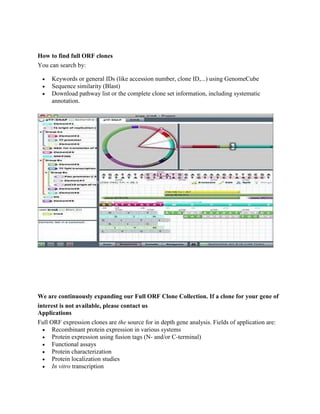
How to find full ORF clones
You can search by:




Keywords or general IDs (like accession number, clone ID,...) using GenomeCube
Sequence similarity (Blast)
Download pathway list or the complete clone set information, including systematic
annotation.

We are continuously expanding our Full ORF Clone Collection. If a clone for your gene of
interest is not available, please contact us
Applications
Full ORF expression clones are the source for in depth gene analysis. Fields of application are:
 Recombinant protein expression in various systems
 Protein expression using fusion tags (N- and/or C-terminal)
 Functional assays
 Protein characterization
 Protein localization studies
 In vitro transcription
Open Reading Frames

Open Reading Frames

  • 1.
    Open Reading FrameIn A Clone Gene Definition:  In molecular genetics, an open reading frame (ORF) is the part of a reading frame that contains no stop codons. The transcription termination pause site is located after the ORF, beyond the translation stop codon, because if transcription were to cease before the stop codon, an incomplete protein would be made during translation.  Normally, inserts which interrupt the reading frame of a subsequent region after the start codon cause frame shift mutation of the sequence and dislocate the sequences for stop codons. Significance:  One common use of open reading frames is as one piece of evidence to assist in gene prediction. Long ORFs are often used, along with other evidence, to initially identify candidate protein coding regions in a DNA sequence.  The presence of an ORF does not necessarily mean that the region is ever translated.  For example in a randomly generated DNA sequence with an equal percentage of each nucleotide, a stop-codon would be expected once every 21 codons.  A simple gene prediction algorithm for prokaryotes might look for a start codon followed by an open reading frame that is long enough to encode a typical protein, where the codon usage of that region matches the frequency characteristic for the given organism's coding regions.  By itself even a long open reading frame is not conclusive evidence for the presence of a gene.
  • 2.
    Example: If a portionof a genome has been sequenced (e.g. 5'-ATCTAAAATGGGTGCC-3'), ORFs can be located by examining each of the three possible reading frames on each strand. In this sequence two out of three possible reading frames are entirely open, meaning that they do not contain a stop codon: 1. ...A TCT AAA ATG GGT GCC... 2. ...AT CTA AAA TGG GTG CC... 3. ...ATC TAA AAT GGG TGC C... Possible stop codons in DNA are "TGA", "TAA" and "TAG". Thus, the last reading frame in this example contains a stop codon (TAA), unlike the first two. Open Reading Finding Tool: 1. ORF Finder: The ORF Finder (Open Reading Frame Finder) is a graphical analysis tool which finds all open reading frames of a selectable minimum size in a user's sequence or in a sequence already in the database. This tool identifies all open reading frames using the standard or alternative genetic codes. The deduced amino acid sequence can be saved in various formats and searched against the sequence database using the WWW BLAST server. The ORF Finder should be helpful in preparing complete and accurate sequence submissions. It is also packaged with the Sequin sequence submission software. 2. ORF Investigator: ORF Investigator is a program which not only gives information about the coding and noncoding sequences but also can perform pairwise global alignment of different gene/DNA regions sequences. The tool efficiently finds the ORFs for corresponding amino acid sequences and converts them into their single letter amino acid code, and provides their locations in the sequence. The pairwise global alignment between the sequences makes it convenient to detect the different mutations, including single nucleotide polymorphism. Needleman and Wunsch algorithms are used for the gene alignment. The ORF Investigator is written in the portable Perl programming language, and is therefore available to users of all common operating systems.
  • 3.
    3. ORF Predictor: OrfPredictoris a web server designed for identifying protein-coding regions in expressed sequence tag (EST)-derived sequences. For query sequences with a hit in BLASTX, the program predicts the coding regions based on the translation reading frames identified in BLASTX alignments, otherwise, it predicts the most probable coding region based on the intrinsic signals of the query sequences. The output is the predicted peptide sequences in the FASTA format, and a definition line that includes the query ID, the translation reading frame and the nucleotide positions where the coding region begins and ends. OrfPredictor facilitates the annotation of EST-derived sequences, particularly, for large-scale EST projects. Ready to express Source BioScience Full ORF (Open Reading Frame) Expression Clones contain the complete coding sequences for genes of interest - exactly in frame, from start- to stopcodon. Due to the flexible Gateway® cloning system, we offer ready-to-use Expression Clones for E. coli, yeast, the baculo system and mammalian cells. Various fusion tags such as His6, GST or V5 are available. All inserts are fully sequence-verified. We guarantee for the absence of frame shifts or stopcodons in frame. You can generate your own Full ORF Expression Clone, using the flexible Full ORF Shuttle Clone with Gateway® entry vector.
  • 4.
    How to findfull ORF clones You can search by:    Keywords or general IDs (like accession number, clone ID,...) using GenomeCube Sequence similarity (Blast) Download pathway list or the complete clone set information, including systematic annotation. We are continuously expanding our Full ORF Clone Collection. If a clone for your gene of interest is not available, please contact us Applications Full ORF expression clones are the source for in depth gene analysis. Fields of application are:  Recombinant protein expression in various systems  Protein expression using fusion tags (N- and/or C-terminal)  Functional assays  Protein characterization  Protein localization studies  In vitro transcription